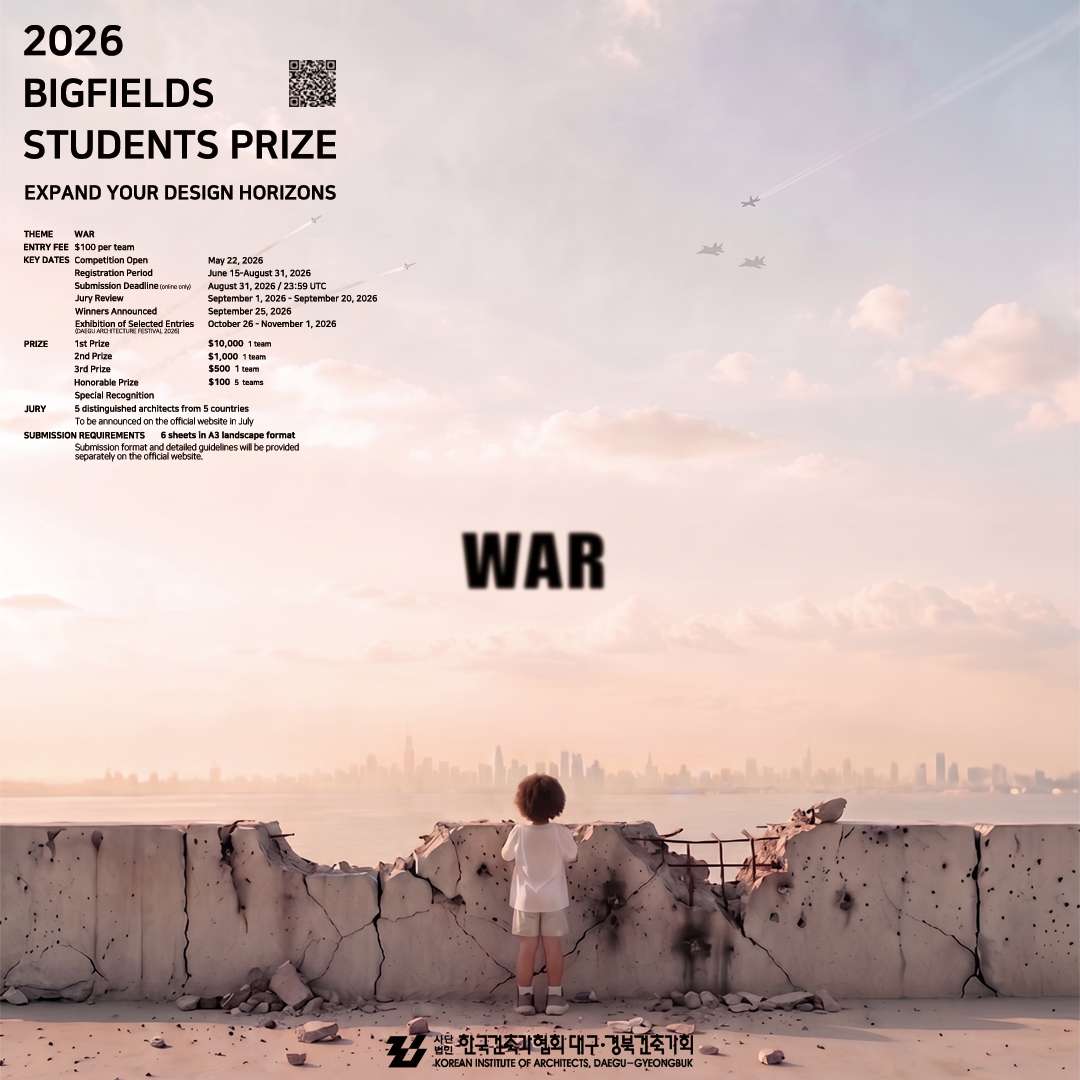
BIGFIELDS Students Prize 2026 – WAR

Organizer record: Daegyeong Architects Association · Directory record not yet reviewed
Competition Brief
BIGFIELDS 2026 is an international student architecture competition organized by the Daegyeong Architects Association, based in Daegu, South Korea. The competition is built around a single overarching theme: “WAR.” The organizers frame war not as a purely military event but as a complex spatial and social condition encompassing urban destruction, displacement and migration, severed memory, reshaped borders, mourning and recovery, and post-conflict reconstruction. The competition specifies no fixed site or program, leaving participants free to define their own context and typology in response to the theme.
The platform describes its mission as fostering international architectural discourse under the name “Dalgu-beol,” positioning itself as a space for critical and creative exchange across architecture, urban design, and landscape architecture. Partners listed on the website include the City of Daegu, the Daegu Institute of Architects, the Korea Institute of Registered Architects (KIRA), and the Daegu Arts Center.
Intent
The competition seeks architectural proposals that engage with “WAR” as a spatial condition rather than a formal exercise. The organizers are explicit that they value the act of questioning over the delivery of polished answers. Proposals may address any scale or typology, including memorials, refugee shelters, humanitarian facilities, post-war community reconstruction, protection spaces, archives, educational facilities, ruins regeneration projects, urban restoration strategies, and speculative experimental concepts. Participants must define and justify their own site or context and explain how it connects to the theme. The brief places particular emphasis on spatial strategy, narrative, expressive power, and cultural interpretation over visual spectacle.
Purpose
The competition is a conceptual ideas platform with no built outcome or procurement procedure attached. Its purpose is to generate architectural discourse around war as a spatial and human condition, and to give students worldwide a forum for critical engagement with one of the most urgent topics of contemporary life. Winning and recognized entries will be published in an online archive. For those interested in how architecture intersects with conflict, memory, and humanitarian space, the brief offers a substantive intellectual framework. You can browse similar conceptual architecture competitions on ArchUp for comparison.
Requirements
The competition is open to students currently enrolled in undergraduate or graduate programs related to architecture, regardless of nationality or age. Teams of up to five members are permitted. Each individual or team may submit only one project. Participants with a direct conflict of interest with jury members are not eligible.
Participants must submit:
- Submission panels formatted according to the competition brief
- All text in English
- No identifying information anywhere in the submission (names, school names, logos, signatures, email addresses, watermarks, or nationality marks are strictly prohibited)
- Files named according to the unique registration number issued upon registration
All proposals must present their own context and justify their site or spatial condition. The submission must maintain clear architectural logic and be formatted as an explicit spatial proposal, regardless of typology or scale.
Student status must be verifiable. Participants may be required to submit enrollment certificates or equivalent documentation during registration or at the award verification stage.
Jury
- Jungwoo Ji (Republic of Korea) – Co-Founder and Principal of EUS+ Architects
- Jo Noero (Republic of South Africa) – Partner and Director of Noero Schwalbach Architects
- Elvira Bakubayeva (Republic of Kazakhstan) – Co-Founder of NAAW
- Aleksandr Danielyan (Republic of Armenia) – Founder of DAAP Architecture Studio
- Khaled Malas (Syrian Arab Republic) – Co-Founder of the Sigil Collective; Professor at the Cooper Union, New York
- Seung-youp Lee (Republic of Korea) – Preliminary Jury; Professor at the Kumoh National Institute of Technology
Fees
| Item | Amount | Details |
|---|---|---|
| Registration and Submission Fee | USD 100 | Per submitted project, non-refundable |
| Payment Method | N/A | Via the official competition website |
Rewards
| Prize | Amount | Number of Recipients |
|---|---|---|
| 1st Prize | USD 10,000 | 1 team |
| 2nd Prize | USD 1,000 | 1 team |
| 3rd Prize | USD 500 | 1 team |
| Honorable Prize | USD 100 | 5 teams |
| Special Recognition | No cash prize | Selected if necessary; number not fixed |
| Total Maximum Cash Prize Fund | USD 12,000 | Across all paid prize tiers |
Dates
| Milestone | Date |
|---|---|
| Competition Opens | 22 May 2026 |
| Registration Period | 15 June 2026 to 31 August 2026 |
| Submission Deadline | 31 August 2026, 23:59 KST (UTC+9) |
| Jury Review Period | 1 September 2026 to 20 September 2026 |
| Results Announced | 25 September 2026 |
| Winning Entries Published and Online Archive | 30 September 2026 |
| Contact | info@bigfieldscompetitions.com |
✦ ArchUp Competition Review
BIGFIELDS is organized by the Daegyeong Architects Association, a regional professional body based in Daegu, South Korea, listed as partnering with the City of Daegu, KIRA, and the Daegu Arts Center. The platform describes itself as newly established, with no publicly documented track record of prior editions or published winner archives at this time. The jury is the strongest transparency asset of this competition: five named members with verifiable professional backgrounds, including Khaled Malas of the Sigil Collective and Professor at the Cooper Union, whose Syrian origin makes him a contextually relevant choice for a competition themed around war, and Jo Noero, a South African architect with a documented record in socially engaged architecture. The theme of “WAR” is intellectually ambitious and genuinely demanding: the absence of a fixed site or program places the full conceptual and contextual burden on the participant. The entry fee of USD 100 is relatively high for a student competition without a documented track record, and the disparity between the 1st prize of USD 10,000 and the 2nd prize of USD 1,000 is unusually steep. The primary benefit for most participants will be portfolio development and exposure through the online archive rather than financial return. For students interested in architecture’s role in conflict, displacement, and post-war recovery, the brief offers a serious and substantive intellectual challenge. Browse more student-focused architecture competitions on ArchUp for comparison.
Final Thoughts
BIGFIELDS is a new entrant in the international student architecture competition space. The Daegyeong Architects Association has institutional standing in South Korea, but the platform itself has no documented history of prior competition editions, published results, or winner announcements. This is a legitimate consideration for students deciding whether to invest USD 100 and significant design time in a first-edition competition.
The theme of “WAR” is one of the more serious and contextually urgent subjects to appear in a student competition brief in recent years. The decision not to specify a site or program is intellectually consistent with the theme, war is not site-specific in the way most architectural briefs are, but it places a significant burden on participants to construct their own contextual argument from scratch. This will favor students with a strong theoretical foundation and the ability to self-define a coherent spatial problem.
The jury panel is geographically and professionally diverse. Khaled Malas’s presence as a Syrian architect and educator at the Cooper Union carries particular weight given the competition’s theme, as does Jo Noero’s career-long engagement with socially critical architecture in South Africa. These are not generic competition judges, they bring direct relevance to the subject matter.
The prize structure is worth examining carefully. The gap between the 1st prize of USD 10,000 and the 2nd prize of USD 1,000 is a tenfold drop, which is unusual even by competition standards. The Honorable Prize of USD 100 per team effectively returns the entry fee for five additional teams. Participants should enter with realistic expectations: the most likely outcome for the majority of submissions is inclusion in the online archive rather than prize recognition.
For students drawn to the intellectual and ethical dimensions of architecture’s relationship with conflict, this competition offers a rare opportunity to engage seriously with a subject that most design curricula address only superficially. You can find more student competition opportunities in our student architecture competitions roundup on ArchUp.
Registration Deadline
Brought to you by the ArchUp Editorial Team
Inspiration starts here. Dive deeper into Architecture, Interior Design, Research, Cities, Design, and cutting-edge Projects on ArchUp.