Bigme B251 Pro Redefines E Ink Performance


Transforming Visual Display Technology: Breaking the Stagnation of E Ink Displays
E Ink displays represent a fundamentally different approach to presenting digital content. Rather than relying on the backlighting used in LCD and OLED panels, they operate through the movement of electrically charged pigment particles, producing a reading experience that closely resembles paper and remains significantly more comfortable for prolonged viewing. For years, however, this technology has been constrained by inherently slow refresh rates, limiting its primary applications to reading and writing while making it less suitable for tasks requiring rapid visual response or dynamic content rendering.
The Challenge of Color and Speed: Expanding Practical Applications
Color E Ink displays introduced an additional technical challenge, as the incorporation of color filter layers further slowed screen refresh compared with monochrome implementations. Within this context, the Bigme B251 Pro seeks to overcome these limitations through a 25.3-inch display capable of reaching refresh rates of up to 60 frames per second, a specification rarely found in this category. This advancement extends beyond improving responsiveness; it broadens the display’s practical scope to include web browsing, productivity applications, and even video playback with a level of fluidity previously unattainable for conventional E Ink monitors.

Visual Processing: Kaleido 3 Technology and Color Balance
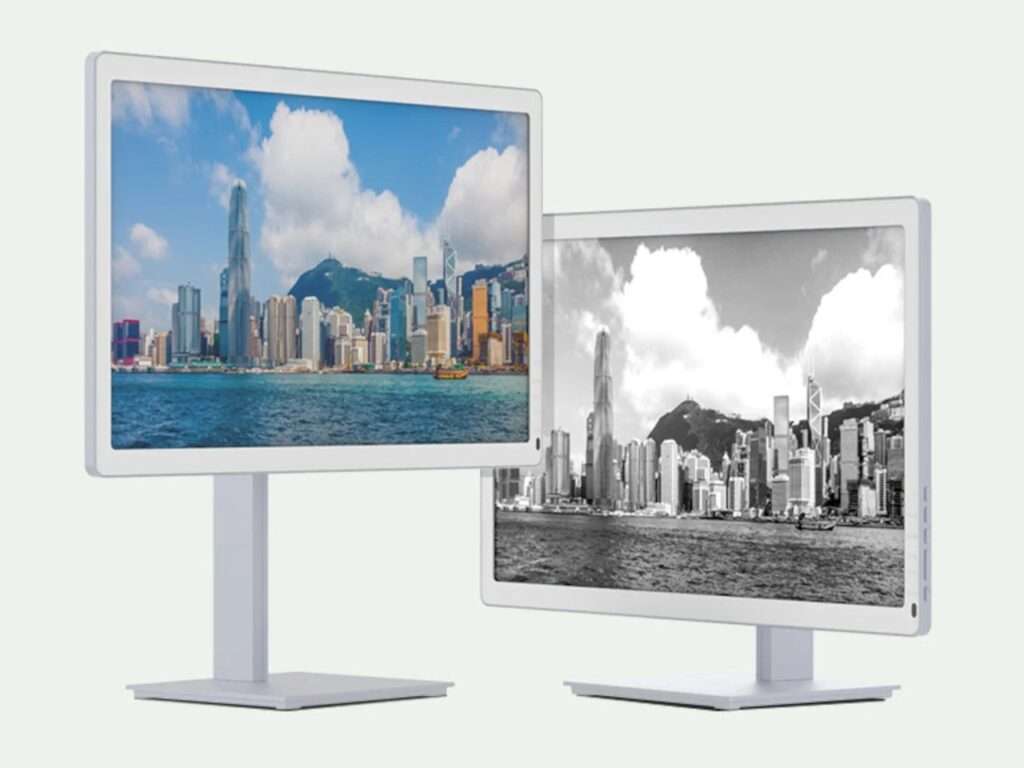
The display is built around Kaleido 3 technology, offering a resolution of 3200 × 1800 pixels with a pixel density of 145 PPI. Although these specifications may appear less sharp than those of certain LCD panels, they accurately reflect the characteristics of color E Ink technology, where the color filter layer reduces the amount of reflected light, consequently affecting contrast and color saturation.
The monitor supports 4,096 colors and 16 grayscale levels, complemented by an adjustable front-lighting system that transitions between warm and cool color temperatures. This flexibility enables users to optimize viewing conditions according to ambient lighting and specific workflows while contributing to reduced eye fatigue during extended working sessions.
Advancing Dynamic Performance: Minimizing Ghosting
Support for a 60 Hz refresh rate represents one of the monitor’s most significant technological advances. It substantially reduces the ghosting effect that has long been associated with E Ink displays while improving motion clarity during scrolling and video playback. Although the visual experience still differs from the fluidity of LCD or OLED panels, the improvement narrows the gap between E Ink technology and conventional displays, making it considerably more practical for everyday computing beyond reading-focused use cases.

Connectivity and Operational Design
The Bigme B251 Pro accepts video input through HDMI and DisplayPort connections, while the USB-C port is dedicated exclusively to firmware updates and does not support video transmission. This distinction is important for users intending to connect the display to computers equipped with Thunderbolt ports. To compensate, the monitor provides wireless screen mirroring alongside a dedicated remote control that enables convenient switching between display modes without directly interacting with the monitor’s physical controls.
Practical Experience: Balancing Eye Comfort and Productivity
The monitor is designed for professionals who spend extended hours in front of a computer, including programmers, writers, and researchers, by combining the visual comfort inherent to E Ink technology with a significantly higher refresh rate than previous generations. Although its price may appear relatively high compared with conventional monitors offering superior resolution or richer color reproduction, its primary value lies in delivering a workspace that minimizes eye strain while maintaining a practical level of performance for everyday professional tasks.


✦ ArchUp Editorial Insight
The article reframes color E Ink displays as an operational platform for digital productivity rather than merely a comfortable medium for reading. The increased refresh rate signals a gradual technological shift that expands their viability within professional working environments. In this respect, the Bigme B251 Pro reflects an evolving design philosophy that seeks to balance visual comfort, responsive performance, and energy efficiency, redefining the role of E Ink technology within the contemporary digital workspace.
Nevertheless, this perspective arguably overstates the practical impact of these technical improvements relative to the technology’s persistent physical limitations. Restricted color saturation, reduced reflected brightness, and connectivity constraints continue to limit widespread adoption, positioning color E Ink displays as specialized complementary tools rather than direct replacements for conventional monitors in architecture, visual production, and other graphically intensive professional applications.