A New Football Campus Opens in Cheonan on a 450,000-Square-Meter Site

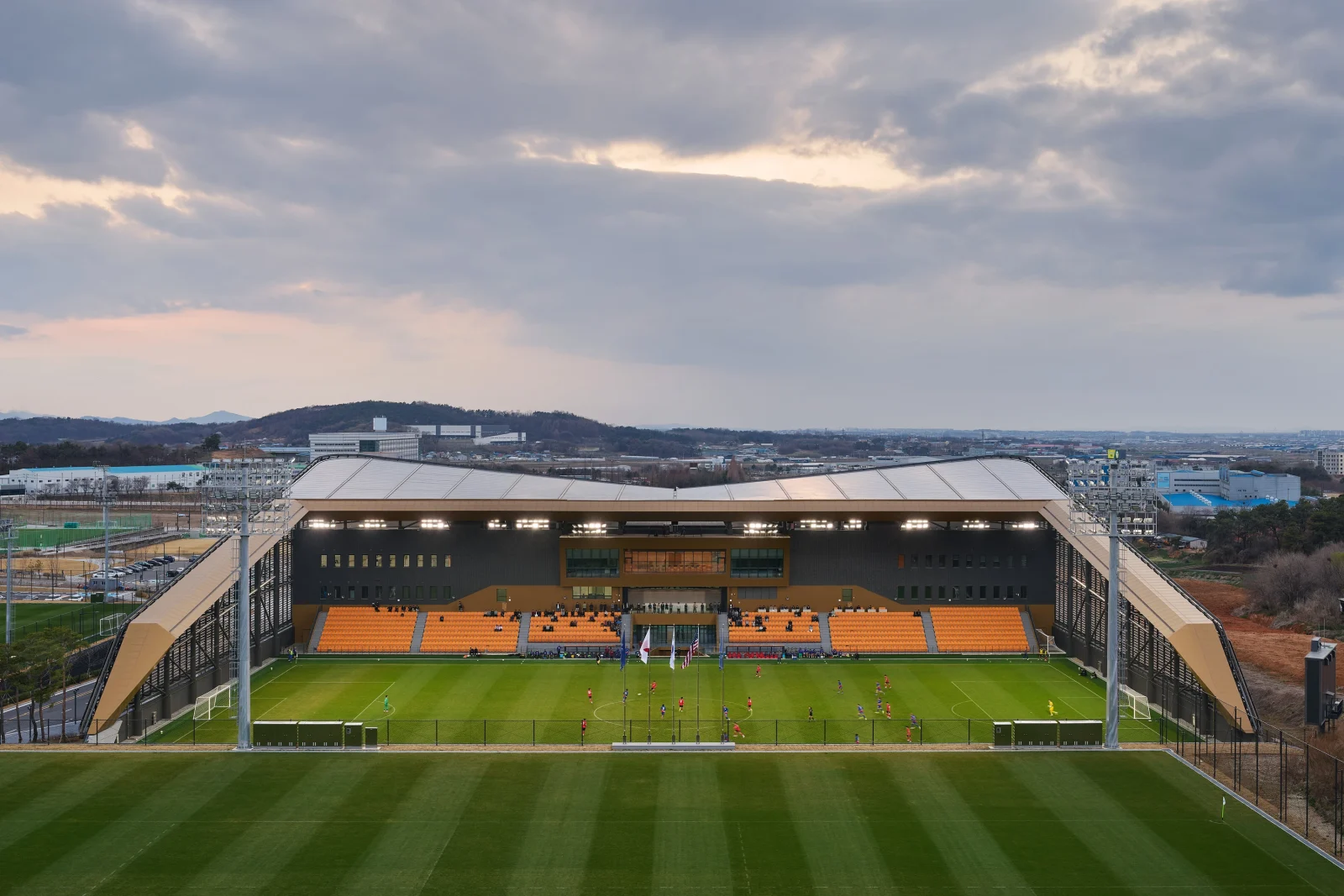
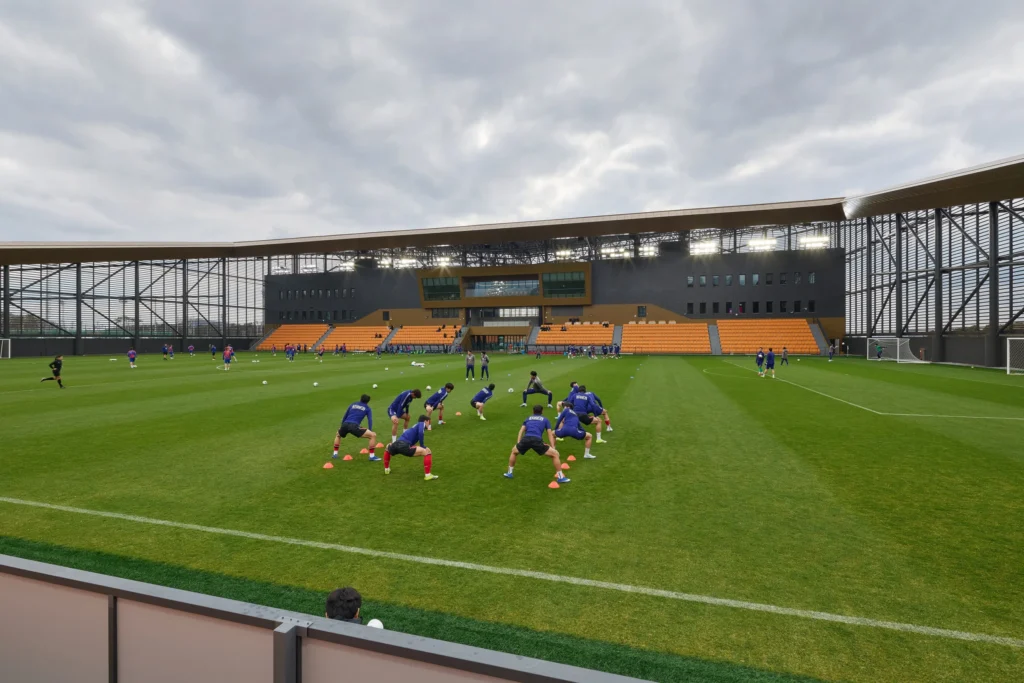
A large new football campus has opened in Cheonan, South Korea, roughly an hour from Seoul. The project brings training pitches, two stadiums, athlete housing, medical facilities and public spaces together on a single 450,000-square-meter site. It gives the national football program a permanent home while turning a working sports facility into a place the public can also visit.
The campus supports men’s, women’s and youth teams at the same time. It also opens parts of the site to supporters, families and young players who want to engage with the sport outside of match days. This dual role closed training environment and open public destination shapes almost every planning decision on site.
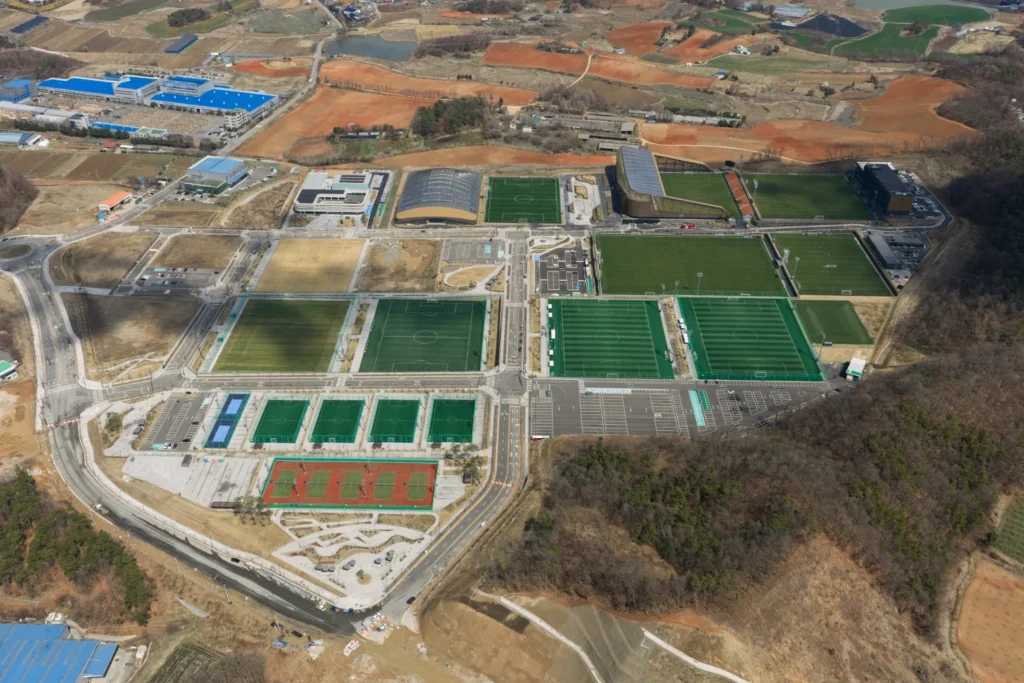
A Central Plaza That Organizes Public and Sporting Life
A public plaza sits at the heart of the campus and acts as the main gathering space. Three major buildings frame this plaza: the indoor stadium, the outdoor stadium combined with the football association headquarters, and a future football museum. Together they form a clear civic center where daily sporting activity and public visits overlap.
The site plan reorganizes circulation the paths people take through the campus so that arriving visitors can quickly read where they are. Public destinations sit closer to the plaza. More private zones for athletes and staff sit further back. This layered structure lets supporters and players share the same site without disrupting each other.
Placing the headquarters directly against the outdoor stadium is a deliberate move. Administrators, coaches and sports scientists work within sight of the training fields. This shortens the distance between decision-making and performance, and keeps management visually connected to what happens on the pitch.
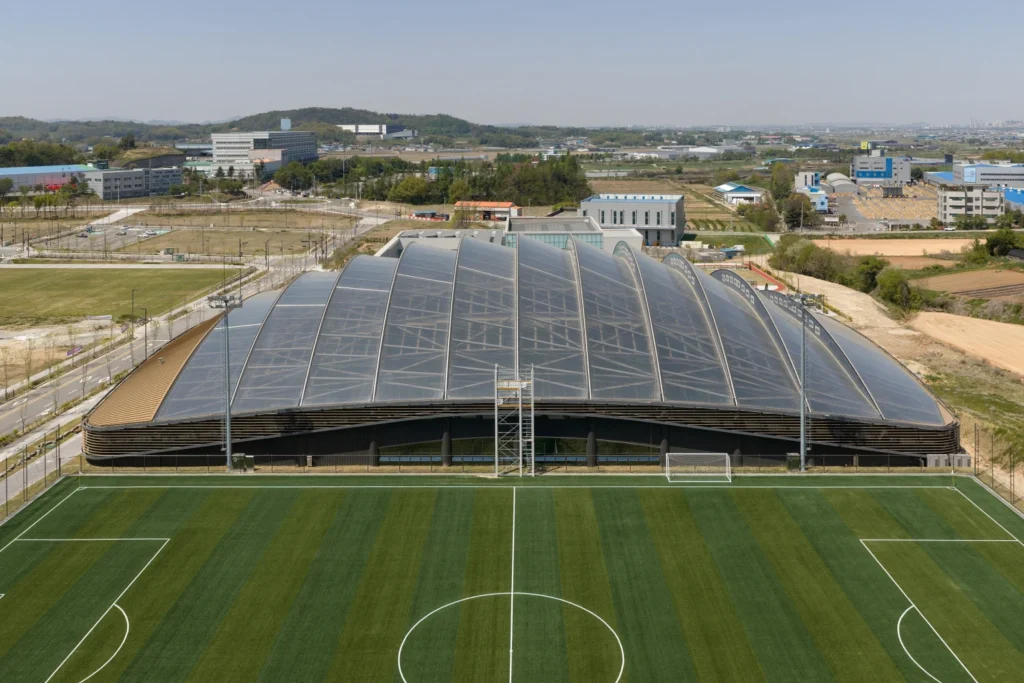
Working with the Terrain Instead of Flattening It
The site sits within a mountainous landscape, and the plan responds to that terrain rather than erasing it. Terraced levels stepped platforms cut into the slope hold the pitches and buildings at different heights. Movement across the campus follows these steps, so the shift from public space to training ground also becomes a physical descent or climb through the landscape.
Specialists in stadium operations and sports science shaped the plan alongside the design team. Experts from the Johan Cruijff ArenA in Amsterdam contributed knowledge on training logistics, media operations, security zoning and long-term flexibility. Their input pushed the campus toward an architecture designed for change able to absorb new coaching methods, new technologies and new sporting demands over time.
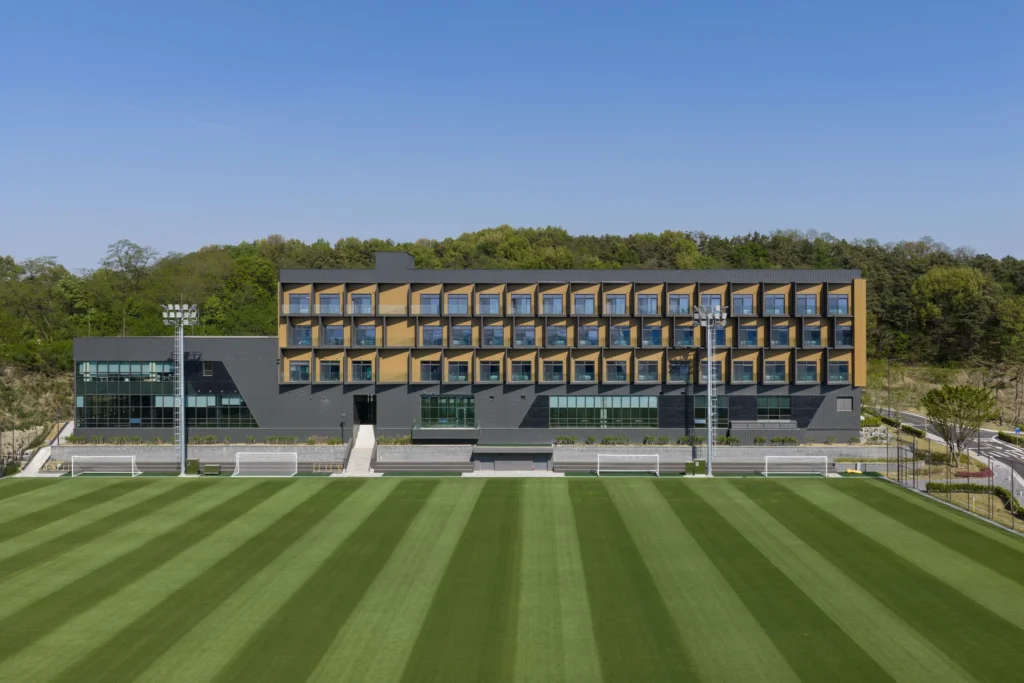
A Program Built Around Performance and Recovery
The campus holds eleven pitches, an indoor arena, an outdoor stadium, fitness centers, healthcare and treatment facilities, retail spaces, youth accommodation, a women’s training camp, and hospitality functions including a hotel and spa. This mix keeps the site active year-round rather than only during national team camps.
Training areas sit close to medical and rehabilitation spaces, which shortens the loop between injury, treatment and return to play. Accommodation blocks stand slightly apart to give players quiet and privacy, but they remain connected to the wider campus through direct routes. Natural materials and views toward the surrounding hills reinforce a calm atmosphere focused on rest.
Technology infrastructure runs through the project as well. Systems for performance monitoring and data analysis sit embedded in the construction, with capacity for future upgrades as sports science evolves.
Campus Logic and Public Threshold
The strongest architectural move here is the honest hierarchy of the site plan. A central plaza acts as a public threshold. From that plaza, visitors move through a graded sequence fan zone, museum, stadium concourses, and finally the restricted training and medical zones. This gradient replaces the usual sharp fence-line separation between spectators and athletes with a slower, spatial one.
The terraced organization also carries real weight. Rather than leveling the ground, the plan lets topography set the rhythm of the pitches and buildings. The tight coupling of headquarters and stadium adds programmatic intelligence: administration, coaching and performance share sightlines. The remaining question is durability whether the public plaza will hold civic life outside major training windows, or quietly empty out.
✦ ArchUp Editorial Insight
This campus argues that a national training center is no longer a closed compound but a hybrid civic design part high-performance facility, part public destination, part institutional headquarters. The graded circulation from plaza to pitch treats spectators as participants in the sport’s wider story, not just ticket holders. The terraced landscape strategy grounds this ambition in real terrain rather than an idealized flat plan. Yet the model carries a quiet tension. Elite training environments demand privacy, controlled access and operational silence, while civic cities demand openness and constant use. Balancing both across 450,000 square meters is expensive to run, and the public half of this equation only works if programming sustains it long after opening day.
Project Team: UNStudio, led by Ben van Berkel, Gerard Loozekoot, Maurizio Papa, Harlen Miller, Crystal Tang, Alistair Williams, Francesco Balducci, Kayla Manuel, Liva Sadovska, Luigi Olivieri, Martijn Dahrs, Rebekah Tien, Suhan Na, Yangkenan Li, Yonghyun Jeong and Zirong Zhao. Advisors from the Johan Cruijff ArenA Stadium Logistics and Sports Science Team included Henk Markerink, Sander van Stiphout and Max Reckers. Location: Cheonan, South Korea.
Project Notes: The Korea Football Association (KFA) commissioned the Korean Football Park as its national campus. The completed project covers a site area of 450,427 square meters and includes an indoor stadium, an outdoor stadium integrated with the KFA headquarters, eleven pitches, athlete accommodation, medical and recovery facilities, and hospitality. A football museum is planned for a future phase. Photography by Rohspace.