
Coachella 2026 Art Installations Transform California Desert With Light, Scale, and Form

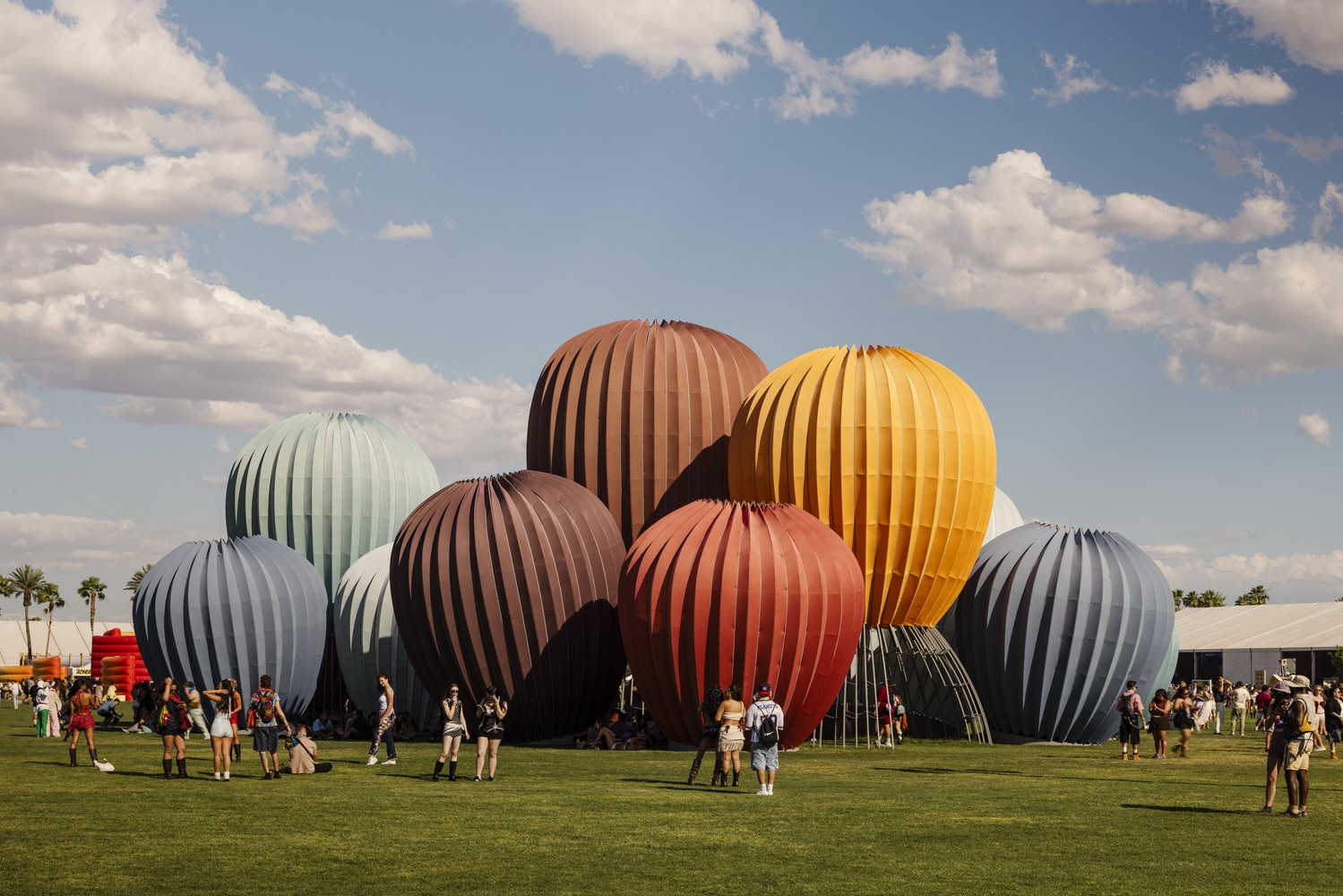
The 25th Coachella Valley Music and Arts Festival returns to Empire Polo Club in Indio, California, April 10–19, 2026. Alongside 130+ musical acts, the festival presents bold large-scale installations exploring monumentality, transparency, and luminance across the desert landscape.
Three New Temporary Installations Define Coachella 2026’s Art Program
This year’s art program, curated by Public Art Company (PAC), pushes the boundaries of immersive architecture in outdoor festival settings. The selection responds to shifting desert light from sunrise to nightfall. Visitors engage physically and sensorially with each work. Moreover, the installations adapt dramatically between daytime and nocturnal conditions, creating two distinct experiences within a single structure.

Sabine Marcelis’s Maze anchors the new commissions with inflated, curving PVC arcs stacked in varying heights. These soft forms draw inspiration from the natural contours of the Coachella Valley. Their colors shift from pale yellow to deep red toward the core. Therefore, the piece functions simultaneously as shade structure, sound filter, and gradient terrain. Meanwhile, at night, the inflated forms glow warmly, converting the installation into an illuminated desert oasis. This dual functionality reflects growing interest in sustainability within temporary public art.
Towering Cactus Forms and Steel Totems Push Structural Ambition
Starry Eyes, a field of geometric towers reaching nearly 40 feet tall, draws directly from the star-shaped golden barrel cactus. The structures alternate in size and tilt outward, mimicking cacti reaching toward sunlight. Brightly colored fabric lacing their outer ribs immerses visitors in pools of saturated color. Star-shaped oculi at each crown frame the open sky above. However, the installation transforms entirely after dark, becoming a glowing cluster of lanterns across the festival grounds.

Visage Brut by The Los Angeles Design Group takes a different approach, using building materials associated with retail construction and reimagining them as expressive art. The steel monolith assembles modular boxes, each folded, rolled, cut, or warped to its structural limit. Subtly anthropomorphic forms animate each box, creating a vertical procession of hybrid geometries. The piece emerged from collaboration with a software-assisted steel fabricator. Therefore, industrial process becomes artistic language, and structural logic becomes figurative presence.

Permanent Works and Returning Installations Expand the Festival Footprint
Beyond the new commissions, six permanent installations remain embedded across the Coachella Valley and surrounding Indio area. These works by artists including Francis Kéré, Edoardo Tresoldi, and Oana Stănescu give the festival a lasting urban planning dimension beyond its annual programming. Moreover, returning installation Network Operations by Dedo Vabo continues blending sculpture with absurdist theatrical performance. The combination of temporary and permanent works positions Coachella’s art program within broader conversations about interior design, public space, and sensory experience. For continued news on large-scale art and festival architecture, follow ArchUp.
A Quick Architectural Snapshot
Coachella 2026 presents three new large-scale temporary installations exploring light, form, and material. Maze uses inflated PVC, Starry Eyes references desert cacti, and Visage Brut repurposes industrial steel. Six permanent works anchor the Empire Polo Club year-round. The festival runs across two weekends in April 2026 in Indio, California.
✦ ArchUp Editorial Insight
Festival architecture has evolved from decorative afterthought to strategic infrastructure. Coachella’s art program reflects a calculated response to shifting audience expectations. Attendees now demand immersive, shareable experiences that justify premium ticket prices. Therefore, temporary installations must deliver dual functionality: daytime shade and nighttime spectacle.
The selection of inflatable PVC, tensile fabric, and modular steel reveals cost and logistics priorities. These materials ship flat, assemble quickly, and disassemble without waste. Permanent installations scattered across Indio serve a different economic function. They extend the festival’s cultural footprint year-round, supporting local tourism beyond the two-weekend event window.
The emphasis on light responsiveness addresses a practical constraint. Desert conditions demand structures that perform across extreme temperature shifts. Monumentality achieved through lightness solves weight and transport limitations inherent to temporary construction.
This project is the logical outcome of experience economy pressures, temporary construction constraints, and year-round destination branding strategies.

★ ArchUp Technical Analysis
Technical and Documentary Analysis of the Coachella 2026 Installations – Indio, California, USA:
This article presents an architectural analysis of the Coachella 2026 installations as a case study in temporary architecture and monumental public art in desert environments. To enhance its archival value, we would like to present the following key technical and design data.
The festival holds its 25th edition from April 10 to 19, 2026, at the Empire Polo Club in Indio, California, featuring three new temporary installations. Sabine Marcelis’s work “Maze” consists of splayed, zigzagging arches made of stacked PVC in varying heights, with colors graduating from pale yellow at the edges to deep red at the core, providing shade, absorbing sound, and transforming at night into warm light sources.
“Starry Eyes” rises nearly 12 meters, drawing its design from the star-shaped golden barrel cactus, with outwardly leaning structures clad in brightly colored fabrics and star-shaped openings at the peaks offering views of the sky, transforming at night into illuminated lanterns. The LA Design Group’s “Visage Brut” relies on modular steel boxes that are folded, rolled, and cropped, with quasi-human figures animating each box, emerging from an experimental collaboration with a software-driven steel factory.
Six permanent works remain embedded in the valley and surrounding areas by artists including Francis Kéré, Eduardo Tresoldi, and Ioana Stănescu.
Related Insight: Please refer to this article to understand the context of modern architectural preservation:
Temporary Architecture in Festivals: Between Sensory Interaction and Sustainability.




✅ Official ArchUp Technical Review completed for this article.