The Grammar of Architecture

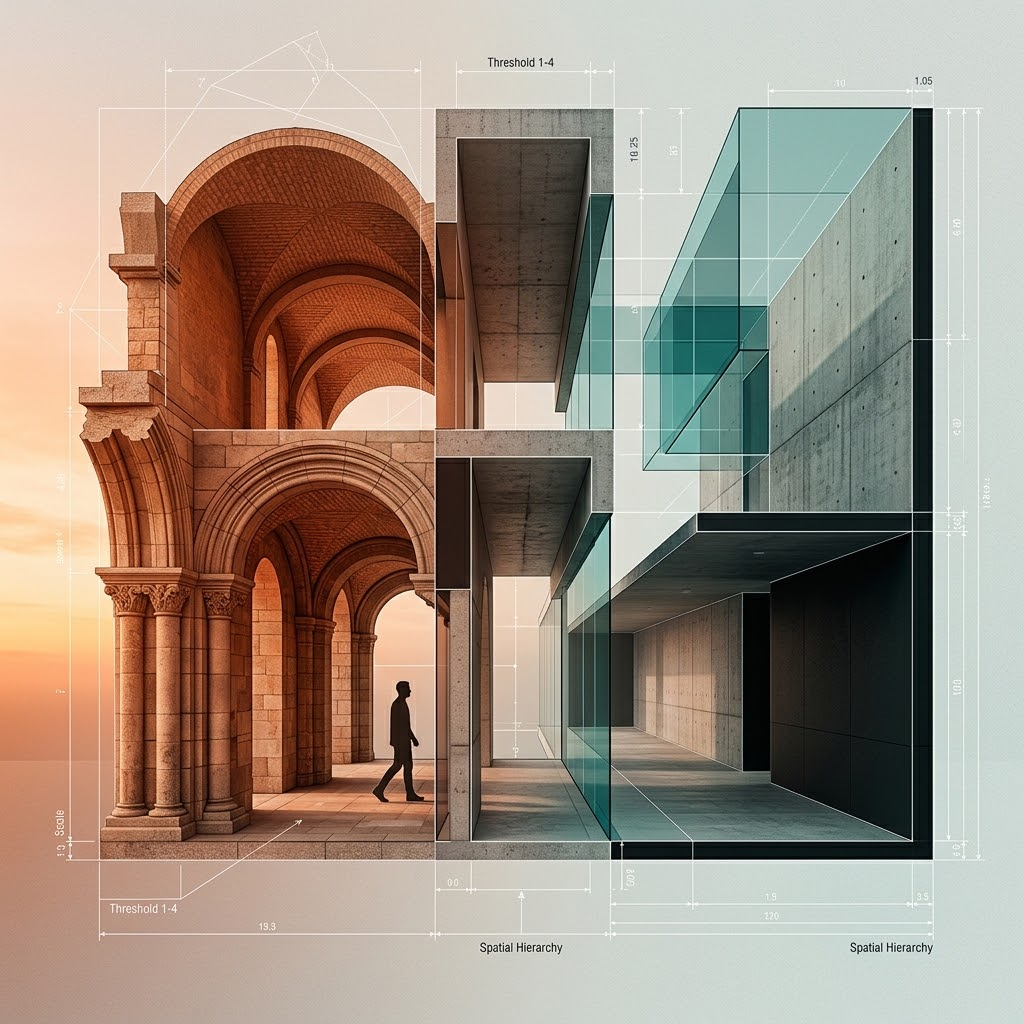
The last time you walked into a restaurant you had never visited before, something strange happened. No one stopped you at the door, yet you knew immediately where to wait, where to sit, and which area was not yours to approach. The reason for this can be explained by architectural grammar. No one handed you written instructions. You read no sign. And still, you behaved as though you already knew the rules of the place before you ever stepped inside it.
This is exactly what happens every day when you speak. You produce a grammatically correct sentence without consulting the rules of grammar in your mind, because a hidden structure is already operating beneath your awareness. The question this article raises is not a question about language alone, nor about architecture alone, but about the strange distance between the two: what if a building, like a sentence, has a grammar of its own? And what if the space you move through every day obeys generative rules similar to those that govern speech?
How Do You Know Where to Stand Without Anyone Telling You?
When you walk into a mosque, you remove your shoes without being asked. When you enter a doctor’s clinic, you sit in the waiting room and do not open the examination room door directly. When you visit a friend’s home for the first time, you understand that the living room is a shared space while the interior rooms are not. No one has explained any of this to you explicitly, yet you act according to a system that is remarkably clear in your mind.
This automatic behavior is precisely what structural linguists studied throughout the twentieth century as they tried to understand how human beings speak flawlessly without formally studying grammar. Zvegintsev’s research demonstrated that language is not a collection of separate words but a structure “closed in on itself,” composed of interdependent elements, so that no single element acquires meaning except through its relationship to the other elements within the total system. A word alone means nothing, just as a door alone means nothing; meaning appears only when the door is placed in relation to the corridor, the corridor in relation to the living room, and the living room in relation to the private rooms.
This is the idea that will carry us through this entire piece: that built space, exactly like language, is not a scattered collection of elements but a system of relationships. A wall is not merely a wall; it is a “comma” within a larger spatial sentence. A door is not merely an opening; it is a “verb” that carries you from one state to another. Once you grasp this, you begin to see every building you have ever entered in an entirely different way.
But the deeper question is this: where did these hidden rules come from? Could there be, as with the grammar of Arabic or English, a “shared system” underlying every building, with each architect producing an individual expression of it? This is precisely what Ferdinand de Saussure discovered more than a century ago, a discovery that will change the way you read any building from now on.
The Building in Front of You Is Not the Real Building
In the early twentieth century, the Swiss linguist Ferdinand de Saussure established a distinction that would later become one of the most important concepts in the history of human thought: the difference between “langue” and “parole.” Langue is the shared system, the underlying social rules held in common by all speakers of a given language, while parole is the individual act, the specific utterance produced by a particular person at a particular moment. As Kelly explains in his analysis of this dichotomy, langue exists as an abstract system before any individual ever speaks it, while parole is its fleeting, momentary embodiment.
Now transfer this idea to architecture. When you look at a residential house in a traditional neighborhood, you are not seeing “a house” in some absolute sense. You are seeing a single individual embodiment of a much larger system: the entire system of traditional Arab domestic living, with its unwritten rules about privacy, the separation of guests from family, and the graduated movement of space from public to private. This particular house is the “parole”; the underlying system behind it is architectural “langue.”
Here lies the paradox that elevates this argument beyond mere poetic comparison: just as two speakers who have never met, in two different cities, can produce entirely different sentences that nonetheless obey the same grammatical rules, two architects who have never met can construct two mosques that differ completely in form yet obey the same “grammar” of religious space: a graduated sequence from the outer courtyard to the prayer hall, a visual axis toward the mihrab, and a transitional zone that prepares the body and mind before entry. The form changes, but the deep structure remains.
But if a system truly underlies every visible form, this means every building has two layers at once: what your eye sees, and what drives what your eye sees from behind. And this is exactly the point at which linguists after Saussure moved toward a far deeper discovery.
The Facade You See Is Not the Real Story
Decades after Saussure, Noam Chomsky introduced an idea that would shake the foundations of linguistics: the distinction between “deep structure” and “surface structure.” The sentence you hear or read is merely a surface, an outward expression, while behind it lies a deep structure carrying the true meaning, transformed through a set of transformational rules into the final form that reaches you. As Newmeyer explains in his analysis of this revolution, what made Chomsky’s work revolutionary was treating the rules of language as a scientific theory subject to the same standards of construction and testing found in the natural sciences, rather than as a mere surface description of usage.
Apply this idea to any contemporary building you pass every day. The gleaming glass facade of an office tower, with its symmetrical columns and modern ornamentation, is the “surface structure.” Behind it lies a deep structure: functional relationships between offices and corridors, a hierarchy separating senior management floors from staff floors, and a circulation system that guides visitors along an entirely different path than employees. Different architects can design two completely different facades for the same underlying functional structure, exactly as the same deep meaning can be expressed through different surface sentences in different languages, or even within the same language.
This explains a disorienting phenomenon familiar to anyone who has worked in architecture: two buildings may appear nearly identical on the facade, yet the lived experience inside them differs radically, because the deep structure, meaning the logic of spatial distribution and functional relationships, is entirely different despite the surface resemblance. The real problem with many failed buildings is not their outward form but the fact that their deep structure was never carefully worked out before it was dressed in an appealing facade.
But all of this remains theoretical unless someone translates it into a practical tool architects can actually use on the ground. This is precisely where the surprise occurs that turns this connection into something more than an intellectual game.
When an Architect Decided to Write a “Dictionary” of Buildings
In 1977, the architect Christopher Alexander published his landmark book bearing a title that struck a traditional architectural ear as strange: “A Pattern Language.” The title was not a passing metaphor. Alexander meant precisely what the words said: that there exists, much like the grammatical rules studied by Saussure and Chomsky, a finite set of recurring architectural “patterns” (a transitional entrance, an interior courtyard, a corner window, a public seating step) that can be combined and recombined in endless ways to produce entirely different buildings and cities, exactly as a finite set of words can be combined to produce infinite sentences.
The same idea Zvegintsev articulated in describing linguistic systems, that units acquire meaning only through their interconnection within a larger whole, is precisely what Alexander built architecturally. No pattern in his theory functions alone; each draws its power from its relationship to the patterns surrounding it: the pattern of the “interior courtyard” is incomplete unless linked to the pattern of the “room that overlooks it,” and the pattern of the “narrow street” only functions in relation to the “low entrance” pattern that precedes it. This is precisely the grammatical idea Matthews addressed when he affirmed that the essence of structuralism lies in understanding how relationships between elements produce meaning that no single element could carry on its own.
This connection is not a retrospective interpretation imposed on Alexander’s book after the fact. It is a link Alexander himself declared explicitly, describing his work as an attempt to write a “generative grammar” for built space, in the same spirit that Chomsky attempted to write a generative grammar for human language. The architect here did not borrow a linguistic term for decoration; he borrowed an entire method for rethinking how human beings learn to build their houses and cities without formally studying architecture, exactly as a child learns to speak without studying grammar.
But if architecture truly has a “language,” this means there must be a scientific method for analyzing it and breaking it down into its smallest elements, exactly as a linguist analyzes a sentence. And this is precisely what architects began doing later on, even without calling it by this name.
Taking a Building Apart the Way You Take Apart a Sentence
One of the greatest achievements of structural linguistics, as Yu explains in her comparative study, was shifting attention from the individual word to the structure of the sentence as a whole, through what is known as “immediate constituent analysis”: breaking a long sentence down into progressively smaller components until reaching the basic units, while showing how these units assemble into hierarchical levels to produce overall meaning.
This is exactly what any competent architect does when analyzing a floor plan, even without ever using this term. The entire building is divided into major functional blocks (public zone, private zone, service zone), each block is then divided into smaller spaces, and the relationships among these spaces are analyzed: which are adjacent, which are separate, which require a transitional corridor. This hierarchical analysis, from whole to part and from part to relationship, is exactly the method of “immediate constituent analysis” that Yu describes, applied here to stone and space instead of word and sentence.
Furthermore, as Baker and Croft explain in their review of lexical category theory, the fundamental method for identifying any grammatical category (noun, verb, adjective) is “distributional analysis”: observing the contexts in which an element appears in order to determine its category. If two elements are used across the same set of contexts, they belong to the same category. This is exactly what a good architectural plan does when it “tests” each space by placing it within different usage contexts: does this room function as a corridor if needed? Does this courtyard function as public or private space depending on the time of day? This distributional testing, even if never named as such in architectural manuals, lies at the heart of good functional design.
But all this careful analysis of relationships and structures leads us to an unsettling question: what happens when these rules are broken, or when the architectural sentence is shortened so drastically that it loses its meaning entirely? This is not a theoretical question. It is exactly what happened in the transformation of modern Arab housing.
When the Architectural Sentence Becomes a Fragment
In the traditional Arab house, there existed a complete, multi-clause spatial sentence: a bent entrance that blocked direct sightlines from the street, followed by a transitional threshold, then a central hall distributing movement, then rooms arranged around it. Every element in this sentence had a clear grammatical function, exactly as subject, verb, and object have clear functions in a well-formed sentence. Zvegintsev demonstrated that removing an element from a complete linguistic system does not merely strip that element of meaning; it disrupts the meaning of the entire system.
Now look at the standard residential apartment in modern Arab cities, particularly in buildings produced quickly for the real estate market: a door opening directly onto a small “reception” area from which any visitor can see straight into the living room, the kitchen, and sometimes the bedrooms. The transitional threshold has vanished, the separation between public and private space has vanished, and the entire architectural sentence has been reduced to a fragment, or as Kelly describes deviation from a linguistic system, to “a usage that threatens the internal coherence of the system.”
This reduction is not a passing aesthetic preference; it carries a real human cost: lost privacy, a guest left confused about where to sit, and a persistent sense of exposure whenever a visitor knocks at the door. The paradox is that this erosion of spatial “rules” occurs in complete silence, without any explicit architectural debate, exactly as linguistic erosion occurs when spoken language is shortened generation after generation without anyone noticing the precise moment the sentence lost its original structure.
And the question all of this raises is not a question about a nostalgic past but about the future: if architecture truly is a system with a grammar and generative rules, can this lost grammar be deliberately restored in contemporary design, or will the real estate market, like any fast-moving vernacular, continue truncating the architectural sentence until it loses its meaning altogether?
The next time you walk into an unfamiliar place and know immediately, without thinking, where to stand and where not to approach, pause for a moment and ask yourself: who taught me these rules? No one did. There was a complete spatial sentence that your body read before your mind ever did. And the real question worth carrying with you after this piece is not about language or architecture separately, but about those increasingly frequent moments when you enter a new space and feel the same confusion you feel reading a broken sentence: have we truly lost the ability to write complete architectural sentences, or have we simply stopped listening to them?
✦ ArchUp Editorial Insight
Treat the article’s linguistic claim as a diagnostic instrument rather than a metaphor, and a different picture emerges: the “grammar” the piece mourns was never encoded into any instrument that survives contact with a bank loan or a sales brochure. Traditional courtyard sequencing carried spatial information — bent entry, threshold, distribution hall — that had no equivalent line item in a construction budget. It cost circulation area without adding a marketable bedroom. Once housing production shifted from owner-commissioned building to developer-led unit assembly for resale or off-plan sale, the floor plate stopped being a spatial argument and became a yield calculation: gross floor area divided by number of sellable rooms, optimized against a two-dimensional marketing render that a buyer evaluates before the building exists. The transitional zone, structurally the first “non-productive” square meter in that calculation, is the first casualty.
This is not a failure of taste among architects; it is a rational response to a procurement sequence in which the party defining the unit typology — the developer, the quantity surveyor, sometimes a design-and-build contractor working from a repeatable template — exits at sale, long before anyone experiences the collapsed sequence from inside. The buyer who opens the door and finds the kitchen, the sofa, and the bedroom corridor all visible at once had no seat at the table when that plan was fixed, months or years earlier, against a spreadsheet rather than a lived scenario. This is the same liability transfer this archive has traced in other unit typologies, from vacancy risk in Architecture for Rent to the total occupancy cost concealed behind an advertised rent figure — the cost here is not financial but experiential, absorbed silently as loss of privacy, and for that reason it never appears on any balance sheet that would force a correction.
What makes this pattern durable rather than accidental is its regulatory invisibility. Building codes across most jurisdictions producing this housing typology regulate egress width, structural loading, fire separation, ventilation minimums — none of them regulate sequencing, none of them ask whether a visitor’s sightline penetrates a private zone on entry. Spatial grammar, in Alexander’s sense, was proposed as a design method, never adopted as an enforceable standard, which means the “generative rules” the article describes have no institutional mechanism defending them against a floor plate optimized purely for saleable area. The same asymmetry appears in the persistence of ornament without underlying logic that this archive identified in Vernacular Architecture and Cultural Identity: arabesque screening or a mashrabiya-referencing facade can be specified as a finish, at negligible cost to the unit count, while the sequencing it once expressed cannot survive the same value engineering, because sequencing consumes area and ornament does not.
The repetition signal is worth naming directly: the same collapsed reception-to-everything plan recurs across cities with no shared climate, culture, or urban history, because it is not responding to any of those conditions — it is responding to a shared production logic, exported by the same handful of regional developers and design-build contractors optimizing for the same investor audience rather than the household that will actually occupy the unit. The reader is left with the structural question the article gestures toward but does not name: whether spatial sequencing can survive without becoming a line item someone is required to price, or whether it will remain, as it is now, a discretionary comfort that only the architect notices is missing.
References
Yu, Jiaying. “A General Comparison on Sentence Analysis and Its Teaching Significance between Traditional and Structural Grammars.” International Conference on Asian Language Processing, 2010.
Zvegintsev, V. “Structural Linguistics and Linguistics of Universals.” Acta Linguistica Hafniensia, 1966.
Kelly, L. G. “Langue and Parole: Once Again.” Canadian Journal of Linguistics, 1970.
Matthews, P. H. “Structural Linguistics in the 1990s.” Lingua, 1997.
Newmeyer, Frederick J. “Has There Been a Chomskyan Revolution in Linguistics?” Language, 1986.
Baker, Mark, and Croft, William. “Lexical Categories: Legacy, Lacuna, and Opportunity for Functionalists and Formalists.” Annual Review of Linguistics, 2017.