Comillas Seafront: Making Room for Sand and Everyday Use

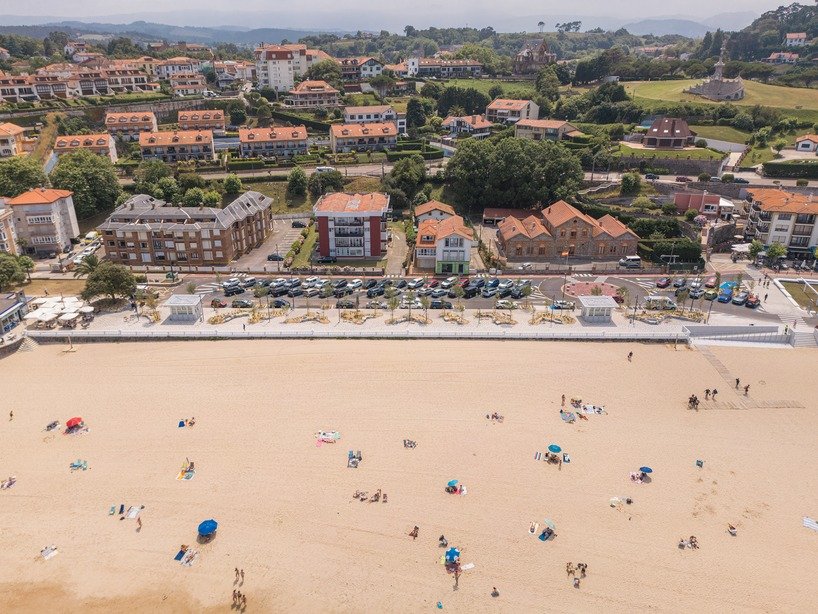
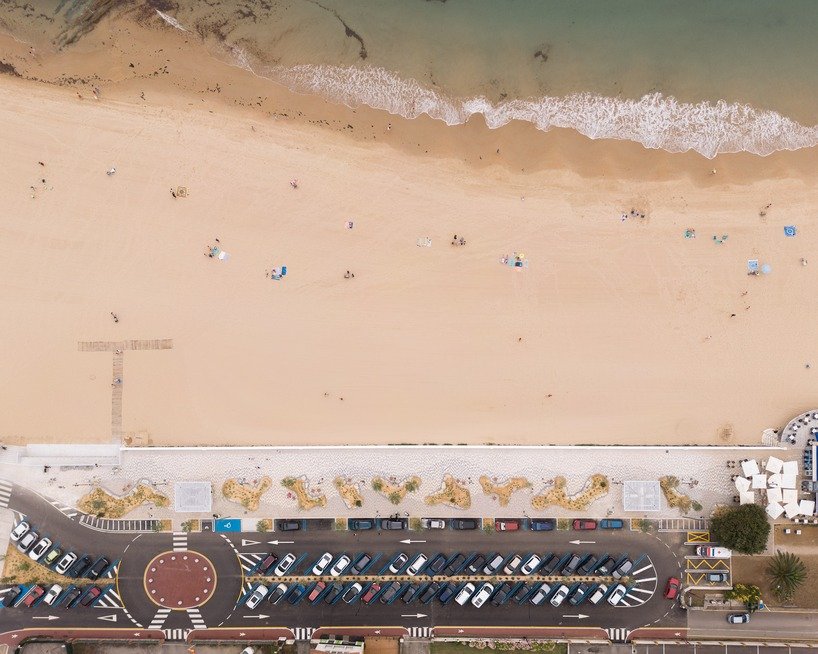
At Comillas, on Spain’s Cantabrian coast, the boundary between town and beach is being treated as a zone of exchange. Wind and people carry sand onto the seafront. The renewed promenade makes room for that movement through planting and permeable paving, rather than treating every deposit as an intrusion into an otherwise sealed urban surface.
The project gives more of the waterfront to pedestrians while reducing the presence of cars. Its principal architectural decision is therefore about the ground: how walking, stopping, vegetation and the shifting edge of the beach can share a continuous public space.
From the town to the sand
The promenade forms an intermediate landscape between the built frontage and the beach. Planted areas interrupt the extent of paving, drawing on the dune landscapes of the Cantabrian coast. Instead of placing a self-contained object beside the sea, the intervention works through a sequence of surfaces and pockets of vegetation.
For a person approaching from the town, this creates a gradual change in the character of the ground. The coast is encountered through the relationship between planting, mineral surfaces and open sand, as well as through the view of the water.
A place to pause without closing the edge
Individual benches are distributed along the promenade rather than assembled into a continuous line of street furniture. They introduce separate places to stop and face the sea, leaving the wider public surface available for movement.
That distinction matters to the experience of a waterfront. A promenade accommodates people passing through and people who want to remain in one place; seating gives the latter a position within a space otherwise defined by circulation. Here, the dispersed arrangement makes stopping part of the route.
Materials that accommodate a moving landscape
Limestone riprap establishes a material connection with the rocky coastline, while permeable paving and planted areas accommodate sand and water within the ground treatment. The landscape takes the coastal dune as a reference, without requiring the public promenade to become an unstructured beach.
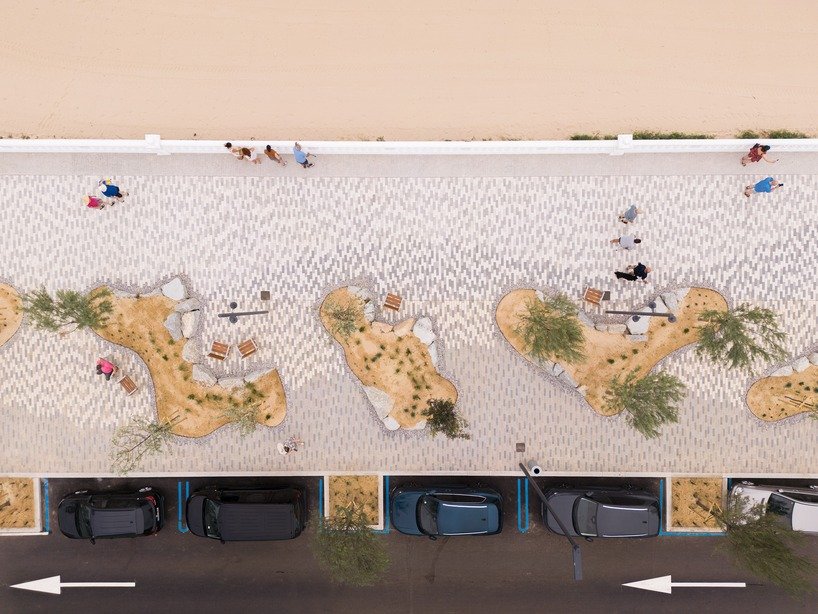
The practical distinction is between areas that can accept deposits and routes that must remain usable. For long-term operation, the relevant questions include how planting is maintained, how deposits are managed and how the walking surface is kept clear enough for different users. Permeability describes a design strategy; its continuing effectiveness depends on the condition of the surface and the ground beneath it.
✦ ArchUp Editorial Insight
Public-space maintenance depends on where an authority draws the line between a usable surface and material to be cleared away. In Comillas, accepting some sand within planted and permeable areas changes that line without removing the need to manage it. The operational question becomes which deposits can remain, which obstruct movement, and who makes that distinction after wind or heavy use. A maintenance brief based only on uniform cleanliness could work against the landscape strategy; an equally unqualified policy of leaving sand in place could undermine access. This extends the issue of openness as a continuing maintenance commitment identified at Terra Pavilion from private occupation to shared public use. Here, the consequences concern people with different walking speeds, mobility aids and reasons for visiting the shore. Reducing the space given to cars creates room for those uses, but their compatibility still depends on clear routes and sustained care. The test is therefore not whether the promenade resembles a dune. It is whether operating decisions can distinguish ecological tolerance from a barrier to movement, allowing planted pockets, scattered seats and pedestrian surfaces to function together over time.
Project credits: Comillas seafront, Cantabria, Spain. Design: Hector Navarro + arkhitekton. Photography: Imagen Subliminal.