
Compartment S4 Champawat: Craft as Civic Infrastructure

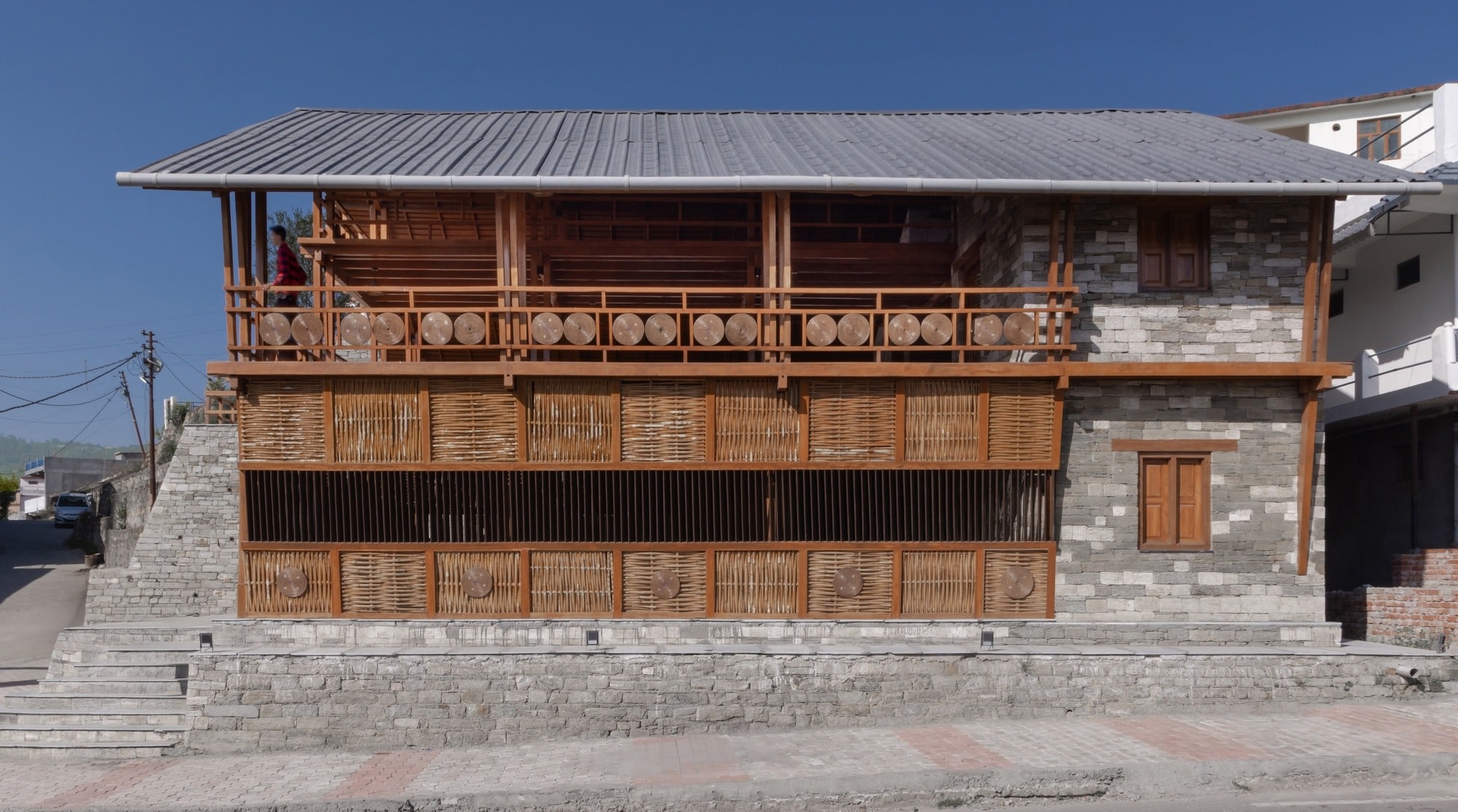
Transformation of Crafts from Product to Architectural Structure
The text raises the question of whether local crafts can shift from being displayed elements inside Buildings to becoming a formative component of Architecture itself. Within this framework, the building is reimagined as an extension of craft processes, where its role is not limited to exhibition but expands to embrace production and the interactions associated with it. Consequently, architecture becomes a medium that reflects the economic and cultural relationships emerging within the rural environment.
The Decline of Crafts in the Context of Urban Transformation
In many Himalayan Cities, crafts have gradually declined, becoming detached from everyday life and often appearing only in seasonal or symbolic contexts. Champawat reflects this condition through the replacement of traditional Construction practices, such as stone, wood, and bamboo, with uniform concrete patterns that do not respond to topography or cultural context. As a result, traditional building practices have been progressively eroded, leading to a loss of their connection to their original functions within society.
Reintegrating Crafts into the Civic Fabric
Within this context, the project proposed by Compartment S4 is presented as a case study that reintegrates crafts into public life rather than isolating them within a conventional market framework. The program moves beyond the idea of commercial display to include spaces that support everyday interaction such as reading, Discussion, and work. Accordingly, the building operates as a civic structure that combines production, exchange, and social use, while simultaneously responding to the lack of public spaces and the needs of younger populations within the city.
| Field | Details |
|---|---|
| Architects | Compartment S4 |
| Area | 250 m² |
| Year | 2025 |
| Photographs | The Space Tracing Company |
| Category | Community, Market |
| Principal Designer | Monik Shah, Aman Amin, Kishan Shah, Krishna Parikh, Prashik Chaudhari, Manuni Patel, Nishita Parmar, Vedanti Agarwal |
| Execution Team | Mr. Kundan ji and team, Sanjay Joshi |
| Client | Kumaon Mandal Vikas Nigam and District Tourism Office, Champawat |
| City | Champawat |
| Country | India |
Adaptation to Topography as a Design Methodology
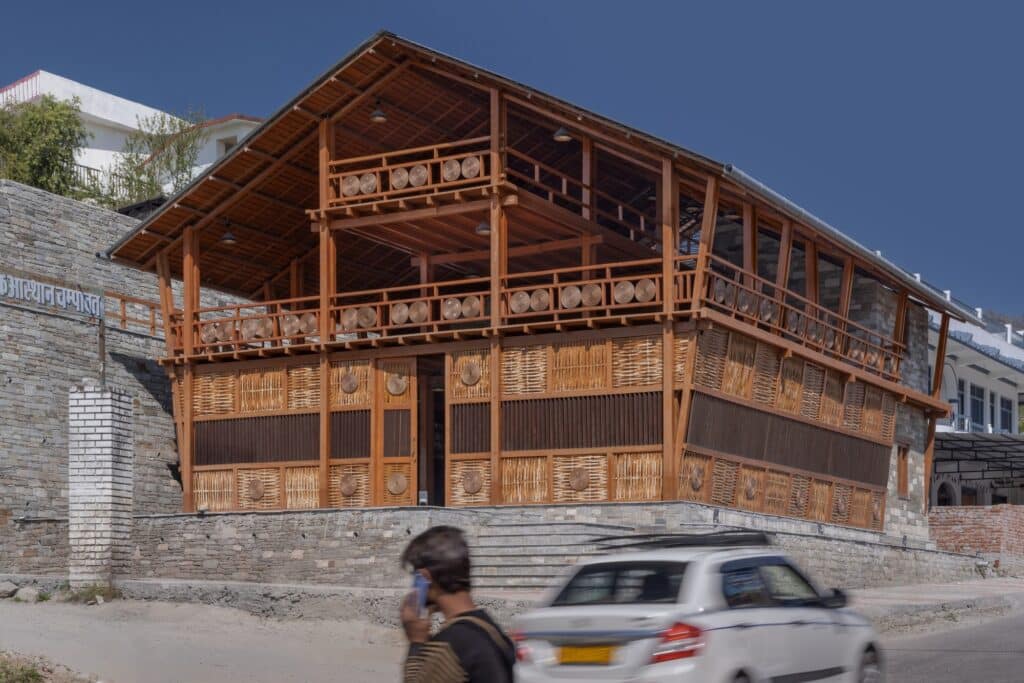
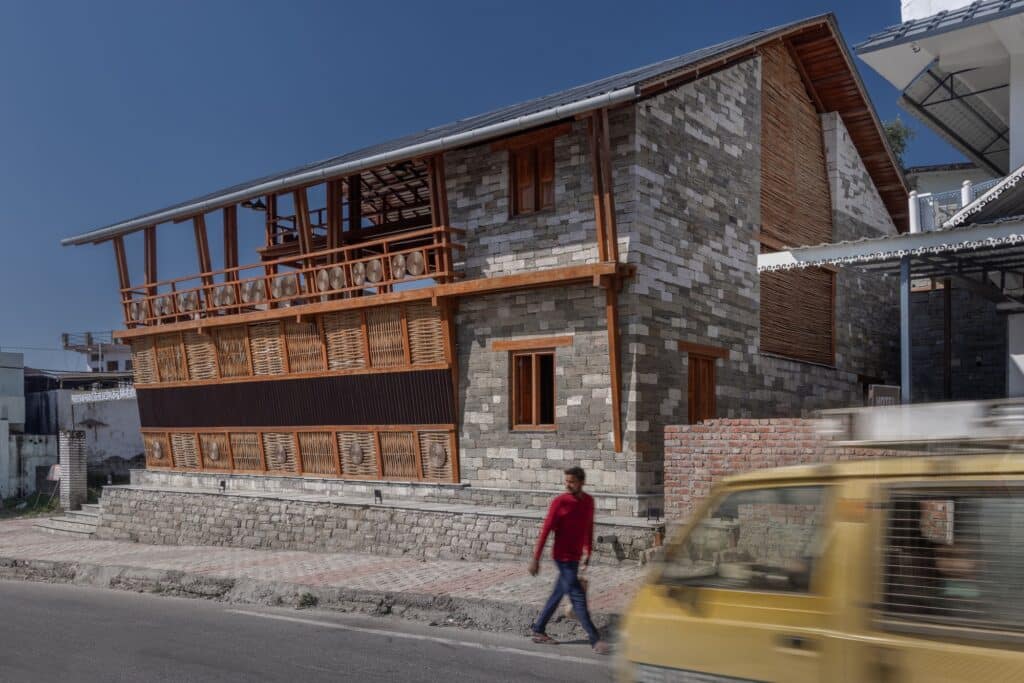
The site demonstrates how architecture can emerge from a direct understanding of topography rather than imposing predefined solutions upon it. The surrounding settlement has evolved through adaptation to the slope, using stone plinths and circulation paths based on steps and terraces, where spatial voids naturally form at points of pause. Accordingly, the Design follows the contours of the land, minimizes excavation work, and treats differences in elevation as spatial potentials that organize movement and generate stepped spatial sequences.
Movement as a Perceptual and Visual Device
Movement within the project shifts from a purely functional path to a gradual experiential sequence. It passes through stepped corridors, platforms, and semi-open thresholds, allowing moments of pause and visual engagement with ongoing activities. In this sense, movement is no longer a neutral element but becomes a means of displaying craft processes, enabling visitors to observe Material Datasheets and artisans at work within a clear spatial progression.
Integrating Production and Display within a Civic Structure
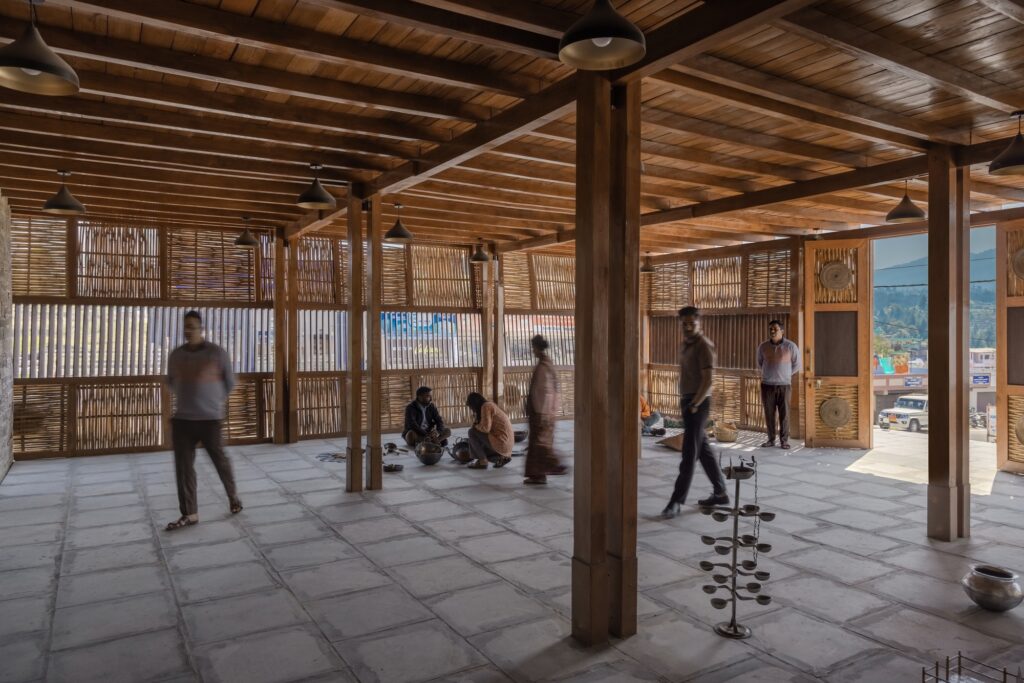
Discussions with the community contributed to redefining the architectural program, revealing a need for flexible spaces that combine work and exhibition rather than separating them. Accordingly, environments were developed to respond to requirements of lighting, ventilation, and storage, while remaining adaptable to the changing nature of crafts. Furthermore, the inclusion of non-commercial spaces, such as reading areas, expanded the project’s role to function as a daily civic infrastructure, where crafts become part of public activity rather than merely displayed objects. For similar community-driven approaches, you can browse the Archive of past case studies.
Structural Organization Based on Functional Gradation
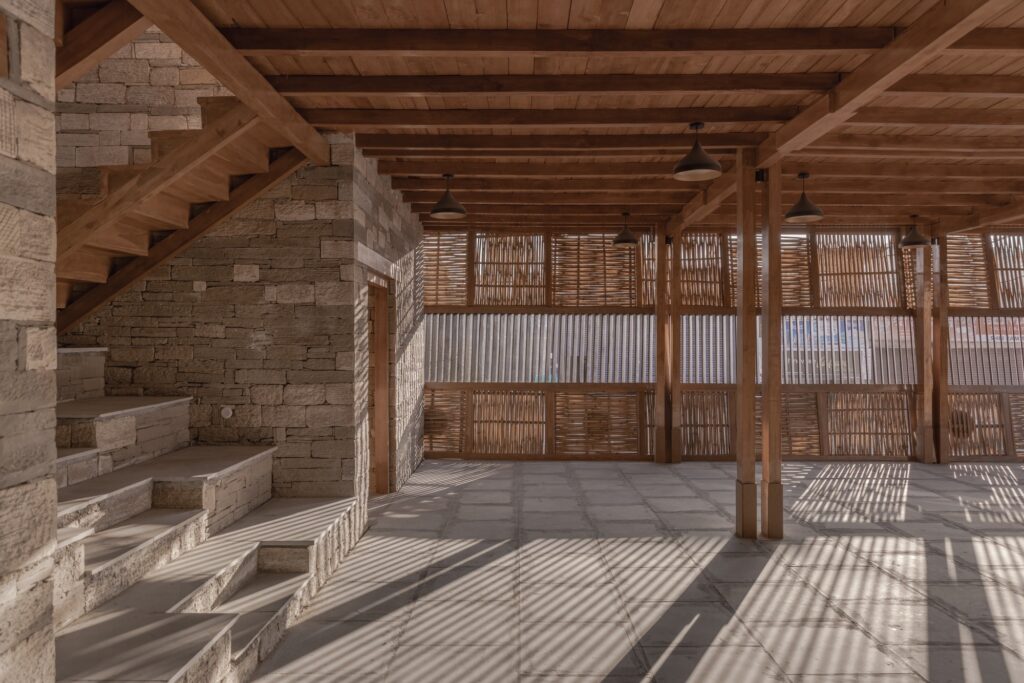
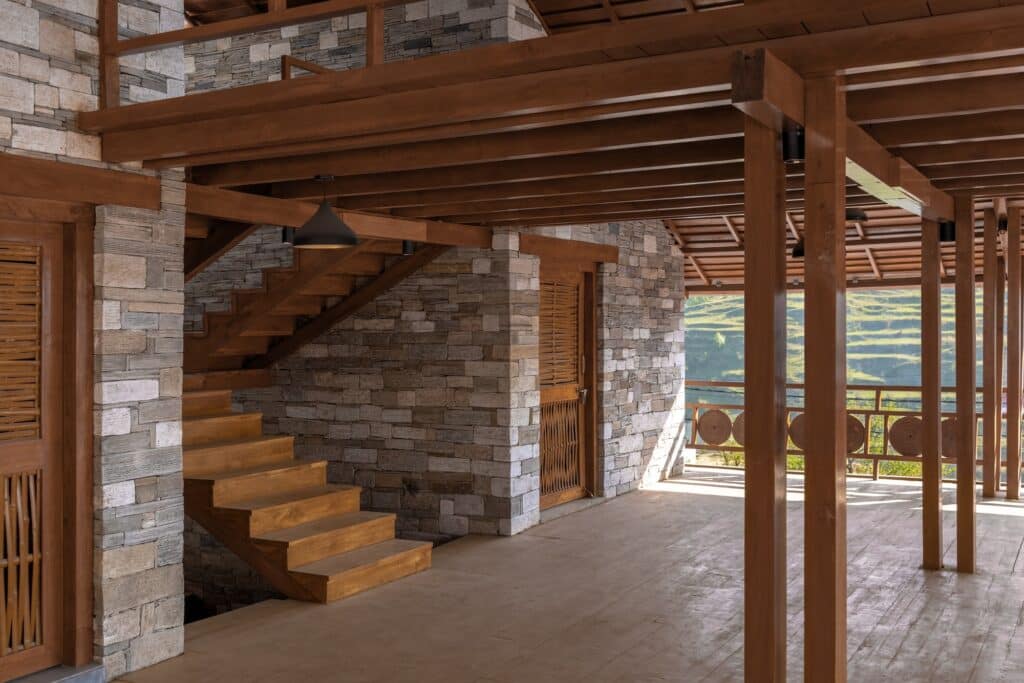
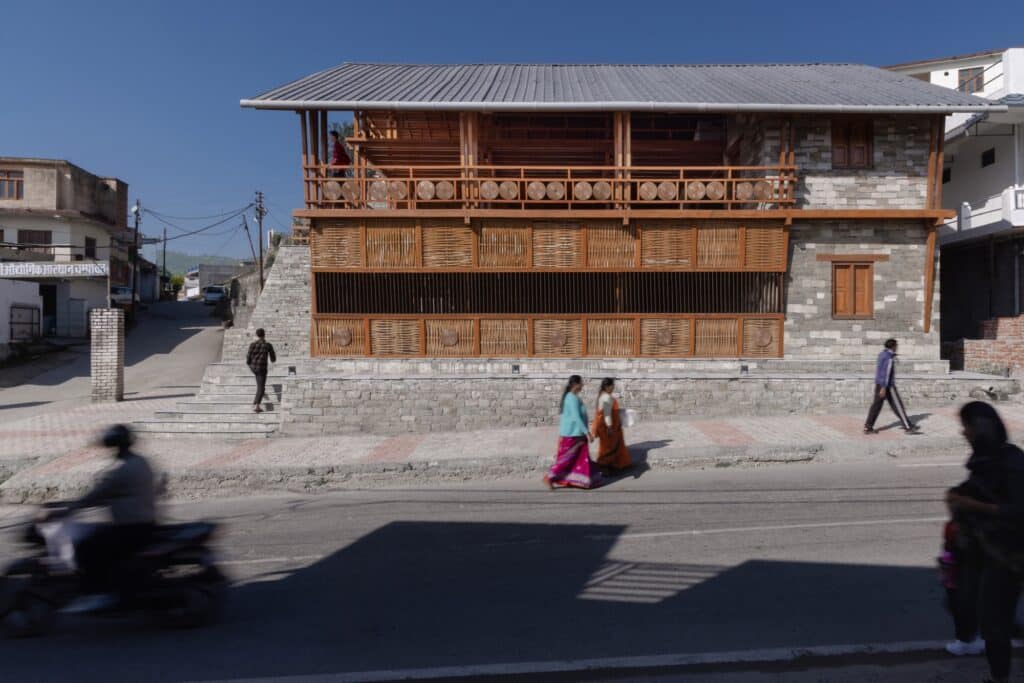
The building is divided into four structural bays, with a clear separation between heavy service volumes and lighter craft-related spaces. Within this framework, local stone is used in a systematic rubble masonry system to form walls and load-bearing elements, providing visual stability while enhancing the building’s thermal performance. This organization reflects a direct relationship between patterns of use and the properties of massing and Building Materials.
Simplification of the Structural System and Its Contextual Responsiveness
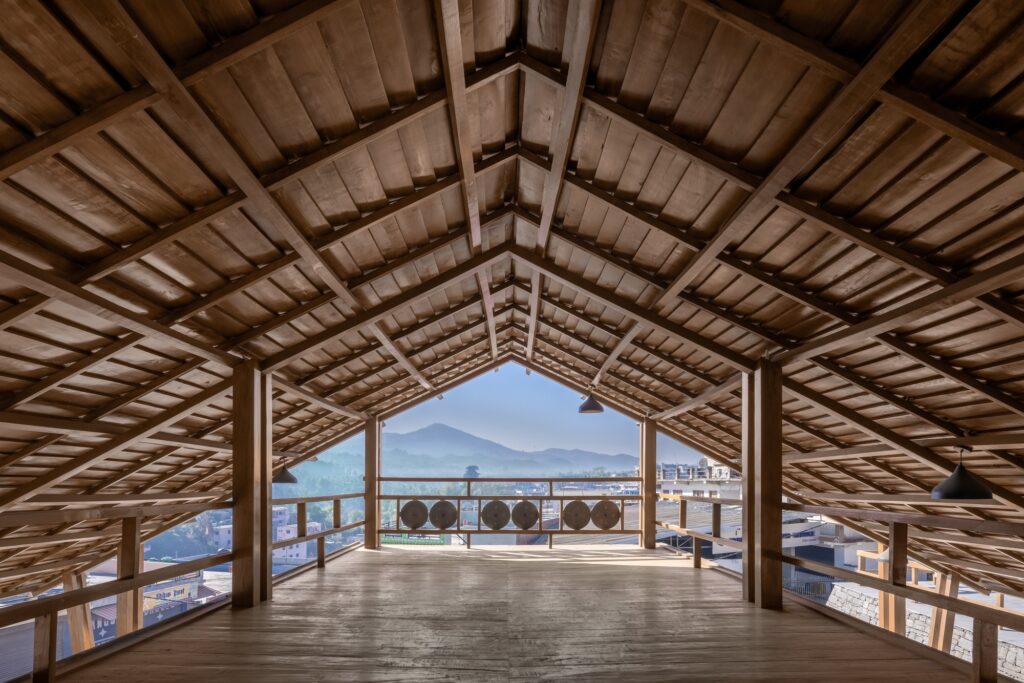
The structural system is grounded in clarity and constructability rather than complexity. Bolted connections are used instead of nails, improving seismic resistance and safety while facilitating assembly and maintenance. The design deliberately avoids intricate joinery that would require rare artisanal skills, particularly in a context where traditional craftsmanship is in decline. Instead, local construction principles are reinterpreted through simplified solutions such as pin joints and expansion connections, maintaining buildability using available local resources. These strategies are part of ongoing Research into resilient construction.
Material Strategy Between Performance and Economy
The selection of materials is guided by a balance between structural efficiency and ease of execution. Teak wood is used for columns due to its durability, while pine timber is employed for beams and roof elements to reduce weight and increase spans. As a result, the material system achieves effective performance without technical overcomplication, while maintaining economic viability aligned with local construction capabilities. To explore further technical insights, you can check the latest Architectural News on material innovation.
Craft as a Structural and Material Logic
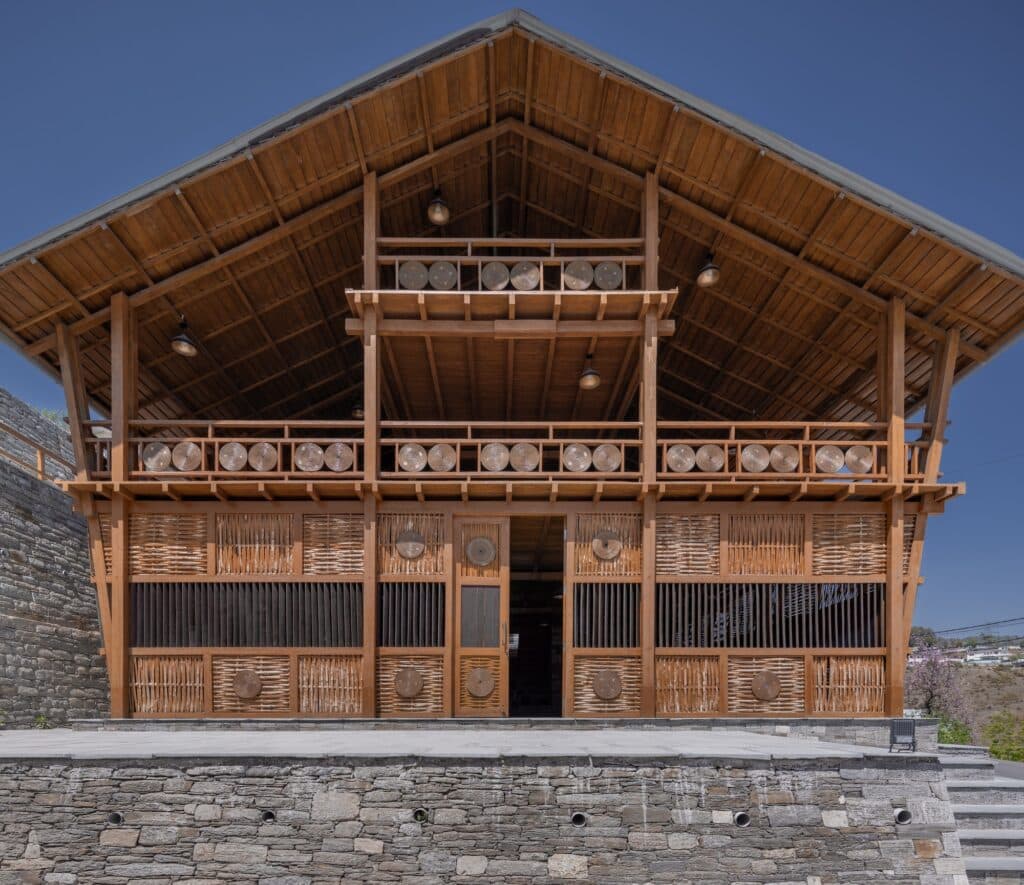
The building proposes a model that redefines local identity through contemporary constraints such as seismic resistance and material efficiency. Within this context, crafts are not used as decorative elements but are extended to form floors, cladding, and spatial components. Elements such as wooden planks, bamboo weaves, and “moonj” grass panels have been developed in collaboration with local groups, transforming craft from an isolated product into an integrated part of the structural and spatial system.
The Façade as an Environmental and Epistemic Device
The façade goes beyond its formal role to operate as an environmental mediator. Bamboo and wicker weaving techniques are employed within modular units that allow light filtration, enhance cross-ventilation, and regulate visual permeability. As a result, these elements contribute to improving climatic performance while simultaneously translating craft knowledge into an architecturally legible system. Thermal comfort is achieved through the interaction of materials with the spatial sequence rather than relying on isolated technical solutions. For more technical insights, you can review detailed Material Datasheets.
Programmatic Flexibility and the Building as a Civic Space
The building maintains adaptability through an open organization that supports changing uses. Elements such as modular kiosks, terraces, and open spaces accommodate a range of activities, from markets to temporary events. The upper terrace functions as both a gathering and observation point, reinforcing the relationship between craft activity and everyday life. Within this framework, the project is not presented as a conventional market but as a civic structure that integrates production and social interaction, offering an alternative model that connects design to local practices and allows it to evolve over time. Similar approaches can be found in the Archive of community-based projects.
✦ ArchUp Editorial Insight
In the Compartment S4 project in Champawat, the architectural formation emerges from an institutional response linked to tourism governance and self-help group programs within a Himalayan transit corridor. The primary driving force is located at the intersection of seismic resistance requirements, the erosion of traditional carpentry skills, the dominance of uniform concrete buildings typologies, and the complexities of a steeply sloped site. These constraints redirect architectural production toward simplified structural systems, modular assembly units, and the use of low-tech local materials. This approach aligns with findings from recent Research on resilient construction.
The outcome is manifested in a spatial organization that integrates craft production within movement routes and visual-functional circulation paths, positioning craft as part of the infrastructure rather than an independent activity. The material system further reflects the limitations of the local labor market and resource efficiency, producing a civic environment that merges economy, learning, and production within a single framework governed by environmental risk considerations and operational constraints. To stay updated on similar innovations, follow the latest Architectural News.

★ ArchUp Technical Analysis
Technical and Documentary Analysis of the Compartment S4 Project – Champawat, India:
This article presents an architectural analysis of the Compartment S4 project as a case study in reinterpreting craft as a civic architectural structure within the Himalayan context. To enhance its archival value, we would like to present the following key technical and design data.
The project has a total area of 250 square meters and was completed in 2025 in the city of Champawat in the Indian Himalayas, executed by Compartment S4 office for Kumaon Mandal Vikas Nigam and the district tourism office. The building is divided into four structural bays, with a clear separation between heavy service blocks and lighter spaces associated with craft, using local stone within a regular rubble stone system for walls and supporting elements.
The structural system relies on bolted connections rather than nails to enhance safety and seismic resistance and to facilitate assembly and maintenance, with pin joints and expansion joints to avoid complex connections. Teak wood columns and pine wood timbers are used for beams and roof elements to reduce weight and improve spans.
Components such as wooden panels, bamboo textures, and “Munj” grass panels were developed in collaboration with local groups, with a facade employing bamboo and rattan weaving techniques in modular units to filter light, enhance cross-ventilation, and control visual permeability. The program includes spaces for reading, discussion, work, and craft, with modular kiosks, terraces, open spaces, and an upper terrace serving as a gathering and observation point.
Related Insight: Please refer to this article to understand the context of modern architectural preservation:
Craft as Architectural Structure: Strategies for Integrating Production and Civic Space.




✅ Official ArchUp Technical Review completed for this article.