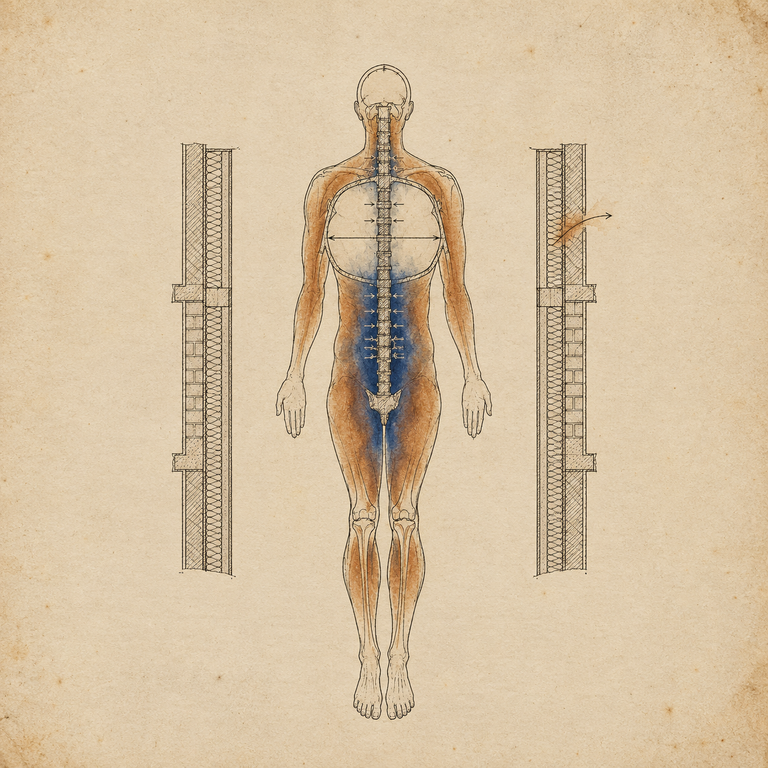
Corridor Memory: How Touch Could Help People Remember Their Way Through Buildings

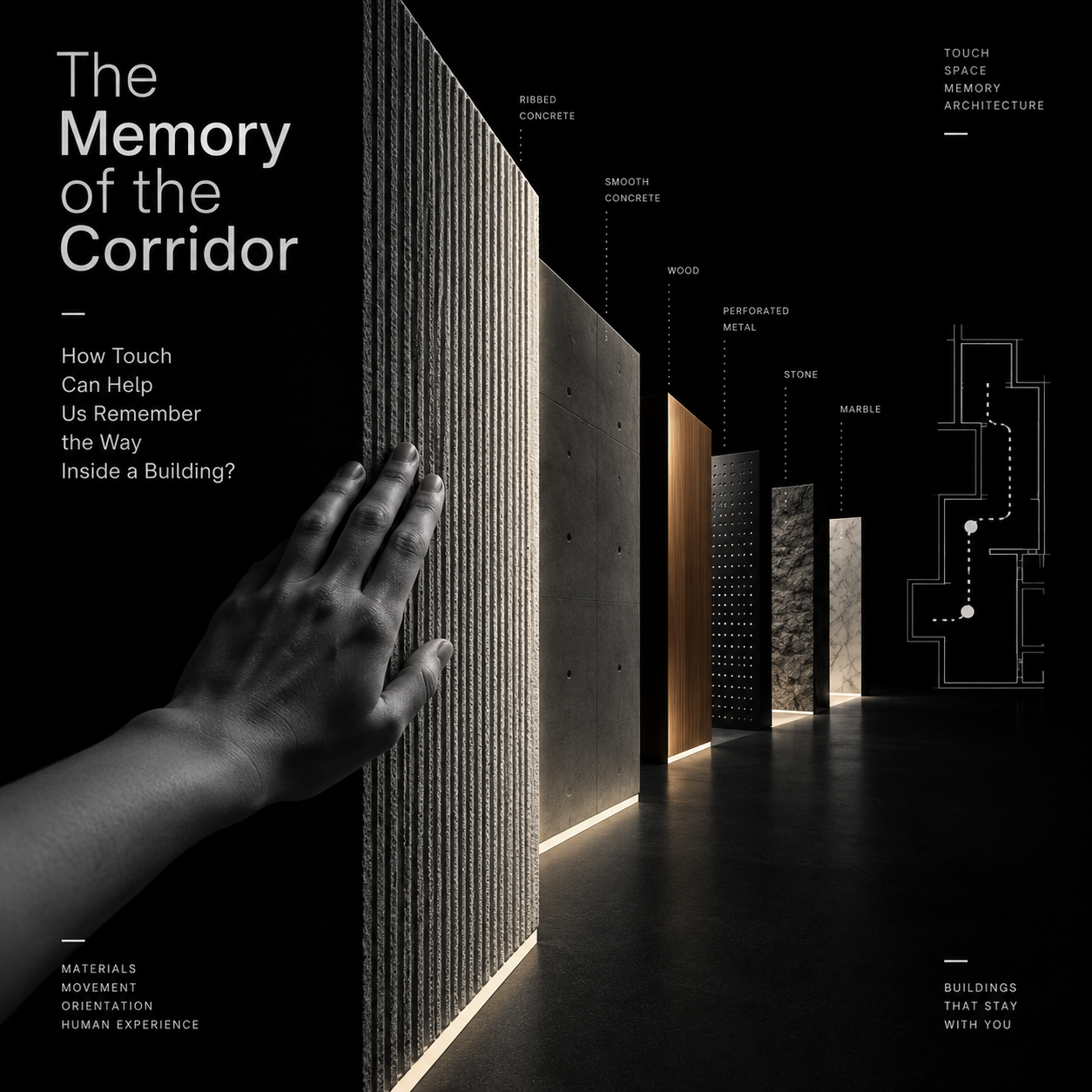
Imagine a building where corridors and doors look almost identical. A visitor can read the room numbers, yet hesitates at a junction they passed only minutes earlier. This familiar situation raises a question about architectural finishes: could the surfaces people touch provide a reference for remembering a place, alongside what they see?
The question does not assume that changing materials will solve wayfinding problems. It examines a more specific relationship between touch and spatial memory. Its starting point is an experiment in cognitive science. Translating that evidence into architecture requires a testable hypothesis about how people experience and remember a route.
What the Evidence Shows
In 2011, Jonathan W. Kelly, Marios N. Avraamides, and Nicholas A. Giudice investigated whether a spatial reference frame acquired through touch could influence how people remembered locations subsequently learned through vision.
Their first experiment involved 42 university students. Changing the perspective from which participants explored objects through touch did not change the reference frame used to remember visually learned locations. In a second experiment involving 44 students, participants explored objects on a square table and were instructed to feel its edges. Under these conditions, the reference frame established through touch influenced the organisation of subsequently acquired visual memories.
The distinction matters. Touch did not improve memory under all conditions. In this experiment, environmental cues that established a directional reference played an important role. The task also concerned objects arranged on a table; it did not test navigation through corridors or differences in the texture of construction materials.
A complementary study by Tobias Katus, Matthias M. Müller, and Martin Eimer, published in 2015, examined the neural processes involved in tactile working memory. The researchers recorded sustained electrical activity associated with retaining tactile information, with activity varying according to memory load. Their findings support the involvement of sensory brain regions in maintaining tactile information. They do not identify an ideal architectural material or establish the effectiveness of a building-scale guidance system.
Together, these studies provide a basis for investigation. Whether an architectural intervention can use these mechanisms to improve route memory remains an empirical question.
From Surface Texture to Spatial Relationships
The design hypothesis proposed here is that a tactile cue’s usefulness may depend on its relationship to movement and decision points, as well as its sensory distinctiveness.
An unusual surface placed arbitrarily may become a detail visitors remember without remembering where they encountered it. A cue consistently associated with the beginning of a wing or a particular transition could, in principle, support a learnable relationship between sensation and location.
This proposed organisation can be described as Haptic Route Grammar: a limited set of recurring relationships between touchable cues and specific functions along a route. The term is introduced here as a working concept, without claiming worldwide priority.
Tactile wayfinding already exists as a field of research and practice. The specific question developed here concerns whether a consistent arrangement of cues can support later route recall, beyond helping people navigate while the cues are present.
Existing guidance also distinguishes material differences from differences that users can reliably detect. The National Academies’ 2025 guide to tactile wayfinding discusses environmental contrasts that can be recognised through touch, alongside subtler variations that may be difficult to distinguish. A visually convincing material palette therefore cannot establish the performance of a tactile system.
A Hypothetical Application in a Public Library
Consider an experimental library layout in which three routes branch from a shared entrance hall. The floor plan, lighting, and signage remain identical across three versions. Only the organisation of touchable surfaces at transition points changes.
In the first version, the surfaces are uniform. In the second, distinguishable tactile variations appear without a consistent relationship to spatial functions. In the third, the same variations follow a repeatable arrangement: one cue marks the beginning of a branch, while another identifies the next decision point.
Comparing these versions would help distinguish the effect of sensory variety from the effect of meaningful organisation.
These relationships would be experimental, rather than a ready-made vocabulary for public buildings. They would need to work alongside established accessibility systems and be developed with users who have different sensory and motor capabilities.
The mode of contact also matters. A variation detectable by the hand cannot automatically be assumed to work underfoot or through a cane. Each interaction requires its own evaluation.
How Could Corridor Memory Be Tested?
Participants would be randomly assigned to the different versions, with exploration time and instructions held consistent. After a defined interval, they would be asked to return to a destination they had previously visited.
The primary outcome would be the number of wrong turns. Additional measures could include hesitation time, requests for assistance, and the accuracy with which participants recall decision points.
A separate task outside the route would help distinguish memory from immediate guidance. Participants might arrange transition points in sequence or indicate the direction of a destination from an imagined position. A delayed test could examine whether any effect persists.
Before testing route performance, the study would establish whether participants can reliably distinguish the tactile cues themselves. Sample size would be determined through a statistical power analysis, and the hypotheses and analysis plan would be registered before data collection.
If the consistently organised version outperformed both alternatives, the result would provide initial support for the proposed grammar. If movement became faster without an improvement in recall, the benefit might concern immediate guidance rather than memory. If no difference emerged, the intervention would lack support under the tested conditions.
This distinction prevents an appealing design idea from becoming a recommendation before its mechanism has been examined.
More Sensory Input Is Not Always Better
Multisensory design requires restraint. A study by Pei-Luen Patrick Rau, Jian Zheng, and Yi Wei, published in 2020, examined visual, auditory, and tactile distractions during reading. It showed that additional sensory inputs can interfere with performance, and that their combined effects do not always equal the sum of their individual effects.
The study did not examine navigation through buildings. Its relevance here is narrower: it challenges the assumption that adding sensory channels necessarily improves a task.
The architectural proposal therefore favours a limited vocabulary of cues, with consistent meanings and locations that serve specific decisions. A cue should provide useful information without requiring the user to process an elaborate sensory code.
Practical performance would also depend on durability, cleaning, reach, and continued access. A surface whose texture changes through maintenance, or becomes hidden behind furniture, may cease to perform its intended role.
✦ ArchUp Editorial Insight
The proposal raises a question for architectural specifications: could continuity in material details have a cognitive value that deserves to be documented and maintained?
If a particular relationship between surfaces and routes is shown to support memory, replacing a finish during operation could affect building performance even when its appearance remains acceptable. An apparently minor substitution might remove a distinction that users have learned to associate with a location.
Under those circumstances, evaluating a replacement would involve more than colour, cost, and durability. It would also require checking whether the cue remains detectable and retains its spatial meaning.
This is a potential implication, dependent on the field evidence proposed here. It gives architectural research a concrete task: identify which detail a user remembers, determine whether that memory helps them find their way, and establish which properties allow the relationship to survive everyday use.
References
- Kelly, Jonathan W.; Avraamides, Marios N.; and Giudice, Nicholas A. “Haptic Experiences Influence Visually Acquired Memories: Reference Frames During Multimodal Spatial Learning.” Psychonomic Bulletin & Review, 2011.
- Katus, Tobias; Müller, Matthias M.; and Eimer, Martin. “Sustained Maintenance of Somatotopic Information in Brain Regions Recruited by Tactile Working Memory.” The Journal of Neuroscience, 2015.
- National Academies of Sciences, Engineering, and Medicine. Tactile Wayfinding in Transportation Settings for Travelers Who Are Blind or Visually Impaired: Volume 2: Guide. The National Academies Press, 2025.
- Rau, Pei-Luen Patrick; Zheng, Jian; and Wei, Yi. “Distractive Effect of Multimodal Information in Multisensory Learning.” Computers & Education, 2020.