The Effect of the Water-to-Cement Ratio on the Performance of Mortar Made from Construction and Demolition Waste

Every kitchen keeps a small rule that nobody writes down: two cups of water for every cup of rice. You follow it faithfully for years. Then one day you lift the lid and find the grains hard and the pot dry, because the rice has changed and you did not notice. The grain that once drank a known measure now drinks more, and the rule no longer tells the truth. What happens in the pot happens on the scaffolding when we replace river sand with aggregate crushed from demolished buildings. The ratio between water and cement that every engineer knows by heart no longer suffices to explain what happens inside the mix. Stranger still, the water drawn out of the mixture can make the mortar stronger, not weaker. How can a material that comes from waste overturn a rule we have always trusted? The answer lies in a number that appears on no drawing: the amount of water that actually reaches the cement.
The Sand That Drinks More Than We Think
Natural sand is a material with a small appetite for water. Its absorption typically ranges between one and one and a half percent of its weight. Sand recovered from construction and demolition waste tells a different story. The review by Silva, de Brito and Dhir indicates that recycled fine aggregate can absorb from five percent to more than thirteen percent, depending on the processing method and the type of waste. The types differ among themselves. Recycled concrete aggregate absorbs roughly 4.7 to 9.5 percent, mixed recycled aggregate between 7.2 and 9.3 percent, and recycled masonry aggregate, derived from brick and building rubble, can reach 13.4 percent.
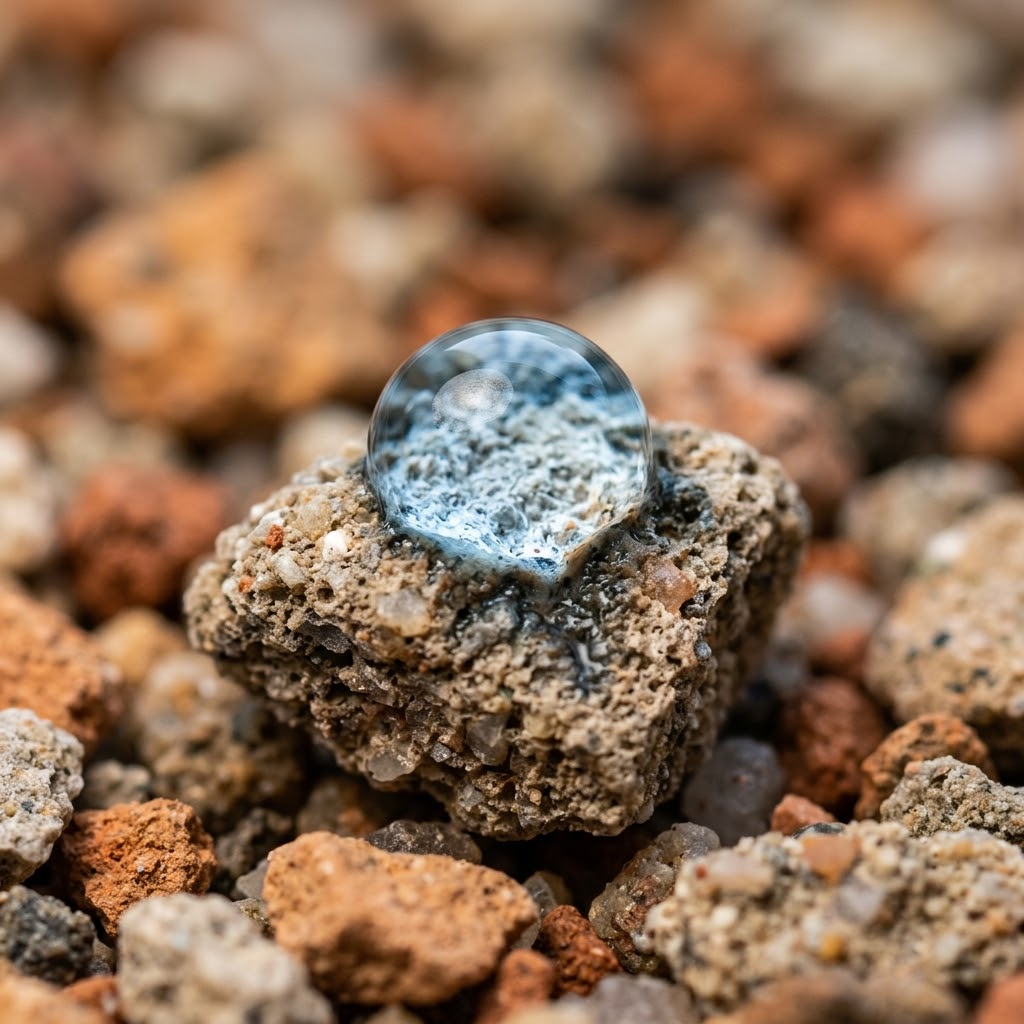
The cause lies in the makeup of the particles themselves. Each grain is a small fragment of an old wall, carrying adhered cement mortar, ceramic particles, and other porous components. These pores work like thousands of microscopic sponges waiting for the first drop of water. The engineer standing before a heap of recycled sand in the site yard does not see an inert material. He sees an open reservoir that draws part of the mix’s water away before the cement can claim it.
These details may look like a laboratory concern, but they touch the economy of the construction site directly. The quantity a foreman orders for each batch may often go into the pores of the aggregate rather than into the cement reaction. So the first question for recycled mixes differs from the traditional one. The question is no longer how much water to add, but which water we mean when we say “water-to-cement ratio.”
When Water Splits Into Two Waters
The heart of the matter rests on a distinction that escapes many practitioners: the difference between the total ratio and the effective ratio. The first is all the water added to the mix divided by the cement. The second is the water actually available for the reaction after the aggregate takes its share. If the aggregate goes into the mix dry, it pulls part of the mixing water into its pores and the effective ratio falls. If the aggregate is soaked before mixing, it carries its own water with it, and the total ratio required to reach the same consistency rises.
Using a three-way analysis of variance, Cuenca-Moyano and her colleagues showed that the total ratio alone explained 46.9 percent of the variance in mortar consistency, the proportion of recycled aggregate 36.6 percent, and the dosage of the chemical admixture 5.7 percent. When the researchers fixed the total ratio at 1.4 and used dry aggregate, the consistency of the mortar fell by as much as 34.4 percent at full replacement, because the aggregate drank the mixing water before the water could do its job. Every mix reached the plastic consistency suited to construction, meaning a flow above 140 millimeters, only when the aggregate was soaked to between 67 and 80 percent of its absorption capacity. The total ratio then rose to between 1.48 and 1.80.
This result intersects with what Saiz Martinez and his colleagues found. They had to increase the mixing water experimentally as the replacement of natural sand rose, to reach a target consistency of 175 ± 10 millimeters. At full replacement with concrete-based aggregate, the ratio needed to reach roughly 0.85 to 1.0, depending on the cement content. These figures may look strange to anyone accustomed to concrete ratios, but they reflect the logic of recycled mortar: the ratio declared on paper means nothing until we know the condition of the aggregate. Once this duality is understood, a deeper paradox emerges, because missing water can sometimes be a blessing.
The Paradox: Thirsty Aggregate Makes Stronger Mortar
It may seem strange that aggregate that steals water from the mix gives it extra strength. What happens at the surface of the particle explains it, in what engineers call the interfacial transition zone. This is the thin layer between the aggregate and the new cement paste, and it is the weakest point in any mortar or concrete. When dry aggregate absorbs some of the free water in the first moments, the effective ratio falls in precisely this zone. The bond improves and the fabric becomes denser.
The figures of Cuenca-Moyano confirm this idea. Every mortar made with dry aggregate exceeded the compressive strength of the reference mortar, which belongs to class M5 with a strength of 7 N/mm², with increases ranging from 17.4 to 61.9 percent. The total ratio accounted for 77.1 percent of the variance in 28-day compressive strength, by far the heaviest factor, while the proportion of recycled aggregate explained only 2.8 percent.
In the study by Vaishnav and Trivedi, the nominal ratio was fixed at 0.4 with a superplasticizer, and dry and saturated aggregate were compared. In the dry condition, strength rose with the replacement proportion up to 75 percent and reached 53.86 megapascals at 28 days, 15.3 percent above the reference mortar. In the saturated condition the picture reversed: the effective ratio rose, strength fell as replacement increased, and the optimal replacement did not exceed 25 percent. The study by Wu and his colleagues, using a water-to-binder ratio of 0.5 and aggregate saturated with a dry surface, confirmed the same trend: compressive strength fell by 3.0, 7.3 and 14.4 percent at replacements of 25, 50 and 100 percent.
The practical conclusion is that recycled aggregate does not weaken mortar by its nature. What weakens it is our letting the aggregate disturb the water accounting. But strength at the fourth week is not the whole story, because a wall lives for decades.
Excess Water Sends Its Bill Years Later
A wall is not tested in the laboratory. It is tested under rain, sun, and moisture rising from the ground. Here the water ratio becomes a question of durability. In the study by Cuenca-Moyano, the total ratio proved the second most important factor in the capillary absorption coefficient, after the dosage of the chemical admixture, explaining 4.9 percent of the variance. As the ratio rises, capillary porosity grows. Even so, the use of dry aggregate reduced capillary absorption by as much as 71.7 percent compared with the reference mortar, because the denser structure obstructs the seepage of water.
The cost of excess water shows most clearly in shrinkage. Wu and his colleagues found that replacing the sand entirely with recycled aggregate at a ratio of 0.5 raised drying shrinkage by 38.0 percent and water loss by 75.3 percent. The water held by porous particles evaporates later, and aggregate that is less rigid than natural sand increases shrinkage. On mortar-rendered facades, this means hairline cracks that open the way for moisture. The same study, however, revealed that adding fine powder from concrete waste at 30 percent reduced the 28-day shrinkage to 0.189 percent instead of 0.215 percent.
Sathiparan showed that mortar containing cement-sand block waste excelled in abrasion resistance, losing about 40 percent less mass at 75 percent replacement. Its chemical resistance to acids and alkalis, however, declined as the proportion of waste rose, particularly when waste from cement-stabilized earth blocks was used. In another direction, Mohammed and his colleagues found that a ratio of 0.475, with washed fines from ready-mixed concrete plants at replacement levels of up to 20 percent, produced strength 19 percent higher than the reference, with lower shrinkage and acceptable capillary absorption. These ratios do not operate in a vacuum, because other tools readjust the equation.
What Calculation Cannot Do, Admixtures and Processing Can
If thirsty aggregate imposes a water dilemma, chemistry and mechanical processing offer a way out. Superplasticizers, including those based on polycarboxylates, allow the mortar to keep its fluidity with less water. They lower the effective ratio without sacrificing workability. Vaishnav and Trivedi fixed the ratio at 0.4 with an admixture of this type. The admixture compensated for the high water demand of the recycled aggregate and allowed 75 percent of the sand to be replaced with mechanically processed aggregate, while strength stayed about 15 percent above the reference.
The air-entraining plasticizing admixture plays a decisive role as well. In the study by Cuenca-Moyano, its dosage was the dominant factor in capillary absorption, explaining 83.5 percent of the variance. Raising the dosage from 1 to 9 percent reduced the absorption coefficient by as much as 55.5 percent, with a clear improvement in the compactness of the mortar.
Mechanical processing changes the raw material itself. Vaishnav and Trivedi compared three methods of producing fine aggregate: manual crushing, manual crushing followed by a jaw crusher, and manual crushing followed by ball milling. The last type, the most heavily processed, achieved the highest density among the three (2.78 g/cm³) and the lowest absorption (7.8 percent), and its strength exceeded the reference by about 15 percent even at full replacement. The review by Silva confirmed that absorption falls and density rises as crushing stages that strip away the adhered mortar increase, and that washing the aggregate lowers absorption by between 35 and 55 percent, which reflects directly on the water required.
Active mineral admixtures also play a role in fully recycled mixes. Wu and his colleagues found that adding 10 percent silica fume or metakaolin to a mortar combining recycled aggregate and recycled powder raised compressive strength by between 35.9 and 38.1 percent and reduced capillary absorption by between 31.4 and 48.4 percent. These tools need someone to turn them into decisions on site, and that is where we arrive now.
From Laboratory to Worksite: Which Ratio for Which Wall?
The studies offer no single magic number, but they draw a clear map of decisions. For non-structural masonry mortar of class M5, dry aggregate at a replacement level of 25 percent can be used with a total ratio of roughly 1.2 to 1.4, which achieves acceptable consistency while maintaining or improving strength. Moving to replacement levels between 50 and 100 percent, presoaking the aggregate to 67 to 80 percent of its absorption capacity becomes the more realistic option, with a total ratio between 1.5 and 1.8, and with acceptance of lower strength than mixes made with dry aggregate.
When strength is the priority, as in a mortar with structural requirements, the solution turns toward dry aggregate at a nominal ratio between 0.4 and 0.5 with a superplasticizer, since strength exceeds the reference mortar at replacement levels of up to 75 percent. When the goal is maximum sustainability, meaning a fully recycled mortar, the path that has proven viable is a water-to-binder ratio of 0.5 with saturated aggregate, replacement of 30 percent of the cement with recycled powder, and 10 percent silica fume or metakaolin.
For the practitioner, this map means that the engineer’s responsibility does not end with specifying a ratio on paper. Measuring the absorption of the aggregate, determining its condition at mixing, and deciding whether to soak it are all site decisions that determine the quality of the wall. Whoever ignores them repeats the mistake of the cook with the pot of rice: applying the same rule to a material that has changed. The larger question remains: what do we do with rules we learned on materials that are no longer the materials of our cities?
Lift the lid of the pot next time and look at the grains. If they are tender, your estimate was right. If they are hard, you did not err in the arithmetic but in assuming the grain had not changed. So it is with mortar made from demolition waste: it asks us to question the material before we question the ratio, and to ask about the stone’s past before we measure its present. The cities being demolished today will build their new walls tomorrow from their own rubble, and in every grain of recycled sand lies the memory of a former building and a capacity we have not yet measured. Do we have the courage to abandon ready-made numbers and teach a whole generation of architects to read the material before they write the specification? And if the water we cannot see determines the durability of what we build, what else do we fail to see in the other rules we trust?
✦ ArchUp Editorial Insight
A single number governs the specification of mortar because it can be written into a contract, checked against a submittal, and carried to a site without the person who chose it being present: the water-to-cement ratio. Research on construction and demolition waste shows what that convenience conceals. Natural sand absorbs roughly one to one and a half percent of its weight, while recycled fine aggregate absorbs from five to more than thirteen percent, so the declared ratio no longer describes the water that reaches the cement. The studies by Cuenca-Moyano, by Vaishnav and Trivedi, and by Wu and colleagues converge on one point. The same nominal ratio yields stronger or weaker mortar depending on whether the aggregate enters the mix dry or saturated, a condition the specification rarely records. Acceptance testing rewards the twenty-eight-day compressive result, while the costs of excess water, including drying shrinkage raised by 38 percent, materialize years later as hairline cracking on rendered facades. The party who fixes the ratio exits at handover. The foreman who decides whether to soak the aggregate works without a mandate to measure its absorption. The occupant who inherits the cracks had a place in neither decision. The crack in the render is therefore the legible record of a measurement that no contract required anyone to make.
References
Cuenca-Moyano, Gema M., et al. “Effects of Water to Cement Ratio, Recycled Fine Aggregate and Air Entraining/Plasticizer Admixture on Masonry Mortar Properties.” Construction and Building Materials, 2020.
Silva, Ricardo V., Jorge de Brito, and Ravindra K. Dhir. “Properties and Composition of Recycled Aggregates from Construction and Demolition Waste Suitable for Concrete Production.” Construction and Building Materials, 2014.
Saiz Martinez, Pablo, et al. “Comparative Study of Three Types of Fine Recycled Aggregates from Construction and Demolition Waste (CDW), and Their Use in Masonry Mortar Fabrication.” Journal of Cleaner Production, 2016.
Vaishnav, S. K., and M. K. Trivedi. “Performance Assessment of Sustainable Mortar Mixes Using Recycled Fine Aggregate Obtained from Different Processing Techniques.” Environment, Development and Sustainability, 2023.
Wu, H., C. Wang, and Z. Ma. “Drying Shrinkage, Mechanical and Transport Properties of Sustainable Mortar with Both Recycled Aggregate and Powder from Concrete Waste.” Journal of Building Engineering, 2022.
Sathiparan, N. “Performance of Sustainable Cement Mortar Containing Different Types of Masonry Construction and Demolition Wastes.” Clean Technologies and Environmental Policy, 2023.
Mohammed, T. U., M. Z. B. Harun, and M. M. U. Masud. “Reuse of Washed Fines from Ready-Mixed Concrete Plants in Mortar.” European Journal of Environmental and Civil Engineering, 2024.