Why a Bee Cannot Fly… and Why That Matters to Architects

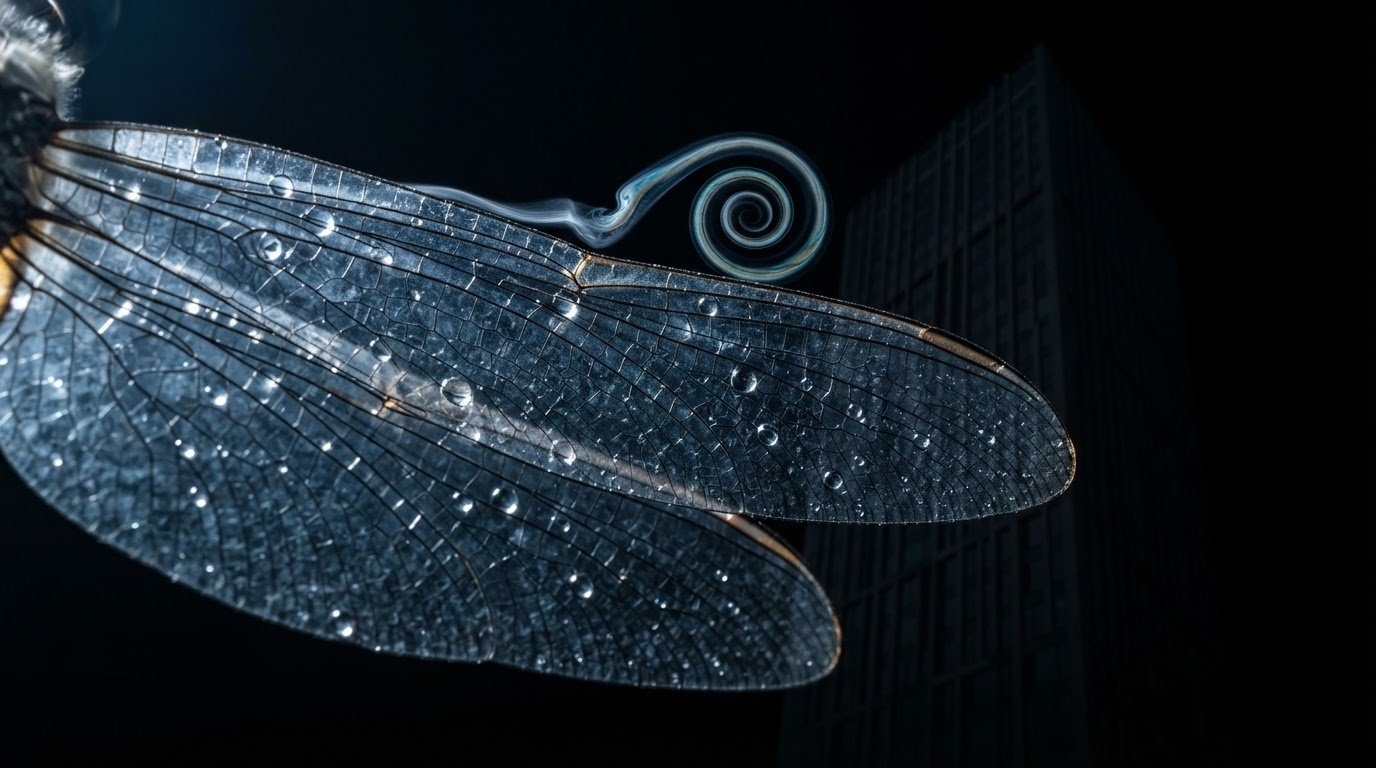
From the leading-edge vortex on a fly’s wing to wind modeling around skyscrapers, a journey through the calculations that changed our understanding of moving space
For decades, a near-mythical claim circulated through the corridors of physics: “a bee cannot fly.” It was no joke, but a calculation entirely correct under the laws of classical aerodynamics — laws originally designed for fixed aircraft wings. The paradox, of course, is that bees fly every day without the slightest concern for what the equations say. The flaw was never in the insect, but in the measurement tools borrowed from the world of static wings and applied to an entirely different world: one of rotational motion, repeated oscillation, and self-collision with the wake the wing leaves behind itself. This gap between theory and reality, later closed by fluid dynamics researchers through decades of precise measurement and computational simulation, does not at first appear to concern architects at all. But anyone following the evolution of wind-analysis tools around towers, the design of kinetic facades, and the emergence of insect-inspired micro-drones for site surveying will recognize that these very calculations have begun creeping into architectural practice through unexpected doors.
When the Old Laws Fail to Explain Motion
The premise researchers in this field started from is deceptively simple: a flapping wing does not move at constant velocity like an airplane wing. Instead, it traces an arc through the air, rotates about its spanwise axis at the end of each stroke, and then passes back through the vortices it left behind in the previous stroke. This cyclical, unsteady pattern renders any calculation that assumes constant velocity fundamentally misleading — a point emphasized by researcher Z. Jane Wang in her landmark review on the anatomy of insect flight. Strikingly, when this idea is projected onto the world of buildings, it closely resembles the difference between calculating wind pressure on a static facade and calculating airflow behavior around a moving or perforated facade whose geometry continually changes: a static model simply does not suffice, and the problem demands multiple layers of modeling, from quick estimates all the way to full computational simulation.
Why Would an Architect Care About a Fly’s Wing?
Linking insect dynamics to architectural design may seem arbitrary, but three practical pathways make this research directly relevant to professional practice. The first is the rise of insect-inspired micro-drones, now increasingly used to survey tight urban sites and inspect the exterior facades of existing buildings, where conventional propeller drones are impractical. The second is kinetic facades — facades with moving elements that respond to sunlight or wind direction — whose designers increasingly borrow principles from flapping motion to reduce mechanical energy consumption. The third, and perhaps most significant, is the modeling of urban wind around high-rise towers using computational fluid dynamics, the very technique originally developed to understand how insect wings generate lift many times greater than classical theory predicts.
From Quick Estimates to Blade Elements: The Layers of Calculation Engineers Borrow
The simplest method researchers use to calculate the average force generated by a hovering flapping wing is to balance the creature’s weight against the rate of downward momentum it imparts — an idea closely related to what propeller engineering calls actuator disk theory. Researcher Ellington developed a refined version of this idea that relies only on the actual sector swept by the wing rather than assuming a full circular disk, while researcher Traub introduced an explicit formula for calculating average lift over a single stroke based on the mean downward air velocity and the inclination angle of the stroke plane. Conceptually, this layer of calculation resembles the quick preliminary estimates a structural or wind engineer performs in the early stages of design, when only a reasonably approximate number is needed before moving into computationally expensive detail.
But when researchers need to know instantaneous force rather than merely average force, they turn to what is known as blade element theory, the most widely used tool in this field. The idea is to divide the wing into fine strips, treating each strip as an independent two-dimensional airfoil moving at its own velocity and angle of attack, then summing the contributions of all strips to obtain the total force. This breakdown into small, independently analyzable units later reassembled directly recalls the logic of load analysis in complex structures, where a large structural member is divided into small sections whose behavior can be calculated individually. The essential coefficients this model requires — the lift and drag coefficients — cannot be taken from conventional aircraft tables, because insect wings operate at very high angles of attack and extremely low Reynolds numbers. Researcher Dickinson and colleagues therefore measured these coefficients directly on a scaled-up, slowed-down robotic fly, using what is known as dynamic scaling — an experimental technique worth pausing on, since it is also used in architectural wind tunnels to study the behavior of scaled building models.
Yet the researchers themselves caution against the limits of this simplified model: it fails to capture instantaneous force peaks at stroke-reversal points and ignores three-dimensional effects such as the wingtip vortex, leading, according to a study by researcher Sun on the hawkmoth, to an error of nearly ten percent in calculated average force and power. This particular caveat precisely mirrors what urban wind engineers face when relying on simplified models to calculate wind loads on towers while ignoring vortex effects generated where a building meets neighboring structures.
The Vortex That Keeps Air “Attached”: A Lesson for Moving Facade Design
The most striking discovery in this field, one that overturned scientists’ understanding of insect flight, is that most of the extraordinary lift generated by a flapping wing does not come from the motion itself so much as from a small, stable vortex that forms above the wing’s upper surface during translation, known as the leading-edge vortex. This vortex keeps air “attached” to the surface rather than separating from it — a condition known in aerodynamics as separation or stall — raising the lift coefficient to values between roughly one point four and two, figures far exceeding what classical steady-state theory would predict. Measurements by researchers Birch, Dickson, and Dickinson showed that this vortex remains stable across a wide range of Reynolds numbers, and that roughly seventy percent of measured lift can be explained solely through the circulation associated with it.
But the story does not end there. When the wing rotates rapidly about its longitudinal axis at the end of each stroke, it generates additional circulation resembling what is known as the Magnus effect. This effect, together with what is called “wake capture” — the wing re-encountering the vortices it left behind in the previous stroke — together contribute roughly thirty-five percent of total lift in the fruit fly. More precisely still, the timing of this rotation is extremely sensitive: advancing the moment of rotation by just eight percent of the full cycle’s duration raised average lift by sixty-seven percent, according to measurements by Dickinson and colleagues.
This discovery has direct resonance for the design of kinetic facades and moving mechanical elements in contemporary architecture. Just as the timing of wing rotation relative to stroke reversal decisively determines lift efficiency, the timing of dynamic shading elements or operable facade openings likewise determines their efficiency in regulating heat and airflow. The deeper lesson here is that repeated motion — whether an insect’s wing or an architectural louver — cannot be calculated in isolation from its recent history: the prior state of surrounding air affects the performance of subsequent motion, a principle that architectural automation engineers are beginning to take more seriously when programming facade responses to shifting wind.
Scaling Laws: From Insect Size to Tower Scale
One of the most persistent problems for flight-dynamics scientists is that experimental lift coefficients do not unify easily across different insect sizes, because they depend on factors such as reduced frequency and aspect ratio. To resolve this, researchers Lee, Choi, and Kim derived a direct scaling law linking a hovering insect’s weight to the strength of the leading-edge vortex and the rotational momentum of the surrounding fluid, without requiring a separate experimental lift coefficient for each species. Remarkably, this single law succeeded in unifying data from thirty-five different species of hovering insects onto one master curve, and produced a practical design rule stating that wing loading scales with the square of frequency, wing length, and stroke amplitude — explaining why hoverflies compensate for their small wing area and narrow stroke amplitude by raising their flapping frequency to very high levels.
This type of scaling law carries direct value for anyone designing fleets of micro-drones of varying sizes for urban site surveying or facade inspection, since it allows predicting the performance of a new size variant without having to re-measure every coefficient from scratch — much as structural scaling laws allow estimating the behavior of a new structural member’s dimensions based on the behavior of similar, previously tested members.
Hybrid Computation as a Practical Model for Engineering Firms
When researchers need full accuracy in calculating instantaneous forces, moments, and power, they turn to full Navier-Stokes equation simulations — the most accurate method and, simultaneously, the most computationally expensive. This approach confirmed that more than eighty percent of average lift in the free hovering flight of eight insect species comes from the translational phase through delayed stall, according to a study by researchers Sun and Du. There are also unsteady vortex-lattice methods, which do not account for viscosity but do capture rotational, added-mass, and wake-capture effects, and have been used to study how wing twist and bending affect lift distribution — a study by Roccia, Preidikman, and Verstraete showed that in-plane twist and bending affect lift only locally, at the moment of stroke reversal, while out-of-plane bending changes lift comprehensively throughout the entire cycle.
But the most practically realistic innovation is one developed by researchers Nakata, Liu, and Bomphrey under the name “CFD-informed quasi-steady model” — a hybrid approach that calibrates the coefficients of a simplified model using a very limited number of costly full simulations, producing a computationally lightweight model that predicts force and power for a hovering hawkmoth with accuracy within just one to three percent of full simulation results, thereby outperforming conventional blade element theory, whose errors reach ten percent. This hybrid model offers a practical example that architectural engineering firms can draw upon: rather than running a full, costly computational simulation for every new facade design or proposed tower form, a simplified model can be calibrated against a limited number of high-precision reference cases, then applied with reasonable confidence across hundreds of design alternatives without repeating the expensive computational process each time.
The path researchers have traced in understanding insect wing lift — from quick momentum-based estimates, through blade element theory and the unpacking of unsteady lift mechanisms, to hybrid models balancing accuracy against computational cost — mirrors precisely the path the wind and ventilation analysis industry follows in contemporary architecture, where no single model fits every stage of design, but rather graduated layers of complexity that the designer selects between according to the precision required and the time and computational budget available.
✦ ArchUp Editorial Insight
The migration of insect-flight mathematics into architectural practice is not evidence of biomimetic inspiration; it is evidence of a computational cost problem. Full Navier-Stokes simulation remains too expensive to run across hundreds of facade or tower iterations, forcing engineering firms toward calibrated, low-fidelity substitutes — exactly the hybrid quasi-steady models fluid dynamicists built for the same reason. Kinetic facades follow a parallel logic: their adoption tracks not aesthetic ambition but the falling cost of actuators and sensors relative to energy-code compliance pressure. Micro-drone survey tools spread not because insect aerodynamics is elegant, but because dense urban sites and liability constraints make propeller drones unusable near occupied facades. In each case, architecture absorbs external computational and regulatory economics and expresses them as form and mechanism. What appears as cross-disciplinary curiosity is, structurally, a cost-driven substitution of expensive precision with calibrated approximation — a pattern original to engineering procurement, not design intent.
References
Lee, J., Choi, H., & Kim, H.Y. “A Scaling Law for the Lift of Hovering Insects.” Journal of Fluid Mechanics, 2015.
Traub, L. “Analysis and Estimation of the Lift Components of Hovering Insects.” Journal of Aircraft, 2004.
Wang, Z.J. “Dissecting Insect Flight.” Annual Review of Fluid Mechanics, 2005.
Han, J.S., Chang, J.W., & Cho, H.K. “Recent Progress in Aerodynamic Modeling Methods for Flapping Flight.” AIP Advances, 2020.
Nakata, T., Liu, H., & Bomphrey, R.J. “A CFD-Informed Quasi-Steady Model of Flapping-Wing Aerodynamics.” Journal of Fluid Mechanics, 2015.
Kim, J.K., & Han, J.H. “A Modified Blade Element Theory for Estimation of Forces Generated by a Beetle-Mimicking Flapping Wing System.” Bioinspiration & Biomimetics, 2011.
Dickinson, M.H., Lehmann, F.O., & Sane, S.P. “Wing Rotation and the Aerodynamic Basis of Insect Flight.” Science, 1999.
Birch, J.M., Dickson, W.B., & Dickinson, M.H. “Force Production and Flow Structure of the Leading Edge Vortex on Flapping Wings at High and Low Reynolds Numbers.” Journal of Experimental Biology, 2004.
Sun, M., & Du, G. “High-Lift Generation and Power Requirements of Insect Flight.” Fluid Dynamics Research, 2005.
Roccia, B.A., Preidikman, S., & Verstraete, M.L. “Influence of Spanwise Twisting and Bending on Lift Generation in MAV-Like Flapping Wings.” Journal of Aerospace Engineering, 2017.
Betteridge, D.S., & Archer, R.D. “A Study of the Mechanics of Flapping Wings.” The Aeronautical Quarterly, 1974.