The Water Has Dried. Why Does a Ring Remain on the Stone?

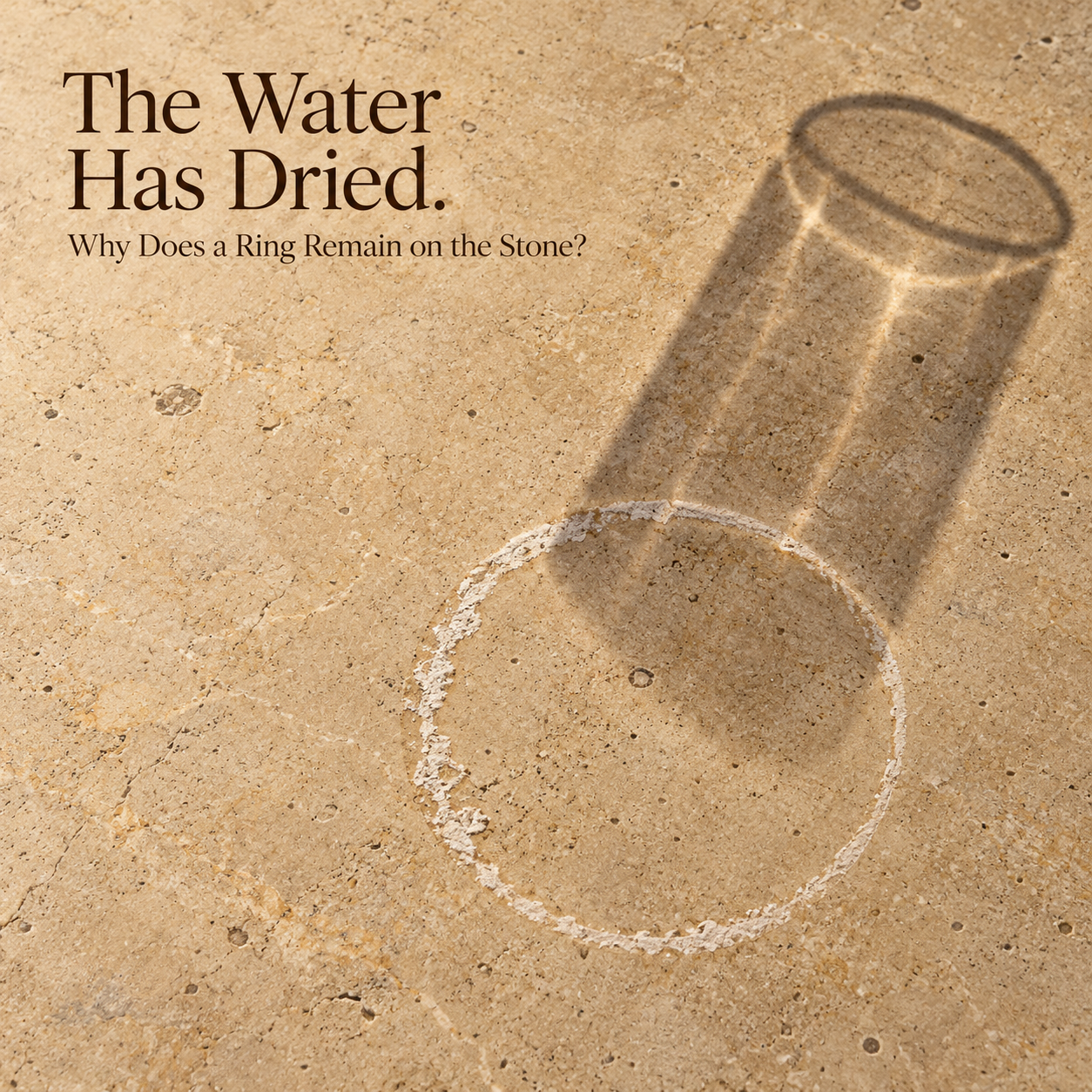
A dark ring remains on a stone sill after the water has disappeared. On a project, that mark can quickly become a dispute about the stone, the cleaning contractor or the waterproofing. Before assigning responsibility, a more basic question is needed: does the outline identify where the contamination originated, or where the drying liquid finally deposited it?
Experiments in soft-matter physics offer a useful distinction between the footprint of wetting and the subsequent movement of suspended particles. Their architectural relevance is a proposed method of investigating recurring stains on horizontal stone ledges and window sills, not a ready-made diagnosis of a particular building.
What the original experiment established
In 1997, Robert D. Deegan and colleagues explained how evaporation can move suspended particles towards a droplet’s stationary perimeter. A pinned contact line means that the wet boundary does not retreat freely; liquid flowing outwards replenishes evaporative losses and transports particles. Their microscopy experiments used dilute polystyrene suspensions on glass. The result explains why a drying deposit need not reproduce the initial distribution of dirt. It does not establish the cause of a stain on porous masonry.
A ring can survive a different flow
Alvaro Marin, Stefan Karpitschka and colleagues reported a further complication in 2019. In experiments with sodium-chloride solutions and tracer particles on glass, salt-related surface-tension differences partly reversed the internal circulation, yet particles still accumulated at the perimeter through interfacial flow. Confocal microscopy and three-dimensional particle tracking supported this distinction. The authors also reported a quantitative disagreement between simulated and measured velocities. A similar final outline therefore need not imply the same transport mechanism.
What cannot be inferred from a photograph
ArchUp’s interpretation is that the visible border should be treated as an observation to explain, not a label for the defect. Neither paper validates a facade treatment or estimates maintenance savings. A stone sill is also not a microscope slide: absorption, roughness, inclination, joints and repeated wetting introduce conditions that these experiments do not reproduce as a building assembly.
For an actual investigation, the working alternatives should remain separate. A surface-particle deposit, a deposit involving dissolved salts, persistent dampness and a change within the stone may require different evidence. The outline alone cannot distinguish them. Nor should a ring be used to rule out water penetration. The relevant diagnostic work belongs to a competent materials or envelope investigation where the condition warrants it.
A proposed architectural test: the sill as an assembly
The application hypothesis is specific: compare the complete sill detail through a controlled wetting-and-drying mock-up before approving its appearance and maintenance assumptions. Test the specified stone, finish, joint and edge together. A loose, freshly cleaned sample may answer a colour-selection question without answering how the installed detail behaves after water reaches it.
Begin with documented samples from the proposed supply. Record their initial dry appearance under consistent light. Compare a clean-water control with a representative, documented wetting liquid only where its composition is known and its use is safe. Keep the applied volume, placement, orientation and drying environment comparable. Record the changing wet boundary as well as the final deposit. Repeat the cycles on replicate samples rather than judging a single drop.
Then compare an alternative geometry, such as an adjusted fall or drip termination, without simultaneously changing the stone and cleaning method. Photograph after an agreed drying interval, record recurrence and test the proposed cleaning procedure on a separate sample. These are suggested project controls, not a standardized protocol established by the cited papers. Acceptance criteria and repeatability need to be agreed for the particular project; there is no research-derived universal pass value here.
A useful outcome would be a documented difference between alternatives, with uncertainty retained. A failed outcome is equally informative: if the mark cannot be reproduced, or changes with the water composition, the team should not attribute it confidently to the material alone. The test is intended to narrow the next investigation, not replace drainage, durability or waterproofing verification.
✦ ArchUp Editorial Insight
The pressure to close a finishing package encourages decisions based on a surface that is clean at a single inspection. Where acceptance records capture only that moment, they can leave the subsequent interaction between water, contaminants and maintenance outside the comparison used to select the detail. The droplet research exposes a specific weakness in this arrangement: a deposit is an outcome of transport, not simply a property of the purchased stone. If procurement separates the stone sample, the sill geometry and the cleaning scope, each package may be accepted without anyone testing their combined behaviour. This is a possible governance failure, not a documented description of the contracts behind the experiments. Its practical consequence is that a recurring mark can arrive at the maintenance stage as an unexplained cleaning task, although the relevant choices were made earlier across several approvals. A project could test this risk by assigning responsibility for one assembly-level wetting review and retaining its record with the finish approval. That would not establish liability or guarantee a stain-free surface. It would make the boundary between material selection, water management and upkeep explicit, allowing the final ledge to be judged as an operating detail rather than an isolated piece of stone.
References
- Robert D. Deegan, Olgica Bakajin, Todd F. Dupont, Greg Huber, Sidney R. Nagel and Thomas A. Witten. “Capillary flow as the cause of ring stains from dried liquid drops.” Nature, 1997.
- Alvaro Marin, Stefan Karpitschka and colleagues. “Solutal Marangoni flow as the cause of ring stains from drying salty colloidal drops.” Physical Review Fluids, 2019.