Living Shields Above Arid Planets: How Extreme Plant Bio-Engineering Reshapes Space Envelopes and Smart Architectural Systems

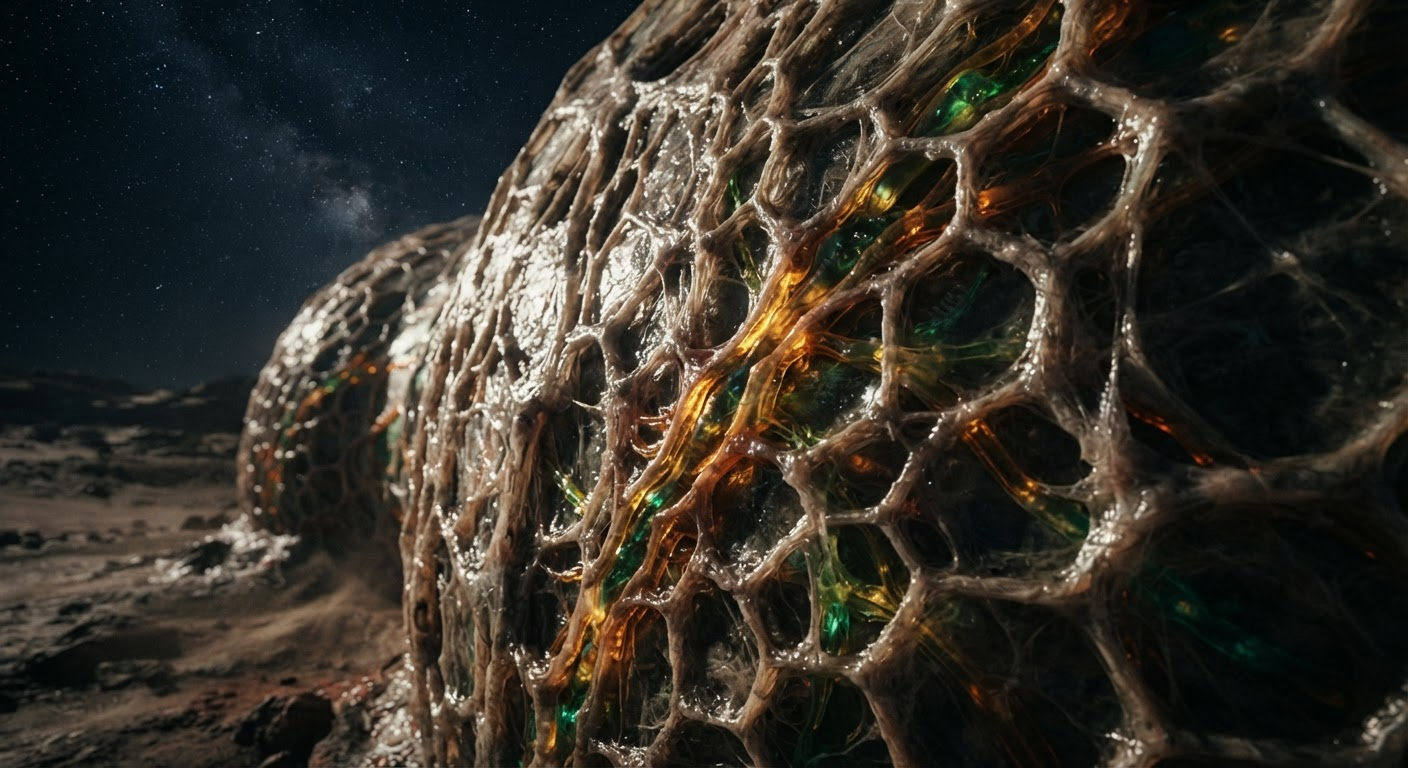
As humanity prepares to establish its first permanent settlements on the Moon and Mars, and to expand the construction of space stations and high-altitude habitats in the upper atmosphere, a quiet technical obstacle confronts this urban ambition: ionizing cosmic radiation. While architects and engineers design intelligent living environments that rely entirely on advanced computing and lightweight materials, high-energy particles threaten the electronic logic driving these envelopes and building systems. Where conventional engineering relies on heavy, costly metallic shields that make extra-terrestrial construction nearly impossible, nature offers an architectural and biological alternative: plants in extreme environments have survived and flourished under radiation pressure for hundreds of millions of years without relying on a single lead wall.
The Paralysis of Smart Systems: The Radiation Challenge in Orbital Spaces
Extra-terrestrial architecture and advanced structures in harsh environments require complex networks of embedded sensors and processors to manage indoor environments, air pressure, and HVAC systems. However, these systems face three primary sources of ionizing radiation: protons and electrons trapped in the Van Allen radiation belts, solar particle events originating from coronal mass ejections, and galactic cosmic rays arriving from beyond the Solar System.
As M. A. Xapsos and colleagues demonstrated, these cosmic particles penetrate the embedded electronic components within space structures, triggering Single Event Effects. A single high-energy particle traversal can induce anomalies ranging from temporary functional disruptions to complete circuit destruction. These impacts span Single Event Upsets—which corrupt data stored in operational memory—to Single Event Latchups, which elevate localized temperatures within electronic components to 350–400 °C, causing localized thermal breakdown and permanent damage to building control systems.
The vulnerability extends beyond isolated particle strikes. As A. H. Johnston observed, Total Ionizing Dose effects accumulate positive charge within transistor isolation oxides across a mission’s lifespan, raising leakage currents and degrading the responsiveness of smart grids. Furthermore, S. Duzellier noted that high-energy heavy particles easily penetrate standard metal shields of space habitats regardless of thickness, forcing architects to seek alternative strategies that transcend rigid concrete or metallic mass in favor of adaptive biological envelopes.
The Cellular Shield: How Plants Engineered Survival Across Millennia
When plants colonized land approximately 460 million years ago, background ionizing radiation levels were significantly higher than today. Restricted by their sessile nature, plants evolved multi-layered defense frameworks against radiation and oxidative stress across evolutionary timescales—offering a model for developing adaptive building materials.
M. M. Caldwell and colleagues demonstrated that plants developed enzymatic and non-enzymatic antioxidant pathways. Extreme-environment plants synthesize secondary metabolites that serve as natural sunscreens and free radical scavengers, notably flavonoids, phenolic acids, and carotenoids. At high altitudes where ultraviolet and cosmic radiation intensify, species such as Plantago asiatica accumulate dense matrices of ortho-dihydroxylated flavonoids. As Y. Murai and colleagues documented, these molecules absorb harmful radiation and dissipate it as safe thermal energy across plant tissues without compromising cellular integrity.
A. Sharma and colleagues confirmed that intracellular carotenoids play a structural and mechanical role in dissipating excess energy through specialized chemical cycles. These microscopic biological constituents act as molecular shock absorbers, protecting cellular tissues from oxidative collapse—a mechanism material scientists now seek to integrate into smart architectural envelopes.
Lessons from Chernobyl and Orbital Stations: Architectural Patterns for Self-Repair
Radiation-exclusion zones, such as the area surrounding Chernobyl, offer living laboratories to examine biological adaptation under chronic exposure. Studies conducted by S. Fesenko on wild flora in Chernobyl revealed that plants subjected to sustained low-dose radiation exhibited increased repair-enzyme activity and elevated gene expression for antioxidant defense, enabling continued growth and spatial expansion despite severe contamination.
Similarly, N. Caplin and N. Willey demonstrated that plant cells repair double-strand DNA breaks three times more effectively than animal cells under equivalent radiation doses. Plants rely on redundant repair pathways, including Non-Homologous End Joining, Homologous Recombination, and photorepair. This functional redundancy ensures that localized damage does not trigger systemic collapse.
In actual space habitation contexts, transcriptomic investigations led by L. R. G. Brito into plants cultivated aboard the International Space Station showed that flora respond to combined microgravity and high-intensity radiation through cell wall remodeling, photosynthetic adjustments, and genomic stabilization via epigenetic modifications. This metabolic plasticity illustrates that organisms actively reorganize their internal structures to adapt to external environmental pressures.
Hybrid Envelopes: Translating Plant Chemistry into Lightweight Architectural Armor
Translating these biological solutions into building technology requires moving away from pure metals like aluminum, which produce secondary radiation when struck by high-energy particles. Lightweight composite materials inspired by plant cellular design offer a viable path forward.
L. Tiedemann and colleagues introduced an architectural alternative that combines low-atomic-number, hydrogen-rich polymers with high-atomic-number elements such as tungsten. These composite materials—such as tungsten-enhanced polyethylene or polyamide—mimic the layered distribution of organic and inorganic matrices within plant cell walls. They provide electron shielding while reducing envelope mass by 30 to 50 percent compared to conventional aluminum, significantly altering the economics of space construction.
Furthermore, V. Sharma and colleagues highlighted the potential of extracting plant secondary metabolites—including flavonoids, polyphenols, and polysaccharides—and integrating them as bio-additives into protective coatings, sealants, and polymer encapsulates that protect photovoltaic systems and environmental sensors. These organic compounds neutralize free radicals, chelate metal ions that catalyze destructive reactions, and dissipate radiation energy as minor thermal vibrations, preserving the structural integrity of the envelope.
Adaptive Intelligence: Self-Reconfiguring Building Control Systems
The application of plant intelligence extends beyond material extraction to inspire the structural logic and operational programming of habitats. Rather than relying on rigid, centralized control hubs for space structures, biological systems suggest distributed, redundant control architectures.
Redundant repair mechanisms observed in the plant genome can inform architectural computing through self-healing networks and adaptive software frameworks. For instance, Field-Programmable Gate Arrays (FPGAs) can mirror plant epigenetic responses; when an electronic processing node experiences radiation-induced damage, the system reconfigures its logic paths to bypass the affected area dynamically, ensuring uninterrupted building operations.
The future architecture of extra-terrestrial habitats and extreme-environment structures will not rely on brute-force mass or massive concrete barriers to block harsh phenomena. Instead, it will embrace adaptive biological envelopes. Understanding the precise engineering that enabled plants to colonize Earth and endure radiation stress opens avenues for lightweight architectural materials, self-healing systems, and responsive envelopes that interact dynamically with their environment to sustain human life across space.
✦ ArchUp Editorial Insight
The shift toward bio-inspired envelopes in extra-terrestrial habitat design is not an aesthetic preference, but the direct consequence of orbital launch economics and mass-to-payload physics. Transporting traditional metallic radiation shielding into deep space imposes prohibitive launch costs, rendering heavy static mass barriers economically unviable for off-world construction. Concurrently, the reliance on commercial microprocessors for automated life-support systems introduces severe operational risks under continuous cosmic particle bombardment. To resolve these capital and payload constraints, aerospace procurement frameworks are replacing structural mass with chemical energy-dissipation strategies and computational redundancy modeled on plant biology. The resulting architectural outcome—characterized by lightweight, polymer-composite skins and self-reconfiguring electronic control topologies—is the logical expression of orbital payload optimization and risk-mitigation protocols.
References
[1] Xapsos, M. A. et al. “An overview of radiation effects on electronics in the space telecommunications environment.” Microelectronics Reliability, 2000.
[2] Johnston, A. H. “Space Radiation Effects and Reliability Considerations for Micro- and Optoelectronic Devices.” IEEE Transactions on Device and Materials Reliability, 2010.
[3] Duzellier, S. “Radiation effects on electronic devices in space.” Aerospace Science and Technology, 2005.
[4] Fesenko, S. “Adaptation to ionizing radiation of higher plants: From environmental radioactivity to Chernobyl disaster.” Journal of Environmental Radioactivity, 2020.
[5] Caplin, N., and N. Willey. “Ionizing Radiation, Higher Plants, and Radioprotection: From Acute High Doses to Chronic Low Doses.” Frontiers in Plant Science, 2018.
[6] Sharma, V. et al. “Effects of radiation and role of plants in radioprotection: A critical review.” Science of The Total Environment, 2021.
[7] Caldwell, M. M. et al. “Ultraviolet-Defense Mechanisms in Higher Plants.” Biotechnology & Biotechnological Equipment, 2011.
[8] Sharma, A. et al. “Photoprotective role of plant secondary metabolites: Biosynthesis, photoregulation, and prospects of metabolic engineering for enhanced protection under excessive light.” Environmental and Experimental Botany, 2023.
[9] Brito, L. R. G. et al. “Recent transcriptomic studies to elucidate the plant adaptive response to spaceflight and to simulated space environments.” iScience, 2022.
[10] Murai, Y. et al. “Altitudinal variation of UV-absorbing compounds in Plantago asiatica.” Biochemical Systematics and Ecology, 2009.
[11] Tiedemann, L. et al. “Characterization of Novel Lightweight Radiation Shielding Materials for Space Applications.” IEEE Transactions on Nuclear Science, 2017.