

- This event has passed.
Musical Bodies 2026
June 7 @ 8:00 am - September 27 @ 5:00 pm
$30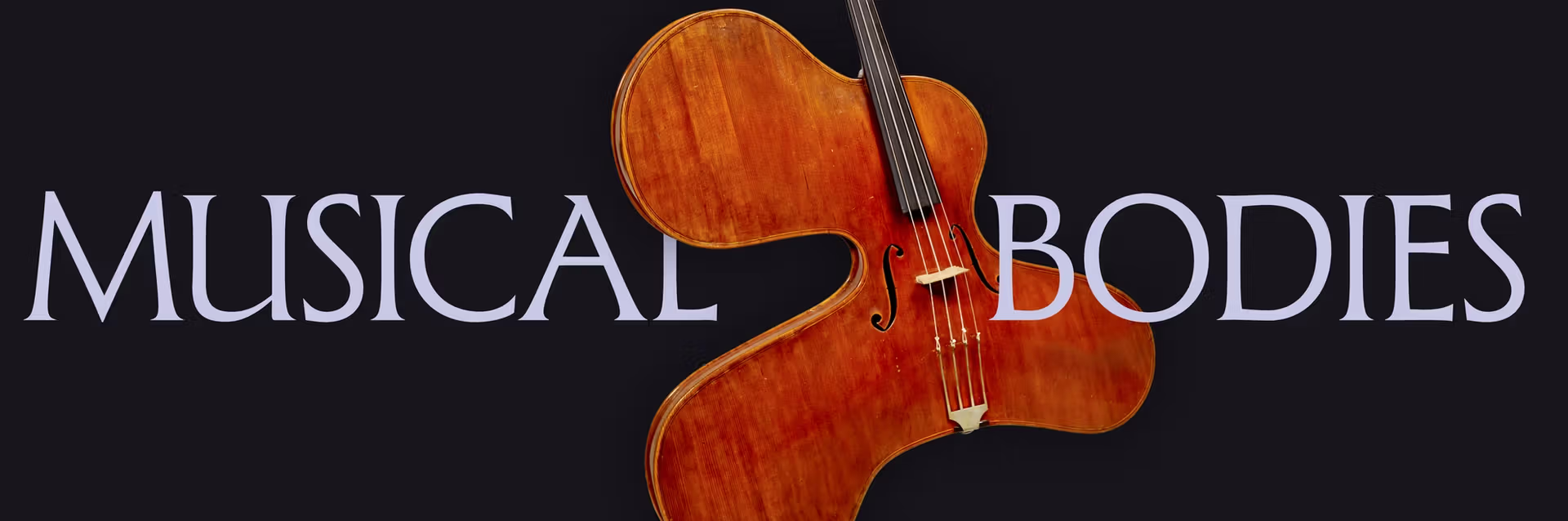
Overview
Musical Bodies is a major contemporary exhibition at The Metropolitan Museum of Art in New York. The show explores the relationship between the human body and musical instruments across 4,000 years of art history. It brings together instruments, paintings, sculptures, and cultural objects to show how sound, identity, and physical form are deeply connected.
Within architecture, the exhibition is often read as a spatial study of how the body can be treated as both an instrument and a reference system for design and perception inside built environments.
Focus
The exhibition focuses on how musical instruments imitate, extend, or abstract the human body. It examines voice, gesture, rhythm, and physical expression as foundational elements of cultural identity. Across different eras and regions, instruments are presented not only as tools for sound but also as symbolic objects representing social beliefs and human behavior.
This conceptual framing connects to broader ideas in design, where form, function, and human interaction are treated as interconnected systems rather than separate layers.
The exhibition positions the body as both origin and instrument, where music and physical expression become inseparable systems of communication.
Program
The exhibition includes around 130 objects from The Met collection and international loans, spanning ancient instruments, paintings, sculptures, and contemporary works. The display is organized thematically, tracing how instruments evolve across time while maintaining references to the human body.
Certain sections include interactive and experiential components that explore sound production through movement and gesture. These spatial strategies connect conceptually with urban planning, particularly in how circulation and bodily movement shape perception within structured environments.
Audience
The exhibition is open to a wide audience including general visitors, musicians, artists, designers, researchers, and students interested in the relationship between sound, culture, and visual art.
Event Details
| Dates | 7 June – 27 September 2026 |
|---|---|
| Venue | The Metropolitan Museum of Art, New York |
| Event Type | Art and music history exhibition |
| Access | Public (museum admission) |
| Fees | Adult $30 • Seniors $22 • Students $17 • Children under 12 free |
✦ ArchUp Editorial Insight
Musical Bodies constructs a framework where the human body is treated as an architectural and acoustic reference rather than a purely biological subject. By linking instruments, gestures, and cultural artifacts, the exhibition reframes music as a spatial and embodied system of knowledge. From an architectural perspective, this highlights how perception and movement can structure experience in much the same way as physical space does. However, the exhibition remains highly curated within a museum context, meaning its exploration of bodily interaction is controlled and symbolic rather than emerging from uncontrolled public or urban conditions.
Closing Note
The exhibition offers a structured interpretation of the relationship between body and sound, positioning musical instruments as cultural extensions of human physicality within a long historical continuum.
Related Events



Event Data Review Notice: Event information is collected and edited by ArchUp’s human Events Desk. Since 10 September 2026, Archive Data Agent, an AI-assisted verification account operating under the ArchUp Events Desk, has provided a secondary review layer to identify and correct routine human data-entry inconsistencies, including dates, schedules, locations, and currency conversions. Final editorial responsibility remains with ArchUp.