Sydney’s Gadigal Metro Station Claims Gold at 2026 WAN Awards for Transport Design


Sydney’s Gadigal Metro Station has secured Gold in the Transport category at the 2026 World Architecture News Awards. The recognition highlights the station’s innovative design and positions it among the world’s leading transport architecture projects. Moreover, the win underscores Sydney’s commitment to design-focused public infrastructure.
Award-Winning Design Merges Function and Aesthetics
The station combines large-scale infrastructure with contemporary architecture that prioritizes passenger experience. Judges praised how the project successfully balances functional requirements with visual refinement. The design creates a space that serves daily commuters while making a strong architectural statement. Furthermore, the station forms part of the Sydney Metro City & Southwest project, a major urban planning initiative transforming mobility across the metropolitan area.
Integrated Urban Precinct Connects Transport and Development
Opened in August 2024, Gadigal Station serves approximately 15,700 daily passengers. The facility sits 25 meters underground and connects to mixed-use developments above ground. These include Parkline Place, a glass-fronted office tower, and a 29-storey residential building containing 234 apartments. Therefore, the station functions as more than transit infrastructure; it anchors an integrated urban precinct. Meanwhile, the development helps ease congestion in Sydney’s central business district through efficient metro connections.
Cultural Identity and Public Art Define Station Character
The station name honors the Gadigal People, the Traditional Custodians of the land. This recognition adds cultural depth to the infrastructure project. Public art installation “The Underneath” by Callum Morton features approximately 10,000 brightly colored porcelain enamel tiles. The artwork creates two 13-meter-high murals depicting stylized train tunnels at station entrances. However, artistic elements extend throughout the facility, reinforcing design as a core priority rather than an afterthought.
Material Choices Root Design in Local Context
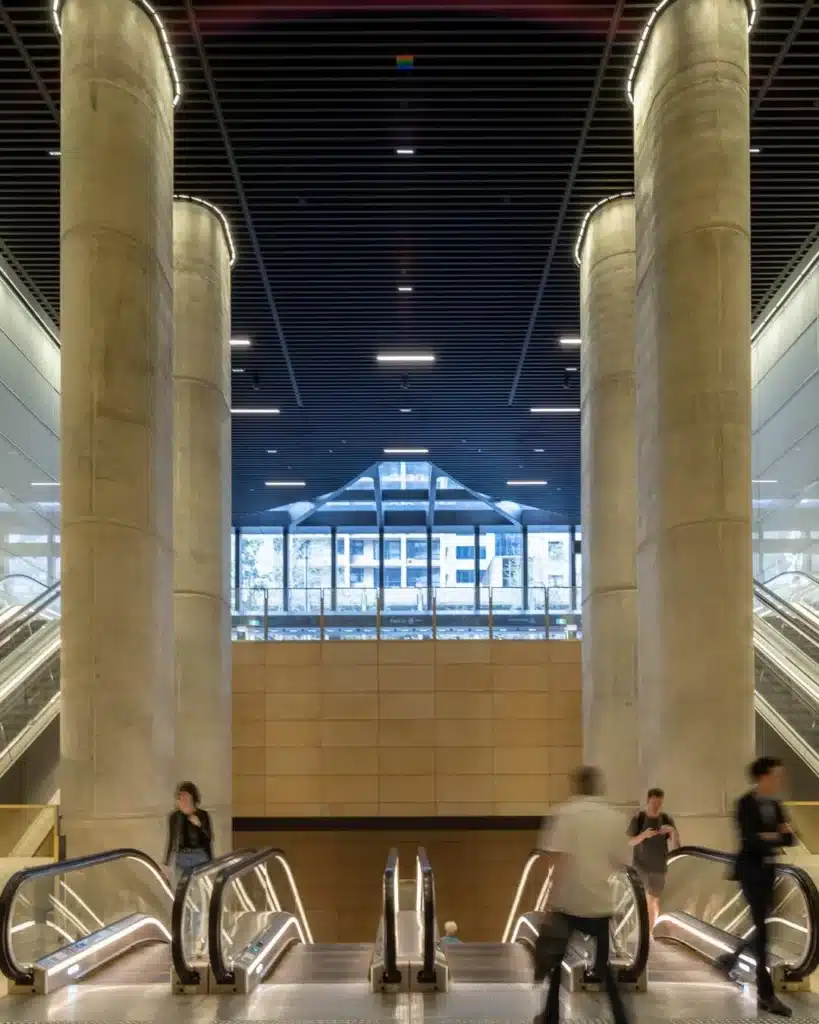
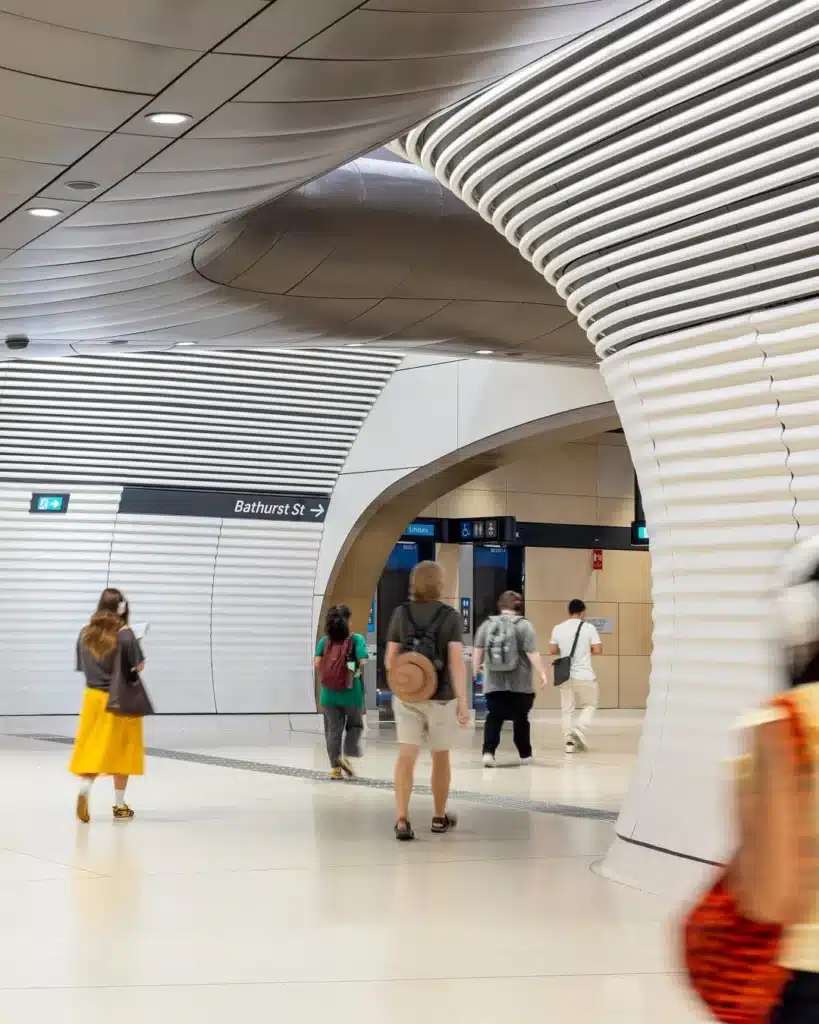
Escalator shafts feature approximately 1,700 sandstone panels sourced from New South Wales’ Central Coast. This choice of building materials connects the project to regional resources. Platforms incorporate about 11,000 custom aluminum tubes that improve acoustics while creating visual interest. Moreover, seating includes benches and timber leaning rails crafted from Australian spotted gum. Six 25-meter-high columns at the Park Street entrance add monumental quality to the space. Platform screen doors enhance safety and accessibility throughout the facility. These material selections demonstrate how construction details contribute to overall design quality.
Travel times from Gadigal include 13 minutes to Chatswood, 9 minutes to Sydenham, and 37 minutes to Castle Hill. Waterloo Metro Station also won Gold in the Transport category, further elevating Sydney’s metro design internationally. Together, these projects represent a shift toward designing transport hubs as civic landmarks that integrate architecture, urban context, and user experience. The WAN Awards recognition confirms that Sydney’s infrastructure projects are setting new standards globally.
A Quick Architectural Snapshot
Gadigal Metro Station transforms underground transit into an architectural destination through local materials, public art, and refined detailing. The project proves that infrastructure can serve functional needs while creating spaces that enhance cities culturally and aesthetically.
✦ ArchUp Editorial Insight
Underground metro stations represent significant public investment that demands justification beyond transportation efficiency. Governments increasingly seek mixed-use developments above transit hubs to offset construction costs and maximize land value. The integration of commercial towers and residential buildings above Gadigal Station reflects this financial logic. Cultural naming and public art installations serve strategic purposes: they build community acceptance for large infrastructure projects that disrupt neighborhoods during construction. The use of local sandstone creates regional identity while supporting domestic quarry industries. Platform screen doors and accessibility features respond to evolving safety regulations and disability legislation rather than design preference. The 25-meter depth requirement stems from Sydney’s geological conditions and existing underground utilities. Award submissions function as city branding tools that attract international investment and tourism.
This project is the logical outcome of transit-oriented development policy + public infrastructure cost recovery models + city branding imperatives.