Genius Loci Weimar Competition 2026

Organizer record: Hendrik Wendler — Genius Loci Weimar · Directory record not yet reviewed
Competition Brief
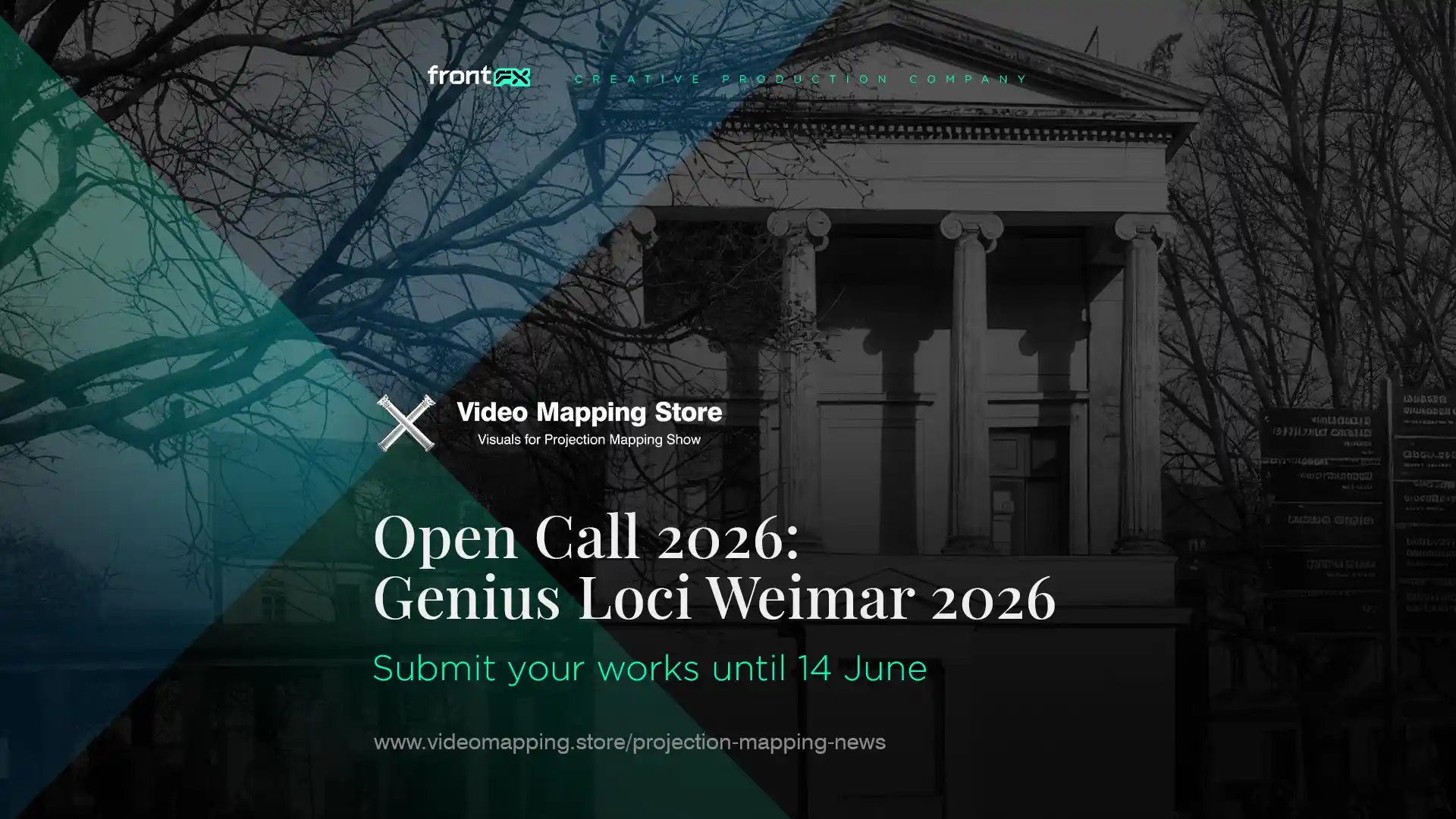
Genius Loci Weimar is an international competition for video mapping and facade projections held annually in Weimar, Germany. The 2026 edition runs under the theme “Democracy and Society,” inviting artists to engage with the historical sites of the city through audiovisual works that respond to the spirit of each place. Selected projects are realized as large-scale facade projections and presented during a live festival in September 2026. The competition sits at the intersection of architecture, art, and media, using historic buildings as the canvas for contemporary visual narratives.
Intent
The competition seeks audiovisual works that engage with the “genius loci” — the spirit of a specific place — and translate that relationship into a contemporary visual language. The theme for 2026, “Democracy and Society,” frames participation around questions of political process, social transformation, and community identity. The organizers are looking for works that demonstrate historical awareness, architectural understanding, and a strong narrative concept for a five-minute video piece.
Purpose
The competition aims to support the production of original video mapping works tied to historically significant locations in Weimar. Winning entries are realized with a production budget and shown to the public during the festival. The event has been running since 2012 and is organized by Hendrik Wendler through the Genius Loci Weimar platform, which also maintains an ongoing archive of past editions and a creative lab program. You can explore similar design competitions on ArchUp for broader context.
Requirements
Applicants must register on the official website and submit a conceptual proposal for one or more of the designated competition buildings. The submission package includes:
- A completed registration form via the official website
- A conceptual idea for the selected location(s), engaging with the theme “Democracy and Society”
- Reference to the animation pack (available for download), which includes building masks, guidelines, and 3D models of competition buildings
Professional knowledge of video mapping techniques is not a mandatory requirement. Approaches may include 3D animation, live-action, short film, illustration, drawing, silhouette cut-outs, and stop motion. The organizers note that technical support during the festival is available. Submissions may address more than one location. One winning entry will be selected per building.
Winning artists are required to develop a full five-minute video by the time of the festival. The production budget is provided upon award. The organizers reserve the right to open a second round or commission third parties if the first round does not yield satisfactory results.
Jury
- Zhou Bo – Professor of Experimental Art at the Sichuan Fine Arts Institute, Director of the Lighting Art Institute, and Chief Curator of the Chongqing International Light Art Festival. Also serves on the editorial board of Lighting Design magazine and holds roles within the China Illumination Society and Chongqing Illumination Society.
- Ding Wei – Faculty member at the Sichuan Fine Arts Institute, Director of the Chongqing Sculpture Society, and Curator of the Third Chongqing International Light Art Festival. Led public art projects at major Chinese airports including Chongqing Jiangbei International and Chengdu Tianfu International.
- HYZ Studio (Lois He and Vio Zhu) – Winners of the 2025 Genius Loci competition. Lois He is a filmmaker and narrative designer; Vio Zhu is a former software engineer at Google and Apple. Their work spans immersive experiences, interactive installations, and architectural projection mapping, with recognition at SXSW Sydney and The Webby Awards.
- The Fox, The Folks – A multimedia artist collective based in Bandung, Indonesia, and winners of the 2025 edition. Specialize in visual storytelling through motion graphics and animation for projection mapping. Recipients of the Grand Prize and Audience Award at the 1Minute Projection Mapping competition in Tokyo (2021) and First Prize at Schlosslichtspiele 2022 in Karlsruhe.
- Studio Zweisiedlerkrebs (Elena Wiener and Josefine Maier) – Winners of the 2025 competition and additionally awarded 5,000 euros by the jury. A creative studio focused on audiovisual and interactive storytelling, with a stated focus on democracy, diversity, and historical contexts.
- Philipp Geist – Berlin-based media artist working internationally in video and light installations, photography, and painting. Recipient of the German Lighting Design Award (2013) for his installation “Time Drifts.” Known for transforming architectural surfaces into moving light sculptures without the use of screens.
- Hendrik Wendler – Founder of Genius Loci Weimar (2012) and of device+context, the company behind the MXWendler video mapping software. Studied architecture at Bauhaus University Weimar.
Fees
| Item | Details |
|---|---|
| Registration Fee | Free |
| Submission Fee | Free |
Rewards
| Prize | Amount | Conditions |
|---|---|---|
| Production Budget (per winning entry) | 7,000 euros | Awarded to each winner to develop a 5-minute video |
| Additional Festival Prize | 3,000 euros | Awarded to one winning work during the festival |
| Maximum Possible Award | 10,000 euros | For the entry receiving both the production budget and festival prize |
Dates
| Milestone | Date |
|---|---|
| Competition Opens | May 2026 |
| Submission Deadline | Sunday, 14 June 2026 at 23:59 CET |
| Winners Announced | 6 July 2026 |
| Festival Dates | 11 to 13 September 2026 |
| Contact Email | team@genius-loci-weimar.org |
✦ ArchUp Competition Review
Genius Loci Weimar is organized by Hendrik Wendler, who founded the festival in 2012 and has maintained a consistent annual or biennial cadence since. The jury for 2026 is notably transparent: all seven members are named and profiled, spanning light art academia, media art practice, and past competition winners — a structure that lends credibility to the evaluation process. The competition occupies a distinct niche: it is neither a conventional architecture competition nor a standard design award, but a production-oriented open call for audiovisual artists working with historic urban sites. The production budget of 7,000 euros per winning entry is realistic for a five-minute video mapping project, and the additional 3,000 euro festival prize provides a meaningful incentive. The primary benefit for participants is the realization of a fully produced, publicly exhibited work in a documented festival context — a tangible portfolio asset. The thematic framing around “Democracy and Society” gives the call a degree of political and intellectual weight, though the connection to architectural research remains indirect. For media artists and audiovisual practitioners, this is a well-structured opportunity with clear deliverables and a festival platform behind it. Browse more international competitions on ArchUp to compare similar calls.
Final Thoughts
Genius Loci Weimar has been running since 2012 with a documented archive of past editions, past winners, and an active festival structure. That history gives it more institutional grounding than many comparable open calls in the video mapping and media art space.
The jury composition for 2026 is one of the more transparent seen in this category of competition. Having past winners sit on the panel is an unusual but contextually relevant decision — they bring direct experience of the competition’s practical demands.
The production budget model is worth noting. Rather than offering a cash prize with no production obligation, the 7,000 euro award is tied directly to the realization of a finished work. This means the competition is not suited to conceptual-only submissions — winners are expected to deliver a complete five-minute video by the festival date. For artists without prior video mapping experience, the organizers offer technical support, which lowers the barrier to entry without lowering the standard of output. For those interested in student and emerging artist competitions, this one merits attention for its clear deliverables and real exhibition opportunity.
The festival’s free admission policy, funded partly through donations, reflects a public-facing mission rather than a commercial one. That context shapes what participation means: works are shown to a general audience in a historic city, not within a closed professional circuit.
For media artists, animators, and audiovisual practitioners with an interest in site-specific work and architectural context, Genius Loci Weimar 2026 represents a structured, well-documented, and production-supported opportunity with a clear public outcome.
Registration Deadline
Brought to you by the ArchUp Editorial Team
Inspiration starts here. Dive deeper into Architecture, Interior Design, Research, Cities, Design, and cutting-edge Projects on ArchUp.