Gourmega: Waste and Value in Interior Design

Waste as Part of the Interior Design Process
Many interior design projects rely on achieving a perfect visual image, which sometimes leads to excessive material consumption. Samples are ordered and then discarded, and finishes are replaced due to extremely minor differences. In some cases, entire surfaces are reworked solely to achieve precise visual uniformity. Therefore, waste here does not appear as a side effect, but as a recurring component within the execution mechanism itself.
Reconsidering the Concept of Visual Perfection
The Gourmega restaurant in Manhattan proposes a different approach to this idea. Instead of hiding minor imperfections or erasing traces of use, the Projects treats them as part of the spatial identity of the place. Through this approach, austerity and reduced intervention become a core element in shaping the interior experience.
Austerity as a Design Choice
This approach reflects a different understanding of luxury within Design. Rather than relying on highly refined finishes, the focus shifts toward minimizing waste and engaging realistically with materials. In this way, restraint in design decisions becomes part of the aesthetic value of the space, rather than merely an economic or practical solution.
Redefining Value within the Concept of a “Waste-Free Restaurant”
Describing the space as a “waste-free” restaurant does not only refer to reducing waste, but extends to rethinking the concept of value itself within design. Materials are not treated as quickly replaceable elements, but as part of a spatial structure that is carefully reconfigured. In this sense, austerity becomes a direct outcome of the Design mindset rather than a purely operational goal.
Material Honesty and the Historical Memory of the Site
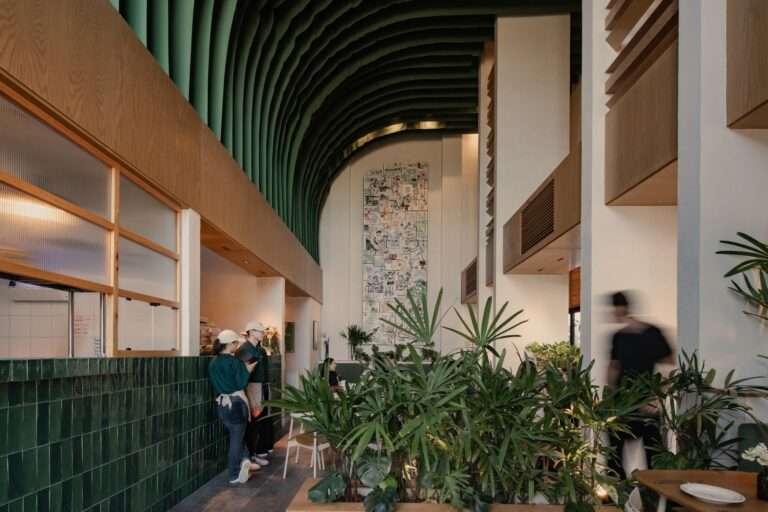
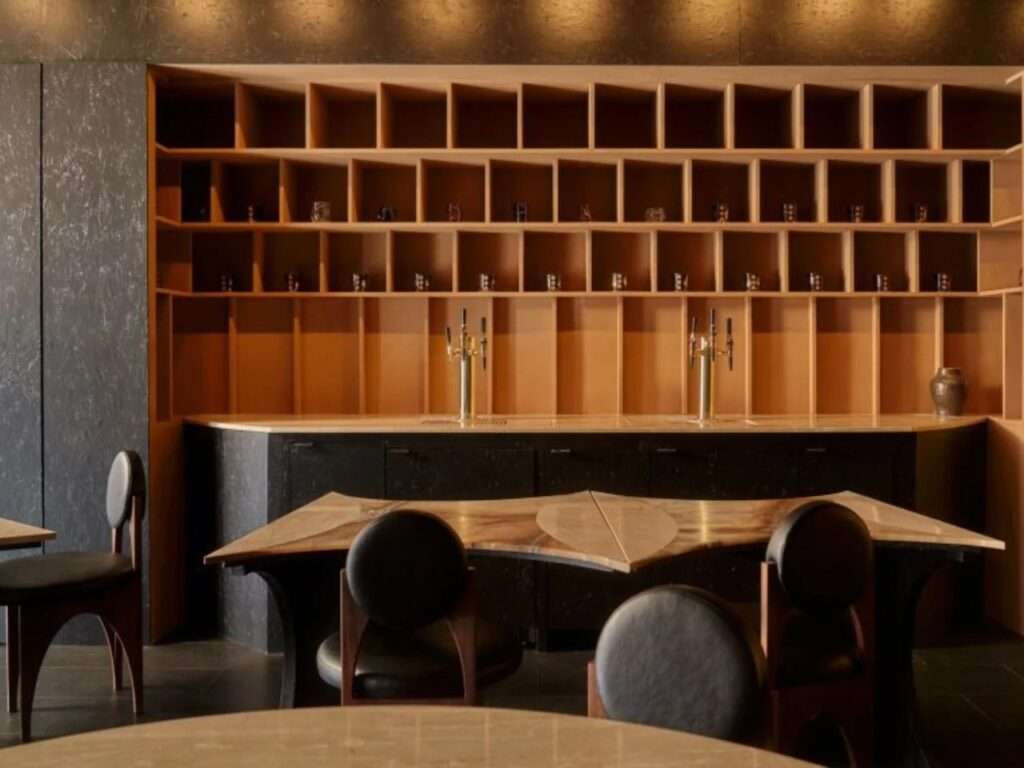
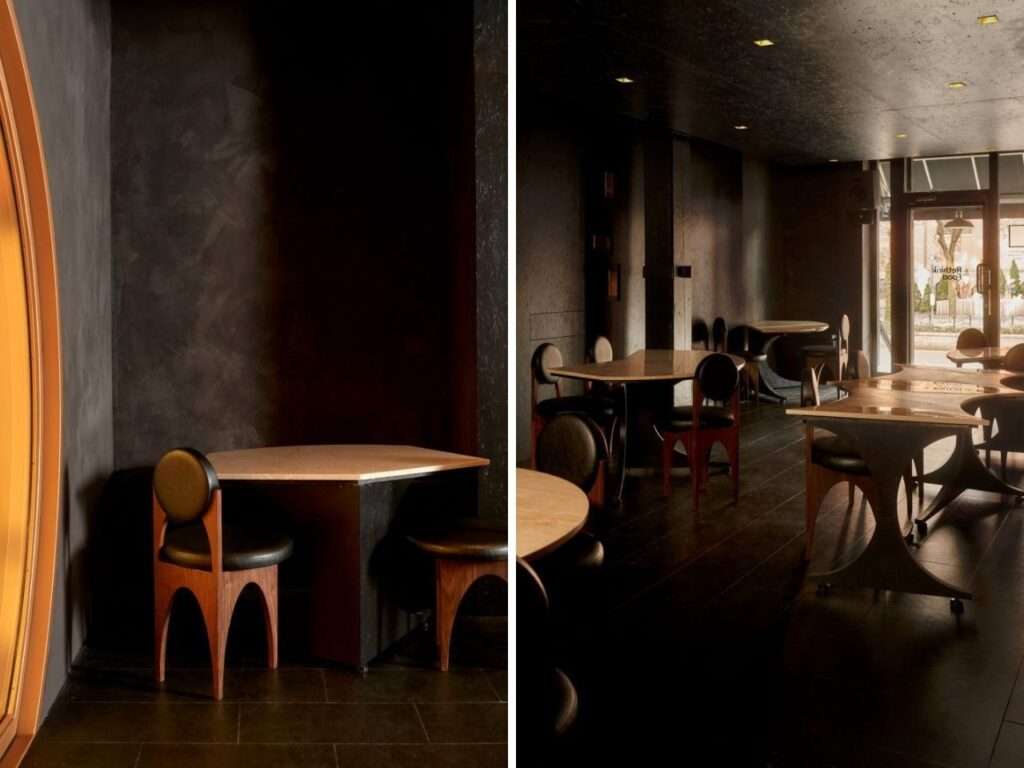
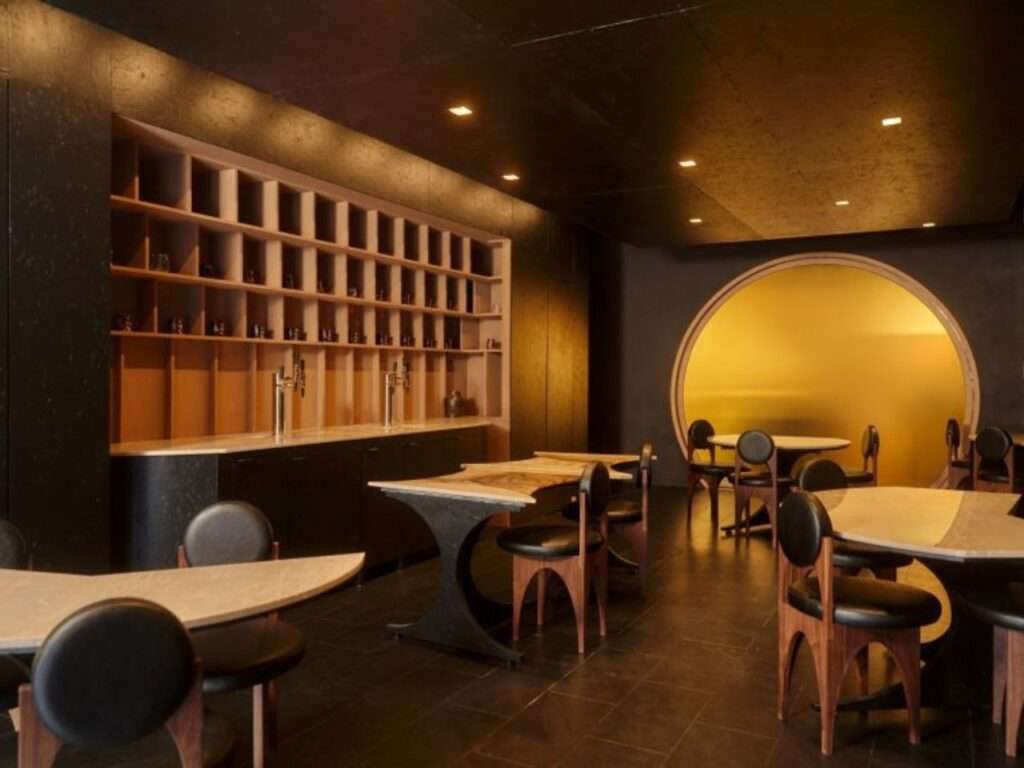
This approach is reflected in the treatment of Building Materials within the space. Lime-washed black walls retain an irregular texture that interacts dynamically with light, while the black-stained cork flooring creates a dual sensation of softness and unevenness. In contrast, walnut chairs with black plant-based leather sit within this visual framework without attempting to dominate it. According to founder Maryam Isufou, this approach is linked to the site’s history, previously known as “Negro Ground.” Rather than translating this history into direct symbols, it is evoked through atmospheric density, where darkness becomes a medium for carrying memory into the present without separating the two.
Visual Transition and the Role of the Kitchen in the Experience
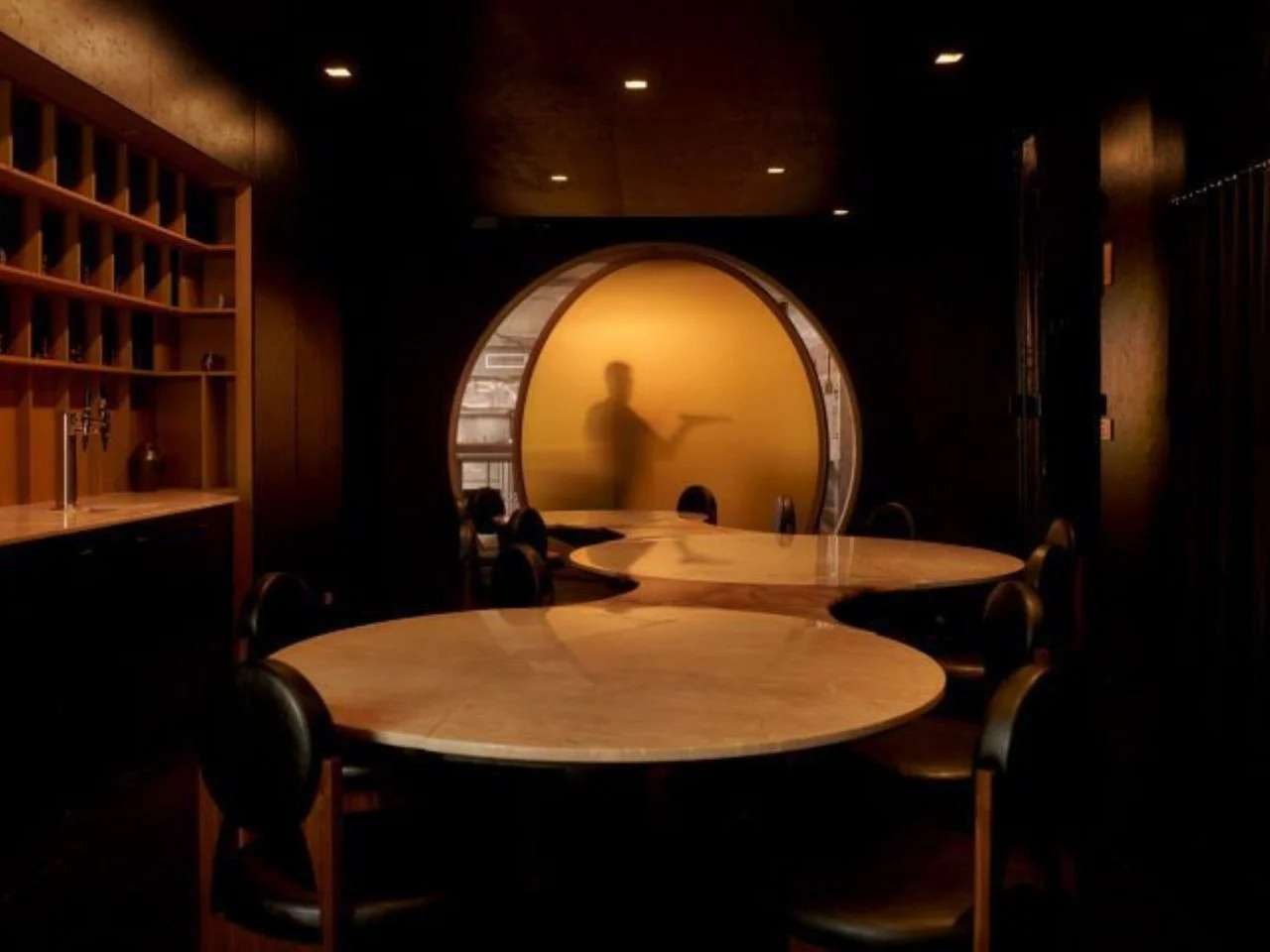
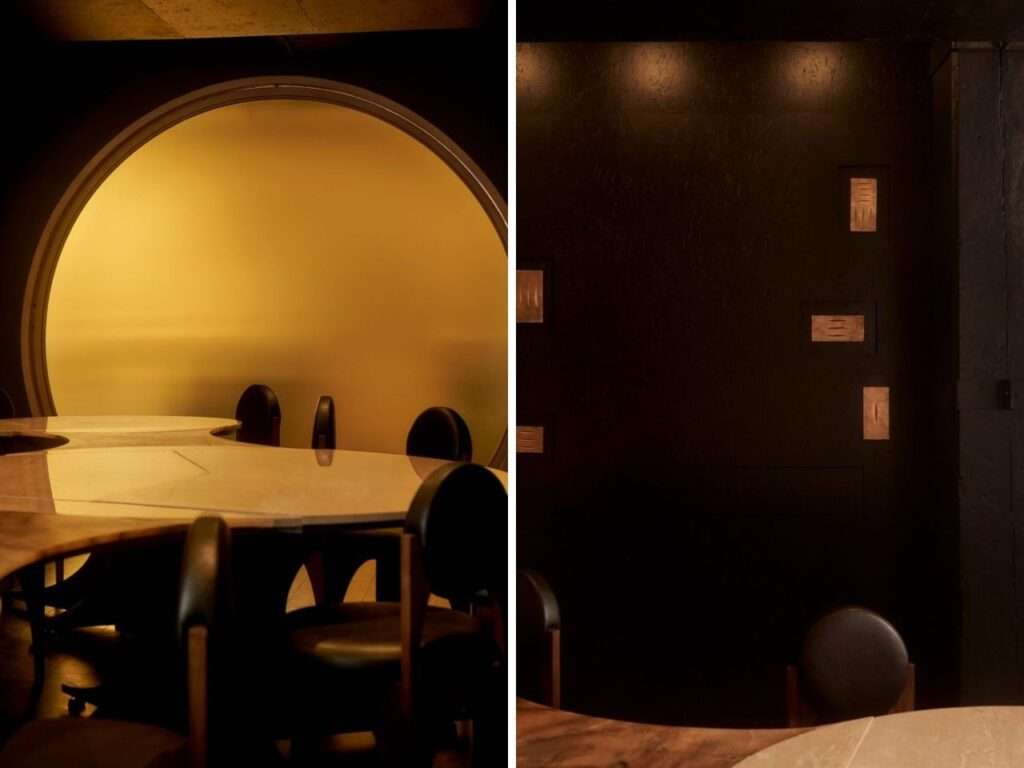
Further along the visual sequence, a clear transitional element appears in the form of a semi-transparent, yellow, pivoting circular door leading to the kitchen. This element functions not only as a spatial divider but as a visual shift within the experience. It reveals the movement of chefs and their silhouettes during work, integrating the act of cooking into the overall spatial composition. Instead of being hidden behind walls, it becomes a living part of the restaurant’s evolving visual field, echoing broader Discussion on spatial integration.
The Central Table and the Reshaping of Spatial Relationships
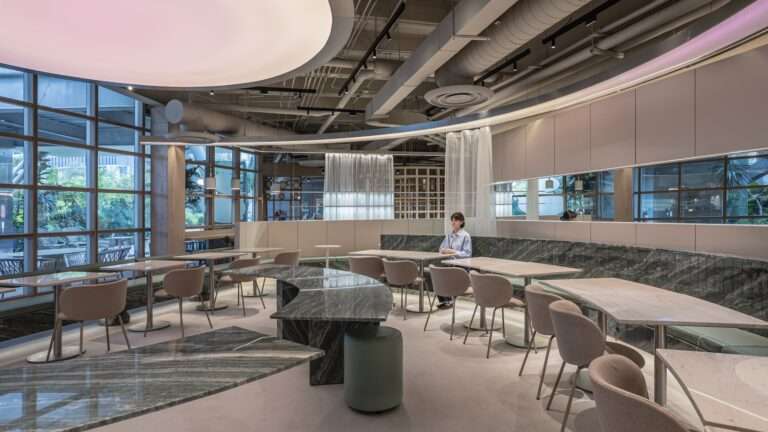
At the heart of the space, one of the most significant design decisions appears in the form of a communal circular table made of alabaster and travertine. It can be reconfigured into seven separate tables, allowing the space to shift functionally between daytime and evening use. However, its importance is not limited to formal flexibility, but extends to its social impact within the space. The circular seating arrangement eliminates the idea of a “head of the table,” redistributing visual and spatial presence equally among all users. In this way, hierarchy within the spatial experience is reduced in favor of a more balanced collective presence, a concept often explored in Research on spatial equality.
The Social Extension of Design Beyond the Space
The project extends beyond its physical boundaries through its partnership with the Rethink Food organization, participating in a system aimed at providing free meals across New York City. This connection situates the restaurant within a broader context related to food distribution and access. Instead of presenting fine dining as an isolated product, it is directly linked to a more inclusive social infrastructure, reminding us of the role of Cities in shaping responsible design.
Sustainability as a Relationship, Not a Material Choice
Within this framework, sustainability is not understood solely as a material choice, but as a system of relationships extending into social responsibility. Design here does not stop at form or function; it redefines the relationship between the space and its surrounding context. As a result, social impact becomes a parallel component to material decisions within the project, rather than a byproduct. For further insights, you can explore our Archive and stay updated with Architectural News on similar topics.
Walls as Incomplete Display Platforms
Buildings within the space are not treated as fixed final elements, but as surfaces open to change and reuse. They are used as exhibition platforms for local African American artists, including bronze panels by artist Nifemi Marcus-Bello. This approach transforms the wall from a closed structural element into a flexible framework that accommodates evolving visual content. The space is therefore not understood as a completed object, but as a system capable of continuous reconfiguration over time, allowing new layers of visual narrative to accumulate.
Design Between Completion and Incompleteness
Gourmega approaches the idea of completion differently from conventional interior design. Instead of pursuing a perfect final image, it accepts that value is not necessarily tied to completion itself. Within this framework, beauty becomes a result of constraints rather than their removal, and history can be embedded within Building Materials. At the same time, this approach opens space for the coexistence of perfection and imperfection within the spatial experience, without attempting to resolve this tension definitively.
✦ ArchUp Editorial Insight
Gourmega in Manhattan should not be read as a conventional interior design outcome, but as a spatial resolution emerging from the intersection of capital efficiency models, waste-reduction discourse, and the pressures of a high-rent urban real estate market. The foundational driver here is not aesthetic intention, but performance optimization within an environment where material reordering and finish replacement are measurable costs. Operational friction emerges from supply chains, labor cost fluctuations, and sustainability reporting requirements, all of which constrain material excess. The resulting spatial configuration relies on flexible furniture systems, exposed production areas, and material reduction that serves budget control more than visual expression. Even the connection to food distribution systems operates as a mechanism for institutional risk reduction and integration into broader social and economic compliance networks, a topic frequently covered in Discussion forums and Research on urban design.
For more insights on how contemporary Architecture handles material constraints and spatial flexibility, browse our Archive or explore related Projects that challenge traditional display methods. You can also stay updated with the latest Architectural News on waste reduction and sustainable design practices.