What Collapsed Rock Already Knows And Architecture Has Yet to Learn

When Geological Thermal Mass Becomes a Lesson in Building Envelope Physics
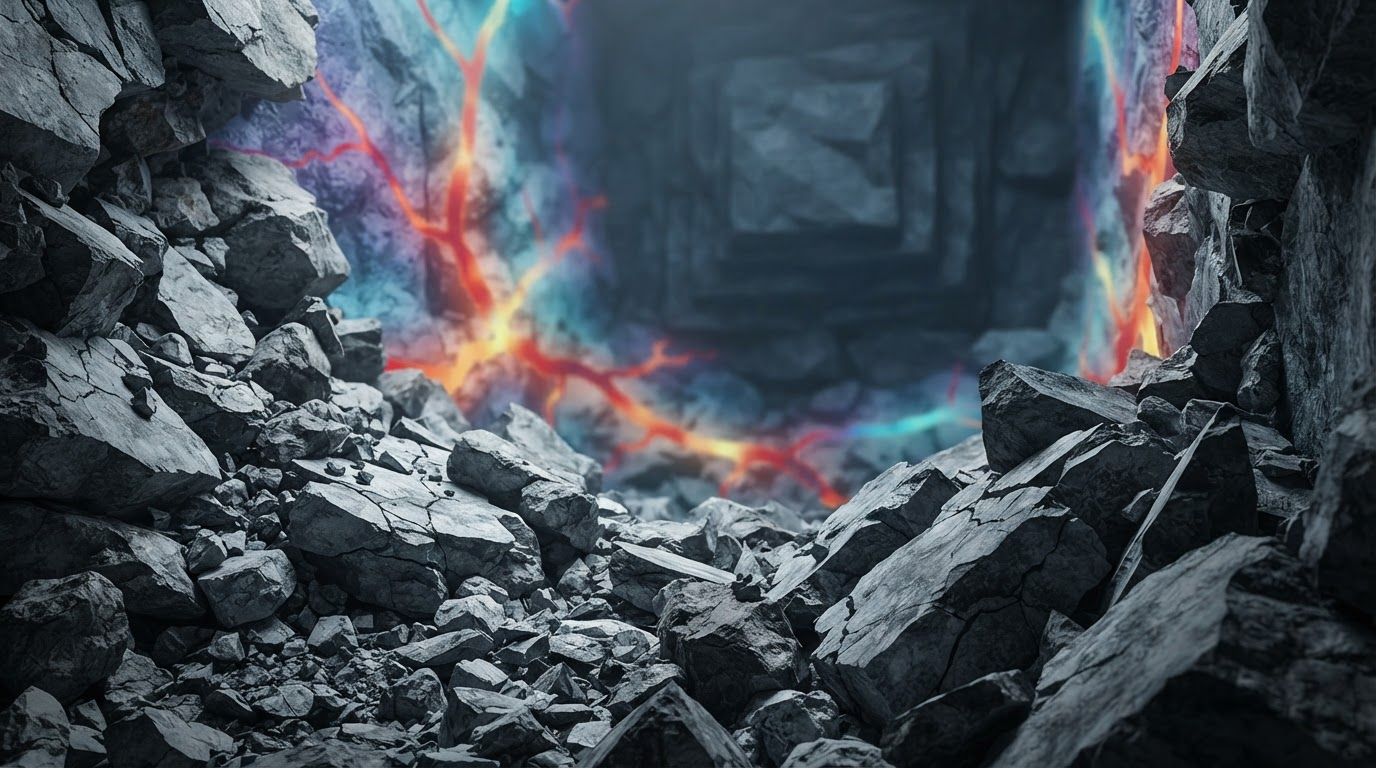
There is a striking paradox unfolding between one hundred and one thousand meters beneath the earth’s surface. When the roof of an abandoned coal mine gives way — its strata fracturing, tumbling, and accumulating in apparent disorder within the excavated void — the result is not mere geological wreckage. Without design intent of any kind, the collapsed mass establishes a thermal system of considerable efficiency. These fractured rocks simultaneously slow and accelerate water movement, retain heat and redistribute it, and produce what can only be described as a geological thermal envelope. It is the structural opposite of what an architect pursues on the twentieth floor of a glazed tower, yet it operates on precisely the same physical principles.
The question this article pursues is not simply how the caving zone behaves in abandoned coal mines. It is what the contemporary architect might draw from this phenomenon.
When Disorder Becomes Structure: The Architecture of the Caving Zone
When a coal seam is extracted by longwall mining, the overlying rock roof collapses into the resulting void in three successive layers — what researchers call the “three-zone system”: the fully caved zone at the base, the overlying fractured zone, and finally the upper bending zone, which remains largely intact. Physical similarity experiments documented by Zhang and colleagues in the journal Sādhanā in 2023 reveal that collapsed rock does not fill the void in absolute disorder. Instead, it distributes itself in a trapezoidal configuration: heavily fractured blocks concentrate at the margins of the void, while the rock toward the center compacts under the load of the strata above.
This heterogeneity is not a deficiency in the system — it is the system’s animating principle. Porosity ranges from fifteen percent in the compacted center to nearly ninety-five percent at the margins, generating a gradient of hydraulic and thermal resistance that closely resembles what a designer pursues when specifying graded insulation layers within a composite wall assembly. More precisely, the fractures form what researchers have called an “O-ring” distribution — a high-permeability annular network encircling the entire void perimeter, functioning as the primary conduit for water and heat movement, much as air cavities within a cavity wall redistribute wind pressure and moderate thermal transfer.
The Breathing Stone: Dual Permeability as a Design Principle
What renders the caving zone distinctive from a thermal standpoint is that it consolidates two opposing systems within a single structure: compacted rock with low permeability, and a fracture network with very high permeability. Scientists describe this as a dual-porosity, dual-permeability system — a principle demonstrated with particular clarity through the TOUGH2 dual-continuum numerical model applied by Bedoya-González and colleagues to the Ibbenbüren Westfield mine in Germany, published in the Hydrogeology Journal in 2022.
What the model reveals is elegant in its simplicity. In winter, the high-permeability fracture network conveys water rapidly in response to rainfall and pressure fluctuations. In the dry summer months, the role transfers to the compacted rock matrix, which releases water slowly and steadily, sustaining continuous flow. The outcome is a thermal system that redistributes energy across two seasons while maintaining a stable water temperature equilibrium within the geological reservoir throughout the year.
At this point, the architect confronts a direct reflection of familiar principles. Is this not precisely what effective thermal mass achieves in a wall or a dense concrete slab? It absorbs heat when the exterior is warmer, and releases it as the air cools. The only difference is scale — from centimeters of concrete to tens of meters of fractured rock — while the underlying logic holds: mass with graded thermal properties resists rapid temperature fluctuation.
The Rising Heat: Natural Convection and the Geometry of the Void
In deep abandoned mines, groundwater temperatures reach 45 degrees Celsius at one thousand meters depth, as recorded by Song and colleagues in a study published in Applied Thermal Engineering in 2018. This substantial thermal differential between the warm base and the cooler upper reaches of the water body does not dissipate passively. It generates buoyancy-driven natural convection: warmer, lighter water rises while cooler, denser water descends in a continuous circulation that requires neither pump nor external energy input.
The three-dimensional behavior of this circulation was characterized by Liu and colleagues through a thermo-hydrodynamic model published in the proceedings of Geo-Chicago 2016 by the American Society of Civil Engineers. Their findings demonstrate that this natural circulation progressively homogenizes the temperature distribution throughout the water body, preventing the formation of stagnant thermal stratification. This is precisely what an architect pursues when designing natural ventilation systems using thermal chimneys or calibrated aperture placement: exploiting an existing thermal differential to produce air movement without mechanical assistance.
Where the Geological and the Architectural Converge
Connecting a geological caving zone to the principles of passive architectural design may initially appear abstract. The physics governing both, however, are identical. Three specific lessons can be drawn directly from the subsurface evidence.
The first concerns the efficiency of graded thermal properties over uniformity. A wall with a density gradient — dense at the interior face, air-permeable toward the exterior — resists heat movement more effectively than a homogeneous wall of equivalent total thickness. What the compacted rock at the center of the caving zone teaches, in contrast to the high-permeability fracture network at its periphery, is that the gradient itself functions as an insulating mechanism.
The second lesson addresses the relationship between thermal mass and internal distribution networks. Inert mass alone is insufficient. Thermal surfaces require a moving carrier medium — air or water — to redistribute stored heat. This is precisely what the water circulating through the mine’s fracture network accomplishes: it transfers heat from warm rock to cooler zones. In architectural practice, this is the logic behind radiant floor systems, water-wall assemblies, and active thermal ceilings — thermal mass requires an internal circulatory system.
The third lesson concerns seasonal alternation as an engineering requirement rather than an operational preference. Studies of geothermal heat extraction from abandoned mines — particularly those conducted by Song and colleagues — confirm that summer thermal injection (storing the season’s cooler conditions within the reservoir) extends system longevity and reduces temperature drawdown over time. This is the foundational logic of seasonal thermal energy storage in net-zero buildings: designing not for instantaneous efficiency, but for equilibrium across both seasons.
When the Asset Becomes the Hazard: The Tension Between Efficiency and Fragility
The geological thermal envelope does not resolve without complication. The fracture network that enables efficient thermal performance also provides the pathways for sudden water inrush and gas migration. Wang and colleagues analyzed an actual inrush event at the Dongyu coal mine in China, published in the Hydrogeology Journal in 2023, and identified three sequential stages: slow seepage that gradually widens fractures through erosion; a sudden upward displacement of the water-resisting stratum by only a few millimeters, sufficient to open pathways catastrophically; and a gradual recession as the reservoir drains.
This tension between efficiency and fragility carries a direct architectural implication. High-performance systems tend to operate near the boundary of instability. A well-insulated slender wall may fail entirely when a single layer is breached. A dense green roof may become a structural liability when saturated by sustained rainfall. In both the geological and the architectural case, the resolution lies in designing explicit control pathways — and resisting the assumption that single-layer perfection constitutes a complete strategy.
Beyond the Surface: What the Subsurface Continues to Offer
When studies such as those conducted by Zhang and colleagues on heat exchange systems in abandoned mines — published in Heat and Mass Transfer in 2023 — establish that borehole inclination angles should not exceed thirty degrees for optimal thermal exchange performance, and that row spacing must reach at least four meters to prevent thermal interference between adjacent units, these findings do not address geothermal engineers alone. They inform the design parameters of shallow ground-source heat pump systems (GSHP), which have become integrated into green building incentive frameworks across numerous European regulatory regimes.
More fundamentally, what this phenomenon communicates to the architect at the level of principle is that nature designs through gradation and multiplicity rather than uniformity and singularity. The collapsed rock, in all its apparent disorder, presents internally one of the most complete models of integrated passive thermal mass — combining storage, distribution, seasonal equilibrium, and self-sustaining convection within a single system that consumes no external energy whatsoever.
Perhaps the deepest lesson the subsurface offers is this: the most effective thermal envelope is not the one that prevents heat from crossing — it is the one that controls precisely when it does.
✦ ArchUp Editorial Insight
The architectural profession’s persistent difficulty with passive thermal design is not a failure of knowledge — it is the logical outcome of a procurement culture that prices mechanical systems as capital expenditure and energy waste as operational cost, separating the two ledgers in ways that make high-performance envelopes appear financially irrational at the point of commission. What subsurface geothermal research reveals is that graduated thermal resistance, internal distribution networks, and seasonal energy equilibrium are not experimental propositions — they are physically proven at a scale orders of magnitude larger than any building wall. That this evidence originates in mining geology rather than architectural research is itself a symptom: the discipline funds aesthetics and structures, but rarely the forensic thermodynamics that would make envelopes unnecessary as a problem category entirely.
References
Ramos, E.P., et al. “Modelling Flow and Heat Transfer in Flooded Mines for Geothermal Energy Use: A Review.” International Journal of Coal Geology, 2016.
Zhang, C., et al. “Fracture Distribution and Deformation Characteristics of Overlying Strata in an Abandoned Gob under Single Coal Seam.” Sādhanā — Journal of the Indian Academy of Engineering Sciences, 2023.
Wang, Y., et al. “Analysis of Water Inrush at Dongyu Coal Mine in China from an Old Water-Logged Goaf Associated with a Syncline Fractured Zone.” Hydrogeology Journal, 2023.
Song, X., et al. “Sustainability Evaluation Model of Geothermal Resources in Abandoned Coal Mines.” Applied Thermal Engineering, 2018.
Wang, D., et al. “Numerical Simulation Study of Goaf Methane Drainage and Spontaneous Combustion Coupling.” Journal of China University of Mining and Technology, 2007.
Zhang, H., et al. “A Geothermal Energy Heat Exchange System Suitable for Abandoned Mines and Its Optimization.” Heat and Mass Transfer, 2023.
Liu, G., et al. “Large-Scale Thermo-Hydrodynamic Modeling of a Flooded Underground Mine for Geothermal Applications.” Geo-Chicago 2016, American Society of Civil Engineers, 2016.
Bedoya-González, D., et al. “A Dual-Continuum Model (TOUGH2) for Characterizing Flow and Discharge in a Mechanically Disrupted Sandstone Overburden.” Hydrogeology Journal, 2022.
Li, Q., et al. “A Method to Identify Coal Spontaneous Combustion-Prone Regions Based on Goaf Flow Field under Dynamic Porosity.” Fuel, 2021.
Zhu, H., et al. “Multi-Field Coupling Laws of Mixed Gas in Goaf.” Procedia Engineering, 2011.
Prykhodchenko, O., et al. “Determining Integral Permeability of Undermined Coal Rock Mass in Closed Mines.” E3S Web of Conferences, 2019.