Abandoned Mines, Inverted Architecture: How the “Caved Zone” Becomes a Thermal Battery for Cities

When Ruin Becomes Structure: The Paradox of the Abandoned Mine
Across Europe alone, thousands of decommissioned mines lie scattered as sealed industrial wounds, typically treated as hazard sites to be closed, fenced off, and forgotten. But what if these wounds were, in fact, among the most valuable untapped thermal infrastructure available today? The numbers make the case plainly: a conservative estimate suggests that roughly 3,000 megawatts of thermal power could be extracted from abandoned coal mines across the European continent alone. This is not speculative energy — it is heat stored within an engineered void that forms, quite literally, above every extracted coal seam, a void that deserves to be read through an architectural lens rather than a purely geological one.
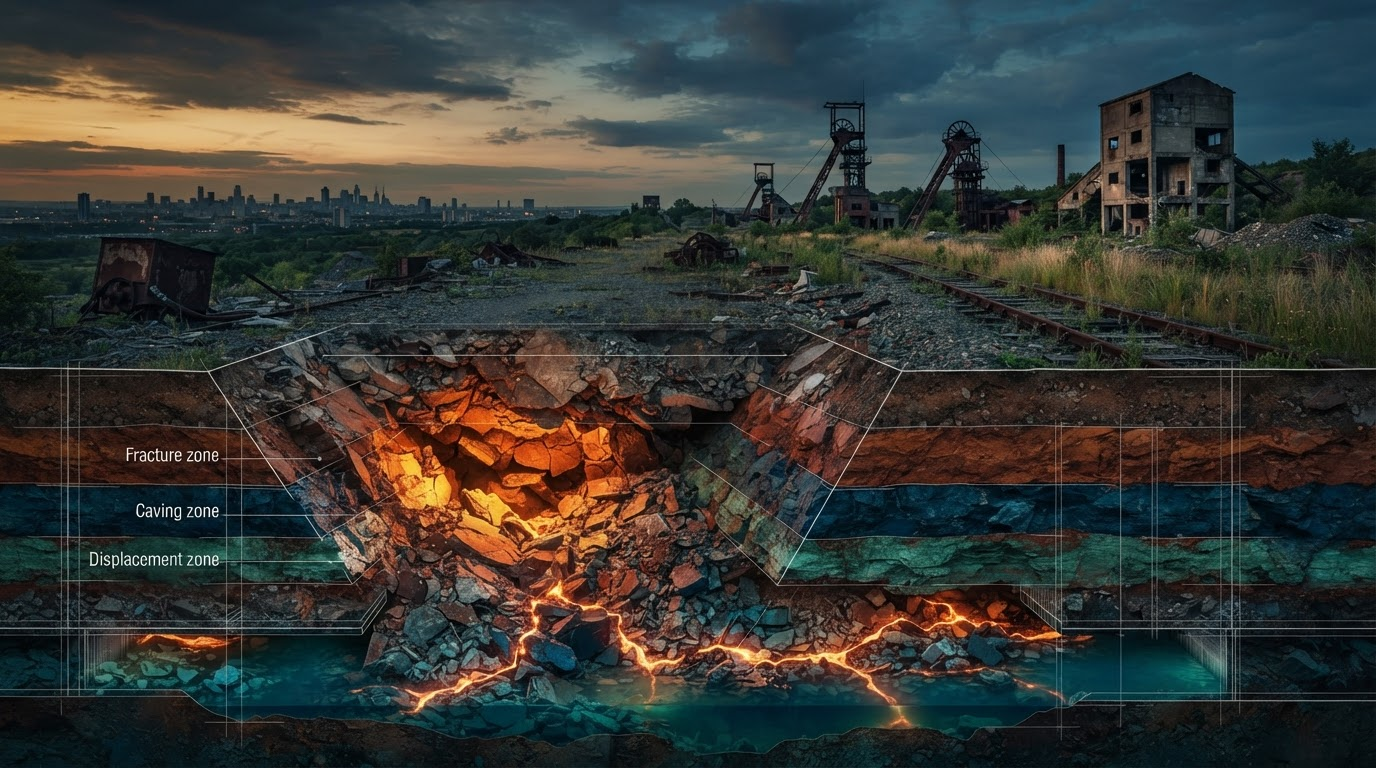
When coal is extracted using the longwall mining method, the resulting void does not remain empty for long. The overlying rock strata gradually collapse into the space, producing a precise layered system: an immediate caving zone where fractured rubble accumulates, followed by a fracture zone that retains relative cohesion despite distributed cracking, and finally a continuous displacement zone where the strata remain intact but slightly deformed. This three-part gradation is what is known as the “caved zone,” or goaf, and it is precisely what gives the abandoned mine its new value as energy infrastructure.
A Rock Sponge: How Rubble Becomes a Porous Reservoir
The most important property that makes the caved zone suitable for thermal storage is its exceptionally high porosity and permeability. When the rock above the extracted void fractures, its original mass expands by a bulking factor — known as K — that typically ranges between 1.08 and 1.23, depending on coal seam thickness and surrounding rock type, as demonstrated by researcher Fan and colleagues. From this factor, the porosity of the collapsed rock can be calculated, yielding results between 7% and 19% of total volume — an enormous proportion when compared to conventional construction materials.
The absolute figures are even more striking: in a typical mining area measuring 3 by 5 kilometers with a coal seam thickness of 6 meters, usable storage capacity can reach 1.58 million cubic meters of void space. This vast volume is not merely engineered emptiness — it is a ready-made reservoir for water, which in turn becomes the heat-exchange medium for geothermal applications.
Researchers Díez and Díaz-Aguado went further, developing a methodology that directly links total coal production to a mine’s geothermal potential. They found that the ratio of thermal power output (in megawatts) to total saleable coal production (in millions of tonnes) ranges between 0.25 and 1.0. In other words, every tonne of extracted coal leaves behind a void whose thermal value can be calculated with mathematical precision — an equation that reframes mining itself, shifting it from an act of depletion to the creation of deferred thermal infrastructure.
Water That Never Cools: Geological Insulation That Outperforms Any Man-Made System
After a mine closes, the caved zone gradually floods with groundwater, transforming into an underground water reservoir with an enormously extensive heat-exchange interface. The interconnected network of voids and fractures allows mine water to circulate freely, making it an excellent medium for heat exchange with the surrounding rock mass, as documented by researchers Menéndez and Ordóñez.
What is remarkable is that this water’s temperature is entirely insulated from surface seasonal fluctuations, governed instead solely by the earth’s natural geothermal gradient, which typically ranges between 0.027 and 0.032 degrees Celsius per meter of depth. In deep mines reaching 500 to 1,000 meters, water temperatures can reach between 20 and 40 degrees Celsius — sufficient for low-enthalpy geothermal applications (meaning thermal energy that is relatively low in intensity but still economically viable for heating purposes).
Researcher Hall and his team pointed out that the network of underground galleries and mine workings, which can extend hundreds of meters deep, functions as a vast heat-exchange interface with the warm surrounding rock. Critically, the hydraulic conductivity of this “mining reservoir” is elevated due to the voids created and the increased porosity resulting from fracturing, enabling very high water flow rates — meaning that a flooded caved zone effectively becomes a highly productive geothermal resource.
From Coal to Megawatts: Calculating a Buried Thermal Fortune
The thermal energy stored within the caved zone is far from marginal. Research indicates that the geothermal potential available from abandoned coal mines in Europe is measured in the thousands of megawatts thermal. In one documented example, static thermal energy reserves in the water of deep copper mines reach 823 million kilowatt-hours — a figure equivalent to the annual output of a small power plant capable of supplying electricity to more than 82,000 households.
Yet more important than this static figure is the fact that thermal energy within the caved zone is not fixed but continuously renewable, as extracted heat is replenished through conduction from the surrounding rock mass. Researcher Ghoreishi-Madiseh and his team demonstrated that seasonal thermal storage systems in similar rock-pit configurations can achieve substantial energy savings, with outlet air temperature differentials reaching 15 to 20 degrees Celsius above or below ambient conditions depending on the season. At the full system level, annual energy savings can reach approximately 21 gigawatt-hours per year in large-scale installations.
The Mine as Battery: When Void Becomes Hybrid Storage System
The importance of the caved zone is not limited to direct thermal extraction — it extends to other energy storage technologies that transform the mine into an integrated system.
In pumped hydro energy storage, researcher Fan and his team proposed a hybrid system that uses the voids of abandoned coal mines as either upper or lower reservoirs, demonstrating that such a system could achieve average efficiency of up to 82.8%, with a regulating energy density of 1.06 kilowatt-hours per cubic meter. Permeability here is a decisive factor: to guarantee a usability coefficient of at least 0.8, permeability must exceed 7.8×10⁻⁸ square meters — a threshold actually achieved in field measurements of the goaf at heights up to 17.8 meters above the extracted seam.
In compressed air energy storage, researcher Menéndez and his team explored the potential for sealing and reinforcing upper galleries — including the caved zone — to store compressed air at pressures ranging from 45 to 75 bar. In a representative facility with a reservoir capacity of 0.18 million cubic meters, up to 197 gigawatt-hours could be generated annually — enough energy to support an entire local electrical grid.
Engineering the Void: How to Design Efficient Heat Extraction
The thermal properties of the caved zone make it an ideal candidate for seasonal thermal storage, but performance depends on precise design details. Studies show that the specific heat capacity of the rock mass significantly affects storage performance — increasing specific heat capacity from 750 to 1,750 joules per kilogram-kelvin reduces outlet air temperature oscillation by 1 to 2 degrees Celsius, enhancing the system’s thermal stability. By contrast, the thermal conductivity of the rock mass has only a marginal effect, not exceeding 2%, because heat transfer in porous rock is governed primarily by air-rock exchange rather than conduction alone.
The fractured nature of the caved zone also facilitates the installation of ground-source heat pump systems. According to optimization studies of these systems, heat-exchange efficiency can be maximized by adjusting borehole angle (recommended not to exceed 30 degrees), row spacing (no less than 4 meters), and arrangement pattern — with staggered arrangements outperforming linear ones. These precise engineering details ultimately determine whether a mine becomes an efficient storage system or merely a wasted void.
Thermal Stability and Resource Sustainability: Can the Mine Be Trusted as a Long-Term Source?
One of the central concerns in considering mine reuse is the long-term sustainability of thermal performance. Here, the findings of researcher Al-Habaibeh and his team are reassuring: their monitoring of mine water temperatures showed notable stability throughout the operational period, with no significant fluctuation over time — suggesting that energy is continuously replenished either from surrounding geothermal rock or from fresh inflows of warm water. The coefficient of performance (COP) for heat pump systems using mine water from the caved zone typically ranges between 3.5 and 4.8, depending on water depth and system design.
Additional field measurements in deep flooded mine shafts revealed that natural convection within the caved zone produces a well-mixed thermal environment, with distinct thermal layers forming clearly. This natural convection, driven by geothermal gradients, continuously replenishes heat extracted from the upper sections of the water column, ensuring the long-term sustainability of this thermal resource.
From Extraction to Revival: The Real Urban Impact
When these physical properties are translated into practical applications, broad possibilities open up for planners and architects. Flooded mine workings within the caved zone can supply heating and cooling to nearby communities, with annual energy savings reaching up to 70% compared to conventional sources. The massive thermal mass of this zone also enables genuine seasonal storage — summer heat can be stored and later extracted in winter, and vice versa.
Perhaps most significant is this resource’s compatibility with intermittent renewable energy: the caved zone can simultaneously function as a geothermal reservoir and as storage volume for pumped hydro or compressed air systems, enabling seamless integration with fluctuating wind and solar power. On a broader environmental scale, harnessing this storage capacity could reduce carbon dioxide emissions by approximately 5 million tonnes annually across European coal mines alone.
The abandoned mine, ultimately, is not a dead industrial relic awaiting final closure — it is an inverted structure beneath the earth, a negative architecture shaped by human extraction, now waiting for someone to read its voids as an engineering opportunity rather than a geological scar.
✦ ArchUp Editorial Insight
The reclassification of the caved zone as thermal infrastructure is not a discovery about rock — it is a consequence of energy-market economics and liability law finally converging. For decades, decommissioned mines remained sealed because closure regulations were written around subsidence risk and groundwater contamination, not resource value; there was no procurement pathway that treated a flooded void as an asset.
What changed is external: decarbonization targets created financial incentive to inventory any thermal mass near population centers, while grid-balancing needs for intermittent renewables created demand for large-scale storage volume that new construction cannot cheaply provide.
The porosity data and permeability thresholds are not architectural achievements; they are the technical justification required to satisfy risk assessors and utility procurement frameworks. The mine’s geometry was fixed a century ago by extraction logic, not thermal logic — its present usefulness is simply the byproduct of that older industrial decision meeting a new regulatory appetite for underground capacity.
References
Menéndez, J., Ordóñez, A., Álvarez, R., Loredo, J. “Energy from Closed Mines: Underground Energy Storage and Geothermal Applications.” Renewable and Sustainable Energy Reviews, 2019.
Hall, A., Scott, J.A., Shang, H. “Geothermal Energy Recovery from Underground Mines.” Renewable and Sustainable Energy Reviews, 2011.
Díez, R., Díaz-Aguado, M. “Estimating Limits for the Geothermal Energy Potential of Abandoned Underground Coal Mines: A Simple Methodology.” Energies, 2014.
Fan, J., Xie, H., Chen, J., Jiang, D., Li, C., Ngaha Tiedeu, W., Ambre, J. “Preliminary Feasibility Analysis of a Hybrid Pumped-Hydro Energy Storage System Using Abandoned Coal Mine Goafs.” Applied Energy, 2020.
Ghoreishi-Madiseh, S.A., Sasmito, A.P., Hassani, F.P., Amiri, L. “Performance Evaluation of Large-Scale Rock-Pit Seasonal Thermal Energy Storage for Application in Underground Mine Ventilation.” Applied Energy, 2017.
Al-Habaibeh, A., Athresh, A.P., Parker, K. “Performance Analysis of Using Mine Water from an Abandoned Coal Mine for Heating of Buildings Using an Open-Loop Single-Shaft Ground-Source Heat Pump System.” Applied Energy, 2018.
Unknown Authors. “A Geothermal Energy Heat Exchange System Suitable for Abandoned Mines and Its Optimization.” Heat and Mass Transfer, 2023.
Unknown Authors. “Geothermal Energy Recovery from Deep Flooded Copper Mines for Heating.” Energy Conversion and Management, 2019.
Unknown Authors. “Field Tests and Multiphysics Analysis of a Flooded Shaft for Geothermal Applications with Mine Water.” Energy Conversion and Management, 2018.