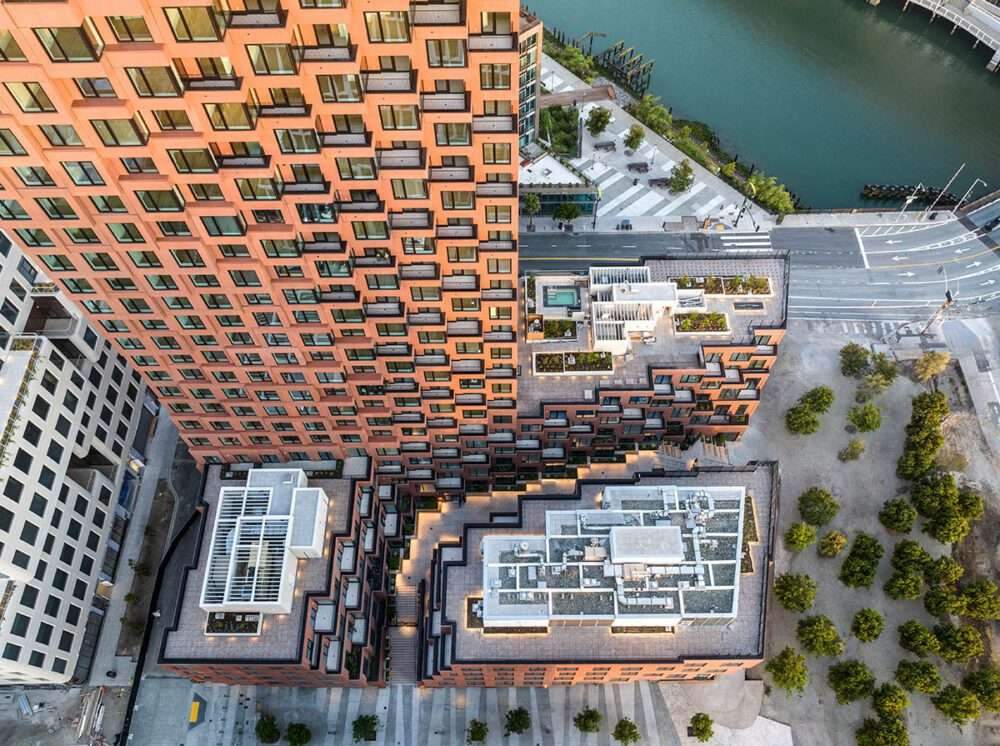
The Building That Breathes and Feeds Its Occupants: When the Roof Becomes a Bioreactor, Not a Dead Slab

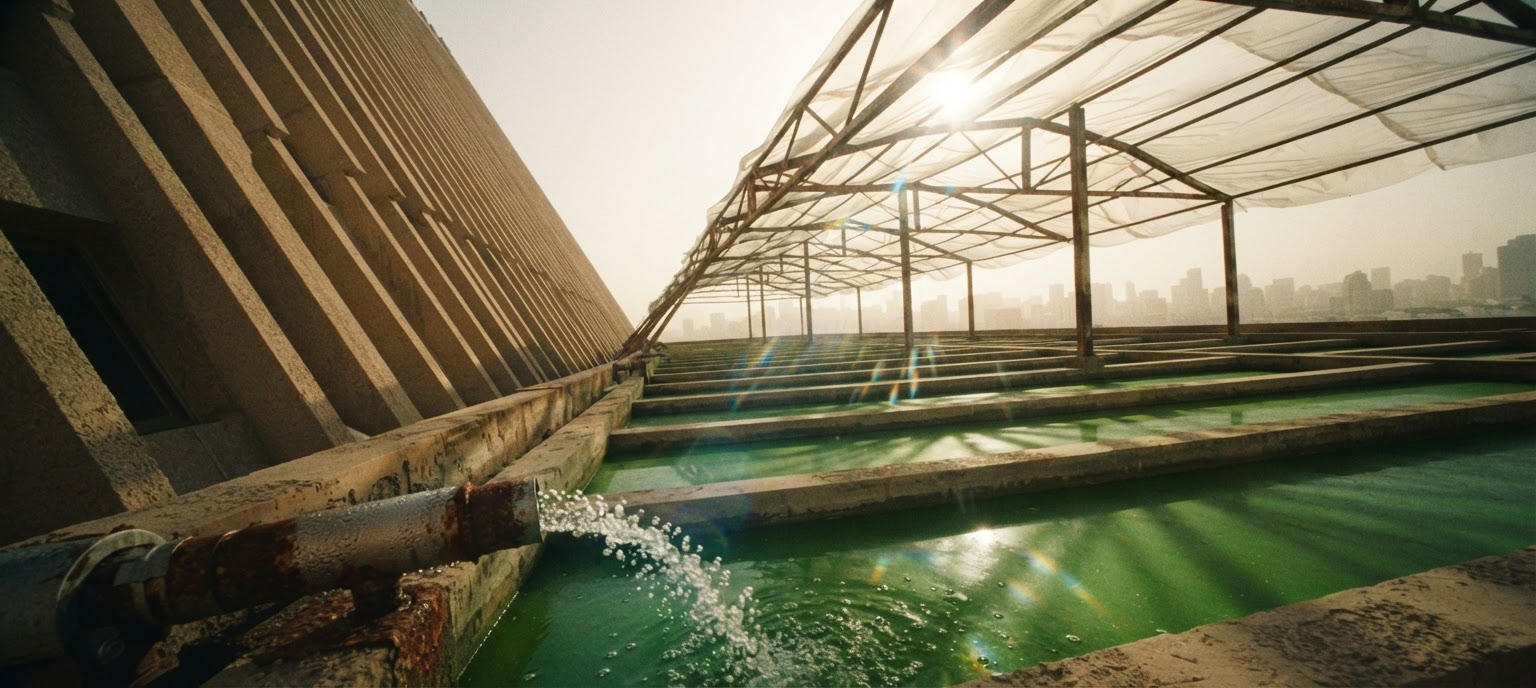
How rooftops transform from costly thermal burdens into living façades that produce spirulina, cool the building, and sequester carbon — without sterile laboratories
In an Arab city whose rooftops scorch above fifty degrees Celsius at noon, the claim that a building’s roof can produce living food sounds like fantasy. Yet hundreds of open-air commercial farms around the world — from the deserts of Inner Mongolia to the tropical rooftops of Mexico — demonstrate daily that spirulina thrives above buildings without cleanrooms or autoclaves, on one condition: the architect must understand the rules of the biological game before drawing the first line. This article traces the findings of fourteen peer-reviewed field and commercial studies, not to offer an agricultural recipe, but to pose a radical architectural question: what if we designed the building envelope as a living membrane rather than a dead barrier?
The Roof That Stopped Being a Roof: From Thermal Insulation to Biological Production
In conventional architectural practice, the roof has remained a purely defensive element: we insulate it thermally, waterproof it, and then forget about it. But when this neglected surface becomes a shallow aquatic basin no deeper than eighteen to thirty centimeters — the depth validated by decades of commercial operation — everything changes. The open raceway pond with its paddle wheel, originally developed by the French Petroleum Institute in the 1970s, remains the workhorse of the global spirulina industry. Clément documented in his foundational study that industrial channels extend up to two hundred and fifty meters in length at a depth of thirty centimeters, with carbon absorption wells one and a half to two meters deep. At a smaller scale suited to a building rooftop, Ranganathan and colleagues demonstrated that a basin just two meters long, half a meter wide, and fifteen centimeters deep — a volume of one hundred and fifty liters — achieves an optimal flow velocity of twenty centimeters per second with a two-blade paddle wheel rotating at six revolutions per minute, producing dead zones of no more than five percent of the basin volume and a mixing time of no more than thirty seconds.
What this means architecturally is that the additional structural load on the roof does not exceed one hundred and fifty to two hundred kilograms per square meter — a load comparable to the ornamental water features some architects place on rooftops without hesitation. The difference is that this basin does not hold decorative fish; it produces complete protein at a rate approaching nineteen grams per square meter per day in commercial operation, as recorded by the massive six-hundred-and-five-square-meter ponds in Inner Mongolia. This building no longer merely consumes; it produces.
The Architecture of the Transparent Envelope: Never Seal the Bioreactor
Here many green-architecture enthusiasts commit a fatal error: they imagine the rooftop bioreactor as a hermetically sealed capsule, like the gleaming glass tubes adorning the façades of exhibition buildings. Field reality says the exact opposite. Mexican experiments in the city of Xalapa — a subtropical climate — documented that open spirulina ponds inside a four-hundred-square-meter greenhouse maintained culture temperature at twenty-one to twenty-two degrees Celsius even though the ambient temperature inside the greenhouse itself exceeded forty degrees. The secret? Surface evaporation from the open water plane combined with continuous paddle-wheel agitation — what García-López and his team described as “one of the fundamental advantages of this type of reactor compared to closed photobioreactors that require artificial cooling.”
The design implication runs deep: the transparent envelope above the bioreactor must be a ventilated, shaded roof, not an airtight lid. Clément specifically warned that covering ponds without ventilation creates a greenhouse effect and drives temperatures above forty degrees, the threshold at which the algae die. By contrast, Thai experiments in Chiang Mai demonstrated that a transparent plastic sheet above the pond, with ten-millimeter glass side walls and four-millimeter acrylic baffles — specifications directly transferable to any rooftop — prevents monsoon rainwater from entering while allowing gas exchange through lateral openings.
A higher-performance alternative may tempt the ambitious architect: the thin-layer cascade system, where water flows at a depth of just ten millimeters and a velocity of half a meter per second across an inclined surface. A field comparison by Clagnan and colleagues showed that this system not only outperforms the raceway in productivity but fundamentally resists biological contamination: the conventional open raceway in the same experiment was overtaken by parasitic ciliates of the genus Sterkiella, comprising thirty-three to thirty-nine percent of eukaryotic organisms — effectively a “failed” culture — while the thin-layer cascade community remained stable. The inclined surface also means a larger evaporation area relative to culture volume, enhancing self-cooling and reducing the volume of water exposed to rain dilution.
The Acid-Alkali War: How Chemistry Protects What Sterilization Cannot
The most dangerous challenge facing a rooftop bioreactor in a hot climate is neither heat nor rain, but microscopic invaders: opportunistic green algae, bacteria, and predatory ciliates carried by wind, dust, and insects. In the laboratory, sterilization solves this problem. On an open-air rooftop, sterilization is impossible. The solution that decades of commercial practice have refined is elegant in its simplicity: make the chemical environment harsh enough that only the desired alga can survive in it.
Richmond, Vonshak, and Arad documented in their pioneering field experiments that a sodium bicarbonate concentration of 0.2 molar — roughly sixteen grams per liter — represents the minimum at which a monoculture can be maintained outdoors. When the concentration dropped to eight grams per liter, invasive Chlorella algae stabilized at one percent of the biomass. When it fell to just four grams per liter, the pond flipped entirely: foreign algae exceeded fifty percent of the harvest within a few cycles.
The automated study of one-thousand-four-hundred-liter experimental ponds confirmed these figures with remarkable precision: at pH 8.5, bicarbonate alkalinity ran one thousand and forty to one thousand one hundred parts per million, and the pond produced seventy-two milligrams per liter per day with sixty-four percent protein and fourteen percent phycocyanin — while remaining spontaneously monocultural. At pH 9.5, alkalinity dropped slightly to eight hundred and forty to eight hundred and ninety parts per million but remained sufficient. At 7.5 — what a non-specialist architect might consider “natural” — green algae two to eight micrometers in diameter and grazing organisms invaded the pond, and the bacterial load surged from four to six thousand colony-forming units per milliliter at alkaline values to four hundred and sixty thousand units at neutral pH. The researchers described this by noting that the alkaline medium “exhibited a self-defense mechanism to prevent potential contamination and maintain the monoalgal status of the culture.”
What does this mean for the architect? It means that the “immune system” of the living building is not a mechanical filter or an ultraviolet lamp, but a pH value automatically regulated between 8.5 and 9.8 through carbon dioxide injection via a solenoid valve. This in turn opens a second architectural opportunity: the carbon dioxide source can be the exhaust from the building’s own central air-conditioning system, converting a harmful emission into a raw material for food production.
Monsoon Rain: When the Sky Threatens the Bioreactor’s Equilibrium
A heavy downpour seems like a passing event in the life of a conventional building. In the life of a rooftop bioreactor, it can be a silent catastrophe. Clément warned that ten centimeters of rainfall in twenty-four hours — “not exceptional in countries where spirulina can grow” — causes unacceptable dilution of the nutrient medium in ponds less than ten centimeters deep. More critically, dilution does not merely mean nutrient loss; it means the collapse of the alkalinity barrier that prevents biological contamination. The Chlorella field trial documented that “algal growth was significantly inhibited on day nine when rainfall occurred,” and the American multi-site ATP³ testing program recorded that “abundant precipitation at the southeastern site negatively impacted pond reliability.”
The engineering response operates on three levels. First, the ventilated transparent roof that prevents direct rain from reaching the culture surface. Second, raising the baseline salt concentration to twenty kilograms per cubic meter — precisely what industrial farms did “on the basis of cell needs and resistance to extraneous organisms,” as Clément documented. Third, an automated system for monitoring water level and pH: when the sensor detects the level rising above the setpoint — eighteen to twenty centimeters — it triggers an alarm and immediately initiates a salt and alkalinity re-dosing protocol. The practical rule distilled from field data: design the baseline alkalinity so that even a ten-centimeter rain column cannot drop the concentration below the minimum bicarbonate threshold.
Nor should the architect overlook a detail that appears simple but proves essential: makeup water treatment. García-López and his team documented that ordinary tap water was chemically treated with sodium hypochlorite at a concentration of half a milliliter per liter, then neutralized with sodium thiosulfate at 0.2 grams per liter before being added to the pond — requiring no sterilization equipment whatsoever. This is a protocol that can be implemented in any rooftop tank with tools costing no more than a few dollars.
Extreme Heat: The Paradox Every Architect in a Hot Climate Must Understand
There is a paradox worth contemplating: spirulina — cultivated in some of the hottest places on Earth — dies above forty degrees Celsius in its aqueous solution. Between thirty and forty degrees, its growth rate remains roughly constant. But above forty, “the algae die more or less quickly,” as Clément put it in a phrase that admits no ambiguity.
The parametric sensitivity analysis by Ras and colleagues revealed that the shading factor, wall transmittance, and plate spacing are the three variables dominating culture temperature, with overwhelming Fisher-test values of 174,739, 144,821, and 62,913 respectively. The researchers concluded that “limiting the irradiance reaching the reactor seems to be the best option to maintain the temperature range suitable for microalgae cultivation.” Field data from Thailand confirmed that partial shading from the surrounding built environment can reduce culture temperature from thirty-eight to thirty degrees Celsius.
This redefines the relationship between the adjacent tall building and the productive rooftop: the shadow cast by the neighboring structure — once considered a flaw in daylighting design — becomes a vital asset that keeps the bioreactor within the required temperature range. The architect can even design responsive shading elements — retractable canopies or horizontal louvers — that deploy automatically when the temperature exceeds thirty-seven degrees and retract when the algae need light in the early morning hours.
For farmers in extreme climates, there is also a biological trick: selecting heat-tolerant strains. The massive Inner Mongolia facility used a strain that tolerates up to forty degrees in solution and operated its six-hundred-and-five-square-meter ponds at culture temperatures between thirty-two and thirty-seven degrees, achieving a productivity of 18.7 grams per square meter per day. At the other end of the climatic spectrum — during cold monsoon nights — Richmond and colleagues demonstrated that covering the ponds with a 0.2-millimeter polyethylene film raised culture temperature by five to seven degrees and restored spirulina dominance after Chlorella had seized thirty-five percent of the biomass in the cold, dropping it to four percent within twenty-eight days. The same cover that shields from rain shields from nighttime cold: one design, two functions.
Maintenance as Agriculture, Not Sterilization: Field Protocols, Not Laboratory Protocols
One of the deepest mental shifts the architect and operator must absorb is that managing a rooftop bioreactor does not resemble managing a biology laboratory; it resembles managing an agricultural field. Contamination is not an “accident” to be prevented but a “pest” to be managed. The American multi-site ATP³ testing program provided unambiguous numbers: harvesting three times per week extended the mean time to culture failure by roughly three days — because each harvest removes free-swimming grazers, infected cells, and excreted organic matter. Using fresh, dedicated inoculum instead of re-inoculating from a declining pond added another five days. The harvest itself passes through two stages: a one-millimeter sieve to remove debris and insects, then a hundred-micrometer nylon cloth to collect the spirulina filaments — a simple mechanical system requiring negligible electricity.
Even invasive organisms can become allies. In an open two-hundred-and-thirty-liter raceway, researchers discovered that naturally airborne ciliates of the genus Colpoda selectively preyed on contaminating bacteria without touching the algae, collapsing bacterial populations and stabilizing the crop. The researchers described this as a “cost-effective approach for selectively controlling bacterial contamination” in open ponds — automatic biological control, requiring no intervention.
And when everything fails — when invasive diatoms exceed a threshold of one per thousand algal cells, or when the predator Ochromonas appears — the established field response is not a rescue attempt but a complete restart: harvest, drain, clean, surface-sterilize, refill, and re-inoculate, in thirty-six to forty-two hours for a one-acre pond. For a relatively small building rooftop, this can be accomplished in half a day. Design the restart procedure as a pre-scheduled maintenance operation, not as a disaster.
Material Lifespan Under the Sun: What the Architect Must Know About Envelope Degradation
Everything described above depends on a transparent envelope that protects the pond while admitting light and ventilation. But this envelope — regardless of its quality — degrades under tropical ultraviolet radiation at a rate that may shock architects accustomed to materials lasting decades. Dilara and Briassoulis demonstrated that unstabilized low-density polyethylene films lose half their elongation — meaning they crack and tear — in less than two months of equivalent exposure. Even films stabilized with photoprotective agents are rated at no more than one to four seasons in northern Europe, and “will only last two to three seasons in the Mediterranean region.” In a tropical climate with more intense ultraviolet radiation and higher temperatures — where the photo-oxidation rate roughly doubles with every ten-degree rise — the envelope must be planned for replacement every one to two years.
The optimal specification distilled from field literature: multi-layer co-extruded low-density polyethylene films with four to ten percent ethylene-vinyl acetate, stabilized with hindered amine light stabilizers (HALS), which demonstrated a thirty-three percent advantage in service life over conventional nickel-quencher stabilizers under real agrochemical exposure. The film thickness must exceed one hundred micrometers to retain an adequate reservoir of stabilizer. All contact points between the film and the metal frame must be painted — because metal particles catalyze oxidation, and contact points can reach seventy degrees Celsius.
This demands a shift in architectural thinking: the transparent envelope is not a permanent structural element but a scheduled consumable, like the filters in an air-conditioning system. The fixing system must be designed to allow film replacement in hours, not days — quick-release clips, not welding or screws.
As for the sensors — the eyes and ears of the bioreactor — automated field trials demonstrated that the submerged pH probe requires calibration every two days against standard solutions at pH four, seven, and ten. The field-tested automated system comprises pH, dissolved oxygen, and temperature probes along with a light sensor, all connected to a data logger reading every minute and a cellular communication module sending real-time alarms — a system designed specifically because “most spirulina cultivators record all these measurements manually, which is very laborious.” In the context of a smart building, these alarms can integrate with the central building management system, making the rooftop bioreactor a natural extension of the building’s sensing and control infrastructure.
Toward an Architecture of Metabolism: The Building as a Living Organism
What these field studies collectively reveal is not merely a recipe for growing algae on a roof. They redraw the boundaries of what a building envelope can be. A roof that cools itself through evaporation instead of consuming electricity. A façade that absorbs carbon dioxide from the air-conditioning exhaust and converts it into protein. A transparent skin replaced seasonally like a living, regenerating membrane. And a self-sustaining chemical defense system that protects the crop without energy input.
The field-documented productivity — nineteen grams of dry biomass per square meter per day at commercial scale, and thirty-eight grams in advanced thin-layer systems — means that a two-hundred-square-meter building rooftop can theoretically produce nearly four kilograms of complete protein per day. This is not self-sufficiency for the building’s occupants, of course, but it transforms the roof from a dead surface that consumes energy cooling the space below into a living surface that produces, cools, and processes emissions simultaneously.
The real challenge is not technical — the technology is tested, documented, and applicable with inexpensive tools. The challenge is architectural through and through: can the Arab architect abandon the conception of the roof as a static fifth façade and begin designing it as a living organism that breathes, eats, excretes, and requires care? Will they accept specifying a consumable material replaced annually instead of a material that lasts thirty years? Will they integrate into their drawings a carbon dioxide pipe route from the mechanical room to the roof, and a green-water drainage path to a harvesting and drying unit?
The research says the answer is possible. It also says that every day this answer is delayed, the Arab rooftop remains a dead slab absorbing heat and producing nothing.
✦ ArchUp Editorial Insight
The rooftop bioreactor is not an architectural invention but a delayed response to three converging economic pressures: the rising cost of mechanical cooling in equatorial cities, the regulatory vacuum that classifies roofs exclusively as waterproofing assemblies, and the real-estate logic that treats horizontal surface area as dead capital. The shallow raceway pond, the ventilated polyethylene canopy, and the carbon-dioxide pipe rerouted from the mechanical room are not design choices — they are the minimum viable adaptations forced by thermal physics and biological chemistry operating within procurement frameworks that still specify thirty-year cladding warranties for materials that degrade in two seasons. Until building codes recognize the roof as a metabolic surface rather than a weather barrier, and until maintenance contracts shift from capital-expenditure logic to agricultural operating cycles, the Arab rooftop will remain what it has always been: a thermally expensive slab producing nothing.
References
Clément, G. “The Development of Spirulina Algae Cultivation.” Chemical Engineering Science, 1980.
Richmond, A., Vonshak, A., and Arad, S. “Production of Spirulina Biomass: Maintenance of Monoalgal Culture Outdoors.” Biotechnology and Bioengineering, 1983.
García-López, D. A., Olguín, E. J., González-Portela, R. E., Sánchez-Galván, G., De Philippis, R., Lovitt, R. W., Llewellyn, C. A., Fuentes-Grünewald, C., and Parra Saldívar, R. “A Novel Two-Phase Bioprocess for the Production of Arthrospira (Spirulina) maxima at Pilot Plant Scale During Different Seasons and for Phycocyanin Induction Under Controlled Conditions.” Bioresource Technology, 2020.
“Large-Scale Cultivation of Spirulina for Biological CO₂ Mitigation in Open Raceway Ponds Using Purified CO₂ from Coal Chemical Flue Gas.” Frontiers in Bioengineering and Biotechnology, 2020.
Ras, M., et al. “Parametric Sensitivity Analysis for Temperature Control in Outdoor Photobioreactors.” Bioresource Technology, 2013.
“Reliability Metrics and Their Management Implications for Open Pond Algae Cultivation.” Algal Research, 2021.
“Illumination System for Growth and Net Energy Ratio Enhancement of Arthrospira (Spirulina) platensis Outdoor Cultivation in a Deep Raceway Pond.” Bioresource Technology Reports, 2021.
Clagnan, E., et al. “Impact of Photobioreactor Design on Microalgae-Bacteria Communities Grown on Wastewater: Differences Between Thin-Layer Cascade and Thin-Layer Raceway Ponds.” Bioresource Technology, 2023.
“Automation of Pilot-Scale Open Raceway Pond: A Case Study of CO₂-Fed pH Control on Spirulina Biomass, Protein, and Phycocyanin Production.” Journal of CO₂ Utilization, 2019.
Dilara, P. A., and Briassoulis, D. “Degradation and Stabilization of Low-Density Polyethylene Films Used as Greenhouse Covering Materials.” Journal of Agricultural Engineering Research, 2000.
“Review of Photobioreactors for Spirulina Cultivation.” 2025.
“Study of Colpoda Ciliates in Biological Control of Bacterial Contamination in Open Ponds.” 2019.