Please Flush: What Does a Restroom Notice Reveal About Shared Space?

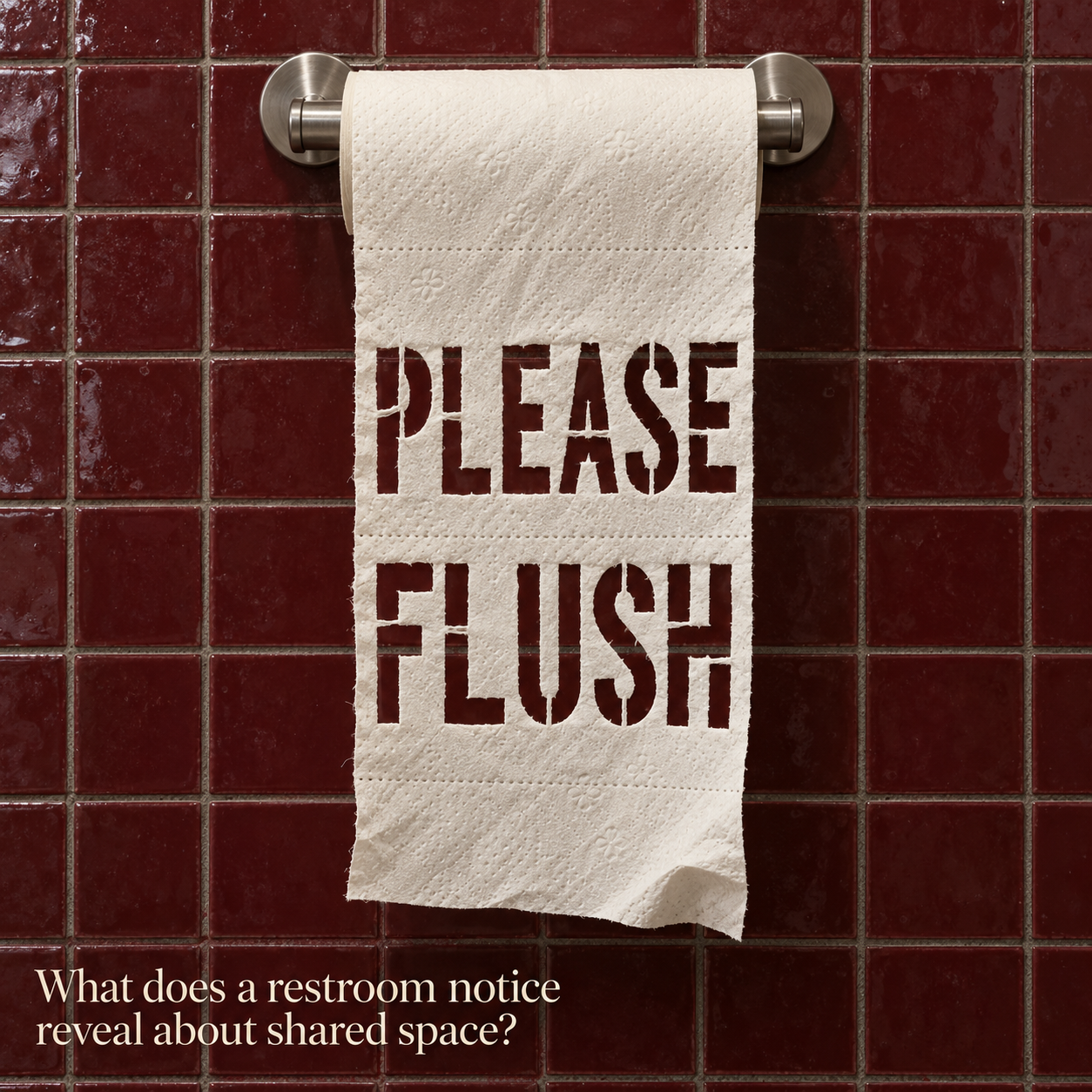
A printed request to flush the toilet is a small intervention in a shared space. It asks one person to leave the facility usable for the next, usually without anyone observing whether the request was followed. The notice expresses an expectation, but it does not explain why that expectation was previously unmet.
This review treats the restroom as a place where behaviour, equipment and maintenance meet. It asks when a reminder can help and when the same reminder conceals a physical or operational failure. The evidence includes a large field study of handwashing, a behavioural framework and an experimental study of flushing. These address different questions; none alone explains every instance of an unflushed toilet.
First establish whether the requested action is possible
Michie, van Stralen and West’s 2011 COM-B framework distinguishes capability, opportunity and motivation as conditions involved in behaviour. Applied here as an analytical lens, it prompts three checks: can the person understand and perform the action, does the environment enable it, and is there a reason to act? The framework is not a restroom trial or a guaranteed design formula.
A user may overlook a flush control, be unable to reach or operate it, expect an automatic sensor, or encounter an actual failure. These are hypotheses to investigate, not excuses to assume. Inspect the mechanism, water supply and usability before treating every unsuccessful flush as deliberate neglect. A bilingual instruction may improve comprehension for some users, but it cannot compensate for a broken actuator.
What a large reminder study actually found
Judah and colleagues tested text messages in highway-service-station restrooms, recording almost 200,000 uses. Their 2009 study reported relative increases in soap use of 9.4% for the most effective message domain among women and 9.8% among men; messages involving social norms and social status worked for both groups. These were context-specific handwashing results, not percentage-point increases or evidence about flushing compliance.
The methodological lesson is to test a message against an outcome. The numerical results should not become a prediction for another country, language, fixture or behaviour. Nor should the observed group differences be converted into fixed stereotypes. A facility needs evidence about its actual users and operating conditions.
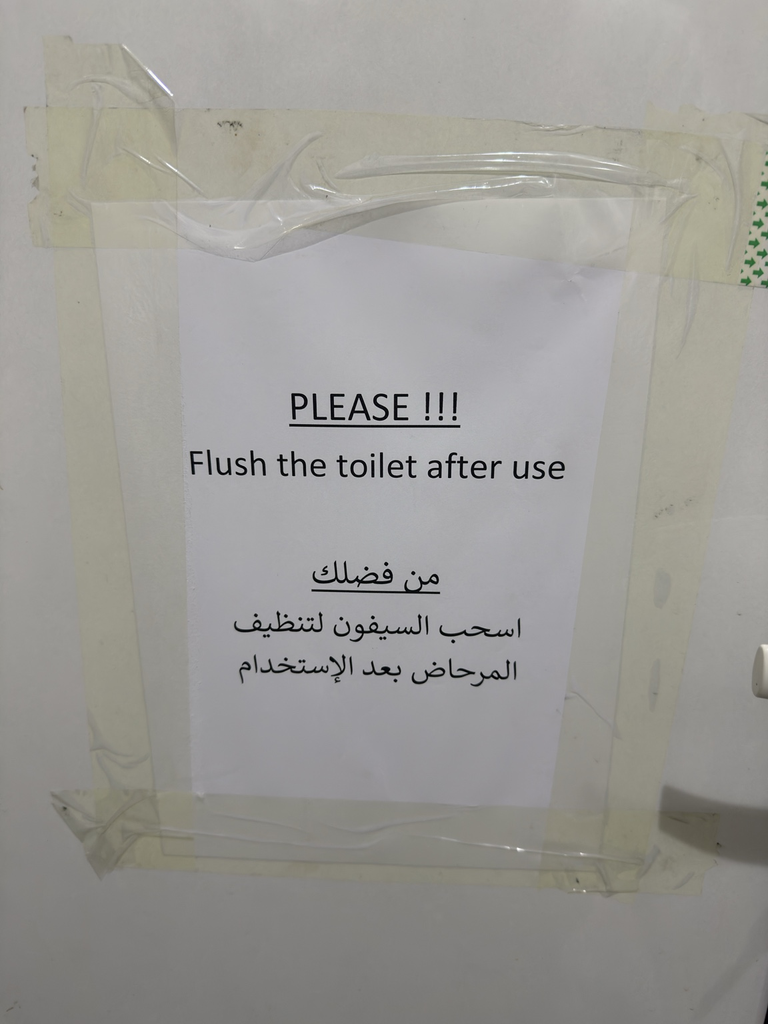
This photograph from a personal observation shows a printed reminder in Arabic and English fixed to a finished surface with several strips of tape. The addition makes communication an operational layer of restroom design: the room now carries an explicit request about what the next user should find. Its two languages and improvised mounting invite questions about visibility, readability and how shared responsibility is communicated at the point of use. The notice documents an attempt to guide behaviour. It does not establish how often flushing was missed, whether the mechanism worked or why the notice was installed.
From accusation to usable information
A sign can identify an action, point to a control or explain how to report a fault. These functions are different. If a mechanism is unfamiliar, a clear diagram close to it may be a more relevant proposal than a general appeal to cleanliness. If faults go unreported, an accessible reporting route may matter more than stronger wording.
Normative claims also need honesty. A message stating that “most people do this” should not invent compliance data. Language that humiliates users may undermine dignity without resolving the cause. The design proposal is a short, legible instruction placed at the decision point, supported by functioning equipment and a maintenance response. Its effectiveness remains an empirical question.
| Observed problem | Check before attributing blame | Intervention to test |
|---|---|---|
| No flush | Control visibility, operation and water availability | Repair, clearer control and a precise reminder |
| Low soap use | Supply, dispenser function and reach | Reliable replenishment plus a tested prompt |
| Repeated wet floor | Leaks, drainage and cleaning method | Correct the source and review maintenance timing |
| Unreported faults | Whether reporting is accessible and acted upon | A simple reporting route with a response owner |
| Confusing instructions | Language, contrast and unfamiliar symbols | User-tested wording and pictograms |
Flushing is necessary, but does not complete the hygiene system
Crimaldi and colleagues’ 2022 laboratory study visualised aerosol plumes from a commercial flushometer toilet. Airflow velocities exceeded 2 metres per second and aerosols reached approximately 1.5 metres within eight seconds. It examined plume physics using a particular setup, not infection outcomes in an occupied restroom. The result supports attention to fixture design and ventilation; it does not justify leaving toilets unflushed or provide a universal safe-distance rule.
The architectural task therefore extends beyond persuading a user to press a button. Cleaning access, ventilation and equipment selection belong in the same brief. Automatic controls may reduce dependence on remembering a step, but their calibration, repair and manual fallback need evaluation. Automation changes the maintenance obligation rather than eliminating it.
A privacy-preserving evaluation
An operator could compare similar periods before and after a reminder while keeping maintenance and supply levels stable. Record faults separately from apparent non-use; otherwise a repair may be wrongly credited to a sign. Use aggregate inspection and maintenance data, avoid cameras in intimate spaces, and collect only what is necessary. More intrusive observation is not justified merely because it is technically available.
Predefine the outcome: fewer unusable fixtures, shorter fault duration or improved availability of soap. Complaints alone are insufficient because they also depend on whether users know how to report. Repeat the assessment beyond the first days to see whether the effect persists. This is a proposed evaluation protocol, not a claim that a particular sign has already worked.
✦ ArchUp Editorial Insight
Shared facilities divide responsibility between people who use them briefly and organisations that control equipment, supplies and maintenance. A reminder is attractive because it is cheap, immediate and visible, whereas repairing an intermittent fault requires diagnosis, access and a budget. That difference can encourage an operator to treat a service problem as a communication problem. The result is a room covered in instructions while the conditions needed to follow them remain unreliable. This is a possible institutional mechanism, not an accusation about every posted notice. A more useful performance contract would separate user-dependent actions from service availability: whether controls work, supplies remain stocked and reported faults receive a response. Designers would then specify access and legibility alongside the fixture itself, and operators would have a reason to document failures instead of accumulating signs. Shared responsibility becomes credible when the institution visibly performs its part. The architecture of a functioning public restroom is consequently also an architecture of maintenance access, understandable controls and a clear route from noticing a problem to repairing it.
References
- Michie, S., van Stralen, M. M. and West, R. The behaviour change wheel: A new method for characterising and designing behaviour change interventions. Implementation Science, 6, 42, 2011.
- Judah, G., Aunger, R., Schmidt, W.-P., Michie, S., Granger, S. and Curtis, V. Experimental pretesting of hand-washing interventions in a natural setting. American Journal of Public Health, 99, Supplement 2, 2009, S405–S411.
- Crimaldi, J. P., True, A. C., Linden, K. G., Hernandez, M. T., Larson, L. T. and Pauls, A. K. Commercial toilets emit energetic and rapidly spreading aerosol plumes. Scientific Reports, 12, 20493, 2022.