GLO! Wearable Art: Designing the Space Around the Body


A wearable artwork changes the space a body occupies. A broad skirt establishes a perimeter; a projecting headpiece changes how a figure approaches another person; an extended sleeve turns a small gesture into a larger arc. In the 2026 World of WearableArt show, GLO!, these relationships make costume a useful subject for architectural observation: shape is experienced through movement, distance and light.
The competition brings together 108 finalist entries by 134 designers from 18 countries. Its Supreme Award went to Sacred Nightfall by Kayla Christensen, a hand-painted and stitched work shown in the cover image. Rather than treating the collection as a succession of unusual outfits, this reading considers how selected works organise the space around their wearers.
A boundary carried by the body
In Te Whare Eke Nei, a broad angular lower form and an enclosing headpiece replace the familiar outline of clothing with a more explicitly constructed silhouette. The visual relationship is between planes, edges and the smaller openings through which the performer remains visible. From this viewpoint, the garment behaves like a boundary carried through the scene.
The architectural connection is one of scale and enclosure. A designer of an exhibition passage or entrance must account for the occupied width of a moving person. Here, the outline makes that width unusually visible. A still photograph does not establish the performer’s actual clearance or ease of movement, but it shows why those questions belong to the design.
Nature translated into volume
More adopts an insect-like figure, using a rounded, reflective body and projecting appendages to extend beyond the wearer’s ordinary proportions. The surface catches light in patches, so the boundary reads through alternating highlights and darker areas. Its effect depends on the relationship between the object and the light falling on it.
Platinum takes a different approach. Layered, spreading forms around the head and torso suggest canopies, while perforated-looking surfaces allow glimpses through the outline. Where one work presents a concentrated shell, the other creates a more porous edge. These are visual comparisons, not identifications of their structural systems or material recipes.


The outline becomes a gesture
Enchantress stretches the figure through a disc-like head and long lateral extensions. Its composition makes the space beside the wearer as consequential as the space directly in front. Moving such an outline would alter the scene through its sweep, even before an audience could inspect its surface detail.
This offers a useful way to think about scenography: the arrangement of bodies, objects and light within a performance space. A wearable work can become part of that arrangement without remaining fixed to the floor. Its apparent scale changes with orientation, and the gap between two performers becomes an element of the composition.

When an object invites interaction
The photographed pairing in Ringing Off the Hook adds another dimension. A telephone is used between two figures, creating a visible action across the space separating them. Recognition comes through both the object and the exchange it makes possible. The scene can therefore be read as a small interaction design, with costume helping to establish the relationship.
In Hen, several figures share the frame. Repeated forms encourage comparison, while their different positions make spacing part of the image. For designers of displays and installations, this is a reminder that the interval between objects can be as important as the objects themselves.


Surface, assembly and the life of a performance
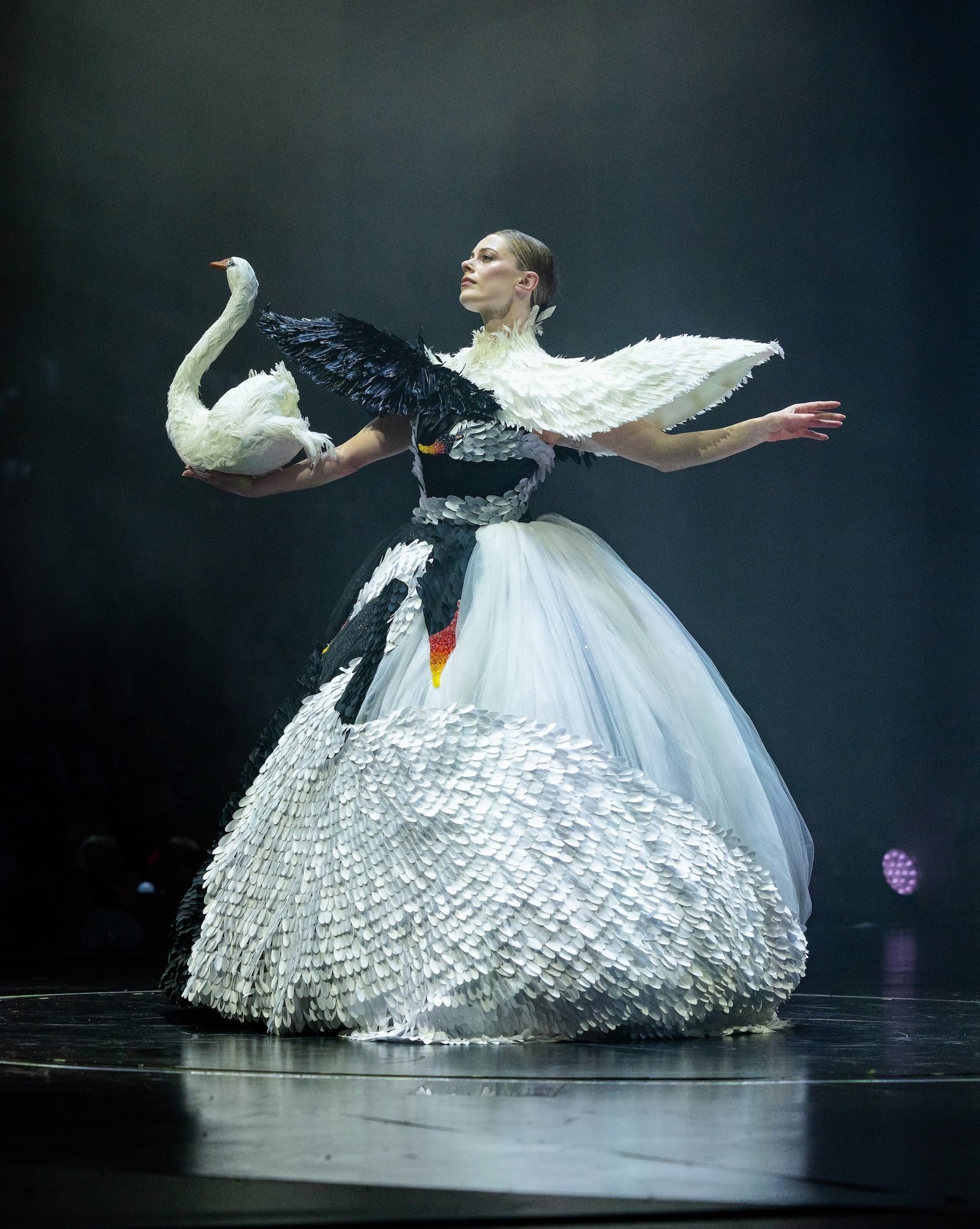
The faceted surfaces of MOTHER VAKA and the contrasting bird forms of My Ugly Duckling show how different kinds of detail establish identity. One is read through folding and changing planes; the other through recognisable figures and a strong tonal contrast. Neither needs to be described as a building to offer lessons about how an assembled form becomes legible.
The production questions sit behind the image: how a work is put on, supported, repaired, packed and stored. A photograph cannot reveal its weight, labour hours or fabrication budget. For a cost study, those would be more useful inputs than apparent visual complexity alone. Similarly, judging reuse or environmental impact would require knowing the materials and how the components are joined.

Designing the space immediately around us
GLO! makes a normally modest scale of design unusually visible: the space immediately surrounding a person. Enclosure, projection, transparency and interaction appear here as things that can be carried and moved. The value for architecture lies in observing those relationships before converting them into larger, fixed structures.
For another reading of how enclosure and visual continuity shape experience, see ArchUp’s analysis of material, movement and light at Align Studio. The settings differ, but both invite attention to what a boundary allows a person to see and do.
Programme and image credits: World of WearableArt, GLO!, TSB Arena, Wellington, New Zealand; 17 September–4 October 2026.