Hematite Concrete: Can Replacing Sand Make a Thinner Radiation Shield?

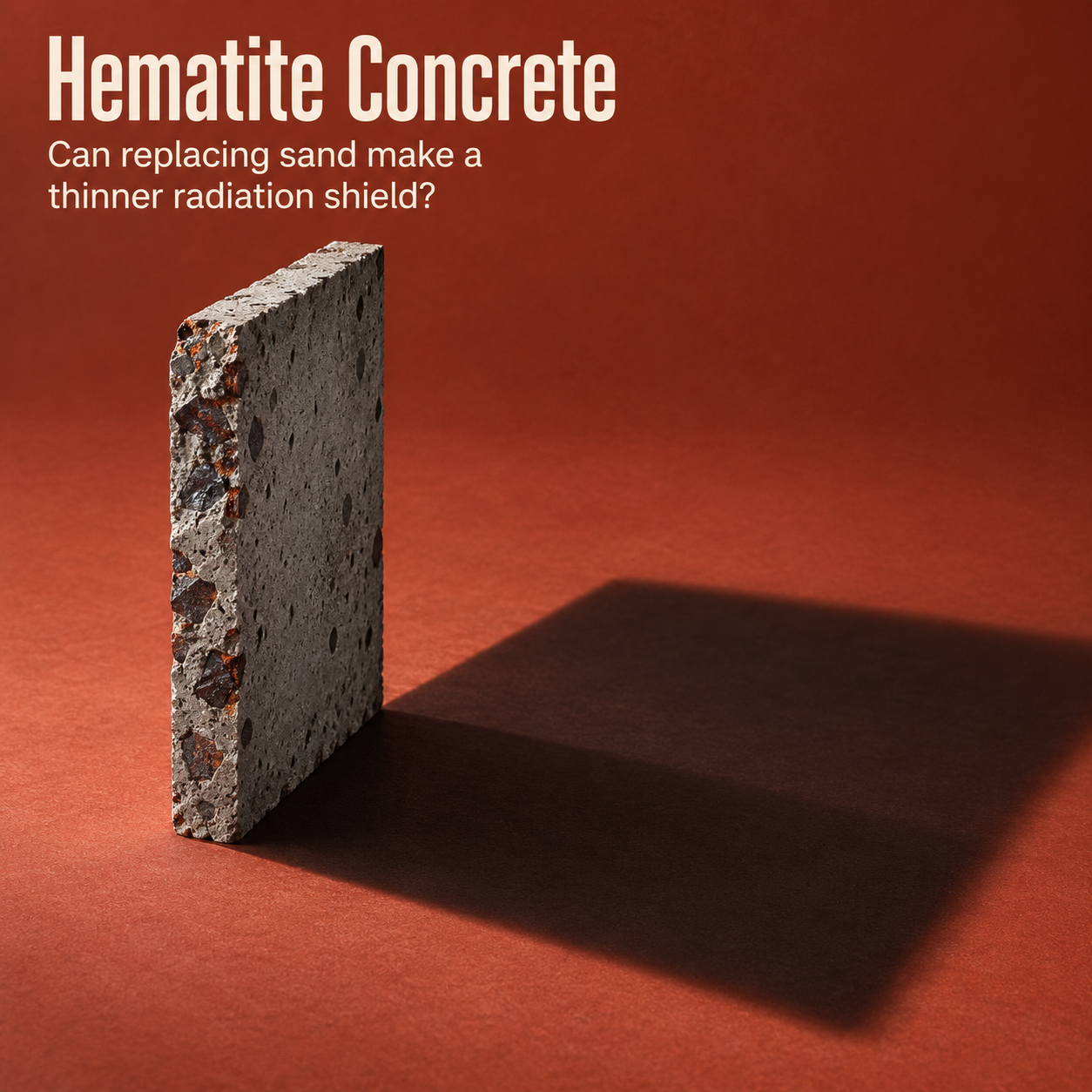
A shielding wall occupies valuable floor area before a room receives its first piece of equipment. Replacing some of its ordinary aggregate with hematite raises a useful architectural question: can a denser concrete provide the required photon attenuation within a smaller footprint? Research supports investigating that possibility, but it does not support choosing wall thickness from the mineral name alone.
Hematite, an iron oxide with the formula Fe2O3, is studied as a heavy aggregate and as a powder. Those roles are not interchangeable. This review of selected studies through 2026 separates sand replacement from cement replacement and laboratory attenuation from a completed building’s protective performance.
Replacing sand changes more than the colour
In a sand-replacement mixture, hematite occupies part of the fine-aggregate fraction. In a cement-replacement mixture, it displaces part of the binder. The second change can reduce the material available for cement hydration; evidence from one route cannot establish an optimum for the other. Replacement percentages also require a stated basis: mass and volume substitutions produce different mixtures when aggregate densities differ.
For building materials evaluation, the relevant comparison is therefore a documented mix with a reference mix, not simply “hematite versus sand”. Aggregate grading, water content, binder composition, fibres and curing must remain visible in the comparison.
What the studies actually tested
| Study | Research approach | Finding and boundary |
|---|---|---|
| Gencel and colleagues, 2011 [1] | Concrete specimens; measurements and Monte Carlo calculations | Gamma attenuation and mechanical strength improved with hematite content. The study did not find an improvement in neutron absorption. |
| Lv and colleagues, 2022 [2] | Partial replacement of river sand in UHPC | At 40% replacement, the reported linear attenuation coefficient was 43% higher and half-value thickness 30% lower than ordinary concrete. |
| Zeyad and colleagues, 2022 [3] | Heavy fine aggregates and different fibres in UHPC | Compared workability, mechanical properties, permeability and shielding, including exposure at 22, 250, 500 and 750°C. This is a multi-variable comparison. |
| Milasi and colleagues, 2023 [4] | Barite, hematite and lead powders replacing 10–30% of cement | A binder-replacement investigation, not a direct test of replacing sand. Its dosage cannot be transferred to the fine aggregate fraction. |
| Zhou and colleagues, 2025 [5] | Magnetite, barite, hematite and limonite; Geant4 and XCOM | Investigated photon attenuation and fast-neutron removal. Calculated indicators require attention to the model and experimental comparison. |
| Marashdeh and colleagues, 2026 [6] | Concrete made with copper, zinc and iron rock ores | Iron-ore concrete reached 2.28 g/cm³ and a linear coefficient of 0.157 cm⁻¹ at 0.689 MeV. Mixed ore is not equivalent to a specified hematite-sand product. |
The Lv study also reported a slight reduction in workability and compressive strength, alongside improvements in flexural and impact performance. Its 43% attenuation gain is relative to ordinary concrete; it should not be presented as the gain over an otherwise identical UHPC control. A stronger shielding result does not mean every mechanical property improves. [2]
Why a half-value layer is not the wall thickness
For an ideal narrow, monoenergetic photon beam, the transmitted intensity follows I = I0e−μt, where μ is the linear attenuation coefficient and t is physical thickness. Under those assumptions, HVL = ln(2)/μ and TVL = ln(10)/μ. HVL reduces the uncollided beam to one half; TVL reduces it to one tenth. Neither is a universal prescription for a room enclosure. [7]
An arithmetic check illustrates the distinction. Using the 2026 abstract’s μ = 0.157 cm⁻¹ gives HVL ≈ 4.41 cm and TVL ≈ 14.67 cm. These are calculations for that coefficient, not independently measured wall requirements. Values at other energies, or derived under different conditions, cannot be placed beside it as if they described the same test. [6,7]
Real shielding evaluation must account for the radiation spectrum, geometry and scattered radiation. The architectural assessment also includes doors, service penetrations and junctions. A good material test cannot establish the performance of an untested discontinuity. This article provides material-selection context; final protection design remains a project-specific radiation-physics calculation.
Gamma rays and neutrons ask different questions
The 2011 findings are especially useful because they resist a broad marketing claim: improving gamma attenuation did not automatically improve neutron absorption. The later computational study addresses both radiation types separately. Hematite should therefore be specified against an identified exposure, not described as a universal “radiation-proof” ingredient. [1,5]
From a promising specimen to a procurement decision
ArchUp proposes evaluating a candidate mix in four connected stages. First, identify the supplied mineral and document grading, composition and replacement basis. Second, trial the actual production method, checking fresh density, placement and uniformity. Third, test hardened density, mechanical performance and attenuation at relevant energies. Fourth, review the complete barrier geometry with the specialist responsible for radiation protection. This is an editorial evaluation framework, not a mix recipe established by the cited papers.
Higher density also changes structural and construction decisions. In a purely illustrative comparison, a 0.30 m layer at 2400 kg/m³ weighs 720 kg/m²; a 0.25 m layer at 3300 kg/m³ weighs 825 kg/m². The thinner option is heavier. These assumed densities and thicknesses do not represent equivalent shielding; they simply show why reduced thickness cannot be equated with reduced load.
✦ ArchUp Editorial Insight
The architectural value of hematite lies in whether its material performance can be translated into a reliable, buildable boundary. A specification that records only compressive strength leaves the principal shielding claim unverified. Conversely, an attenuation certificate without a clear link to the delivered mix does not resolve the construction problem. The useful procurement unit is the verified barrier system: material, production consistency, geometry and inspection. The potential floor-area benefit should be assessed alongside additional weight, handling and testing, rather than treated as a free consequence of replacing sand.
Evidence note: selected publisher abstracts, institutional publication records and the cited technical reference were checked. This is a critical research synthesis, not an exhaustive systematic review; inaccessible numerical details were not adopted as design recommendations.
References
- Gencel O., Bozkurt A., Kam E., Korkut T. (2011). Determination and calculation of gamma and neutron shielding characteristics of concretes containing different hematite proportions. Annals of Nuclear Energy 38(12), 2719–2723.
- Lv Y. et al. (2022). Effect of incorporating hematite on the properties of ultra-high performance concrete including nuclear radiation resistance. Construction and Building Materials 327, 126950.
- Zeyad A.M. et al. (2022). Effect of aggregate and fibre types on ultra-high-performance concrete designed for radiation shielding. Journal of Building Engineering 58, 104960.
- Milasi S.E., Mostofinejad D., Bahmani H. (2023). Improving the resistance of ultra-high-performance concrete against nuclear radiation: Replacing cement with barite, hematite, and lead powder. Developments in the Built Environment 15, 100190.
- Zhou P. et al. (2025). Understanding the effects of different aggregates on the neutron and gamma radiation shielding properties of ultra-high performance concrete using Monte Carlo methods. Construction and Building Materials 467, 140375.
- Marashdeh M.W., Akhdar H., Rilwan U., Joseph S.R. (2026, 10 February). Thermal, structural, and morphological characterization of copper, zinc, and iron rock ore-based concrete for enhanced gamma radiation shielding application. Journal of the Australian Ceramic Society.
- Hubbell J.H., Seltzer S.M. (1995). Tables of X-Ray Mass Attenuation Coefficients and Mass Energy-Absorption Coefficients. NISTIR 5632. Section 2: exponential attenuation.