When Color Becomes an Acoustic Decision: Dark Materials, Absorbent Surfaces, and What the Architect Sees but Doesn’t Hear

The design of modern cinema halls demonstrates how material choices function simultaneously as visual and acoustic decisions. Dark wall cladding, upholstered seating, and irregular ceiling panels serve acoustic purposes by controlling sound absorption, reflection, and reverberation time, which immersive audio formats like Dolby Atmos require to function as intended.
A persistent gap exists between architectural practice and acoustic engineering, as most material specifications are made without consideration of sound absorption coefficients. In spaces where audio quality is central to the user experience, this disconnect produces technically equipped but acoustically compromised environments, pointing to a broader educational deficiency in architecture and interior design training.
ArchUp Desk —
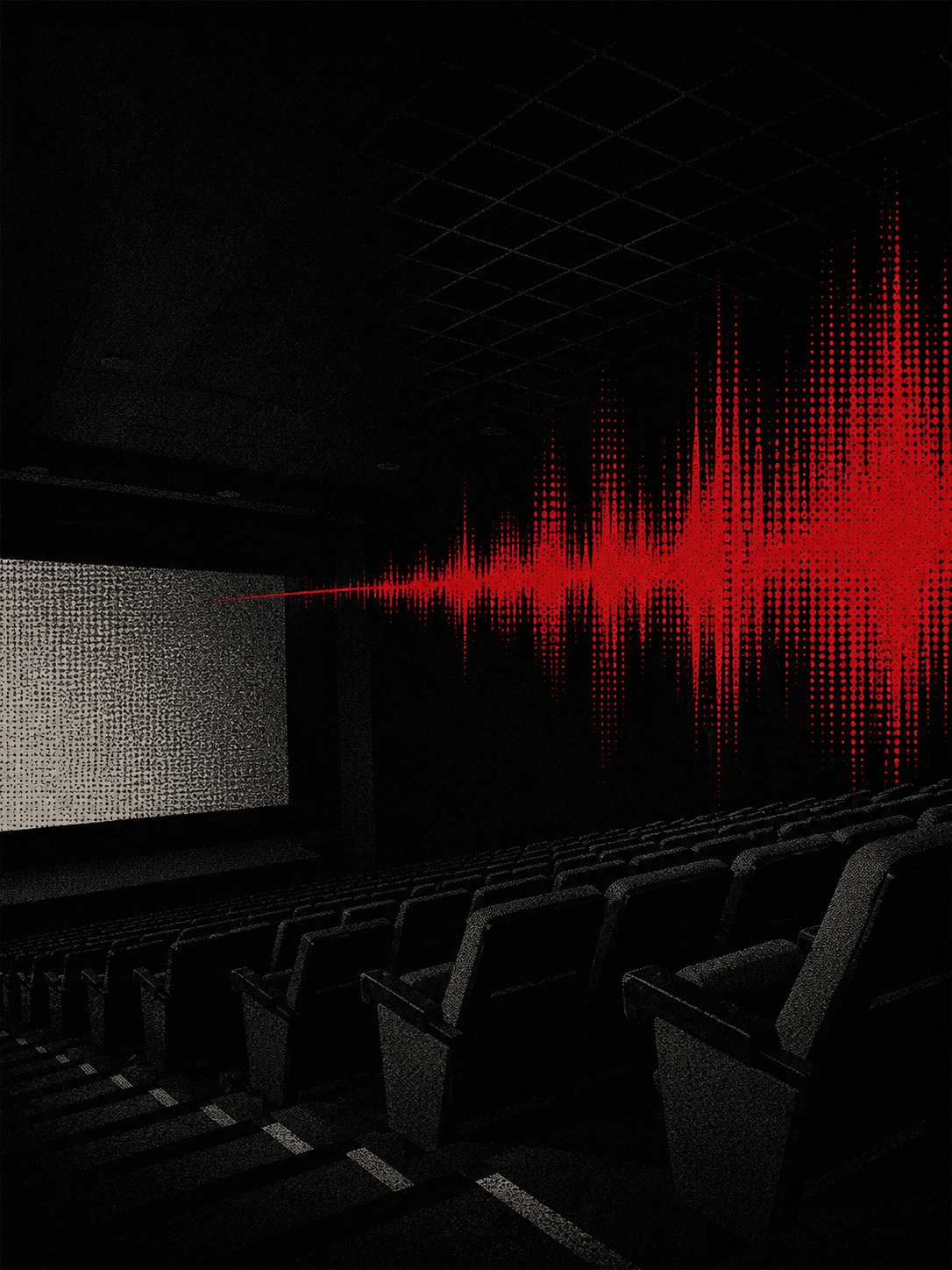
There is a profound, almost uncanny moment experienced in modern cinema halls. You sit down, close your eyes for a second, and feel the sound enveloping you from everywhere and nowhere simultaneously. This phenomenon does not occur simply because the speakers are powerful; it happens because the room itself is meticulously designed to disappear. Black walls, heavily upholstered seating, and suspended ceilings with irregular mesh panels—these are not merely aesthetic choices made by a visually trained eye. They are, fundamentally, strict acoustic decisions. When an architect selects a dark material for wall cladding, they are not just choosing a color; they are deciding exactly how much sound energy they will allow to bounce back into the space.
For a long time, this intersection between acoustic science and architectural decision-making existed in a gray area between two disciplines that rarely spoke the same language. The architect typically views a material in terms of surface, texture, and visual identity. The acoustic engineer evaluates it based on its coefficients of absorption, reflection, and diffusion. However, recent developments in sound design—particularly with the proliferation of immersive audio systems in both commercial and cultural venues—reveal that this dual thinking is no longer a luxury reserved for specialists. It has become a prerequisite for any space striving to be an experiential destination rather than a mere container.
The Dark Material: When Absorption Becomes Identity
The selection of dark materials in cinema halls is neither a coincidence nor a fleeting design trend. Dark materials—whether acoustic foam, specialized cladding, or fabric infused with sound-absorbing fibers—typically possess a porous or fibrous internal structure. This structure intercepts sound waves and converts their kinetic energy into thermal energy rather than reflecting them back into the room. This property is quantified by physicists as the “sound absorption coefficient,” a metric ranging from zero (a completely reflective surface) to one (a completely absorbent surface).
A black wall painted with a smooth latex finish has an absorption coefficient close to zero; acoustically, it acts as a mirror. Conversely, a black wall clad in compressed acoustic filtration boards or custom fibrous panels behaves entirely differently, absorbing between 70% and 95% of incoming sound energy in the mid-to-high frequency ranges. The difference between the two is invisible to the naked eye, but it is vividly measured in “reverberation time”—the metric that determines whether you are sitting inside a “live” dynamic space or a chaotic echo chamber.
In modern commercial cinemas, international cinematic engineering standards target a reverberation time not exceeding 0.3 seconds at 500 Hz for a fully occupied hall. This number is not just a technical specification; it is an existential requirement for immersive audio formats. Systems like Dolby Atmos rely on the listener hearing the direct sound from the speaker before any reflections can interfere. If the reverberation time exceeds this threshold, the precise spatial sharpness of the 64 individual speaker feeds enabled by Atmos is lost, downgrading the room from a precise auditory theater into a blur of undifferentiated ambient noise.
The Black Ceiling and Vertical Absorption: The Forgotten Dimension
When Dolby Atmos introduced a vertical dimension to cinematic audio in 2012 by requiring rows of overhead speakers, it opened an architectural door that many designers were unprepared for. In traditional interior design, the ceiling was either a neutral finishing element or a canvas to be up-lit. In an Atmos-equipped hall, however, the ceiling becomes an active audio source. It must emit sound from above while simultaneously preventing unwanted downward reflections that could disorient the viewer’s spatial perception.
This acoustic paradox requires what engineers call a “diffusive surface”—a texture that breaks up incident sound waves and scatters them in multiple directions rather than bouncing them back at a single angle of reflection. Zig-zagging wooden baffles, staggered geometric topographies, and irregular metal grids are architectural solutions designed to serve this exact purpose. Notably, most of these elements are rendered in dark or neutral colors to keep visual attention anchored to the screen, yet their primary function is to manage the downward acoustic energy.
Recent research analyzing Alfonso Cuarón’s film Gravity—a benchmark for Atmos integration—highlights how the concept of the “immersive point-of-audition” places the audience existentially inside the narrative space. However, this immersive illusion collapses entirely if the viewing room produces parasitic reflections that blur the boundaries between the front, rear, and overhead speakers. In other words, the acoustic treatment of a space is not merely a service to technology; it is a service to the human experience crafted by the filmmaker.
Acoustic Economics: Who Pays for Silence?
In a real estate development environment where construction costs constantly push toward economical solutions, acoustic design is often one of the first line items to be reduced or eliminated from interior plans. In the global commercial cinema market, professional acoustic treatments for a mid-sized hall typically account for 8% to 15% of the total interior finishing budget. To a developer facing margin pressures, this figure often appears negotiable. However, the architectural consequence of cutting this budget is a compromised space that actively sabotages the very audio technology the operator paid thousands of dollars to install.
This contradiction is evident in the growing divide between premium cinema halls—which integrate acoustic design from the earliest conceptual stages—and economy-tier halls that bolt digital surround systems onto walls never intended to receive them. The former produces true immersion; the latter merely produces loud noise. The distinction does not lie in the quality of the speakers, but in how the walls negotiate with them.
What Must the Architect Know Before Choosing a Material?
The uncomfortable truth in acoustic spatial design is that most interior decisions are made in a vacuum, isolated from acoustic physics. The architect operates within visual, formal, and functional frameworks, while the acoustic engineer is often summoned later to “fix” what has already been built. This sequence is entirely backwards. In spaces where sound is an existential dimension rather than a utility—such as cinemas, theaters, opera houses, trading floors, and grand places of worship—the partnership with the acoustic engineer must begin during the initial material specification phase, not during final finishing.
A dark material, when chosen with cognitive awareness, is more than an aesthetic preference. It is an acoustic contract dictating how the kinetic energy of sound will behave within the boundaries of a space. Black pigment absorbs light, but it does not inherently absorb sound. A visually rough material might be terrible at absorbing low frequencies, while a visually smooth fabric over a deep air gap might excel at it. The sound absorption coefficient of each material across all frequency bands is the true data point that belongs on the design table, right next to the color swatch and the cost estimate.
It is increasingly clear that the interior design profession is being pushed to redefine its relationship with acoustic physics. This is not just because technology demands it, but because end-users can now instantly perceive the difference. A space that allows you to hear exactly what the director intended—rather than what the wall permits—is a space that commands a return visit.
Perspective What this analysis exposes is not a technological gap, but an educational one. The vast majority of architecture and interior design curricula do not teach sound as a pliable “design material,” but rather as an engineering problem to be outsourced. The result is generations of architects who specify cladding materials using eyes trained to read color, texture, and cost, but lacking the ability to read an absorption coefficient. In an era where immersive audio is migrating from cinema halls into hotels, residences, and public spaces, this professional blind spot is directly measurable by the moments a user feels a subtle spatial discomfort without knowing why. A silent space is not an empty space; it is a space that knows exactly how to manage what enters it.
✦ ArchUp Editorial Insight
The design of modern cinema halls reveals a critical intersection where material choice functions as both a visual and acoustic decision. Non-architectural data highlights that immersive audio formats like Dolby Atmos necessitate strict environmental controls, forcing the interior envelope to manage sound absorption, reflection, and reverberation times. This systemic pressure generates an institutional decision framework prioritizing the “deadening” of the room. Dark wall cladding, highly upholstered seating, and irregular ceiling baffles are not merely aesthetic choices but calculated acoustic dampeners.
Consequently, the architectural outcome exposes a persistent gap in conventional practice: material specifications are often made without referencing sound absorption coefficients, leading to spaces where the visual intent contradicts the acoustic reality. In 2026 cities, this design logic redefines the cinematic void as a highly engineered “black box,” finalizing the transition of interior building materials from passive surfaces into active, performative layers required to execute cinematic sound infrastructure.
Credits / References
- Source Material:
- Scott, T. (2016). From One to Many: A Short History of 20th Century Multichannel Cinema Sound. SMPTE Motion Imaging Journal. DOI: 10.5594/jmi.2016.2579959. — Langkjær, B. (1997). Spatial Perception and Technologies of Cinema Sound. Convergence: The International Journal of Research into New Media Technologies, 3(4), 62–82. DOI: 10.1177/135485659700300408. — Idrovo, R., and Pauletto, S. (2019). Immersive Point-of-Audition: Alfonso Cuarón’s Three-Dimensional Sound Design Approach. Music, Sound, and the Moving Image, 13(1), 1–26. DOI: 10.3828/msmi.2019.3. — Sergi, G. (2013). Knocking at the door of cinematic artifice: Dolby Atmos, challenges and opportunities. The New Soundtrack, 3(2), 107–121. DOI: 10.3366/sound.2013.0041. — Tan, S.-L., Wakefield, E., and Jeffries, P. W. (2017). The Effects of Diegetic and Nondiegetic Music on Viewers’ Interpretations of a Film Scene. Music Perception, 34(5), 605–625. DOI: 10.1525/mp.2017.34.5.605. — Bruhn, J. (2013). The Unheard Voice in the Sound Film. Cinema Journal, 52(3), 23–47. DOI: 10.1353/cj.2013.0031. — Gallagher, M., Stringer, J., and Lee, N. J. Y. (2013). Reshaping contemporary Chinese film sound: Dolby Laboratories and changing industrial practices. Journal of Chinese Cinemas, 7(3), 263–280. DOI: 10.1386/jcc.7.3.263_1. — Woideck, N. (2009). Sound Art (?) on/in Film. Organised Sound, 14(1), 45–54. DOI: 10.1017/s1355771809000090.
- — ArchUp Desk | 2026 —