In Broken Light: Mirrors Reframe a Historic House


A mirror in a historic house usually returns a recognizable room. In In Broken Light at Toronto’s Spadina Museum, fractured reflective surfaces do something less settled: they break the view into parts. Five sculptural interventions extend across four storeys, using glass, mirrors and photography to establish different relationships with the building.
The doorway becomes a frame
Open Wing Death is seen through an existing doorway, its faceted form held within the rectangular opening. The contrast matters. The room provides a stable frame, while the object produces many small, differently directed views. Patterned walls and the polished floor remain visible around it, preventing the sculpture from becoming an isolated studio object.
The work occupies the unrestored third floor and is dedicated to the household’s domestic staff. Its scale makes the visitor negotiate the room around an unfamiliar presence. Rather than claiming that the original space has disappeared, the installation brings its proportions into sharper comparison with a new volume.

A domestic object changes its role
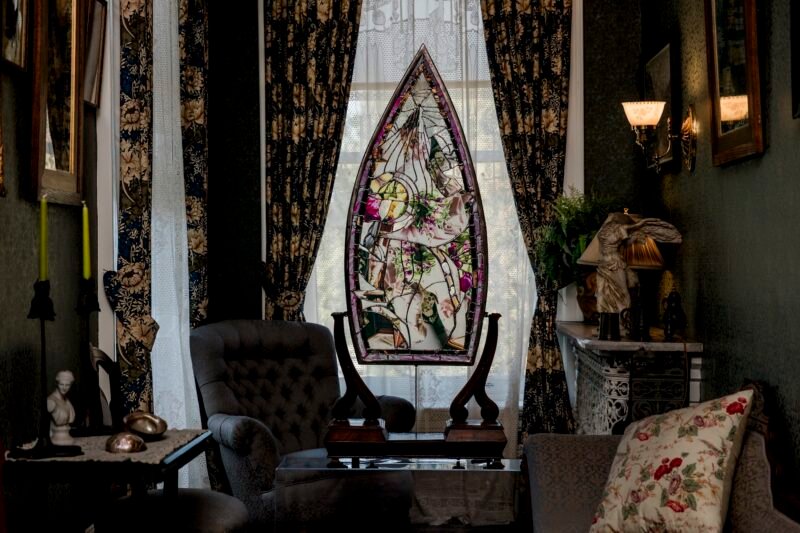
Tiber incorporates photographic imagery in reassembled stained glass and uses a reclaimed antique dressing-table mirror holder. The support retains the outline and proportions of a domestic furnishing, even as the image it carries departs from an ordinary reflection. Positioned among upholstered seats and patterned curtains, it belongs to the room in one sense and interrupts it in another.
The work’s construction uses traditional Tiffany stained-glass techniques to join broken pieces. Curator Adrien Sun Hall connects the visible fractures and repairs to queer becoming and personal transformation. Keeping that interpretation tied to the material is important: the seams are not merely a decorative pattern placed over an intact surface.
Reflection at the threshold
In Orpheus Twice, fractured reflective panels occupy a doorway in a worn interior. They complicate the usual promise of an opening: instead of providing an uncomplicated view ahead, the threshold returns fragments of the space around the viewer. A familiar architectural element becomes a place to pause and look more carefully.

Light occupies more space than the object
The Shattering casts scattered points of light onto surrounding surfaces. Its physical body is compact compared with the room affected by its reflections. This distinction is useful for exhibition design: an object’s footprint does not describe its full spatial reach. Lighting and reflective surfaces can extend an installation across walls, ceiling and floor without adding another enclosure.
Such effects also require restraint. The light that makes an intervention legible can distract from neighbouring objects, while highly reflective edges need a clear viewing distance. Lighting therefore becomes part of organizing the encounter, alongside the placement of objects and routes through the rooms.

✦ ArchUp Editorial Insight
Working inside a historic house means confronting rooms that already carry a strong visual identity: patterned fabrics, domestic furniture, narrow openings and surfaces with visible age. The intervention cannot be read independently of that setting. In Broken Light responds by distributing reflective objects across different rooms rather than creating a single neutral display space. The architectural consequence is a shift in attention. Visitors may first notice a doorway, a window or an old wall because the work interrupts or redirects their view of it. ArchUp reads the most productive relationship as one between continuity and disturbance: recognizable domestic settings remain present, while broken reflections prevent them from settling into a single, complete image. This approach also has limits. A visually commanding sculpture can compete with the room whose history it is meant to reveal, and reflections can make the edge of an object harder to read. Clear circulation, appropriate viewing distance and careful lighting therefore matter as much as the reflective surface itself. The lesson for exhibition design is not simply to add mirrors to an old interior, but to make each placement explain something about the space around it.
Credits: Installation and artworks: Ry Van Der Hout. Curator: Adrien Sun Hall. Setting: Spadina Museum, Toronto.