InfraVision Think Tank Student Competition 2026

Organizer record: Vauban IP · Directory record not yet reviewed
Competition Brief
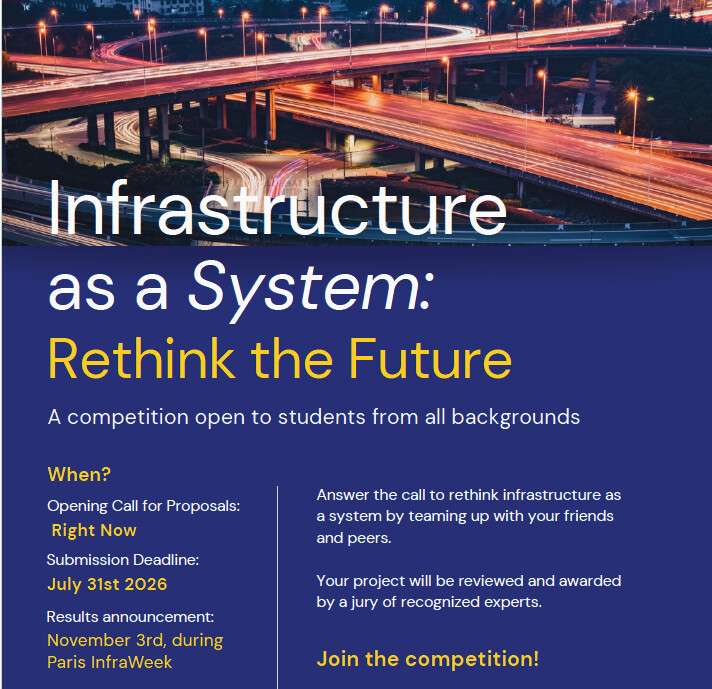
InfraVision Think Tank has launched its 2026 student competition under the theme “Infrastructure as a System.” The competition invites students from a wide range of disciplines, including architecture, urban planning, engineering, economics, public policy, computer science, and complex systems, to design a fictional infrastructure project capable of remaining relevant and resilient across uncertain future conditions. The core challenge is not to propose the theoretically optimal infrastructure under fixed assumptions, but to design one that can adapt as those assumptions change.
InfraVision is a think tank founded by Vauban IP with the support of Altermind. It operates as a platform for discussion among infrastructure stakeholders, including asset operators, investors, policy experts, and start-ups. The 2026 student competition is its third annual edition. Past editions addressed the themes “Inclusive Infrastructure” (2024) and “Cities of Tomorrow” (2025), with the 2025 winners drawn from the University of Bath and Universidad Técnica de Oruro.
Intent
The competition frames infrastructure design as a strategic and systemic challenge rather than a technical exercise. Students are asked to reason in scenarios rather than certainties, to engage seriously with uncertainty, and to combine strategic thinking with technical understanding and creativity. The brief situates participants as members of a fictional strategic task force advising on an infrastructure project that must remain operational and valuable by 2030 to 2035, a window in which demand, technology, regulation, and resource constraints are all expected to shift significantly.
Purpose
The competition’s stated purpose is to foster interdisciplinary thinking around infrastructure and to give students an opportunity to raise their professional profile through exposure to an expert jury and publication of results at Paris Infraweek 2026. There is no built outcome or procurement procedure attached. The primary benefit is educational and networking-oriented: participants receive feedback from the jury and gain visibility within the infrastructure policy and investment community. Those interested in how urban design and infrastructure intersect can find this competition a relevant analytical exercise.
Requirements
Teams must consist of 1 to 6 members. All team members must hold active student status during the 2025-2026 academic year. There are no restrictions on faculty or disciplinary composition, though multidisciplinary teams are encouraged.
The registration process requires teams to send an email to contact@infravision-thinktank.com with the following:
- Names, school and department affiliations, degrees studied, and expected graduation dates of all team members
- A concise project overview of 1 to 3 sentences
- Contact details including email and phone number of the team’s contact person
The final submission must include:
- A presentation of 30 to 40 slides
- A written abstract
- Visual representations, sketches, digital or physical models where applicable
The submission is expected to address the following dimensions:
- Project vision and value creation
- 2 to 3 contrasted and plausible future scenarios
- Resilience and adaptiveness, including risk and vulnerability identification
- Explicit trade-offs between cost, efficiency, resilience, and sustainability
- Bold bets and quick wins, including disruptive technologies or innovative financing models
- Stakeholder engagement and implementation strategy
- System perspective connecting the project to wider ecosystems such as mobility, energy, or urban planning
- Implementation roadmap and budget logic
- Impact assessment with a defined indicator of success
Jury
- Sadie Morgan (Head of Jury) – Architect and co-founder of drMM (dRMM Architects). Founder of the Quality of Life Foundation, which advocates for design quality in public infrastructure. Known internationally for her work on the High Speed 2 rail project in the UK as Chair of the Independent Design Panel.
- Erik Jones – Director of the Robert Schuman Center for Advanced Studies at the European University Institute. Specializes in European politics, political economy, and international relations.
- Patrice Geoffron – Professor at Université Paris Dauphine PSL. Specializes in energy economics, industrial economics, and infrastructure regulation.
- Didem Nisanci – Senior Fellow at the Global Climate Policy Project at Harvard University and Massachusetts Institute of Technology. Former Chief of Staff at the U.S. Department of the Treasury.
Fees
| Item | Details |
|---|---|
| Registration Fee | Free |
| Submission Fee | Free |
Rewards
| Prize | Amount | Details |
|---|---|---|
| 1st Place | 7,000 euros | Awarded to the winning team |
| 2nd Place | 5,000 euros | Awarded to the second-placed team |
| 3rd Place | 3,000 euros | Awarded to the third-placed team |
| Total Prize Fund | 15,000 euros | Combined prizes across all three positions |
Dates
| Milestone | Date |
|---|---|
| Competition Opens | 15 May 2026 |
| Expression of Interest Deadline (Registration) | 30 June 2026 |
| Submission Deadline | 31 July 2026, 23:59 Paris time (CET) |
| Jury Review Period | 30 July to 8 September 2026 |
| Results Announced | 3 November 2026 at Paris Infraweek 2026 |
| Contact | contact@infravision-thinktank.com |
✦ ArchUp Competition Review
InfraVision Think Tank is organized by Vauban IP with the support of Altermind, a private think tank with a focused mandate around infrastructure policy and investment. The organization has three documented annual editions, published past winning projects, and a consistent thematic structure, which establishes a baseline level of institutional credibility. The jury for 2026 is fully named and credible: Sadie Morgan is a well-known figure in the UK infrastructure and architecture scene, particularly through her role on the HS2 Independent Design Panel, and the remaining three members bring expertise in European policy, energy economics, and U.S. climate finance, all directly relevant to a brief centered on infrastructure under uncertainty. The competition is not architecture-specific, it sits at the intersection of strategic planning, policy, and design, which means it attracts a broader audience and rewards systems thinking over formal design skill. The prize structure, 7,000, 5,000, and 3,000 euros, is proportionate to the effort expected, given that a 30 to 40 slide submission with scenario modeling and stakeholder analysis represents a substantial intellectual investment. There is no built outcome. The practical benefit is primarily visibility and potential networking within the infrastructure investment and policy community through the Paris Infraweek announcement. For students in architecture and urban design who want to engage with infrastructure at a strategic level, this competition offers a structured, well-juried outlet with real financial rewards.
Final Thoughts
InfraVision’s student competition is one of the few infrastructure-focused student calls that takes seriously the intersection of design, policy, economics, and systems thinking. The fact that it is not limited to architecture or engineering students is a meaningful feature, not a limitation. The 2025 winning entries included urban design frameworks for Bhopal and an organic city growth model from Bolivia, which signals that the jury values conceptual ambition and cross-disciplinary thinking over technical precision alone.
The jury is this competition’s strongest asset. Sadie Morgan’s presence as head of jury, combined with Erik Jones, Patrice Geoffron, and Didem Nisanci, creates a panel that spans design practice, academic research, energy economics, and international finance policy. This is an unusual breadth for a student competition and points to a genuine attempt to evaluate proposals from multiple expert perspectives.
The submission format, 30 to 40 slides plus a written abstract, is demanding in scope but not in production quality. This favors teams with strong analytical and communication skills over those with high-end visualization capabilities, which is appropriate given the brief’s emphasis on scenario thinking and trade-off analysis rather than formal design output.
The competition’s fictional project framing gives teams significant latitude, which is both a strength and a challenge. With no fixed site, program, or client, the quality of the proposal depends almost entirely on the intellectual rigor of the team’s argument. Students accustomed to site-specific design briefs may find this open-ended framework more demanding than expected.
For interdisciplinary student teams interested in how infrastructure shapes cities and territories, this is a well-structured, credibly juried, and financially meaningful competition. You can find additional student-focused opportunities in our coverage of architecture and design competitions for students on ArchUp.
Registration Deadline
Brought to you by the ArchUp Editorial Team
Inspiration starts here. Dive deeper into Architecture, Interior Design, Research, Cities, Design, and cutting-edge Projects on ArchUp.