Permanent Art and Science Pavilion at NOI Techpark Bolzano 2026

Organizer record: NOI S.p.A. · Directory record not yet reviewed
Competition Brief
NOI Spa, an in-house company of the Autonomous Province of Bolzano, has launched a restricted design competition for the construction of a permanent pavilion on plot A7 of NOI Techpark in Bolzano, Italy. The pavilion is intended to serve as a space of dialogue between art, culture, science, and technology — conceived as a kind of laboratory and prototyping environment for new forms of interdisciplinary collaboration. The brief positions the building as a direct architectural expression of the concept “Nature of Innovation,” which is the founding ethos of NOI Techpark itself.
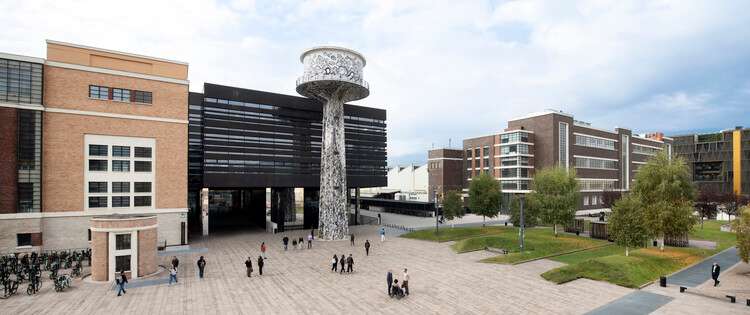
NOI Techpark was developed from 2012 onwards on the former Alumix aluminum factory site in Bolzano, a complex of rationalist industrial buildings under historical protection. Today it hosts over 70 companies and start-ups, four research institutes including Fraunhofer Italia and Eurac Research, and three faculties of the Free University of Bozen-Bolzano. The new A7 pavilion will sit in a strategically prominent position directly opposite the main entrance building (A1), adjacent to the existing swimming pool — a remnant of the site’s modernist industrial past. The pavilion brings architecture, cultural programming, and scientific research into direct proximity for the first time at this site.
Intent
The competition seeks a design that embodies the cross-disciplinary spirit of the techpark, creating a building capable of fostering genuine collaboration between art and science. The pavilion is not intended as a standard cultural venue, but as a space for active experimentation — a place where art functions as a tool for transformation and innovation, not merely for display.
Purpose
The competition is a restricted procurement procedure organized under Italian public procurement law. Its purpose is to identify the best design concept and award the resulting design services contract to the winning team. The estimated construction cost is 1,919,318 euros. The competition addresses a real gap in NOI Techpark’s programmatic offer: while the campus is well-equipped for scientific research, it currently lacks a dedicated space for the kind of cultural and artistic experimentation the brief describes. Architects interested in design competitions tied to publicly funded cultural infrastructure will find the institutional context here unusually substantive.
Requirements
The competition is structured as a single-phase restricted procedure with a pre-qualification stage. In the pre-qualification phase, applicants must submit:
- A reference project demonstrating work of comparable complexity (built or award-winning unbuilt project)
- A participation application form
- Annex A (system-generated)
- A stamp duty declaration
- The European Single Procurement Document (ESPD), system-generated
Reference projects may be public or private buildings. They must demonstrate contextual sensitivity and a level of complexity similar to the competition subject. Pre-qualification evaluation criteria are: urban quality, architectural quality, functional aspects, and environmental sustainability in construction and management.
The functional programme for the pavilion includes: a foyer with cloakroom, a performance hall equipped for lectures, concerts, film projections, and exhibitions, and two artist-in-residence spaces for workshops and educational activities. The brief places particular emphasis on architectural quality, originality, environmental sustainability, energy efficiency, use of recycled or recyclable materials, structural durability, and acoustic and lighting comfort, in accordance with Italian minimum environmental criteria (CAM). All submissions are evaluated anonymously. Submissions are made via the bandi-altoadige.it platform.
Jury
The jury composition is not publicly disclosed in the available competition documentation. The competition is organized by NOI Spa and conducted anonymously through the official South Tyrolean public procurement platform. No named jury members have been identified in the official call or third-party publications at the time of writing.
Fees
| Item | Details |
|---|---|
| Registration Fee | Free (public restricted procedure) |
| Submission Fee | Free |
| Submission Platform | bandi-altoadige.it (ausschreibungen-suedtirol.it) |
Rewards
| Prize | Amount | Details |
|---|---|---|
| 1st Place | 12,600 euros | Cash prize for the winning design |
| 2nd Place | 9,000 euros | Cash prize |
| 3rd Place | 5,400 euros | Cash prize |
| Honorable Mentions | 9,000 euros total | Distributed among selected additional entries |
| Total Prize Fund | Up to 36,000 euros | Combined prizes and honorable mentions |
| Construction Budget | 1,919,318 euros | Estimated cost of works for the winning design to be built |
Dates
| Milestone | Date |
|---|---|
| Competition Published | 12 May 2026 |
| Pre-qualification Submission Deadline | 29 June 2026, 12:00 PM |
| Submission Platform | bandi-altoadige.it / ausschreibungen-suedtirol.it (Tender No. 031663-2026) |
✦ ArchUp Competition Review
This competition is organized by NOI Spa, an in-house company of the Autonomous Province of Bolzano — a public body with a well-documented institutional track record in managing one of northern Italy’s most significant innovation campuses. The organizational credibility is high; the competition is conducted under Italian public procurement law with anonymous evaluation and formal pre-qualification, which provides a structured and transparent process. The most notable limitation in terms of transparency is the absence of named jury members in the publicly available documentation — a gap that reduces the ability to assess the independence and depth of the evaluation panel. The brief itself is one of the stronger aspects of this call: it targets a real site with historical significance, a defined functional programme, and a clearly articulated design ambition rooted in the relationship between architecture, art, and science. The prize structure — 36,000 euros total — is modest relative to the 1.9 million euro construction budget and the complexity of a cultural pavilion brief, but the primary benefit for the winning team is the design commission itself. The restricted procedure with pre-qualification effectively limits participation to offices with a demonstrable track record in comparable public or cultural buildings, which filters out less experienced studios. For practices with relevant experience in cultural architecture competitions and Italian public procurement, this is a credible and well-grounded opportunity with a real built outcome.
Final Thoughts
The NOI Techpark pavilion competition sits at a point where public infrastructure investment, cultural programming, and architectural ambition converge in a genuinely unusual way. The techpark itself is a recognized model for the adaptive reuse of industrial heritage — the former Alumix factory was transformed into a LEED v4 Neighbourhood Development Gold-certified campus, the first in Europe — and the new pavilion extends that approach into cultural and artistic territory.
The brief’s insistence on treating art as a tool for experimentation, not just display, is a more specific and demanding framing than is typical for cultural building competitions. Participants will need to demonstrate not just architectural competence but an understanding of how interdisciplinary programming works spatially.
The jury’s non-disclosure is a structural weakness. For a public competition of this nature, identifying the evaluation panel in advance is standard practice and an important signal of institutional transparency. Its absence here is notable, even if the anonymous evaluation process itself is procedurally sound.
The prize fund of up to 36,000 euros is low for a competition asking for design proposals for a 1.9 million euro cultural building on a historically significant site. The compensation is more appropriate for a pre-qualification stage than for a fully developed design competition — though it is important to note that the pre-qualification phase only requires a reference project submission, not a full design proposal. The full design development burden falls after selection.
For established Italian or European offices with experience in cultural and public architecture, this is a substantive public commission with a clear institutional backer, a coherent brief, and a real construction budget. You can explore more similar institutional architecture competitions on ArchUp.
Registration Deadline
Brought to you by the ArchUp Editorial Team
Inspiration starts here. Dive deeper into Architecture, Interior Design, Research, Cities, Design, and cutting-edge Projects on ArchUp.