The Pattern That Nature Also Solved

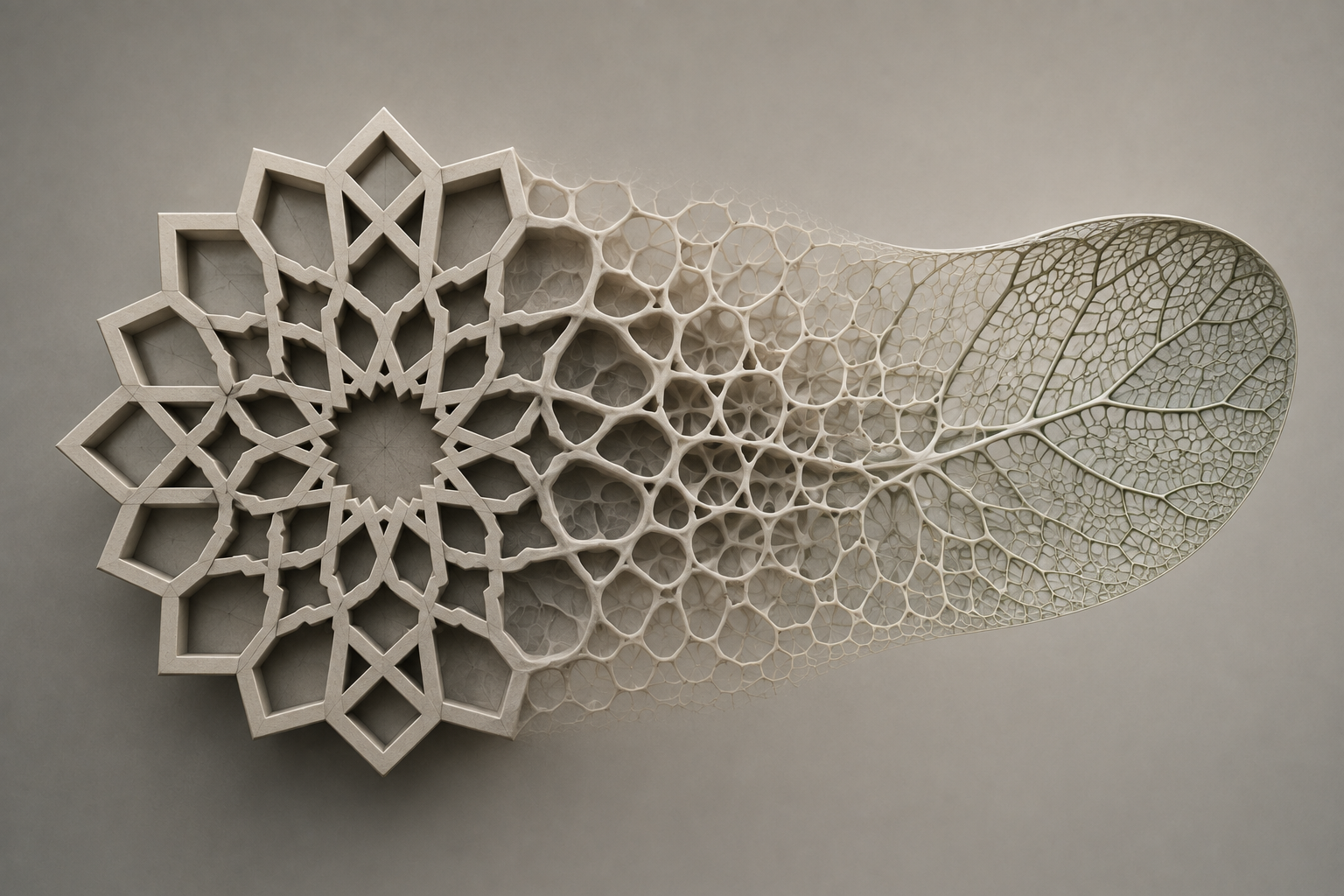
Islamic geometric patterns share deep structural and generative mathematical logic with natural systems like quasicrystals, plant growth, and cellular structures. Rather than intentional imitation, this represents a mathematical convergence, as medieval artisans independently discovered the same fundamental rules that govern physical and biological organization.
These historical patterns rely on iterative rules, recursive scaling, and emergent order rather than simple visual resemblance. Modern architectural practice applies these generative principles to parametric design and environmental optimization, transforming traditional geometry into performative, functional engineering solutions rather than mere decorative motifs.
In 2007 two physicists published a finding that should have unsettled every historian of Islamic art, and quietly did. Looking at the tilework of the Darb-i Imam shrine in Isfahan, completed in 1453, they found a pattern that Western mathematics did not describe until the 1970s and did not find in nature until the 1980s. The craftsmen of Isfahan had built a quasicrystal, an arrangement that never exactly repeats yet is not random, ordered by the golden ratio, five centuries before Roger Penrose drew it on paper and before anyone detected it in the atomic lattice of a metal alloy. This is the fact that reframes the entire conversation about Islamic ornament, and it is worth stating precisely, because the temptation is to treat it as a charming coincidence. It is not a coincidence. It is evidence that the artisan working with compass and straightedge, and nature working with atoms and cells, were solving the same mathematical problem, and arriving, independently, at the same answer.
That is the real subject worth pursuing, and it is more demanding than the usual admiration of Islamic geometry. The question is not whether the arabesque looks like climbing vines or the muqarnas looks like a cave of hanging stone. Of course they do, and that resemblance is the shallowest thing about them. The serious question, the one a growing body of research has begun to answer, is whether the deep structure of these patterns, the rules that generate them, is genuinely the same structure that governs how a plant arranges its leaves, how a tissue packs its cells, how a lung branches, how a zebra gets its stripes. And the answer, carefully qualified, is yes, in specific and measurable ways, though almost never because anyone intended it. This distinction, between looking alike and being alike, is the whole intellectual spine of the matter, and getting it right is what separates a real architectural hypothesis from a decorative metaphor.
Resemblance Is Not Homology
Begin by clearing away the false cases, because the field is littered with them and they discredit the true ones. The arabesque, the flowing vegetal scrollwork, genuinely resembles tendrils and vines, but its construction follows circle based grid systems inherited from Sassanid and Byzantine precedent, not any biological growth algorithm. Its likeness to a plant is a matter of cultural transmission and visual metaphor, not shared mathematics. The muqarnas is habitually called stalactite vaulting because it hangs like mineral formations in a cave, but a stalactite is deposited drop by drop by chemistry while a muqarnas is composed cell by cell by geometry, and the fact that they end up looking similar tells you nothing structural. If the argument for a connection between Islamic ornament and nature rested on these resemblances, it would be worth nothing, and the honest scholar has to say so plainly before making the stronger claim. Most popular writing on this subject never gets past the resemblance, which is exactly why it never says anything.
The genuine homology lives somewhere else, in the generative logic rather than the finished appearance, and it has four signatures that recur in both the architecture and the biology. Both build complexity by iterating simple local rules rather than by drawing a complex whole. Both scale hierarchically according to irrational proportions, the golden ratio above all. Both produce emergent order that the rules do not obviously predict. And both tend to settle at the edge between rigid order and chaos, the zone where the most intricate and most stable patterns appear. When a pattern and a tissue share those four properties, they are not merely similar. They are, in a real mathematical sense, the same kind of object, and that sameness is what the recent research has been documenting with increasing rigor.
The Documented Cases
Consider what has actually been shown, because the evidence is specific rather than poetic. The girih patterns, reconceived around 1200 as tilings of five standard polygons and combined by the fifteenth century with self similar subdivision, generate at Darb-i Imam a nearly perfect quasi periodic order in which the ratio of one tile type to another approaches the golden ratio, the identical signature that defines a Penrose tiling and a physical quasicrystal. The connection to life is not forced. The same golden ratio governs phyllotaxis, the arrangement of leaves and seeds in plants, and quasicrystalline packing has been proposed as the very mechanism behind it, which means the girih tiling, the sunflower head, and the atomic alloy are three expressions of one underlying rule. The muqarnas, analyzed across the levels of a bazaar vault, proves to be fractal, a rhomboid seed scaling and multiplying in self similar steps toward unity at the apex, in exactly the way a bronchial tree or a vascular network branches, and computational fractal analysis of a Sinan mosque has measured this nested complexity numerically, the same technique biologists use to characterize a lung surface.
The parallels reach into the mechanism of formation itself, which is where the analogy becomes most serious. Square Kufic script, the blocky calligraphy that tiles so many Persian domes and walls, has been regenerated by cellular automata, the computational model in which simple rules applied to a grid of cells produce complex global patterns, and the automaton reproduced a historical inscription almost cell for cell. This matters because cellular automata are one of the standard models of biological morphogenesis, the process by which cells, following only local signals, differentiate and organize into an organism. When the same computational engine that models a developing tissue also reproduces a seven hundred year old inscription, the construction of the pattern and the construction of the body are revealed to share a grammar. Voronoi tessellation, the space filling scheme found in epithelial cells and bone and dragonfly wings, produces, when organized around centers through shape grammars, patterns exhibiting all the characteristics of biological growth and identical to the principles of Islamic geometry. And an algorithmic survey of hundreds of historical hexagonal patterns found that they occupy only a small subset of the mathematically possible design space, sharing deep structural equivalence beneath surface variety, exactly as biological species share deep genetic homology beneath divergent forms. The patterns evolved, in other words, the way life evolves, a limited set of generative rules exploring a vast space of possible forms and actualizing only a fraction.
Convergence, Not Imitation
Here the argument must make its most important move, the one that keeps it honest and, paradoxically, makes it more profound rather than less. These analogies are almost entirely convergent, not causal. The medieval artisan did not study cells or leaves and set out to imitate them. He worked with a compass and a straightedge and a philosophical commitment to unity expressed through multiplicity, and that geometry led him, inevitably, to the pentagon, the decagon, the recursive subdivision, and therefore to the golden ratio, because the golden ratio is not a biological quotation but an unavoidable outcome of those constructions. Nature arrived at the same ratio from the opposite direction, through the physics of packing and the pressures of evolution. Two systems, one working in stone and thought, the other in tissue and time, converged on the same mathematics because the mathematics was true independently of both. This is a deeper claim than imitation could ever be. Imitation would make Islamic ornament a clever copy of nature. Convergence makes it an independent discovery of the same underlying order, which is a far greater achievement, and a far more interesting one for a designer to inherit.
Understanding this correctly changes what the tradition offers contemporary practice. If the patterns were mere copies of natural appearance, the modern architect could do no better than copy them in turn, and the design would remain decorative. But if the patterns are independent solutions to real mathematical problems of packing, scaling, and emergence, then they are usable as engineering, and this is precisely how the most serious contemporary work is treating them. Islamic patterns are being rebuilt parametrically so that a single rule set generates infinite variations, the way a genetic network generates the diversity of a species. Responsive facades have been modeled directly on the signaling dynamics of epithelial cells, translating biological feedback into surfaces that open and close with the sun. Mashrabiya screens, the great environmental filters of Islamic building, are being optimized by genetic algorithms for daylight and cooling, treated as performative systems that balance light, air, privacy, and structure the way a biological membrane balances competing functions at once. In each case the pattern is no longer ornament applied to a finished building. It is the functional logic of the building itself, and the projects that understand this are producing surfaces that are simultaneously heritage and high performance, which is the combination the region most needs and least often achieves.
The Questions Still Open
What makes this a live research frontier rather than a closed case is how much remains genuinely unstudied, and here the honest scholar becomes an excited one, because the gaps are wide and reachable. No one has yet tested whether the star and polygon patterns of Islamic geometry are formally equivalent to reaction diffusion systems, the Turing equations that generate a leopard’s spots and a shell’s markings, though the suspicion that they are is strong and testable by simulation. No one has analyzed the muqarnas with the structural tools of engineering to ask whether its form, which spans wide with little material, approaches the optimality of trabecular bone or honeycomb, a hypothesis that could turn a decorative vault into a structural principle. No one has compared the porosity of the mashrabiya, its connectivity and pore distribution and tortuosity, against biological filtration systems like sponge networks and diatom skeletons, though doing so could produce screens with performance no intuition would find. No one has modeled the historical evolution of the patterns themselves as an evolutionary process, asking what pressures of structure and culture and beauty selected the few patterns that were built from the vast space of those that could have been. And no one has yet trained a neural network on both Islamic patterns and biological microstructures to see whether they share a hidden mathematical space, a common ancestor of form that neither tradition could see on its own.
These are not idle speculations. They are the shape of a research program, and they point toward something the architectural research community and the fast building cities of the Islamic world are unusually well placed to pursue, a design methodology that treats the geometric heritage not as a museum of finished motifs to be quoted but as a living library of tested generative rules to be extended. The news and the design competitions still largely reward the mashrabiya as a beautiful surface, a cultural signal applied to a modern box, when the deeper prize is the mashrabiya as a proven environmental machine whose logic can be pushed far past anything the medieval builder imagined. There is a real sustainability argument in this, because a pattern that is genuinely homologous to a biological filter is, potentially, as efficient as one, and efficiency of that order is not decoration, it is performance won through geometry before any machine is switched on.
So the conclusion is not that Islamic ornament is beautiful, which needs no defending, and not that it resembles nature, which is the least interesting thing true about it. It is that the tradition, working centuries before the mathematics that would explain it, discovered structural truths that nature had also discovered, and encoded them in stone and tile with such fidelity that we are only now, with quasicrystals and cellular automata and fractal analysis, catching up to what the craftsmen already knew in their hands. The ornament was never merely on the building. It was the same kind of thinking that builds a leaf and a lung and a crystal, performed in geometry rather than in life, and the architect who inherits it inherits not a style to be copied but a science to be continued, a body of solved problems whose solutions are still, five centuries later, ahead of us in the places we have not yet thought to look.
✦ ArchUp Editorial Insight
The Darb-i Imam finding is not a discovery about Islamic ornament — it is a discovery about the relationship between constrained tools and mathematical truth, and the article’s most structurally consequential argument is the one it names precisely: that convergence is a deeper claim than imitation, because two systems arriving independently at the same solution reveals something about the solution rather than about either system. The medieval artisan with compass and straightedge and the physicist working with atomic diffraction data were both operating under constraints — one material and philosophical, the other experimental and mathematical — and those constraints led both, through different paths, to the golden ratio, because the golden ratio is an unavoidable outcome of those constructions rather than a cultural preference either party had the option to refuse. What the article does not fully pursue, however, is the institutional consequence of this finding for contemporary practice, which is the question this archive has traced from Vernacular Architecture and Cultural Identity through The Indonesian Consulate to Makkah and Jeddah: the profession consistently inherits geometric systems as surfaces to be quoted rather than as generative logics to be extended, not because it lacks the mathematical capacity to distinguish between the two, but because the procurement model that governs the heritage brief rewards visual recognition over structural fidelity — the client who can see the pattern on the facade considers the tradition honored, and the architect who has encoded the pattern’s generative rule into the building’s environmental performance has produced something the brief never asked for and the appraisal will never measure, which means that the distance between the Isfahan craftsman and the parametric designer is not primarily a distance of knowledge but of incentive, and closing it requires not better software but a different conversation about what the commission is actually for.
Ibrahim Fawakherji — ArchUp
Sources
- Lu PJ, Steinhardt PJ. Decagonal and quasi crystalline tilings in medieval Islamic architecture. Science, 2007, 315(5815), 1106 to 1110.
- Al Ajlouni RA. The global long range order of quasi periodic patterns in Islamic architecture. Acta Crystallographica Section A, 2012, 68(2), 235 to 243.
- Kiani Z, Amiriparyan P. The structural and spatial analysing of fractal geometry in organizing of Iranian traditional architecture. Procedia Social and Behavioral Sciences, 2016, 216, 766 to 777.
- Ostwald MJ, Ediz O. Measuring form, ornament and materiality in Sinan’s Kilic Ali Pasa Mosque: an analysis using fractal dimensions. Nexus Network Journal, 2014, 17(1), 5 to 22.
- Sabetfard M, Nadimi H. Generating square Kufic patterns using cellular automata. Nexus Network Journal, 2019, 22(2), 275 to 290.
- Herr CM, Ford RC. Cellular automata in architectural design: from generic systems to specific design tools. Automation in Construction, 2016, 72, 39 to 45.
- Gago RM. Architectural design through the geometrical principles of biological growth. Periodica Polytechnica Architecture, 2016, 47(1), 8 to 13.
- Alani MW. Algorithmic investigation of the actual and virtual design space of historic hexagonal based Islamic patterns. International Journal of Architectural Computing, 2018, 16(1), 34 to 57.
- Abdullahi Y, Embi MRB. Evolution of Islamic geometric patterns. Frontiers of Architectural Research, 2013, 2(2), 243 to 251.
- Zahri M. Mathematical modeling of a class of symmetrical Islamic design. Symmetry, 2019, 11(4), 517.
- Ma Y, Mohd Ariffin NF, Abdul Aziz F, He X, Tong Q, Yu M. Innovative design of Islamic geometric patterns in living spaces: parametric and digital design with Grasshopper and ControlNet. Nexus Network Journal, 2024, 26(4), 853 to 876.
- Dutt F, Das S. Computational design of a bio inspired responsive architectural facade system. International Journal of Architectural Computing, 2012, 10(4), 613 to 633.
- Vazquez E, Duarte J, Poerschke U. Masonry screen walls: a digital framework for design generation and environmental performance optimization. Architectural Science Review, 2020, 64(3), 262 to 274.