When Makkah Looked to the Sky and Jeddah Looked to the Sea

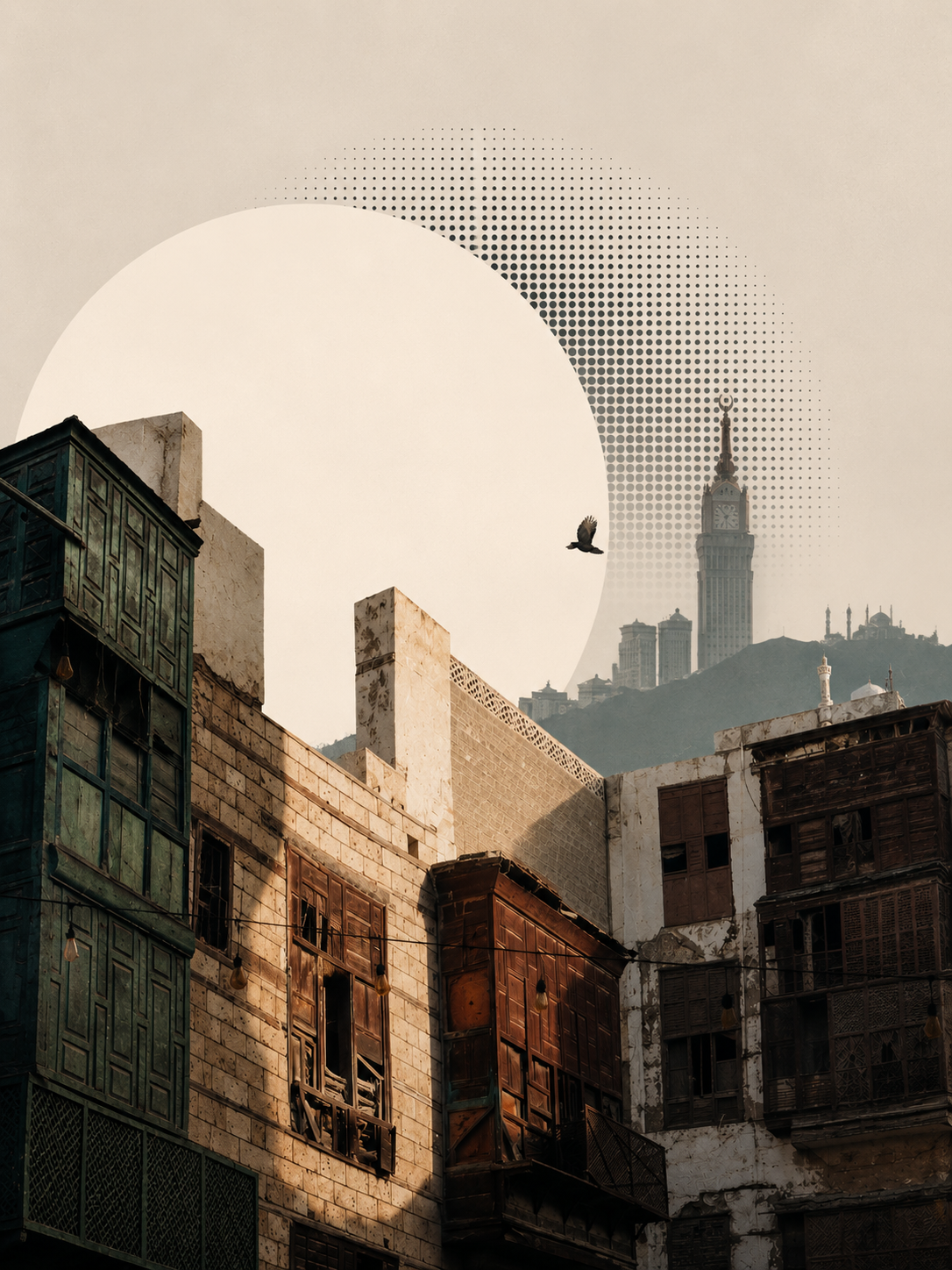
Stand on the mountains above Makkah four hundred years ago and you would not have seen a single ship. Stand on the shore at Jeddah and you would never have glimpsed the Ka’ba. Between them lay a hard day and night of caravan across bare country, and yet neither city could survive a week without the other. The scent knew this before any map did. In both places the same incense moved through the same carved wooden screens at dusk, oud and sandalwood that had come up on the same vessels as the timber those screens were cut from, because the smoke, like the wood it curled around, had crossed the Indian Ocean to arrive. That is the fact this article is built on, and it is easy to miss because it hides in plain sight. Makkah and Jeddah were never two rival cities. They were one city with two personalities, and the distance between them was not a separation but a division of labor.
One of them was governed by the sky. The other was governed by the sea. Makkah grew concentrically around the Ka’ba at the lowest point of the valley of Ibrahim, and everything in it, its density, its land values, the way the houses climbed the surrounding hills, was dictated by a single force, the universal desire of the pilgrim to sleep within walking distance of the Haram. Jeddah grew along a different logic entirely, strung between its gates and its harbor, a walled mercantile port whose reason for existing had been fixed as early as the year 647, when it was designated the landing place for pilgrims arriving by sea. The sanctuary city faced upward, toward the vertical fact of the sacred. The port city faced outward, toward the horizontal fact of trade. And the architecture each produced was the precise handwriting of that orientation.
I want to describe the two urban temperaments before the history, and I offer this as an impression rather than a proven fact, the kind of thing one senses walking both cities rather than reading them. The person of Makkah lives inside sharp terrain, always climbing or descending, the whole town bent toward one center, movement quick and channeled by the valley walls. The person of Jeddah lives on the flat, with the sea lying open in front, a slower rhythm, a wider mix of faces, the pace of a place that waits for ships rather than one that answers a call to prayer five times a day. I cannot prove that geography writes itself into character. But the two cities feel like two people, and the feeling is consistent enough that I trust it as an observation even where I would not defend it as a law.
The Red Sea Did Not Divide the Cities, It Connected Them
Here is the sentence that unlocks everything, and it took me years to see it. The Red Sea was not a barrier between Jeddah and the world. It was the road that carried the world to Jeddah. This is why scholars since the 1950s have spoken of a Red Sea Style, a shared architectural language of coral stone masonry, lime plaster, and carved timber that appears not only in Jeddah but in Yanbu, in Suakin on the Sudanese coast, in Massawa, in the Yemeni ports, a family of buildings that belong to the water rather than to any single shore. That style was not imposed by any empire. Ottoman rule after 1517 supplied the political frame and the commercial security, but the houses themselves were built privately by the merchants and officials who circulated through the ports, which means the buildings are the physical record of a genuinely cosmopolitan sea. Jeddah was never only a Hijazi town. It was bound by daily traffic to Sudan, to Yemen, to Egypt, to India, to Java, to East Africa, and its design traveled in and out with the tides.
Nothing shows this more plainly than the timber. The Hijaz has almost no structural wood of its own, so the beams and the joinery of Jeddah came by sea, teak and shorea from southern India, from Burma, from Java, carried conveniently as ballast in the holds of Indian Ocean ships and unloaded onto a coast that had no forests. The construction of a Jeddah house was therefore an act of maritime logistics before it was an act of building. The most famous illustration is Bayt al-Nasif, raised between 1872 and 1881, whose patron, tradition holds, bought a wrecked teak ship simply to salvage its timber for the walls and screens of his house. Whether or not the story is literally true of that one house, it is true of the whole city. Jeddah was assembled, in part, from the dismantled bodies of the ships that served it, a port that built itself out of the sea’s own vessels.
The signature material beneath the timber was coral. The best of it, the manqabi, was cut fresh from the living reefs of the seabed, soft enough to carve when first raised and hardening in the air, so that the city was literally quarried out of the water it sat beside. Coral is porous and weak, vulnerable to salt and humidity and the abrasion of sandstorms, which forced an entire engineering culture into being. Walls ran some eight hundred millimeters thick at the base and stepped inward floor by floor. They were wrapped always in lime render burned from coral rubble and seashells. And crucially, horizontal courses of timber were laid into the masonry at intervals of roughly a meter and a quarter, the taqlilat, which gave the brittle coral wall the tensile give it lacked and absorbed the movement of heat, and which were deliberately left accessible so that a mason could later shore up the wood and replace a failed stone beneath it. Burckhardt already noticed in 1814 that Jeddah’s buildings tended to fail at their shallow foundations, and the whole ingenious system of timber reinforcement was the city’s long answer to the weakness of its own material. This is the sustainability of necessity, a building culture that turned a poor stone and an imported stick into a coherent structural logic that stood for centuries.
The Screen That Breathed
If coral was the body of the Red Sea house, the rawshan was its face, and it is the emblem of the whole tradition. The rawshan, plural rawashin, is the projecting latticed wooden bay window that hangs over the street, a three sided timber box deep enough to sit or recline inside. Its intelligence is environmental and social at once. It let in graded light and controlled the airflow, and because the wood itself absorbs and releases moisture it cooled and humidified the breeze as it passed. It lowered the interior temperature. And it gave privacy, allowing the women of the house to watch the street without being seen, a single carved object solving climate and custom in the same gesture. In Jeddah the rawashin were stacked one above another until they formed a second projecting facade for the entire house, a cliff of carved teak animated by shadow, and the merchant boom that followed the opening of the Suez Canal in 1869 pushed these facades ever higher and ever more elaborate as families like the Naseef and the Nawar and the Hazzazi rebuilt to display their new wealth.
And the rawshan carries the region’s whole cultural entanglement in its joints. It resembles the Cairene mashrabiyya but is not the same, the mashrabiyya turned from ebony and beech, the rawshan built of flat carved teak from Asia. Scholars have traced its ancestry to Anatolia, to Egypt, to Gujarat, to the Swahili coast, and the honest conclusion is that the strands of trade and migration in the Red Sea are too knotted for any single origin to win. There is even a folk story that Indian sailors carved Jeddah’s screens while their ships lay waiting in the harbor, almost certainly not true, but revealing in its persistence, because everyone who looked at these screens understood instinctively that they had arrived by sea. The rawshan is the memory of the ocean, written in wood, hung on the front of the house for everyone to read.
Meanwhile Makkah wrote its identity in a different register, because Makkah answered to the sky rather than the sea. It had no central square, no royal palace, no civic monument in the European sense. It had the Haram, and everything else arranged itself as a response to that gravitational center. A dense ring of dwellings, colleges, and pilgrim hostels pressed directly against the sanctuary walls, doors and windows opening straight into its colonnades, and the residential quarters climbed the hills behind because nearness to the Ka’ba was the one thing that set the price of land. The colleges themselves were astonishingly international. Between the twelfth and fifteenth centuries, madrasas in Makkah were endowed by Syrian merchants, by the sultans of Yemen, by Mamluk officials, and by the rulers of Bengal, of the Deccan, of Cambay on the Indian coast, all of them funding through distant endowments a foothold beside the sanctuary. The same sea that fed Jeddah with teak fed Makkah with patronage, and the two dependencies were the two halves of a single system.
Two Clocks Running at Once
Now close your eyes and let the centuries move, because the comparison the research invites is with Europe, and it is most honest when it is set side by side rather than ranked. Around the year 1600, while the cities of Europe were being reshaped by bastioned fortifications, aristocratic palaces, and the first deliberate state planning, the Hijazi cities grew organically, without squares or boulevards or civic monuments, and European travelers registered the difference with a consistent disappointment, praising the picturesque first view from the sea and then finding the labyrinth within illegible. Jeddah in that century was a city of coral houses and rising rawashin, of Javanese and Indian timber, of merchants and pilgrims and ships. Makkah was a city with no center but the Ka’ba, spreading around the sanctuary like iron filings around a magnet. Neither was a failed version of a European city. Each was an exact answer to a different question. Europe was arranging the display of power it already held. The Hijaz was arranging the reception of the world.
Then jump two centuries and the two clocks that had run at different speeds briefly synchronize. Around 1800 Europe entered its industrial age, and within a few decades the Suez Canal, the steamship, the telegraph, and eventually the Hijaz Railway inserted Jeddah and Makkah into a single global circulation. The effect on the fabric was immediate. Jeddah’s houses climbed to six and seven and even eight storeys, each floor a household of one extended clan around a spiral stair, the ground floor kept for warehouse and office and reception, because in a merchant city the home was also a place of business where goods could be received and pilgrims could be lodged for rent. The projects that most defined the age, though, were not houses at all. They were waterworks. Because the pilgrimage became an international public health emergency after the cholera epidemics of the 1860s, the Ottoman state overhauled the ancient ‘Ayn Zubayda aqueduct that carried water from Wadi Nu’man to Makkah, built cisterns and fountains and ablution stations, and eventually piped water toward Jeddah, culminating in the city’s first desalination plant in 1911, known locally as al-Kandasa. The deepest engineering of these cities was never in their monuments. It was in the quiet, relentless problem of bringing water to a valley and a coast that had almost none.
It is worth pausing here to set the coast against the interior, because it completes the picture and connects to the mud towns of Najd. While Jeddah was importing teak from India to hang carved screens over its streets, the towns of central Arabia were building an entirely different identity out of unfired brick, palm wood, and local stone. This is not a contrast of better and worse. It is two environments producing two architectural languages, the humid trading coast reaching outward across the water for its materials and its motifs, the dry defensive interior turning inward to the oasis and making everything it needed from the ground beneath it. The Red Sea house was a sheath of imported surfaces on a cosmopolitan society. The Najdi house was a compact system sealed against heat and threat. They are two dialects of survival, spoken in the same peninsula, and the fact that they sound nothing alike is the most Arabian thing about them.
The end of the old fabric came not through the gradual modernization that reshaped European cities but through sudden erasure. Jeddah’s wall was demolished in 1947, and the historic core, now called al-Balad, was slowly swallowed by the modern metropolis, its stock of traditional houses falling from around a thousand to roughly three hundred in the decades after 1980. Makkah’s transformation was more total still. The Saudi expansions from the 1950s onward swept away almost the entire historic quarter around the Haram, and of the twenty three medieval madrasas the scholarship records that no vestige survives. The architectural research that now laser scans the Nawar and Hazzazi houses, and that has demonstrated in simulation how the rawshan and the shaded court and the thermal mass of the coral wall once kept interiors bearable, is in part a race against a loss that is already far advanced. By the 2000s, only two craftsmen in Jeddah still understood the traditional construction, and only one could still make the carved lime plaster. The UNESCO inscription of Historic Jeddah in 2014 turned the news toward rescue, and al-Balad has since drawn conservation strategies, restoration loans, and the kind of design attention and competitions that heritage revival attracts, which is a return worth making, so long as what is recovered is the intelligence of the buildings and not merely their photogenic surfaces.
The two personalities have not disappeared. They have only changed their instruments. Makkah still answers to the sky, its skyline now a ring of towers looking down on the sanctuary they were built to serve, the old concentric logic of the valley made vertical and enormous. Jeddah still answers to the sea, a commercial and cosmopolitan city whose historic heart, for all its losses, still carries in its surviving coral walls and teak screens the memory of every coast it once traded with. The incense that opened this article still drifts through the ports of the Red Sea, and it still arrives, as it always did, from somewhere across the water.
So the conclusion is not a comparison of two cities but a single realization about how they were bound. Remove Jeddah and Makkah cannot reach the sea. Remove Makkah and Jeddah becomes a harbor with no destination, a gate opening onto nothing. For five centuries these were not merely neighbors. They were two organs of one body, drawn by geography, fixed in coral and teak by architecture, and kept alive by the ceaseless movement of pilgrims and merchants between the valley and the shore. The sky needed the sea to arrive, and the sea needed the sky to have a reason to come, and the truest monument of the Hijaz was never a single building in either city. It was the seventy kilometers of road between them, along which an entire civilization walked, sailed, and breathed as one.
✦ ArchUp Editorial Insight
The rawshan is not a design feature — it is a logistics document, and the article’s most structurally precise contribution is its demonstration that the carved teak screen hanging over a Jeddah street is simultaneously an environmental engineering device, a social governance instrument, and a material record of the Indian Ocean trade network that made its existence possible, which means that its disappearance is not an aesthetic loss but the erasure of a complete technical system whose intelligence — the moisture absorption, the graded privacy, the passive cooling — was encoded in the joinery itself and cannot be recovered by photographing the surviving examples. The division of labor the article describes between Makkah and Jeddah is the most analytically compact urban model this archive has encountered: one city governed by inelastic doctrinal demand, the other by elastic commercial supply, each incapable of independent survival, producing together a territorial economy whose architectural grammar was dictated not by any planner or patron but by the physical properties of coral quarried from the seabed, timber salvaged from wrecked ships, and the seventy kilometers of caravan road that connected a valley with no harbor to a harbor with no sacred center. The article’s most uncomfortable implication — which it approaches but does not fully name — is that the UNESCO inscription and the restoration competitions now directed at al-Balad are subject to the same structural critique this archive identified in Vernacular Architecture and Cultural Identity and in The Kingdom of the Stone Markers: heritage recovery that reconstructs the surface of a building culture without reconstructing the trade network, the craft transmission, the two remaining craftsmen who understood the lime plaster, and the social system that generated the original demand for privacy and passive cooling, is not conservation — it is the production of a stage set whose photogenic coral walls accurately represent a civilization that the restoration process itself has already decided cannot be allowed to fully return.
Ibrahim Fawakherji — ArchUp
Sources
- Um N. Reflections on the Red Sea Style: beyond the surface of coastal architecture. Northeast African Studies, 2012, 12(1), 243 to 271.
- Orbasli A. The conservation of coral buildings on Saudi Arabia’s northern Red Sea coast. Journal of Architectural Conservation, 2009, 15(2), 49 to 64.
- Abdulgani K. Jeddah. Cities, 1993, 10(1), 50 to 59.
- Alelwani R, Ahmad M, Rezgui Y. Public perception of vernacular architecture in the Arabian Peninsula: the case of rawshan. Buildings, 2020, 10(9), 151.
- Trevathan I, Chaplin TD. Framing the sanctuary: a study of paintings on Sinan’s domed arcade in the Grand Mosque of Mecca. Journal of the American Institute for Conservation, 2021, 61(3), 145 to 161.
- Low MC. Ottoman infrastructures of the Saudi hydro state: the technopolitics of pilgrimage and potable water in the Hijaz. Comparative Studies in Society and History, 2015, 57(4), 942 to 974.
- Mortel RT. Madrasas in Mecca during the medieval period. Bulletin of the School of Oriental and African Studies, 1997, 60(2), 236 to 252.
- Al-Hathloul S, Aslam Mughal M. Makkah: developing the Center of Islam District. Urban Design International, 2001, 6(1), 43 to 61.
- Ricca S. Urban heritage in the Arabian Peninsula: the experiences of Jeddah and Dubai. Built Heritage, 2018, 2(2), 108 to 122.
- Jäger-Klein C, Styhler-Aydın G, Radinger G, Stumpf W. Studies on solar radiation and natural ventilation in a typical historic house in the old town of Jeddah. Bauphysik, 2015, 37(6), 345 to 354.
- Peacock ACS. Suakin: a northeast African port in the Ottoman Empire. Northeast African Studies, 2012, 12(1), 29 to 50.
- Breen C, Forsythe W, Smith L, Mallinson M. Excavations at the medieval Red Sea port of Suakin, Sudan. Azania, 2011, 46(2), 205 to 220.
- Mazower M. Travellers and the oriental city, c. 1840 to 1920. Transactions of the Royal Historical Society, 2002, 12, 59 to 111.
- Higgs A, Bidwell R. Travellers in Arabia. The Geographical Journal, 1977, 143(2), 322.
- Waheeb SA. Environmental and cultural sustainability of the architectural elements of two historical mosques in historic Jeddah. Journal of Umm Al-Qura University for Engineering and Architecture, 2023, 14, 26 to 35.