Kurasu Pavilion Beijing: Coffee Rituals in Temporary Architecture

Pop-up Stores as a Platform for Architectural Experimentation
Pop-up stores have emerged as a suitable field for testing architectural ideas. They allow a clear concept to be presented within a short timeframe, without the long-term commitment that often leads to more conservative solutions. Within this context, the project under study appears as an example of such practice, where the temporary space is treated as a site for Architecture experimentation rather than a permanent building.
Transforming a Brewing Tool into Architectural Language
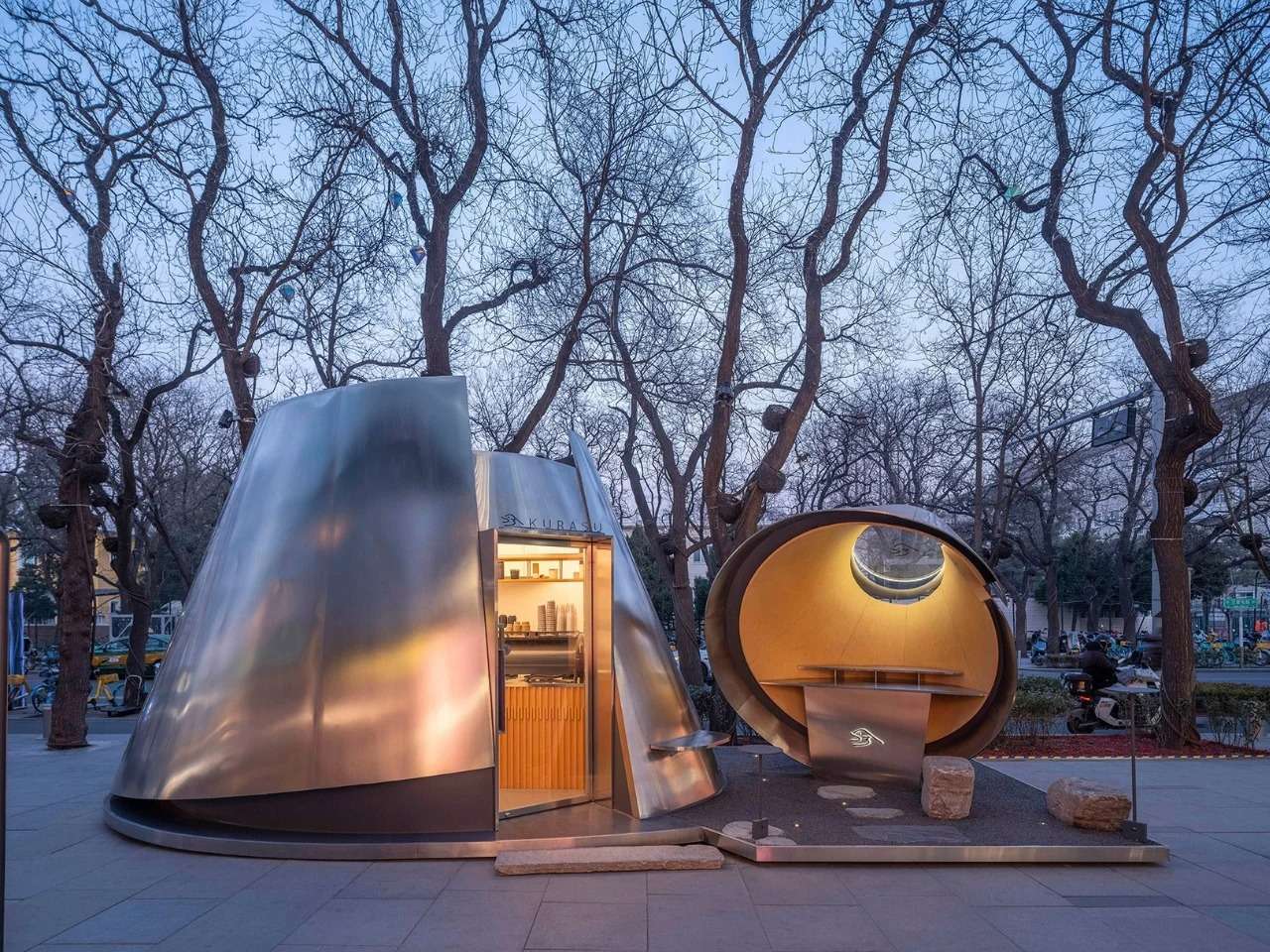
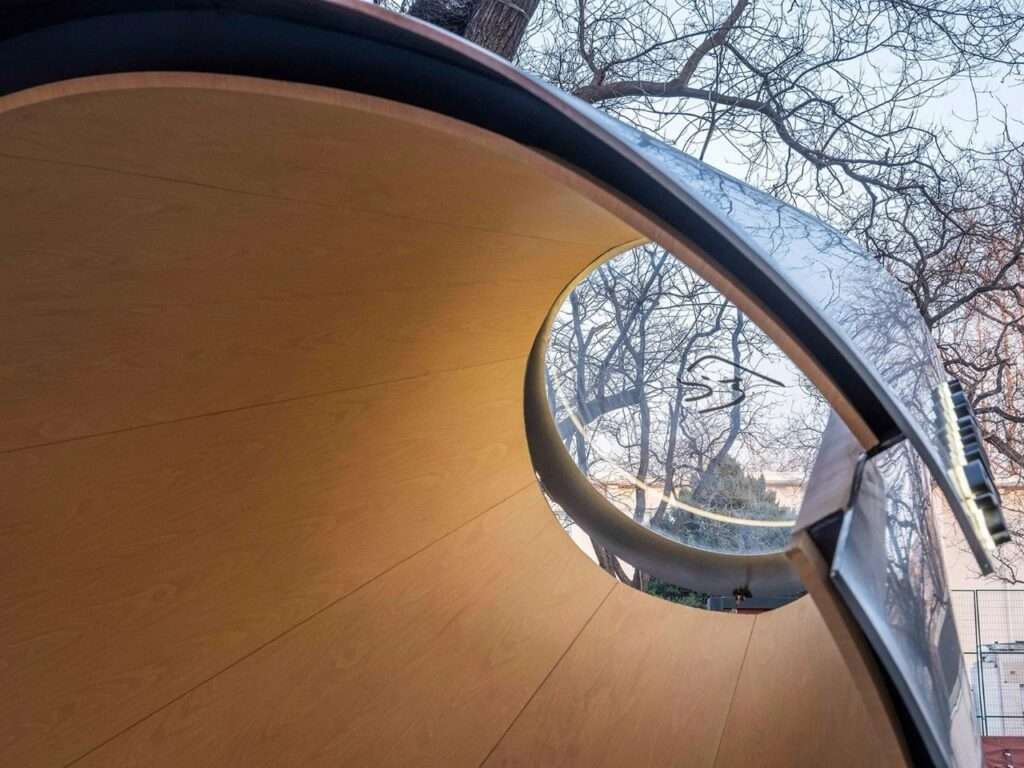
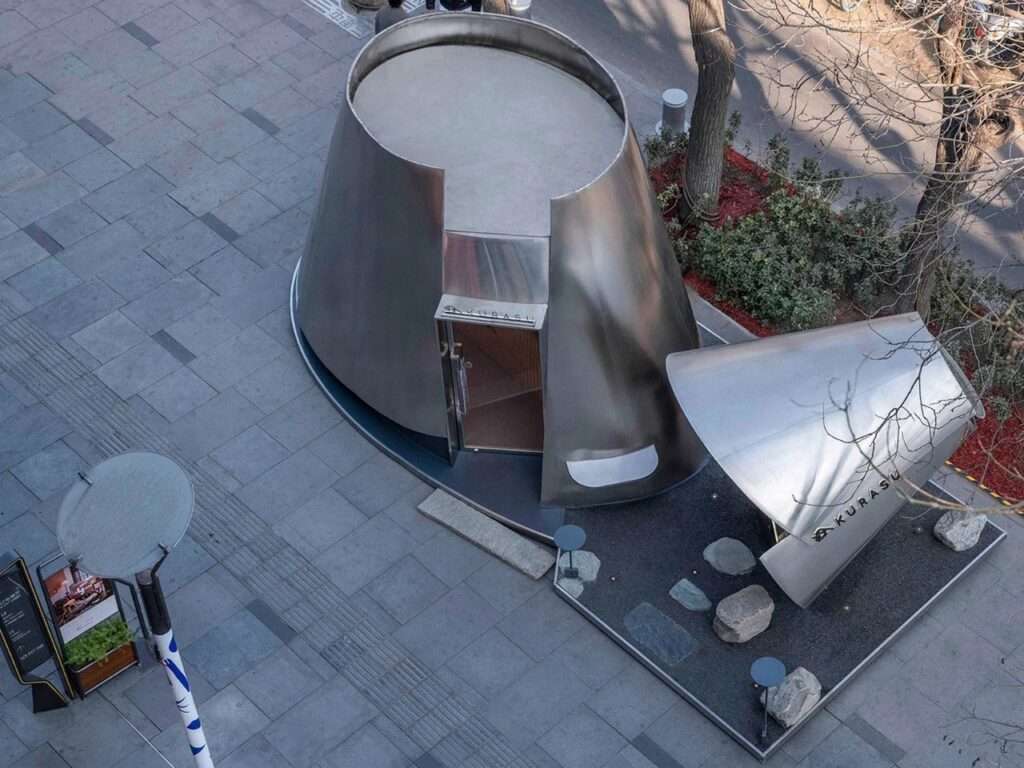
The Design concept is based on translating the logic of the pour-over coffee brewing tool into a direct architectural composition. This is achieved by scaling up the familiar conical form and turning it into a spatial element composed of two interconnected volumes. In this way, the resulting form becomes a geometric translation of a small functional object, while maintaining a clear reference to its origin.
Materiality and Reflection in an Urban Context
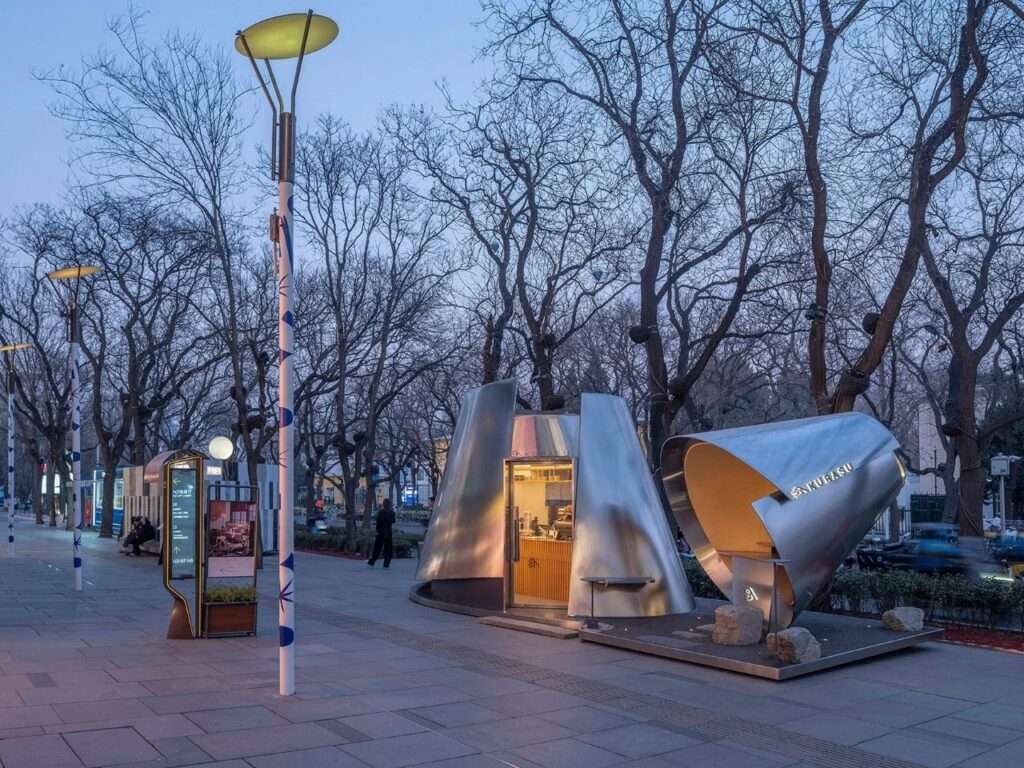
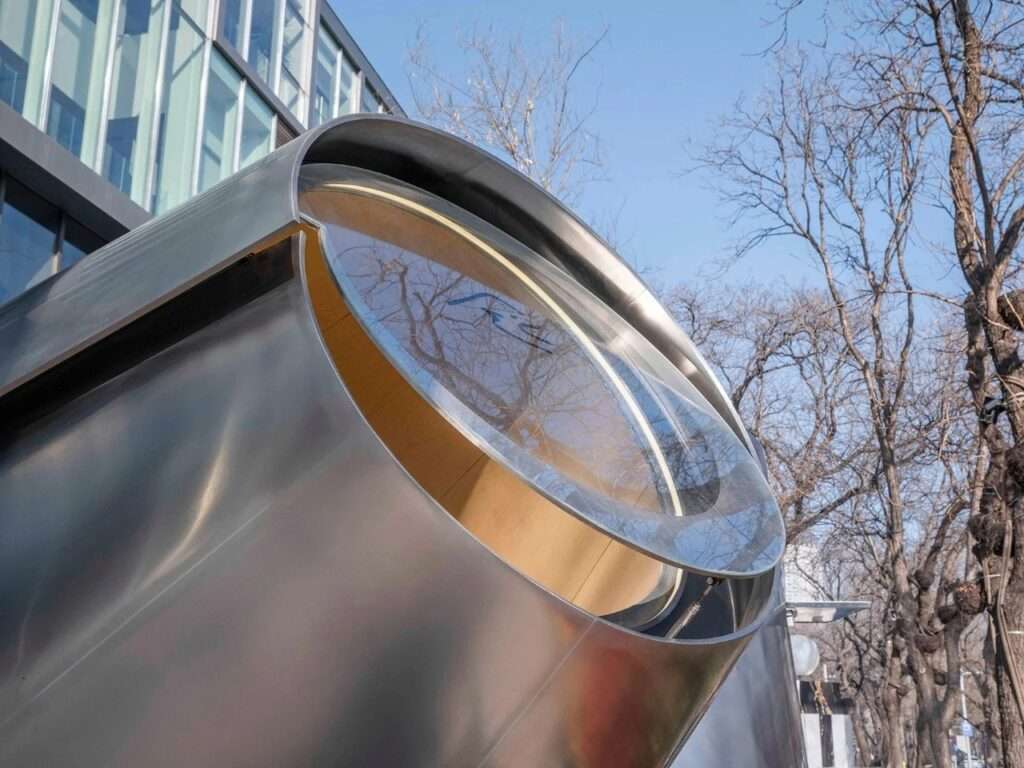
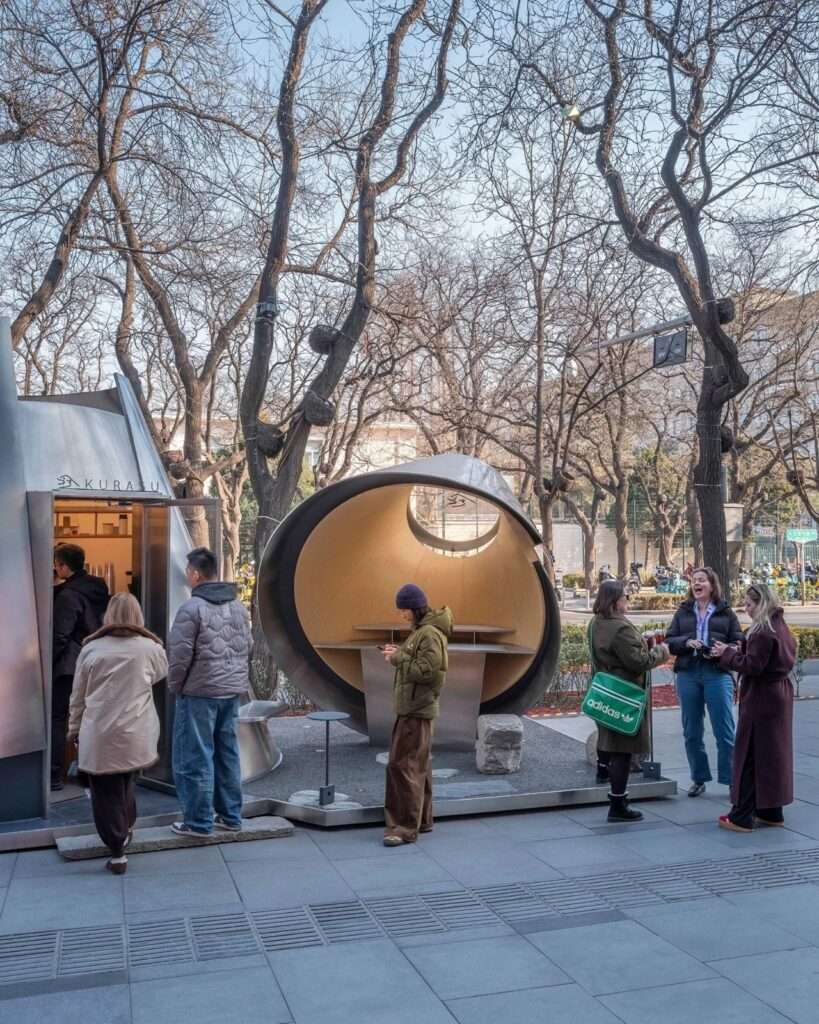
Both volumes are clad in reflective stainless steel, allowing the surface to become part of the surrounding environment rather than isolating itself from it. As a result, the structure continuously interacts with movement and light within the urban site. The overall composition also evokes an origami-like effect, where the volumes appear precisely folded, reducing the sense of mass and reinforcing the experimental character of the work. For more on innovative surface applications, explore our Material Datasheets.
The Relationship Between Volumes and the Formation of Interior Experience
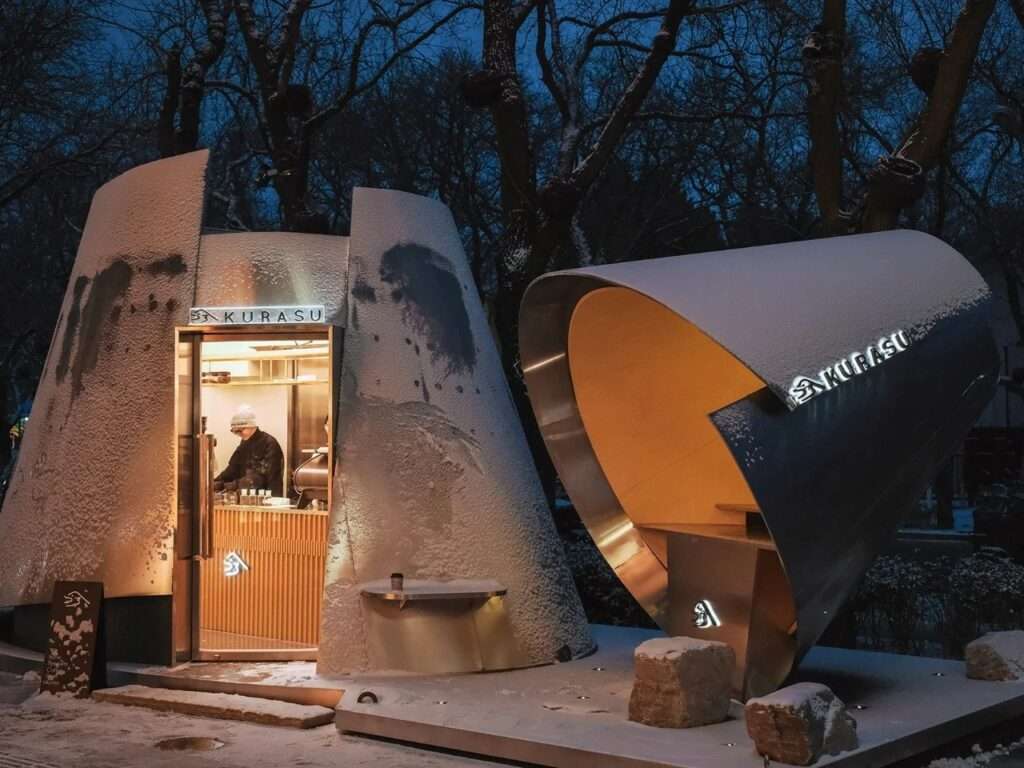
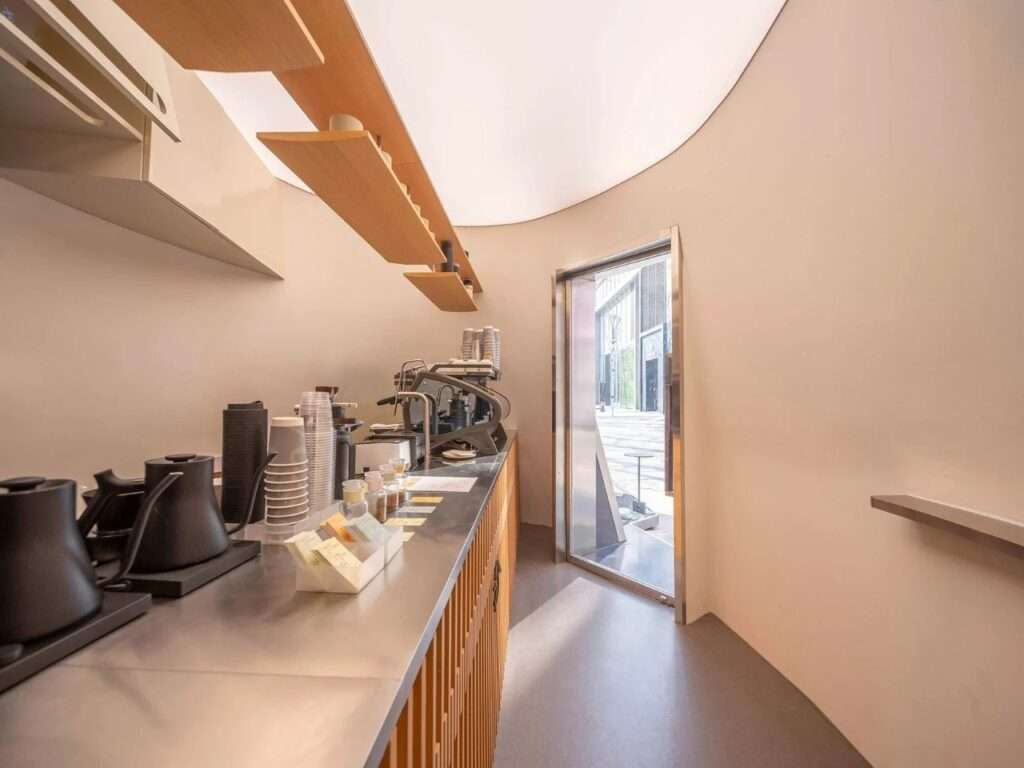
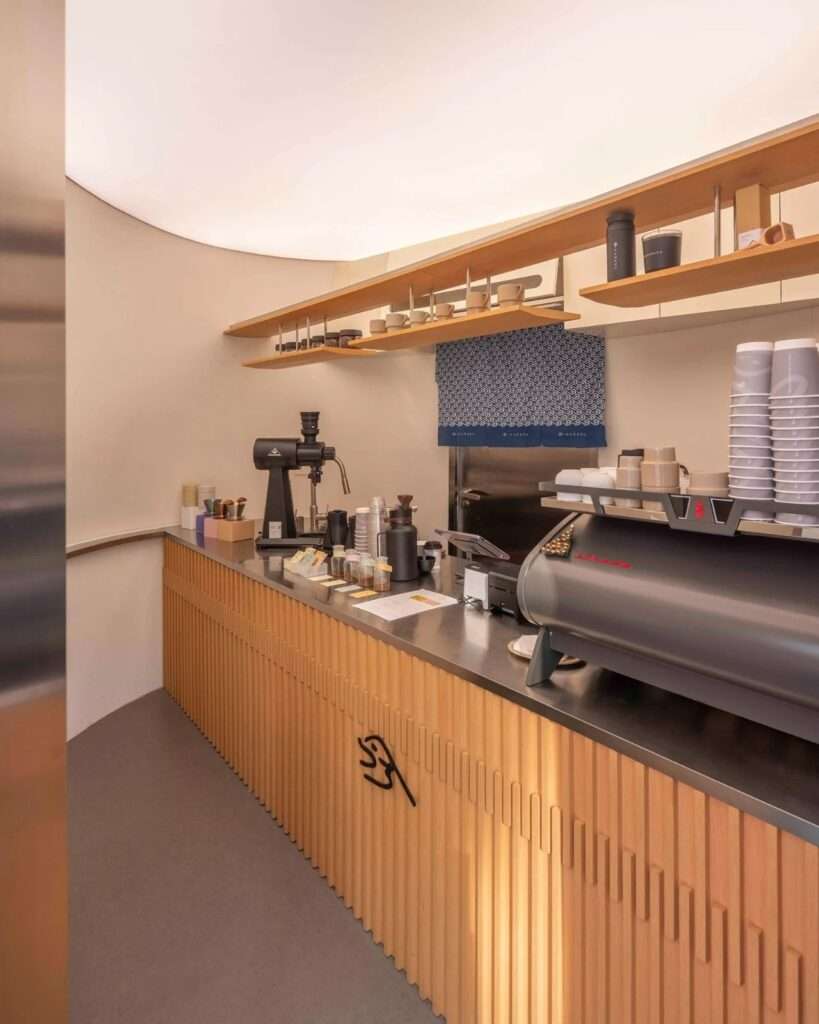
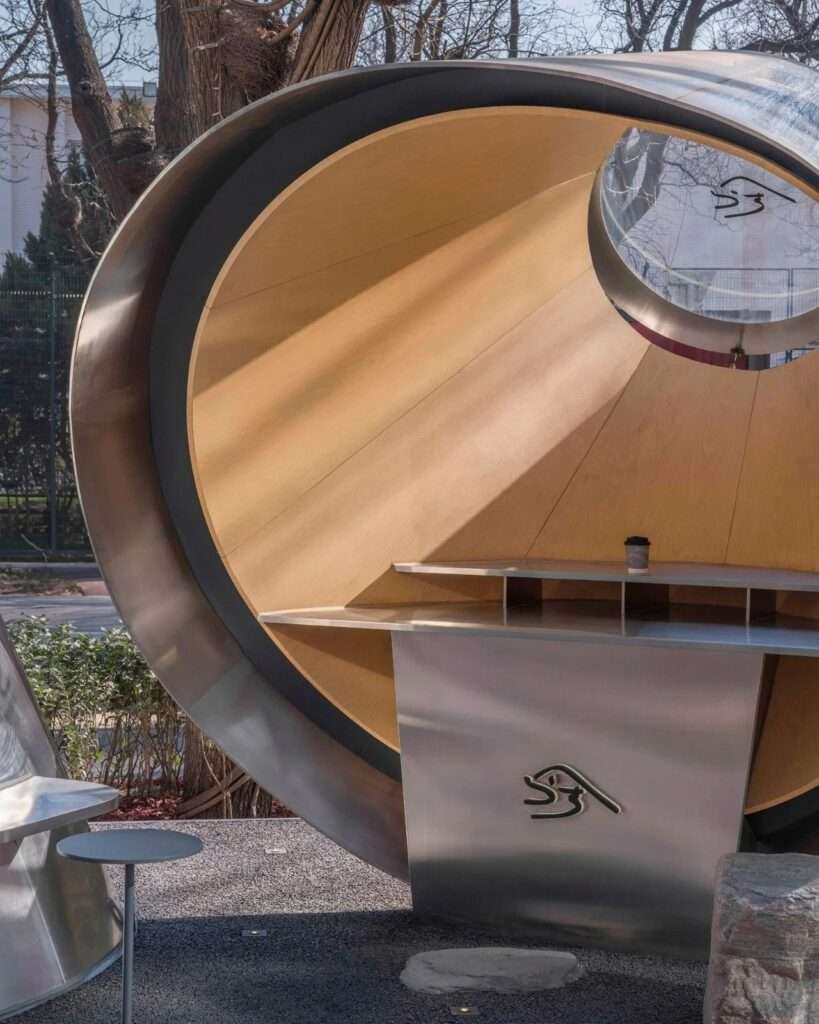
The spatial organization is based on the two volumes functioning separately in terms of use, while remaining a unified composition. The larger volume is oriented inward to form an enclosed space dedicated to the ritual of coffee preparation. Within this void, a linear central counter separates the barista from the customer, while the slanted walls improve functional performance; they provide additional circulation space behind the counter and, at the same time, enhance the perceived spaciousness of the visitor’s side despite the limited physical area. This approach to internal arrangement is a key focus in Interior Design.
Spatial Perception within a Constrained Envelope
The design relies on altering the user’s perception of space rather than changing its actual dimensions. This type of spatial manipulation creates an indirect sense of expansion, which is difficult to achieve within small interiors. However, it is executed without drawing attention to its mechanisms, resulting in a smoother spatial experience and without a clear awareness of intentional visual illusion.
The Second Volume as an Interactive Urban Interface
The smaller volume acts as a cantilevered extension toward the street, functioning as an open display area and a miniature exhibition space. In this way, it becomes a tool for engaging with the surrounding urban environment. Instead of relying on conventional signage, the architectural form itself becomes the attraction for passersby, placing the façade in an active role within the daily flow of movement. Similar strategies can be observed in various global Cities.
Materials as a Driver of Spatial Experience
Material selection here is not merely aesthetic but an essential part of constructing the experience. The external stainless steel surface reflects light and the surrounding environment, including reflections of winter trees. As lighting conditions change, the pavilion transforms at sunset into a glowing lantern-like object, strengthening its presence within the context without excessive formal expression. A deeper understanding of such choices is available in our section on Building Materials.
Contrast Between Exterior and Interior Spatial Perception
In contrast, the interior offers a different approach based on visual warmth and texture. The use of aluminum with a wood-grain-like finish softens the harshness of the metallic character, while curved surfaces help diffuse light more gently within the compact space. This contrast between a relatively cold industrial exterior and a warmer interior creates a deliberate experiential transition, where the interior reshapes user expectations rather than confirming them.
Structural Elements and Their Relationship with the Surrounding Environment
A steel base connects and stabilizes the two volumes, with raised edges that create a visual impression of lightness despite structural solidity. The flooring consists of dark gravel and natural stone slabs, while an operable glass roof allows the space to connect directly with the sky. As a result, the perception of the place continuously shifts with light and natural movement, defining the composition as a carefully calibrated system that goes beyond a simple temporary installation. This integration of structure and context is a recurring theme in our Research.
Architectural Rituals and Brand Identity
For a brand like Kurasu, whose identity is rooted in the quiet rituals of specialty coffee, transforming the act of preparation itself into architectural expression becomes a coherent extension of its ethos. The pour-over method relies on slowness, precision, and intentionality, which is directly reflected in the logic of the pavilion. Whether this alignment between concept and experience was fully planned or refined through execution, the outcome reads as a single cohesive system.
Reevaluating the Idea of “Temporary” in Architecture
Pop-up stores are often treated as experimental spaces that fall short of permanent architecture in terms of seriousness. However, the Kurasu pavilion in Beijing offers a different interpretation of this assumption. When the concept is clear and constraints are real, a temporary structure can achieve a level of completeness comparable to permanent Buildings, and sometimes even surpass them, as it leaves no room for delaying decisions or softening design intent.
Completeness of Experience Through Immediate Presence
In this type of project, the idea is constructed and presented directly without a long temporal layer of revision or adjustment. As a result, users engage with the work as it is, responding either with acceptance or rejection. In this context, the pavilion succeeds in establishing itself as a complete work, where concept and experience align without a visible gap between them. You can explore similar innovative case studies in our Projects section.
✦ ArchUp Editorial Insight
Coffee pop-up pavilions operate as a response tied to short-term leasing models within high-density commercial districts, where spatial use is governed by rapid return maximization and short occupancy cycles rather than long-term continuity. In the case of the Kurasu pavilion at Taikoo Li Sanlitun in Beijing, the project emerges as a spatial production of brand ritual, translating the pour-over coffee tool into a usable architectural form. The primary driver is the need to maintain presence within dense pedestrian flows, while execution constraints and fabrication speed push toward prefabricated metal systems and reduced on-site labor. Reflective steel functions as a substitute for traditional advertising by embedding the façade into the movement of the surrounding market. Internally, the separation between circulation and service reorganizes operational efficiency and occupancy patterns. Ultimately, the pavilion appears as a negotiated outcome between commercial capital cycles, urban movement distribution, and temporary occupancy structures. Stay updated with the latest trends and discussions via our Discussion page and Architectural News.