What Abd al-Wahhab Knew at Twenty-Five That Abd al-Ghafour Had Forgotten at Sixty

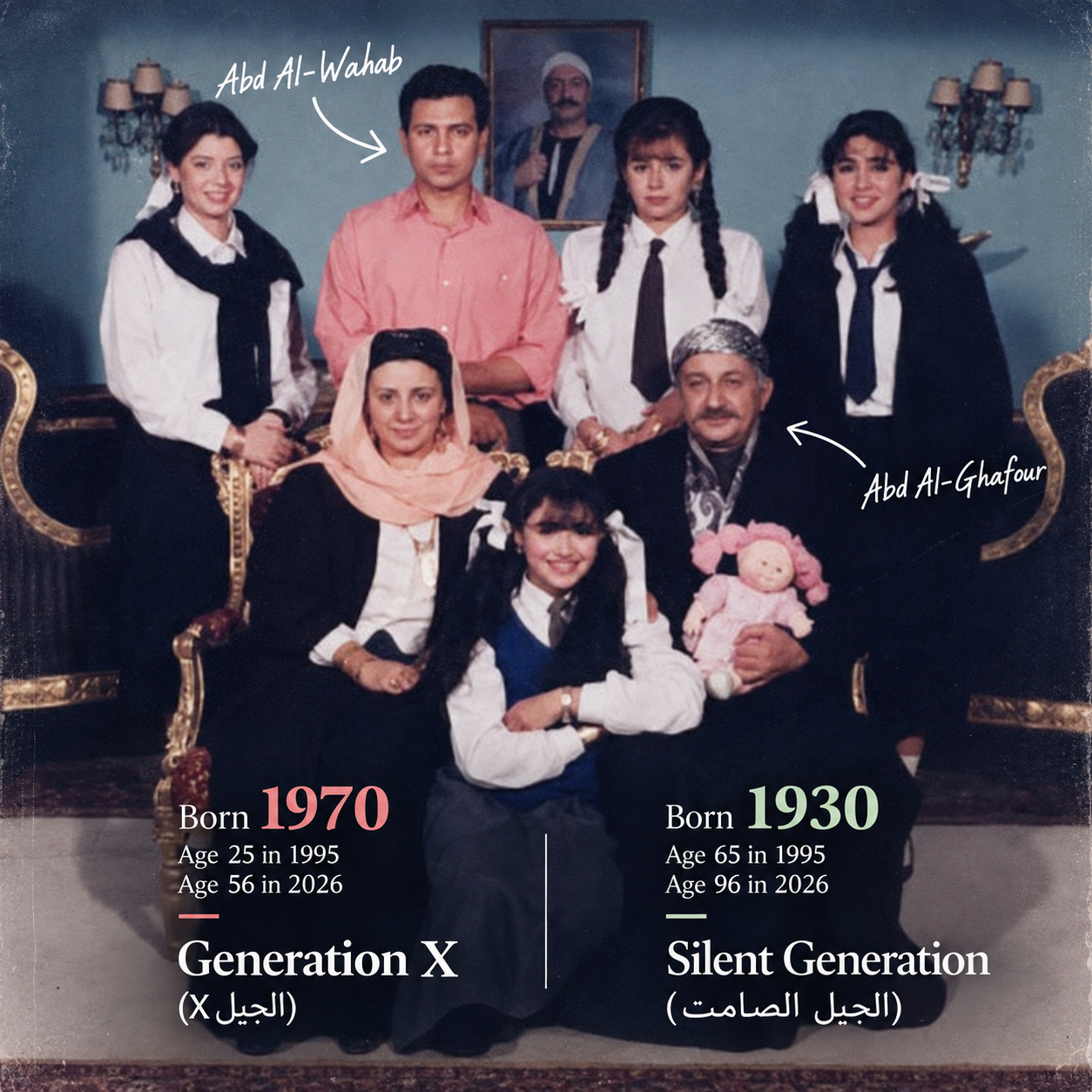
Ibrahim Fawakherji — ArchUp
In 1995, a television drama called Lan Aish fi Jilbab Abi moved through Arab households with the particular force that only certain works achieve: not through spectacle, but through recognition. The audience did not watch it. They saw themselves inside it.
I was among that audience. Young enough that it arrived as entertainment, old enough that it left something behind. What it left, I did not fully understand until I watched it again in 2026, from a position in life that the person I was in 1995 could not have imagined.
The second viewing changed everything about what I thought I had seen in the first.
Fixing the Coordinates
The mathematics of that moment need to be established before anything else, because the generational argument depends entirely on who was watching what, from where.
Abd al-Wahhab was approximately twenty-five. He occupied the screen with the particular confidence of someone who has not yet been wrong in ways that cost him significantly. Energy without wisdom. Certainty without the scar tissue that only accumulates through living.
Abd al-Ghafour was approximately sixty. He had the opposite problem: experience calcified into dogma, patterns of thought formed in a different world and never revised to account for what the world had since become. He was not a villain. He was something more interesting and more troubling than that: a person who had been right, at some earlier point, and had made the fatal mistake of treating that as a permanent condition.
The drama placed these two men in conversation across a generational gap. The young watched the younger character and saw themselves. The older generation felt, depending on their temperament, either vindicated or accused.
What nobody fully understood in 1995 was that the drama was not really about either man individually. It was about what happens when accumulated experience stops listening to fresh perception, and what that silence costs everyone it touches.
Architecture in 1995: The World Before the Screen
When the drama aired, architectural practice operated in a mode that the current generation cannot fully reconstruct from the drawings alone.
The primary instrument was the hand. Parallel rulers, technical pens, trace paper stacked in layers until a solution emerged or the deadline forced one. A mistake was not a keystroke away from correction. It was a physical event requiring a physical response: the razor blade scraping the trace, the correction fluid applied in thin coats, the redrawing from scratch when the error was structural rather than cosmetic.
AutoCAD existed in 1995, but it existed in the way that any technology exists at the beginning of its adoption: as a tool for the practices that had invested in the hardware and the training, not yet as the universal infrastructure of the profession. Most architectural work in the region was still produced by hand, and the hand imposed its own discipline. You thought before you drew because drawing was expensive in time and material.
The twenty-five-year-old entering architecture in 1995 was Abd al-Wahhab entering his profession: full of ideas that the available tools could not yet fully express, working inside a system that the generation above him had built for conditions that were already beginning to change.
What that generation did not tell him, because they did not know it themselves, was that the change was only beginning.
There is one detail I cannot ignore. In episode twenty-nine, Abd al-Ghafour asks about his steel inventory: three tons.
In 1995, I heard it as drama. In 2026, I heard it as a technical mistake.
Three tons is far too little for a construction operation of the scale the character supposedly represented. Yet the writer, director, actor, and viewers—including me—accepted it.
That is the larger lesson: the drama that shaped our professional imagination was emotionally convincing, but not always technically literate.
The Lesson Hidden Inside the Drama
The drama’s power in 1995 came from its emotional truthfulness. It captured something real about how established authority operates on emerging ambition: the condescension, the assumption that seniority is equivalent to correctness, the refusal to consider that someone younger might see something that someone older has stopped being able to see precisely because they have seen so much.
Abd al-Wahhab’s generation absorbed this lesson with the full force of personal identification.
But here is what the second viewing reveals, with the arithmetic of time applied honestly.
The generation that identified with that younger character in 1995 is now the age that Abd al-Ghafour was in the drama.
They are the sixty-year-olds.
And the question that the drama was actually preparing them to answer, which they could not have understood in 1995 because they had not yet lived the years required to encounter it, is this: what did they do with what they knew at twenty-five?
Did they carry that clarity into their sixties? Or did they become, without noticing, the character they had once watched with the comfortable distance of the young person who is certain they will never become that?
The Architecture of Generational Error
Architecture has its own Abd al-Ghafours. They appear in faculty positions, in the senior partnerships of established firms, in the committees that shape what gets built and what remains on paper. Their experience is genuine. The problem is not that they are wrong in the way that novices are wrong. The problem is that they are wrong in the way that the very experienced are wrong: with confidence, with precedent, and with the institutional authority to make their wrongness consequential for the people who work under them.
The practitioner who entered the profession in 1995 drawing by hand, who then learned CAD in the late 1990s, who then adopted BIM in the 2000s, who then encountered generative design and parametric tools in the 2010s, and who must now navigate an AI agent architecture that did not exist eighteen months ago: this practitioner has been asked to rebuild their professional identity five times in thirty years.
Each rebuild required them to be, temporarily, the person who did not know. The person who was slower than the new graduate. The person who asked questions that made them feel exposed. The person who could not yet see what the next generation could see instinctively because the next generation had grown up inside the new tools rather than migrating to them.
The practitioners who survived these transitions with their professional relevance intact are the ones who treated each new tool not as a threat to their accumulated expertise but as a new vocabulary for expressing it. They remained, in some essential sense, capable of being twenty-five again inside each new technological context.
The ones who did not survive, or who survived by retreating into roles that insulated them from the need to adapt, became Abd al-Ghafour without recognizing the transformation.
2026: The AI Agent and the Vanishing Middle
The current moment is different from the previous transitions in a way that requires honest acknowledgment.
When CAD arrived, it changed the instrument but not the fundamental nature of the work. The architect who could draw by hand could also learn to draw with software. The knowledge transferred, even if the muscle memory did not.
When BIM arrived, it changed the workflow but preserved the role. Coordination became more sophisticated, documentation became more integrated, but the architect remained the person who made the design decisions and directed the process.
The AI agent era does not work this way.
An agent does not wait for instruction at each step. It receives an objective and pursues it, managing its own sequence of decisions, calling its own tools, returning not with a draft for review but with a completed task. The massing study that a graduate architect would spend a day developing can now be generated in multiple versions within minutes. The organizational diagram that would previously have required dedicated desk time can be produced, evaluated, and discarded faster than the same person could have drawn the first iteration.
This does not make the architect redundant. But it makes a specific kind of architect redundant: the one whose primary professional value was the execution of defined tasks rather than the judgment that determines which tasks are worth executing and what the results mean.
The generation that entered the profession in 1995 at the drawing board built their foundational competence through years of execution work. They learned to design by drawing, and they learned to draw by drawing badly and then better, thousands of times, with the discipline that slow tools impose. That foundational competence is real. It produced something in the practitioner that the faster tools cannot produce in the same way.
But that generation now carries the responsibility of being the bridge. They have the foundational competence. They also have, or should have, the scar tissue of having rebuilt their professional identity repeatedly. They know what it feels like to be displaced by a new tool and to choose engagement over retreat.
What they cannot afford, in 2026, is to stand where Abd al-Ghafour stood in the drama: insisting that the old way of working is not merely different from the new way but superior to it, and using institutional authority to make that insistence consequential for the people who work beneath them.
The Generational Audit
The discipline this moment requires is specific.
The first question is about memory. Can you recall, with precision rather than nostalgia, what you believed was wrong about the previous generation’s approach when you were twenty-five? Not in the abstract, but in the specific: what decisions did they make that you would have made differently? What assumptions did they carry that you could see clearly because you had not yet acquired them?
The second question is about persistence. Are those same things you could see clearly in 1995 still visible to you in 2026? Or have you accumulated enough of the same assumptions that the visibility has been compromised without your noticing?
The third question is about transmission. What have you done to ensure that the generation behind you does not fight the same battles you fought?
If the answers are difficult, if the memory has softened, if the clarity has been compromised, this is not a judgment. It is an accurate description of where the work remains undone.
What the Drama Cannot Tell You
Lan Aish fi Jilbab Abi ends where dramas end: with a resolution that closes the narrative without closing the questions it has raised. What it cannot tell you, because it was made before the outcome was available, is whether the generation that identified with its younger protagonist used that identification to build something structurally different from what they had criticized.
From where I sit in September 2026, the answer is: inconsistently. Some members of that generation built practices and relationships that genuinely differ from what they once opposed. Others replicated the same patterns from a position of authority rather than frustration, wearing the role without remembering what they had felt when someone else was wearing it.
The drama prepared both outcomes equally. It gave its audience the emotional experience of the younger man’s clarity without specifying what that clarity required when they reached the position the older man occupied.
That specification was always going to be the audience’s own work.
For the Generation Now at Twenty-Five
This review addresses primarily the generation that watched the 1995 drama and is now at the age it depicted as authority. But it would be incomplete without a word for the generation that is currently twenty-five, working with tools that have no analog in anything the profession previously knew, entering a practice environment where the agent handles what the junior architect once spent their formative years executing.
The lesson is not that youth is correct and experience is wrong. It is that every generation inherits patterns that were functional in their original context and have since been applied beyond it. The work of a generation is to identify those patterns precisely enough to modify what is failing while retaining what still functions. This is harder than either acceptance or rejection, and it is the work the drama was preparing its audience to do.
The drawing board produced discipline. The CAD screen produced precision. The BIM model produced coordination. The AI agent produces something that does not yet have a name, because the profession has not yet decided what to call the quality of judgment it requires.
That naming is not the work of the sixty-year-old alone, or the twenty-five-year-old alone.
It is the work they need to do together, if either of them can remember that this was always the point.
✦ ArchUp Editorial Insight
The drama’s second viewing is not a nostalgic act — it is a structural audit, and the article’s most analytically precise contribution is its identification of the mechanism by which an entire generation can absorb the emotional truth of a critique without absorbing its institutional obligation: that recognizing Abd al-Ghafour at twenty-five does not automatically prevent becoming him at sixty, because the pattern the drama exposed is not a character flaw but a systemic one, reproduced by every generation that acquires authority and discovers, too late, that authority and accuracy are not the same variable. The five professional rebuilds the 1995 generation has undergone — hand drawing to CAD to BIM to parametric to agent — are not merely technological transitions; they are repeated encounters with the experience of not knowing, and the practitioners who survived them with their judgment intact are precisely those who learned to treat not-knowing as a professional condition rather than a temporary embarrassment to be concealed from the people below them in the hierarchy. What connects this to what this archive identified in Between Two Films and in The Astra essay is the same structural concern: the AI agent era is eliminating the execution layer through which the twenty-five-year-old has always built the foundational competence that makes the sixty-year-old’s judgment worth having, which means that the drama’s resolution — the naming of what the new tools require, done together across the generational gap — is not merely a cultural aspiration but a survival condition for a profession that cannot afford to have its senior generation guarding a formation pathway that no longer exists, while its junior generation operates tools whose implications neither cohort has yet had the time, or the institutional permission, to fully understand.
Ibrahim Fawakherji — ArchUp