Between Two Films

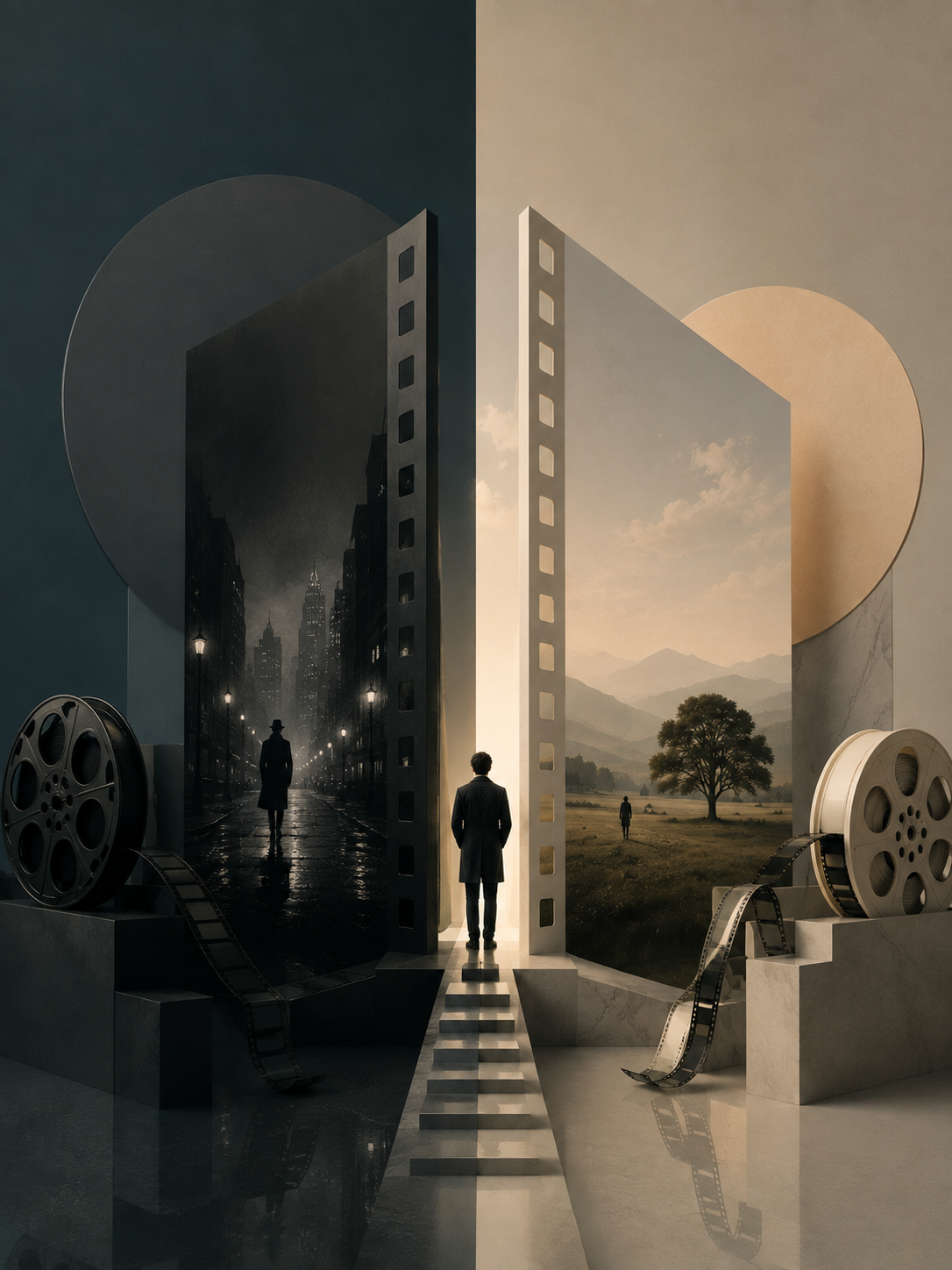
Media and professional industries face a major shift as artificial intelligence automates routine production tasks. While automated systems make generic content abundant, human judgment, personal experience, accountability, and unique authorship become increasingly scarce and valuable.
This transformation poses challenges for early-career professionals losing traditional foundational training. Ultimately, long-term success in creative and technical fields relies on cultivating original critical thinking, domain expertise, and real-world observation rather than focusing on execution and volume.
Ibrahim Fawakherji — ArchUp
Within the same week, I watched two films that had nothing to do with each other and could not stop thinking about them together.
The first was a sequel nobody expected. The Devil Wears Prada had become, in the twenty years since its release, something close to a cultural shorthand for a specific kind of professional world: fashion media, editorial authority, the hierarchy of taste, and the particular brutality of institutions that trade in influence. The sequel arrives at a moment when that world is visibly unraveling. The magazine is struggling. Advertisers are negotiating from a position of strength they did not previously hold. Journalists are being displaced. The editorial project, the idea that a publication could possess genuine authority over what matters, is under pressure from every direction.
What struck me was a single moment in the film. The threat of AI was mentioned once. Briefly. Almost in passing. And then the story moved on.
For a film about the collapse of a media institution, the absence felt conspicuous. As if the screenwriters had acknowledged the accelerant without being willing to follow where it leads.
The second film was a documentary about AGI. It did not look away.
The documentary laid out a timeline and a set of projections. A system more capable than human cognition in most measurable dimensions, operating at speeds thirty times faster than human processing. The researchers interviewed divided roughly into two camps: those who viewed this as an inflection point that could be navigated toward broadly positive outcomes, and those who were visibly troubled in ways that careful professional language could not entirely contain.
I am not a technologist. I cannot evaluate the technical claims with the precision they deserve. But I know what I felt watching the film, and it was something more specific than the generalized anxiety that technology discourse often produces.
I kept thinking about the people in the previous film.
The journalists who had spent careers developing the judgment to know what mattered and what did not. The editors who had built, over decades, the institutional authority to make cultural distinctions stick. The photographers, the critics, the writers whose value was inseparable from the years of accumulated attention they had brought to a specific domain.
And I kept thinking about what happens to that kind of value when the system that required it to be produced by a human being, slowly, expensively, through experience, no longer requires the human being.
I have been writing about AI and architectural practice for long enough that I have had to account for my own earlier positions. In those earlier pieces, I argued consistently that the correct response to AI was engagement rather than refusal, that the practitioner who learned to work with the tools would outperform the one who resisted them, and that the skills most protected from automation were the ones involving judgment, context, and accountability rather than production and execution.
I still hold that position.
But watching these two films in the same week produced something that simple optimism cannot fully absorb.
There is a version of the future in which everything I just described is correct. The architect who can direct AI agents, who can frame the right question before the system generates the answer, who brings irreplaceable judgment to the moment when a decision becomes binding, survives and thrives. The writer whose value lies in the accumulated strangeness of their particular way of seeing, rather than in the volume of text they can produce, finds that the scarcity of that quality becomes more valuable as the abundance of generic text increases.
AI will make writing abundant. It may make authorship scarce.
The sentence arrived in my thinking somewhere between the two films and has not left since. Every time content becomes cheaper to produce, what becomes rarer and more valuable is the source: the provenance, the accountability, the specific human being willing to put their name on a position and defend it over time.
But this is also where the honest version of the argument requires a difficulty to be acknowledged.
The people who will navigate this transition well are the ones who already have something that takes years to develop: a body of work, a formed sensibility, an archive of observations, a reputation that makes their judgment worth more than the same words produced by a system with no history and no skin in the game. The people earlier in that process, the ones who were supposed to be building that foundation through the years of production work that AI is now displacing, are in a structurally different position.
And this is the version of the story that the fashion media film could not bring itself to tell. Not the experienced editor who finds a new role in the changed landscape. But the young journalist who was supposed to spend a decade building the experience that would eventually make them irreplaceable, and who is entering a market where that decade of formation is being structurally compressed or eliminated before it can occur.
I thought about children.
A specific version of the thought: what do we tell a child in school today about why they are learning what they are learning? The answer that education has always given, implicitly and sometimes explicitly, is that the knowledge and the skills being acquired will be required to do work that matters. That the effort of formation has a destination.
If a system operating at thirty times human speed and with measurably superior performance across a growing range of cognitive tasks becomes the primary instrument of knowledge work, the educational argument changes in ways that nobody has yet worked out how to narrate honestly to a twelve-year-old.
I do not think the answer is to stop educating children. The answer has something to do with educating toward the things that remain specifically human precisely because they are not efficiently producible: the capacity for genuine curiosity, the tolerance for ambiguity that produces original questions, the ethical seriousness that makes accountability meaningful, the embodied experience that no system trained on text can accumulate.
But this is easier to state as a principle than to operationalize in a curriculum.
I thought about ArchUp.
The most dangerous investment for any architectural media platform in the years ahead is the infrastructure for producing content at volume. A news item about a new project, a competition announcement rephrased from a press release, a summary of a conference, a 600-word overview of a building: all of these are approaching the point where the marginal cost of AI-assisted production is negligible. A thousand platforms can produce them. Most of them already are.
What becomes valuable in proportion to the abundance of generic content is exactly the opposite. The first-person observation from someone who was actually in the building. The analytical position developed over years of engagement with a specific domain. The archive that demonstrates continuity of thought. The editorial judgment that knows which question to ask before anyone else has formulated it.
I spent twenty years building an archive on a hard drive named Hima. That archive is what made the La Défense comparison possible: the photograph taken in 2006 that no AI could have produced, the architectural eye that had changed between the two visits, the specific combination of memory and analysis that made the twenty-year gap legible.
The AGI documentary was pessimistic about many things. But it was not pessimistic about this. The insight it could not generate, because it had not been twenty-three years old in 2006 standing on a concrete deck in western Paris with a modest camera and no particular theory about why those photographs would matter, cannot be replicated by a system trained on what others have already written about concrete decks in western Paris.
The observation precedes the data. The experience precedes the analysis. The presence precedes the archive.
I keep returning to a comparison that COVID made available in a way that nothing else had.
Within weeks, a rule that had seemed fundamental to professional life, that the employee must be physically present in the office to be considered genuinely working, was revised. Not gradually. Overnight. The revision revealed that the rule had not been fundamental at all. It had been an organizational convention held in place by institutional inertia and the absence of sufficient pressure to examine it.
AGI, if it reaches the capabilities the documentary projects, may do the same thing to a deeper rule: that producing more requires more human beings working more hours. The arithmetic of expertise, in which value scales with the volume of professional labor applied to a problem, may cease to hold in the domains where AI assistance becomes genuinely capable.
This will not be a disaster for everyone it displaces. For some practitioners, it will be a liberation. The architect who was spending 70 percent of their time on production work that required presence but not judgment will find, in the AI-assisted version of their practice, that the proportion inverts. The time recovered is not incidental. It is the time that the practice actually required to do its best work and consistently failed to protect.
But this recovery has conditions. It requires that the practitioner have something to do with the time. That they have cultivated the judgment, the sensibility, the professional character that makes the recovered time worth having. The question is not whether AI makes architectural practice easier. The question is whether the practitioner is prepared for a version of the work in which the purely executional components are handled by the system, and what remains is almost entirely the part that requires being genuinely good at thinking about buildings.
The fashion media sequel will probably be remembered, if it is remembered, as a film that described a transition it could not fully see. The AGI documentary will probably be remembered, if its projections are anywhere near accurate, as one of the last documents produced before the landscape it describes became the landscape everyone simply lives in.
What I take from watching them together is not optimism or pessimism. It is a sharper version of a position I have been developing for several years.
The value worth building is not the capacity to produce content quickly.
It is the capacity to notice something that has not yet been noticed, to ask a question that has not yet been asked, to be accountable for a position that was arrived at through genuine engagement with the world rather than through the optimization of existing patterns.
The architect who can do this, and who has the tools to execute what that perception requires at speed and at scale, will be in a position that no version of AI I can currently imagine threatens.
The architect who cannot do this, but who has excellent production skills, is in a position that is becoming more precarious by the quarter.
This is the honest version of the story that the fashion media sequel could not tell.
And it is the version that anyone building a practice, a platform, or a professional identity in the years ahead will need to reckon with, regardless of which film they watched first.
✦ ArchUp Editorial Insight
The essay’s most structurally significant observation is not its optimism about judgment-based practitioners but its identification of the cohort for whom that optimism does not apply — the early-career professional who was supposed to spend a decade building the accumulated foundation that makes judgment possible, and who is entering a market where the production work that funded and structured that formation is being systematically eliminated before the formation can occur. This is the generation that the fashion media sequel declined to show, and the omission is not accidental: the narrative of the experienced editor finding a new role in the changed landscape is politically and commercially easier to tell than the narrative of the structural elimination of the apprenticeship model that produced the experienced editor in the first place. The argument that authorship becomes scarce as content becomes abundant is analytically sound but carries a distribution problem the essay acknowledges without fully resolving — scarcity is valuable only to those who already possess the scarce thing, and the path to possessing it ran through precisely the years of production work, the internship, the junior commission, the small publication, that this archive has traced from Before You Enter the Office through The Internalized Jury as the profession’s most systematically exploited and least examined labor formation mechanism, now facing not reform but elimination — which means that the next generation of practitioners with irreplaceable judgment will be drawn almost exclusively from those whose formation was funded by family capital rather than by the market, and the architecture that results will encode that narrowing in every brief it accepts and every question it fails to ask.