Le client is NOT roi

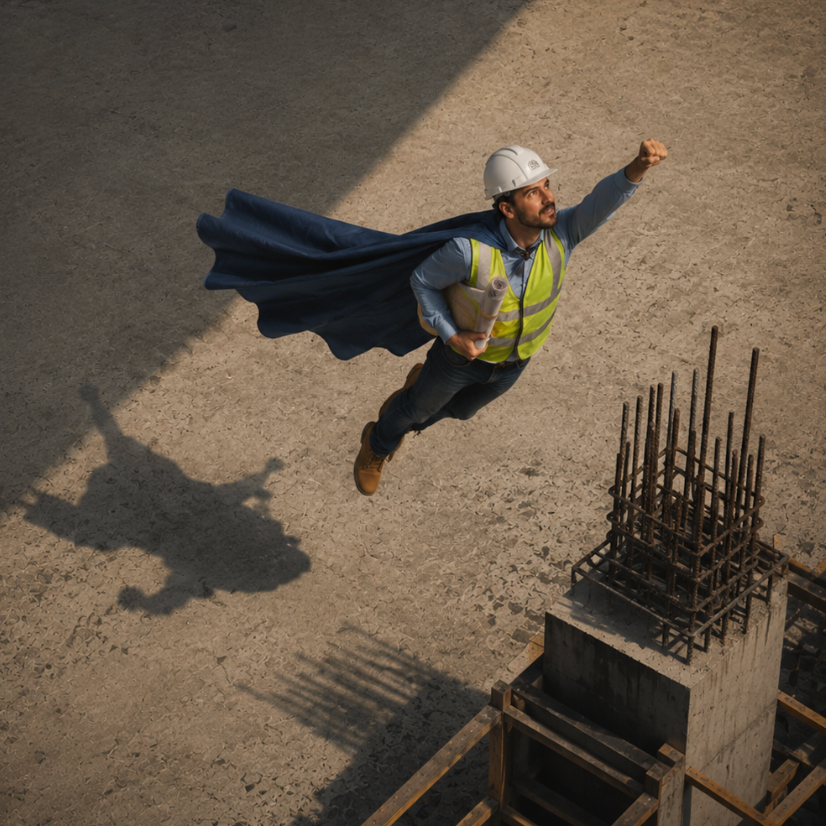
Architectural success depends on a balanced partnership where the client provides vision and the architect contributes technical expertise. Financial ownership of a project does not automatically confer the specialized knowledge required for sound design decisions. Professional judgment is essential for ensuring long-term structural integrity and functional performance.
The relationship functions best when clients defer to an architect’s navigation while maintaining active engagement. True professionalism involves prioritizing the project’s durability over simple compliance with contradictory requests. Ultimately, the quality of a completed building reflects the depth of the collaborative decisions made during its creation.
Ibrahim Fawakherji — ArchUp
Client Naturel: Why Owning the Land Does Not Mean Owning the Judgment
This title deliberately subverts the well-known French expression Le client est roi (“The client is king”) through a provocative inversion. Its purpose is not to diminish the client’s importance, but to challenge the assumption that ownership or financial investment alone guarantees the best architectural decisions. By inserting the word NOT into the original phrase, the title argues that successful architecture emerges from a balance between the client’s vision and the architect’s expertise, rather than from unilateral authority. It is an invitation to rethink one of the profession’s oldest assumptions, not a rejection of the client’s role.
A few days after publishing Look Who’s Talking, a message arrived from a reader.
He was not an architect. The tone of the message made that clear within the first sentence. He wrote, briefly and directly: you were harsh on clients.
I closed the message. Then I went back and read the article again.
Was I harsh?
Perhaps.
But not on clients. On an idea that has become increasingly prevalent in the construction market: the belief that owning land and capital automatically confers the authority to make every architectural decision.
That is the idea I want to address here. Not to defend architects, not to attack clients, but to defend the project itself. Because the building, once built, does not care who won the arguments during its construction. It only carries the quality of the decisions that were made.
I chose the French title deliberately.
Naturel means natural. And I mean by it the client in his human nature, before he becomes a landowner or a project financier. The human being naturally wants to control what he owns. When he buys a car he wants to choose its color. When he commissions a building he wants to see it as he imagined it in his mind. This is not a flaw. It is a normal and reasonable impulse.
The problem begins when the desire to participate becomes the desire to lead a process the person does not have the tools to navigate.
After years of practice, I have come to distinguish clearly between two types of clients.
The first is the client with a vision. This person is a gift to any architect. He arrives knowing why he is building, even if he does not know how. He says: I want something that changes this street. I want a building that outlasts me. I want an identity that does not exist yet in this city. When that is the starting point, the architect’s role is to translate the vision into architecture. The relationship has a natural hierarchy that both parties can work within. The client provides the direction. The architect provides the navigation.
The second type is the client with a list. No coherent vision, but a long accumulation of specific preferences that often contradict each other. Make the reception larger. Make the kitchen smaller. Change the stone color. Add a window. Remove the window. Raise the ceiling. Lower the ceiling. Move the staircase. The project gradually loses its internal logic and becomes a document of the client’s changing preferences rather than a resolved architectural idea.
Both types are equally human. Neither is a villain. But the relationship with each requires a completely different professional posture, and confusing the two leads to projects that serve no one well.
Here is something I want to say clearly, because it tends to generate resistance.
The client is the landowner. The client holds the capital. The client makes the final decision about what gets built. None of this is in dispute.
But owning the money does not transfer the knowledge.
Owning a hospital does not make you a surgeon. Owning an aircraft does not make you a pilot. Owning land does not make you an architect. This is not a diminishment of the client. It is a statement about the nature of expertise and what it takes years to develop.
When a client commissions an architect, he is not purchasing a set of drawings. He is purchasing two or three decades of accumulated judgment: the knowledge of which materials fail under specific conditions, which structural decisions carry hidden costs, which spatial configurations work for daily life and which ones only work in photographs, which choices will cause problems five years from now that are invisible today. That judgment does not appear in the floor plan. It lives in the decisions the architect makes before and during and after the drawing.
A client who overrides that judgment because he has the contractual authority to do so is not exercising his rights. He is discarding the most valuable part of what he paid for.
I want to be direct about something that the profession tends to avoid saying publicly.
When an architect agrees to everything the client requests, purely to avoid conflict, he is not being professional. He is being a vendor. And the difference between the two is not a question of style or communication approach. It is a question of what happens to the building five, ten, and twenty years after completion.
I have seen clients request materials that are visually compelling and structurally inappropriate. I have seen them insist on spatial arrangements that look balanced on a plan and are functionally impossible to inhabit. I have seen them push for cost reductions that eliminate components they cannot see, components that determine whether the building performs as designed for the next half century.
When I push back on these requests, it is not because I want to prove I am more intelligent. It is because I know what comes next. I have seen what happens when those decisions go wrong, and I carry professional responsibility for the outcome in ways the client does not. My name is attached to the building after the client has moved on to other things. My judgment is what the building will be evaluated against when something fails.
This is not arrogance. It is the basic condition of professional responsibility, and it is why professional relationships of this kind exist in the first place.
The architecture contract has more in common with a marriage contract than most people in the industry are comfortable acknowledging.
A marriage does not begin in the first ten minutes of meeting. There are questions. There is negotiation. There is discovery of how the two parties think, what they value, where they agree and where they do not. Then comes the commitment, with both parties understanding what they are entering.
The architectural commission works the same way when it works well. What follows the signature is a relationship that may last one, two, or three years, involving hundreds of decisions and thousands of details, each of which will be embedded in the fabric of the building for decades. Beginning that relationship with a contest to establish dominance is not a sign of a client who knows what he wants. It is a sign of a project that is already in trouble.
The most productive client relationships I have experienced share a specific quality: the client brings his knowledge of what the project is for, and genuinely defers to the architect’s knowledge of how to achieve it. Not passive deference. Active, engaged deference that still asks hard questions but accepts expert judgment when the expert’s reasoning is sound.
That balance is harder to achieve than it sounds. It requires the client to be honest about the limits of his expertise, and it requires the architect to be worth trusting with the responsibility.
There is a dimension of the architect’s work that clients rarely see because it happens in spaces the client never enters.
The architect who takes on a commission is simultaneously managing a relationship with the client, with the contractor, with the municipal authority, with the fire and safety departments, with material suppliers, with structural and mechanical consultants, with the building code as it exists today and as it is likely to evolve. He is making binding commitments on behalf of the client in all of these relationships, commitments that the client does not have the background to evaluate directly.
When that work goes well, the client experiences a smooth process and a building that performs as described. The difficulty was invisible. When it goes badly, the client sees delays, cost increases, and defects, but often cannot trace them back to the specific decisions where the problems originated.
This is the nature of complex technical work. The expertise that prevents problems is by definition expertise that produces no visible evidence of the problems it prevented. This makes it very easy to undervalue.
A fee of eight or ten percent of construction cost sounds significant until you calculate what it buys: full professional responsibility for every decision in that list, across the entire duration of the project. There are not many professional services that offer that level of comprehensive accountability at that price.
I want to end with something that is not a defense of architects as a profession.
There are architects who deserve the criticism their clients give them. Who are slow to communicate, careless with deadlines, rigid about their own aesthetic preferences at the expense of the client’s actual needs, dismissive of budget reality. These failures are real and they damage the profession’s credibility.
But the solution to those failures is not to transfer authority for every decision to the person who owns the land. The solution is to find architects who are genuinely competent and genuinely honest, and then to extend them the professional trust that makes it possible for that competence and honesty to function.
The client who enters the relationship determined to override expert judgment whenever it conflicts with his immediate preferences will get the building his decisions deserve.
The client who enters the relationship with enough confidence to listen, enough intelligence to ask hard questions, and enough trust to accept well-reasoned answers, will get something different.
Architecture is not a contest between a landowner and a designer to determine who has more authority.
It is a long partnership in which one person carries the dream and the other carries the knowledge of what it will take to make the dream stand.
Both are necessary.
Neither is sufficient alone.
Twenty years after the building is complete, no one will ask who won the arguments in the meeting room. They will ask one question only.
Did the architecture succeed?
That is the only result that matters, and it is the only one worth fighting for.
✦ ArchUp Editorial Insight
The argument this essay constructs is structurally a professional authority claim — which is not a disqualification, but the condition that must be named before the claim can be evaluated honestly. The inversion of Le client est roi is rhetorically elegant, but it conceals a more uncomfortable question: if the architect’s judgment is to be trusted over the client’s preferences, what institutional mechanism currently exists to verify that the judgment being asserted is actually sound, and not merely confident? The essay correctly identifies the information asymmetry between client and professional — a condition Look Who’s Talking examined as structurally embedded in the relationship — but it resolves that asymmetry entirely in the professional’s favor without addressing the parallel asymmetry that the client cannot easily detect: the difference between an architect whose accumulated judgment genuinely protects the project and one whose resistance to client intervention protects only their own aesthetic preferences, a distinction that the fee structure, the contract, and the licensing framework currently do nothing to make legible, which means that the essay’s most honest sentence — “find architects who are genuinely competent and genuinely honest” — is also its most structurally incomplete one, because it locates the solution entirely in the client’s discernment while the profession retains exclusive control over the information that discernment would require.