Oslo Architecture Triennale Returns With “Nature First” Material Experiments

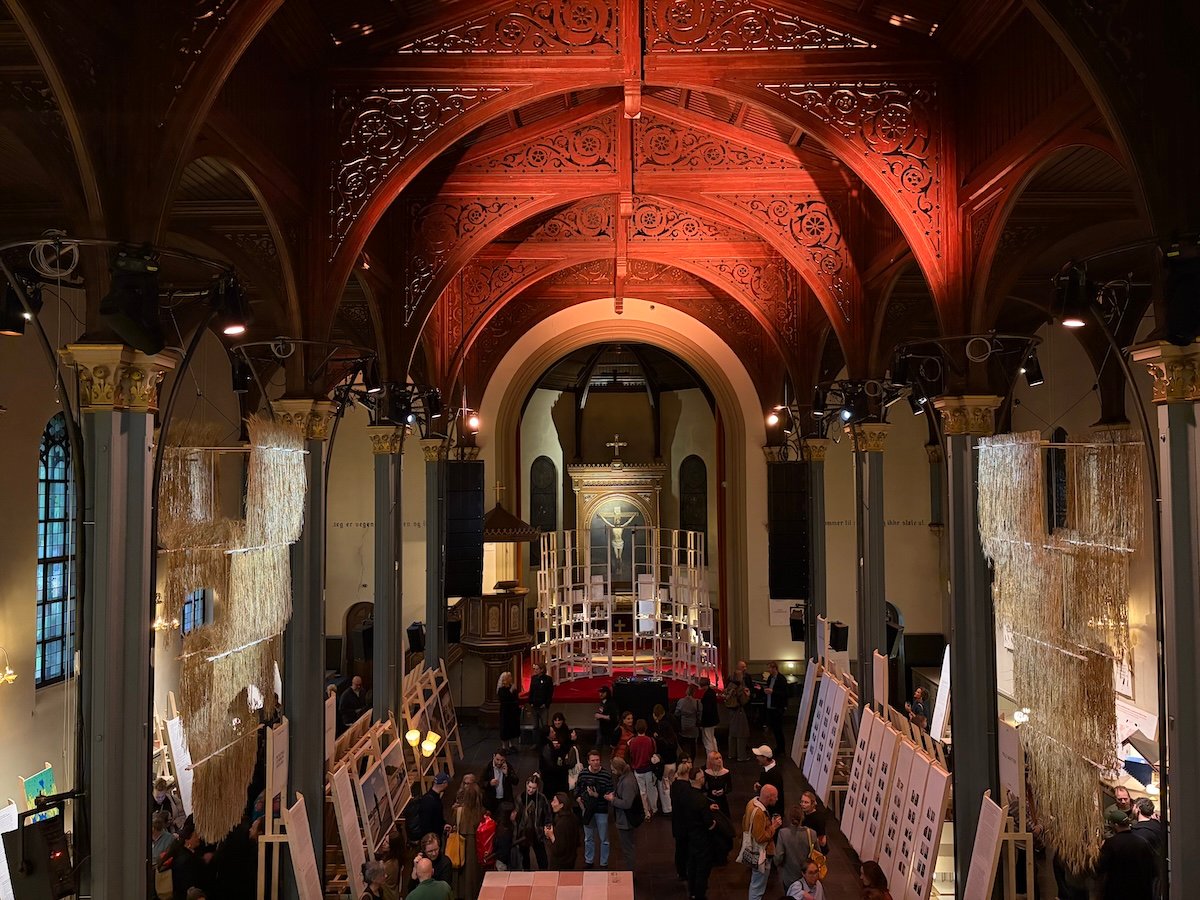
The ninth Oslo Architecture Triennale opened September 17 under the theme “What if nature comes first?” presenting over 30 global projects that test bio-based, locally sourced, recycled, and low-embodied-carbon materials as strategies for an environmentally sound built environment.
Headquartered in Sofienberg Kirke, a deconsecrated 19th-century church in Oslo’s Grünerløkka neighborhood being transformed into a community center, the two-week festival includes seminars, workshops, city walks, and daily “morning sermons” from the church pulpit. The exhibition’s most compelling solutions cluster around material innovation: a site-fabricated cocciopesto table top absorbing CO2 as it cures; reclaimed steel from decommissioned ships and oil rigs with a carbon footprint one-sixth of recycled electric-arc-furnace steel; load-bearing stone blocks cut from quarry waste; and wool cladding tiles made from agricultural waste fibers.

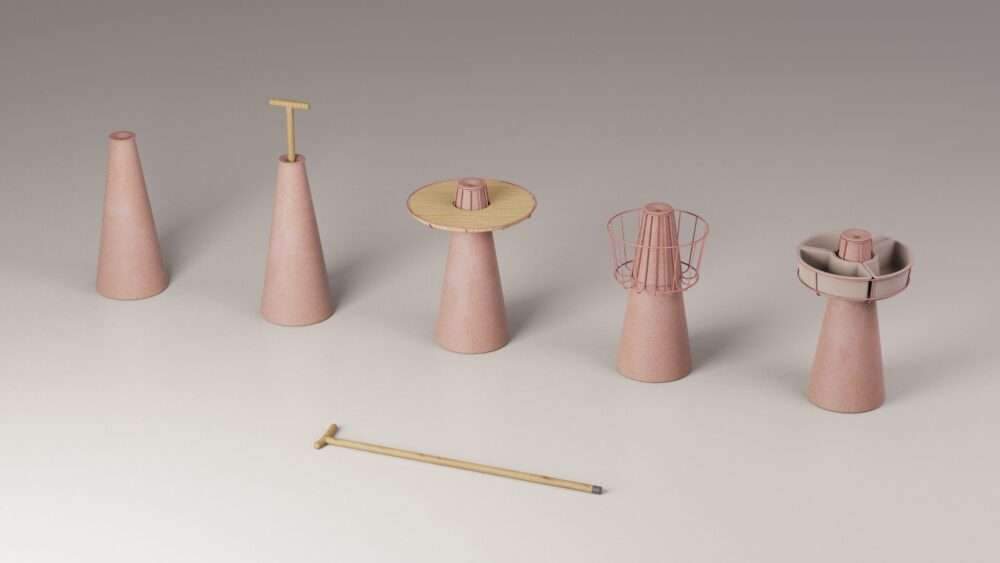
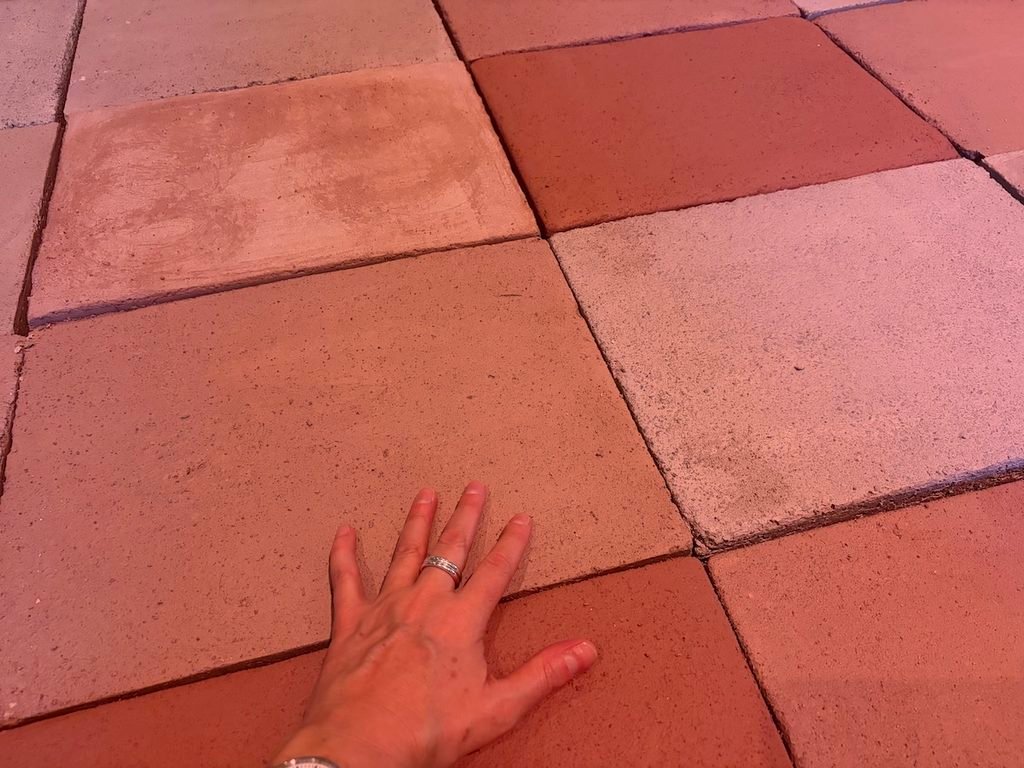
The cocciopesto installation, led by Vienna-based studio dreiST, mixes crushed discarded brick and lime from the Oslo region into unfired panels that continue absorbing carbon during curing — equivalent to the emissions from lime production. Nordic Circles, founded by architect Fredrik Barth and circular business developer John Jacobsen, salvages structural steel from ships and rigs, fabricating it into welded profiles and sheet piling at 0.067 tons CO2 per ton of steel versus 0.4 tons for conventional recycling. Their reclaimed steel has already built an eight-story office building in Bergen.
“Lasting Larvikite,” by Oslo-based Arkitekt Martin Hopland and Studio Widerøe, makes the case for stone as a load-bearing material using “leftover” larvikite blocks quarried in southern Norway. Meanwhile, the Grinham Research Group at Harvard’s Graduate School of Design, led by Jonathan Grinham, transforms waste wool — 60 percent of the 1.95 billion kilograms produced annually — into insulating cladding tiles. The process uses alkaline treatment and citric acid to bind wool fibers into a rigid biocomposite without petrochemical resin, producing a low-density insulating back panel and a dense weather-resistant outer layer suited for energy retrofits.

Beyond the church walls, Transborder Studio and collaborators pilot an “underwater garden” in the Oslo fjord — modular platforms growing eelgrass and sugar kelp to sequester CO2 and restore marine habitat. The experiment originated from a housing competition entry proposing a building above an underwater garden; though a conventional scheme won, the developer sponsored the pilot. Early results show seagrass thriving while kelp struggles with sediment and algae. The triennale runs through October 1 with 100 krone (approximately $10) admission to most events.

Analytical Critique
The triennale’s curatorial focus on material specificity over formal speculation is its strength: each project demonstrates a measurable carbon or ecological metric rather than a conceptual gesture. The cocciopesto and wool installations make carbon sequestration legible in real time — visitors witness curing panels and waste fibers becoming building envelope. However, the exhibition’s church setting aestheticizes what are essentially industrial processes; the “morning sermon” framing risks positioning material substitution as liturgy rather than logistics. The fjord pilot, while ecologically vital, remains a mitigation experiment adjacent to the triennale proper, not integrated into its spatial narrative. Scale gaps persist: an eight-story steel building and a fjord garden are proof-of-concepts, not systemic replacements for concrete and steel supply chains.
✦ ArchUp Editorial Insight
Oslo Architecture Triennale 2026 stages a material reckoning that the construction industry has deferred for decades: the carbon cost of extraction hides in the supply chain, not the building site. By exhibiting waste streams — ship steel, quarry stone, sheep wool, demolished brick — as primary structure, the triennale inverts the liability transfer that defines modern construction: virgin material risk externalized to ecosystems, waste burden externalized to landfills. The cocciopesto panels absorb the lime’s carbon debt during curing; the wool tiles retain biogenic carbon from grass-sheep-wool cycles; the reclaimed steel avoids the electric arc furnace entirely. But the church venue reveals the limit: these materials enter the market as exhibition pieces, not commodity streams. The archive’s compressed construction studies show that material substitution only scales when factory tolerances replace on-site craft — the dreiST panels were mixed on-site, the wool tiles pressed by hand. Until the logistical chain (certification, supply continuity, code acceptance) matches the material promise, “nature first” remains a curatorial position, not a procurement reality. The fjord garden, sitting outside the church, is the honest counterpoint: ecological repair that cannot be packaged, only tended.
Project Team
- Curator & Director: Line Ramstad
- Cocciopesto Installation: dreiST (Sophie Coqui, Luisa Zwetkow)
- Reclaimed Steel: Nordic Circles (Fredrik Barth, John Jacobsen)
- Load-bearing Stone: Arkitekt Martin Hopland, Studio Widerøe
- Wool Cladding: Grinham Research Group, Harvard GSD (Jonathan Grinham)
- Fjord Pilot: Transborder Studio, Oslo Sauna Association, NIVA
- Venue: Sofienberg Kirke (deconsecrated church)
Project Notes
- Event: 9th Oslo Architecture Triennale (OAT)
- Theme: “What if nature comes first?”
- Dates: September 17 – October 1, 2026
- Location: Sofienberg Kirke, Grünerløkka, Oslo, Norway
- Projects Exhibited: 30+ global projects
- Material Focus: Bio-based, local, recycled, low-embodied-carbon
- Key Metrics: Nordic Circles steel 0.067 tCO2/t (vs 0.4 conventional); 1.95B kg wool/yr, 60% wasted
- Admission: 100 NOK (~$10) most events