Outdoor Furniture: Designing for Movement, Shade and Storage


An outdoor chair occupies more space than its legs mark on the ground. Someone has to approach it, turn towards a companion, pull it away from a table or leave it for the night. Shade adds another moving boundary. Read together, eight outdoor furniture and shading designs show how these everyday actions can shape a terrace before any permanent wall is built.
The useful comparison is not a ranking of styles. It is a distinction between what remains fixed, what moves during use and what can be put away. A residential terrace and a hospitality terrace may contain similar objects, but moving, cleaning and storing them can involve very different routines.
Shade without a pole through the table
The Sensu canopy in the cover image projects from a support positioned to one side. Its horizontal opening mechanism and adjustable orientation make the shade a separate element from the furniture beneath it. The central space can therefore be arranged without accommodating an umbrella pole through a table.
That freedom does not remove the support from the plan: the base still occupies ground, and the canopy needs an appropriate operating envelope. The useful design decision is where to place those less visible demands. A sheltered seating area is not simply a chair positioned somewhere under the outline of an open canopy.
Shade design: Sensu, Dirk Wynants for Extremis. Cover image courtesy of Extremis.
Turning and rocking change the occupied area
Tuuci’s Horizon Swivel Lounge Chair introduces a full 360-degree turn and a choice between classic and deep seating. Turning allows the sitter to redirect attention without dragging the entire chair. In a layout, however, clearance has to be considered through the turn, rather than only in the position selected for a photograph. Seat depth is another distinction between a brief upright conversation and a more reclined stay.
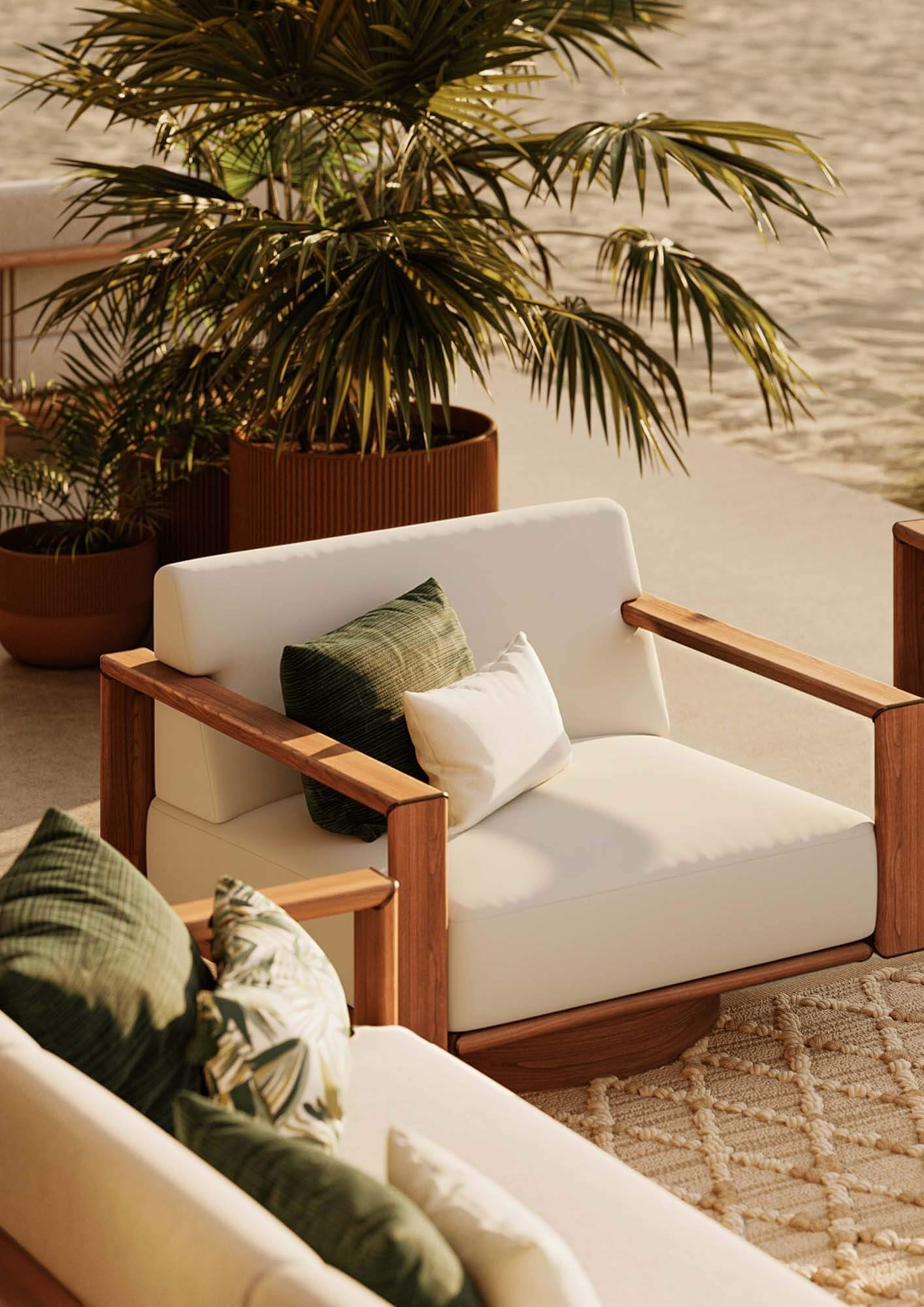
ORCA’s cedar Buoy Rocking Chair makes movement more explicit. Its curved lower form supports a rocking action rather than a change of orientation. The design invites a different relationship with the floor: the relevant occupied area includes the sweep of the movement, not just the resting contact point. That distinction matters near paths, low tables and the edges of a small deck.

A frame can organise the view behind a sofa
Ithaca uses solid teak across seating and tables. In the sofa image, the exposed rear frame is not treated as a hidden service side: repeated vertical elements hold a clear rhythm around the cushions. This makes the back worth considering when a sofa stands between two parts of a terrace instead of against a wall. The structural material also remains visually distinct from the upholstery.

MAGNA offers another way to define a group. Its generous seating is arranged around a low table, with open frames keeping the individual pieces visually legible. The photographed composition shows how a sofa and separate chairs can establish an inward-facing place for conversation. It does not establish the clearance available in a real project, where routes through the group still need to be resolved.
Curved upholstery and the edge of a gathering
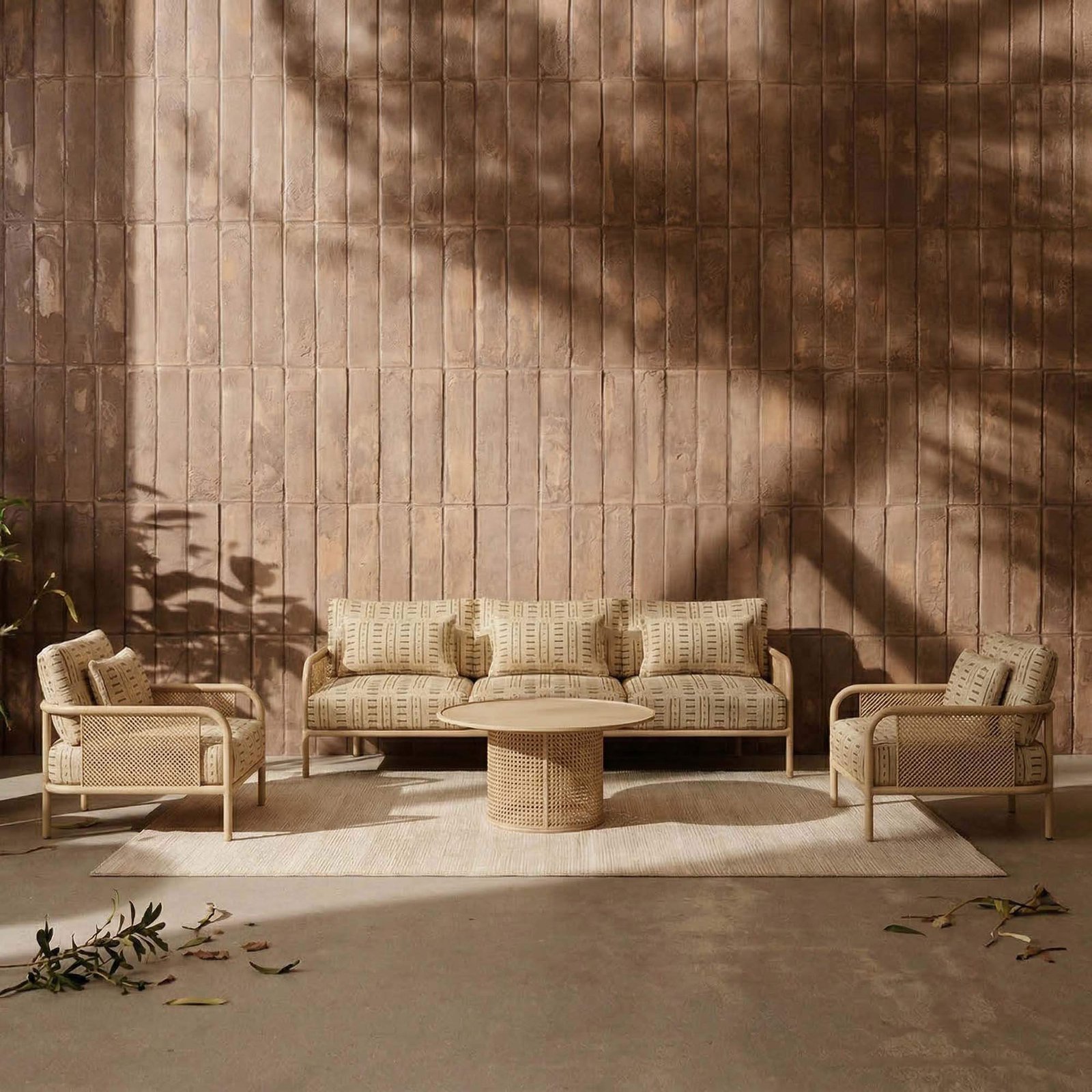
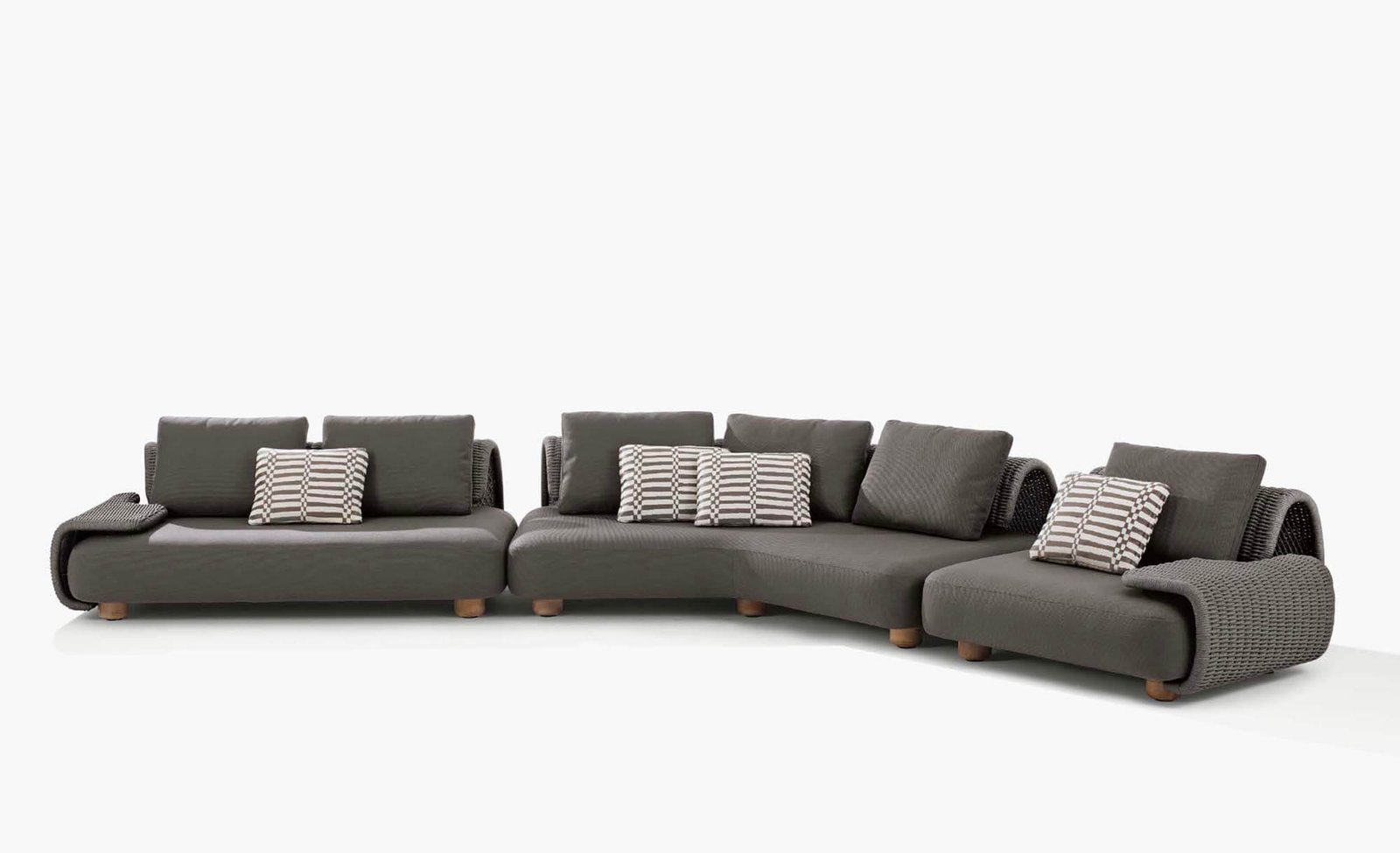
Shore uses a handwoven rope structure and curved, shell-like forms. In the illustrated configuration, upholstered sections turn the seating line rather than maintaining a single straight frontage. Such a change can help a group face itself, but the outer edge must also be read from the circulation side. A welcoming curve towards the sitter can consume space behind the seat.
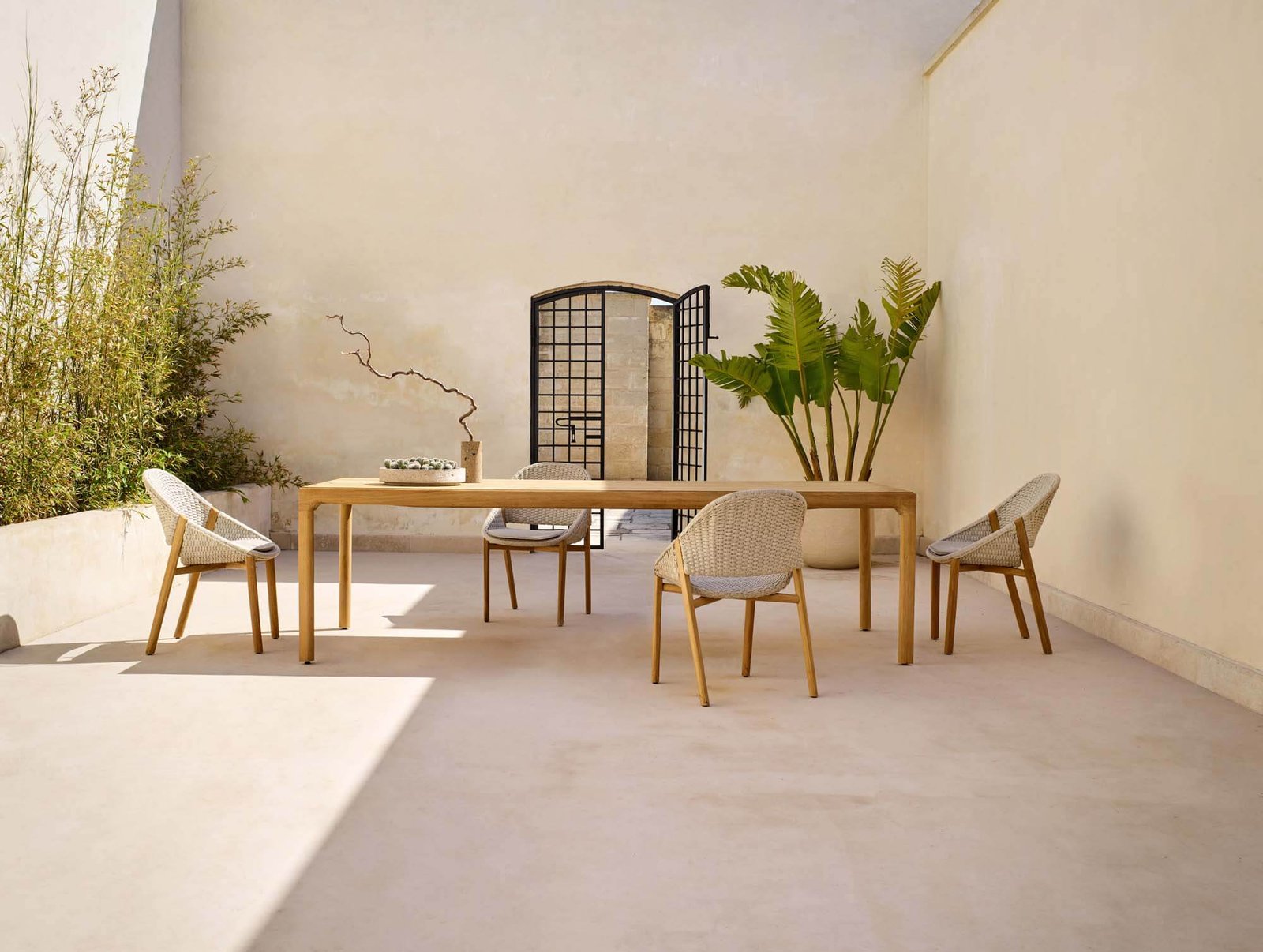
The ELIO image shifts the discussion from lounging to dining: rounded chairs surround a rectangular table, and the empty floor around the group is a significant part of the composition. A dining chair needs room to withdraw and a route past an occupied seat. Those actions are easy to overlook when furniture is evaluated as a collection of silhouettes.
Folding is a storage decision, not only a mechanism
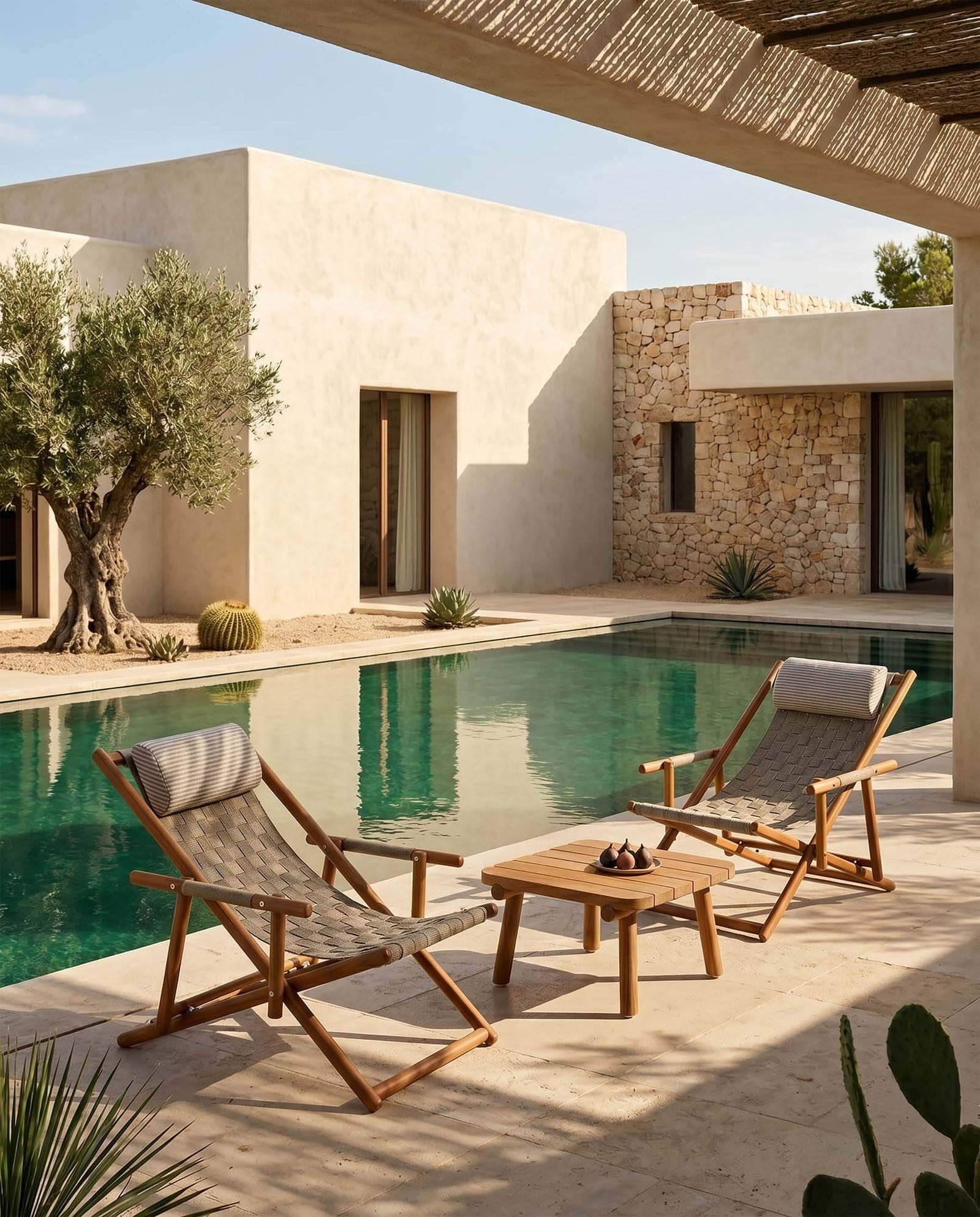
The UZ Deck Chair combines solid teak with a handwoven fabric seat and can fold. Its architectural relevance lies in the change between use and storage: a space that accommodates loungers in the afternoon might need a different arrangement at another time. Folding can support that change, provided there is a suitable storage location and a practical way to move the chairs there.
Across these examples, timber, rope, fabric and moving joints introduce different cleaning and inspection tasks. Appearance alone does not establish weather resistance, replacement-part availability or service life. The specification question is whether the intended routine can maintain the particular combination of materials and mechanisms.
This relationship between furniture and shelter also appears at the rooftop of the Nora Hotel, where a roofed pavilion and smaller areas of umbrella shade create different places to pause. In both cases, the space between the objects is part of the design.
✦ ArchUp Editorial Insight
Outdoor seating has to accommodate changing sun, changing activities and periods when nobody is using it. These examples address different parts of that pressure: a cantilevered canopy separates shade from the centre of a table, a swivel chair changes the direction of attention, a rocker introduces movement, and a folding chair offers a different storage condition. ArchUp’s reading is that flexibility belongs to the relationship between an object and its surroundings, not to a mechanism in isolation. A chair that rotates into a circulation route is not spatially flexible, and a folded chair still needs somewhere to go. The same distinction applies to generous upholstery: it can support long periods of rest while increasing the number of components that must be cleaned, dried or stored. The architectural consequence is to design the unoccupied space around the furniture with as much care as the furniture group itself. That means considering movement, access and service alongside the visual composition. The trade-off is between a fixed arrangement that is easy to understand and an adjustable one that demands active management. Neither is automatically better; the useful question is which changes the place genuinely needs to accommodate.