Pénétrable BBL Jaune: Mass and Spatial Interaction


Structural Deconstruction and the Dissolution of Spatial Boundaries
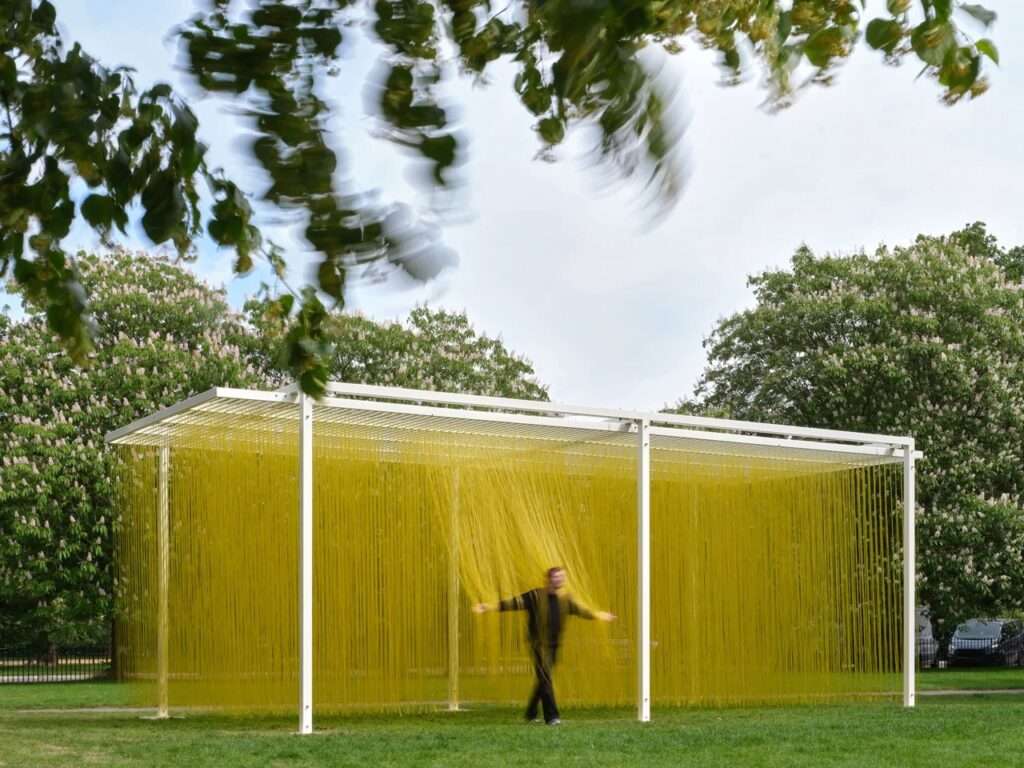
The sculpture “Pénétrable BBL Jaune” operates within a sculptural context that rejects the binary opposition between “viewer and art object,” offering instead an alternative grounded in the deconstruction of solid mass and its transformation into a spatial phenomenon. From the outside, the white steel frame imposes a strict geometric order that contains thousands of hanging PVC tubes in a dense yellow hue. This initial visual contradiction constructs a chromatic mass that, at first glance, appears solid and static; however, this presence is not intended to isolate space but to redefine it. The four thousand tubes do not form a continuous wall; rather, they function as a permeable field that draws in and fragments light, transforming the mass from a fixed visual entity into a penetrable kinetic structure. This approach resonates with contemporary discussions in Architecture and experimental uses of Building Materials.
The Scenographic Experience and Spatial Passage
The act of approaching the sculpture becomes a living scenographic experience that reshapes human movement within architectural space. At the moment of entry, the illusion of a solid mass dissolves, and the user experiences a physical passage in which the boundary between body and material collapses. The flexible tubes brush against the passerby’s arms, shoulders, and face, generating a dynamic interaction in which air movement intertwines with the elasticity of the suspended elements. The human subject shifts from an external observer to an active component that completes and activates the space itself. This material and psychological exchange fulfills Soto’s obsession with dissolving boundaries, as the artwork becomes an extended experience embedded in the user’s perception and bodily movement rather than a static object displayed in space. Such experiential strategies are increasingly explored through contemporary Design and spatial Interior Design practices.


Spatial Transition from Steel Entity to Relational Network
The placement of “Pénétrable BBL Jaune” in the open-air setting of London’s Serpentine Galleries marks a radical shift in the understanding of spatial phenomena and their relationship to the surrounding architectural environment. The work moves from the concept of a solid “object” to that of an open interactive “relation.” The yellow tubes reconfigure the external space by transforming color from a static visual surface into a dynamic atmospheric field influenced by sunlight and the orientation of natural light. The structure is no longer a mass inserted into public space; instead, it becomes a mediator that reorganizes human movement and pedestrian pathways, turning passing crowds from passive observers into active participants in the daily scenographic production of space. Similar spatial experiments can be observed across innovative Projects, urban Cities, and notable examples of public Buildings.
Kinetic Dynamics and Psychophysical Interaction
The vitality of the work emerges from its absolute rejection of visual stasis, replacing it with a living critical reading grounded in physical sensation and the psychological impact of materiality. The experience depends on air movement and the interplay of shadows produced by the oscillation of PVC tubes, preventing the sculpture from becoming a purely photographic or surface-level object. The architectural design of the work imposes a direct sensory test; the chromatic field sways with the movement of passersby and wind, altering reflected light and dissolving the boundary between the human body and the artistic system as a whole. This dynamic interaction stimulates spatial awareness and redefines the notion of “public art” as an extended field of tangible material experiences. These themes continue to inform ongoing architectural Research and professional Discussion.

✦ ArchUp Editorial Insight
The text diagnoses a radical transformation in the concept of architecture, reframing Soto’s kinetic installation as an interactive spatial condition rather than a solid mass. Through the use of flexible construction materials such as PVC tubes to dissolve structural boundaries, the project succeeds in replacing passive observation with a tangible sensory experience, transforming public space into an envelope in which body, light, and air interpenetrate. The use of experimental materials aligns with evolving approaches in Construction and specialized Material Datasheets.
However, this phenomenological interpretation carries a romanticized lens that overlooks the dynamics of institutional real estate investment. The translation of interactive art into urban space often functions as a tactical mechanism for producing developers’ visual identity, where this open interaction is leveraged to generate cultural capital. Consequently, the celebrated dissolution of architectural barriers risks becoming a carefully managed product, reducing urban spontaneity into a pre-scripted performative spectacle. Such critiques frequently appear in Architectural News and long-term analytical records preserved within the Archive.