

PhytoSymbiosis Seat: Interactive Public Seating

The Seat as a Design Case within the Public Realm
At first glance, the PhytoSymbiosis Seat can be read as an architectural element placed within a public garden. However, it extends beyond being a conventional piece of furniture. This outdoor design, developed by a student from the Royal College of Art and recognized in the NY Product Design Awards, raises a direct Design question: what if public furniture were not a separate object within nature, but rather an active component of its structure?
Research Methodology and Urban Observation
The seat was developed over a nine-month period of Research within an urban context in London. During this phase, user movement within public green spaces was tracked, alongside documenting the growing gap between city residents and their surrounding natural environments. This approach relied on field Research rather than direct theoretical assumptions.
Material Testing and Its Relationship to Site
To deepen the understanding of the materials used, plant scientists from Kew Gardens were consulted. In parallel, residents from areas near Westfield Park were invited to physically engage with and evaluate samples of plant materials. This type of interaction with both site and materials contributed to shaping a design outcome more closely tied to its context, without relying solely on conventional desk-based processes.

Material and Its Interaction with Plant Growth
The frame is composed of bio-concrete with a porous surface, where this porosity was intentionally designed through material experimentation rather than as a visual feature. The purpose of this surface is to provide adhesion for English ivy, which relies on dense aerial roots that can reach 30–40 roots per 10 centimeters of stem. These roots anchor themselves to the rough concrete, resulting in the formation of a composite structure that becomes more cohesive over time, in contrast to most public furniture elements that gradually deteriorate. Here, plant growth is transformed into a structural support component rather than a source of weakness through controlled materials behavior.
Formal Logic and Distribution Geometry
The overall form is based on Voronoi geometry, an organizational pattern used to understand how resources and spaces are distributed in nature, particularly in contexts of plant growth and competition. The networked structure within the frame is not presented as a decorative element, but as an engineered response aligned with the behavior of climbing plants, allowing the ivy to be guided through and within the structure in a controlled manner through Design logic.
Structural Analysis and Computational Modeling
This formal system is supported by finite element analysis (FEA) to test the efficiency of structural cohesion under varying conditions. This computational validation demonstrates that the form is not driven solely by aesthetic considerations, but by precise structural modeling that integrates material behavior, plant growth, and the stability of the system as a whole within a broader Research framework.
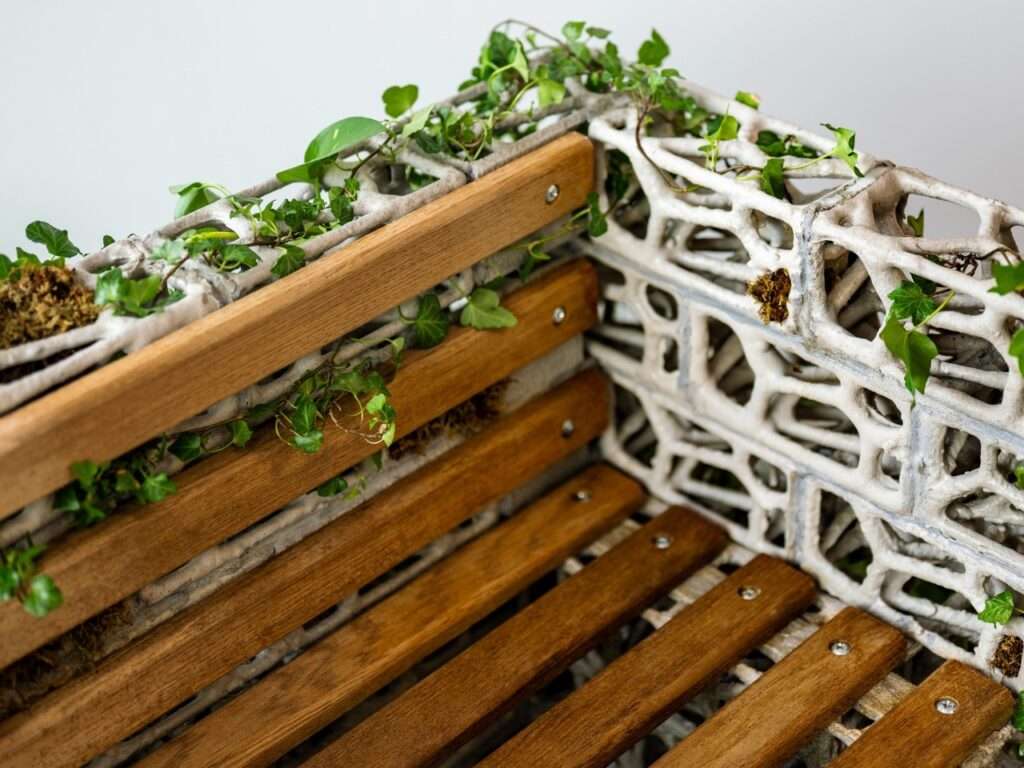
The Social Dimension as Part of the Design Function
This project is grounded in the idea that the seat is not a static object, but an entity intended to undergo continuous care from its users. Residents are expected to water the plant, guide the growth of the ivy, and make incremental decisions that influence the evolution of the final form. The system also incorporates a water-level sensor that alerts users when intervention is needed, transforming the relationship with the architectural element into one of ongoing engagement rather than momentary use, reinforcing the role of Design.
From Use to Care
This interaction shifts the act of sitting from a functional practice into an extended relationship of care, where the user becomes part of the growth cycle of the plant integrated with the structure. As a result, a gradual bond forms between the individual and the architectural element, one that emerges from continuous interaction with its biological needs, rather than merely using it as public furniture shaped by materials.
Usage Outcomes and Societal Impact
Initial observations indicate measurable social changes. Volunteer participation rates in surrounding neighborhoods increased by 40%, while carbon emissions decreased by 62% compared to conventional furniture. The project also relies entirely on native plant species, supporting biodiversity and reducing the risks associated with invasive species. Over time, the seat evolved into a gathering point for residents, fostering dialogue and knowledge exchange around plant care, an outcome that aligns with the project’s original objectives and broader sustainable development goals within the context of urban Cities.

Redefining the Public Seat
Public seating is typically treated as a neutral element within the urban space, used temporarily and then left without further interaction. In this context, the PhytoSymbiosis Seat offers a reinterpretation of the seat’s role, shifting it from a passive object within the environment into an active component of an interactive system connected to its surroundings through Design.
From Passive Use to a Relationship of Participation
This transformation places the seat within a framework of shared responsibility, requiring users to engage continuously rather than relying on brief, transient use. As a result, a reciprocal relationship emerges between people and place, one built on attention, return, and gradual interaction. In this sense, the seat becomes a small point of activation within the public realm, linking individual use to collective behavior within a shared environment informed by ongoing Research.

✦ ArchUp Editorial Insight
The PhytoSymbiosis Seat emerges as an indirect response to the intersection of architectural education systems, sustainability-linked funding criteria, and the governance mechanisms of public space management within cities. The project does not originate from a purely aesthetic intention; rather, it is shaped by the need to comply with measurable environmental and social performance indicators. Within this framework, user participation becomes embedded in the logic of reducing operational costs associated with maintaining green spaces and managing Construction systems.
Key tensions arise from municipal maintenance regulations, the costs of horticultural upkeep, and the limits of legal liability. These constraints inform a redistribution of responsibility, shifting care from institutional management bodies to user behavior through a system of sensing and feedback.
As a result, plant growth is positioned as an alternative to conventional maintenance cycles. The material stability of the seat becomes contingent on patterns of use and social interaction, rather than on institutional structures alone, effectively reconfiguring maintenance as a decentralized, behavior-driven process grounded in advanced materials.

★ ArchUp Technical Analysis
Technical and Documentary Analysis of the Plant Cohabitation Bench Project – London, United Kingdom:
This article presents a design analysis of the Plant Cohabitation Bench project as a case study in redefining the public bench as an interactive system. To enhance its archival value, we would like to present the following key technical and design data.
The project was developed over a nine-month period of observation in an urban context in London, in consultation with botanists from Kew Gardens and involving residents from areas near Westfield Park, and received recognition at the NY Product Design Awards.
The frame is made of bio-concrete bricks with a porous surface designed to enable English ivy (which relies on aerial roots reaching 30-40 roots per 10 cm of stem) to cling to the rough concrete and form a composite structure that becomes increasingly cohesive over time. The overall form is based on Voronoi geometry, supported by finite element analysis to test structural cohesion efficiency.
The system includes a water level sensor to alert users when watering is needed, where residents are asked to water the plant, guide the ivy’s growth, and make gradual decisions that affect the final form’s evolution. Initial experience indicates a 40% higher volunteer participation rate in neighboring neighborhoods, a 62% reduction in carbon emissions compared to traditional furniture, and reliance on entirely local plants to support biodiversity.
Related Insight: Please refer to this article to understand the context of modern architectural preservation:
Interactive Public Furniture: Strategies for Integrating Biomaterials and Sensing.




✅ Official ArchUp Technical Review completed for this article.