Regional Sports Infrastructure Expands with National Tennis Centre in Qiddiya City

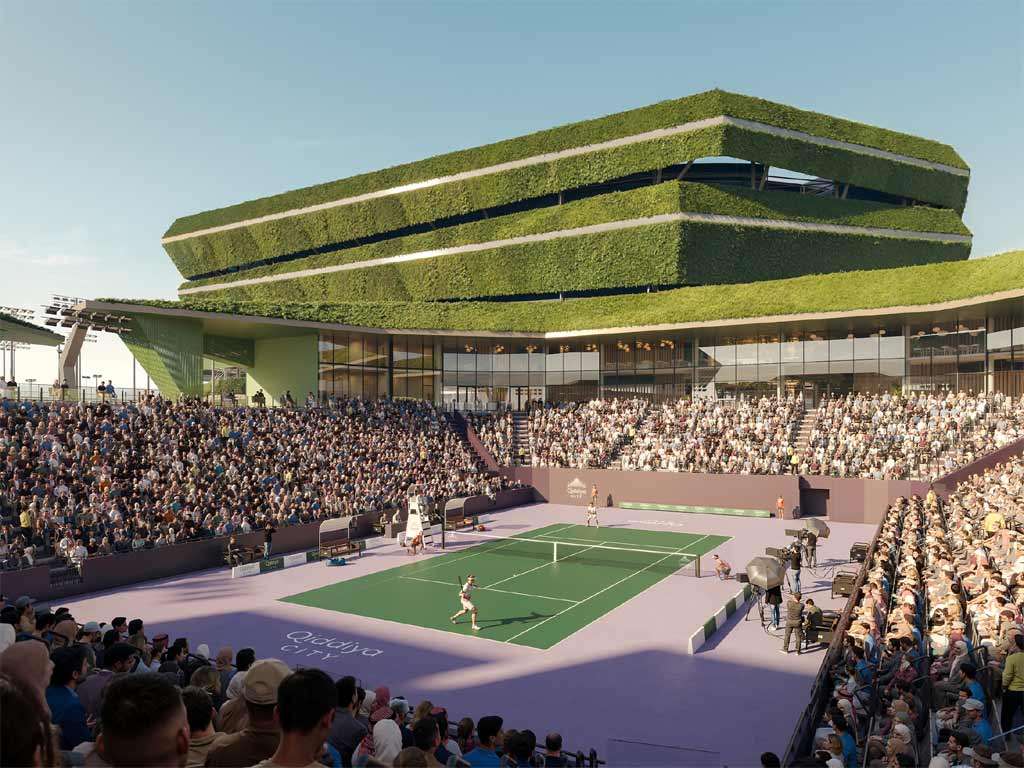
Saudi Arabia recently unveiled plans for a major sports infrastructure project in Qiddiya City that will establish the largest tennis complex in the Middle East. The facility integrates 30 professional-grade courts into the mountainous topography west of Riyadh, marking a significant typological shift for regional athletic venues. This intervention centralizes elite tournament capacity with a permanent hub for long-term athlete development and public participation.
The project comprises a diverse array of court surfaces and spectator capacities to meet international competition standards. The program includes 28 hard courts and two clay courts, satisfying the technical requirements of the ATP, WTA, and International Tennis Federation. This variety allows the venue to host a broad spectrum of professional tournaments while providing specialized training environments for high-performance athletes.
Tiered Spectator Arenas and Flexible Programmatic Logic
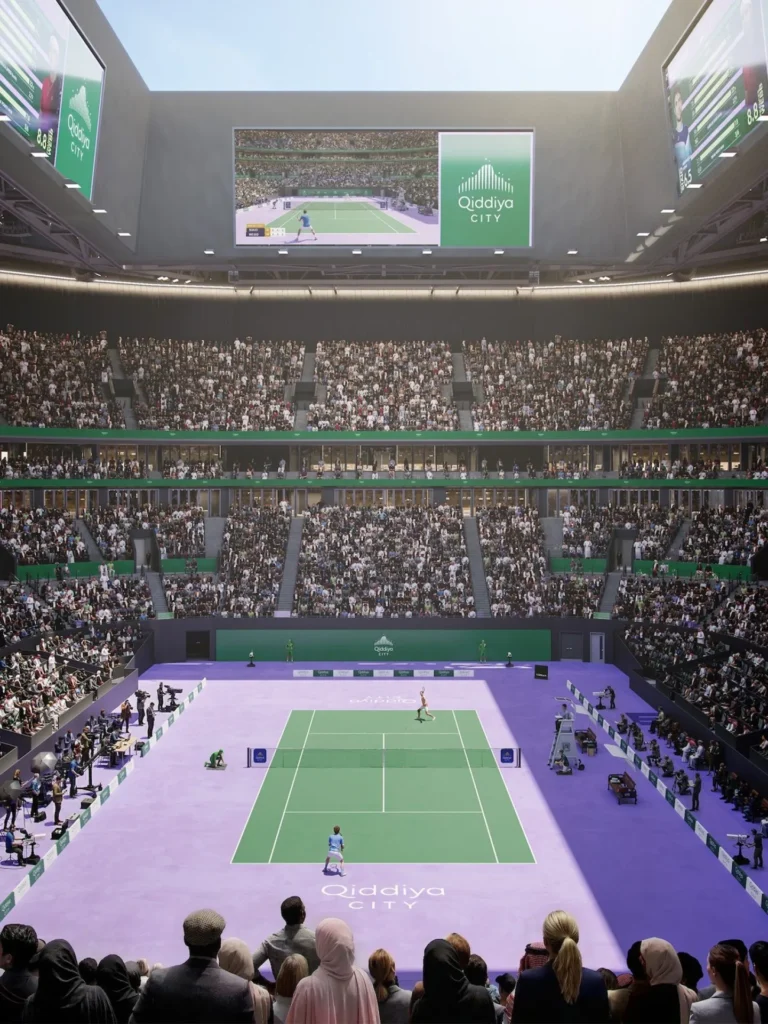
The centerpiece of the construction effort involves a 15,000-seat Center Court. This primary venue utilizes a retractable roof system to manage environmental conditions and facilitate multi-functional use. Beyond the main stadium, the master plan incorporates an 8,000-seat multi-purpose arena, a 5,000-seat Court One, and a 2,000-seat Court Two, resulting in a total site capacity of approximately 33,000 spectators.
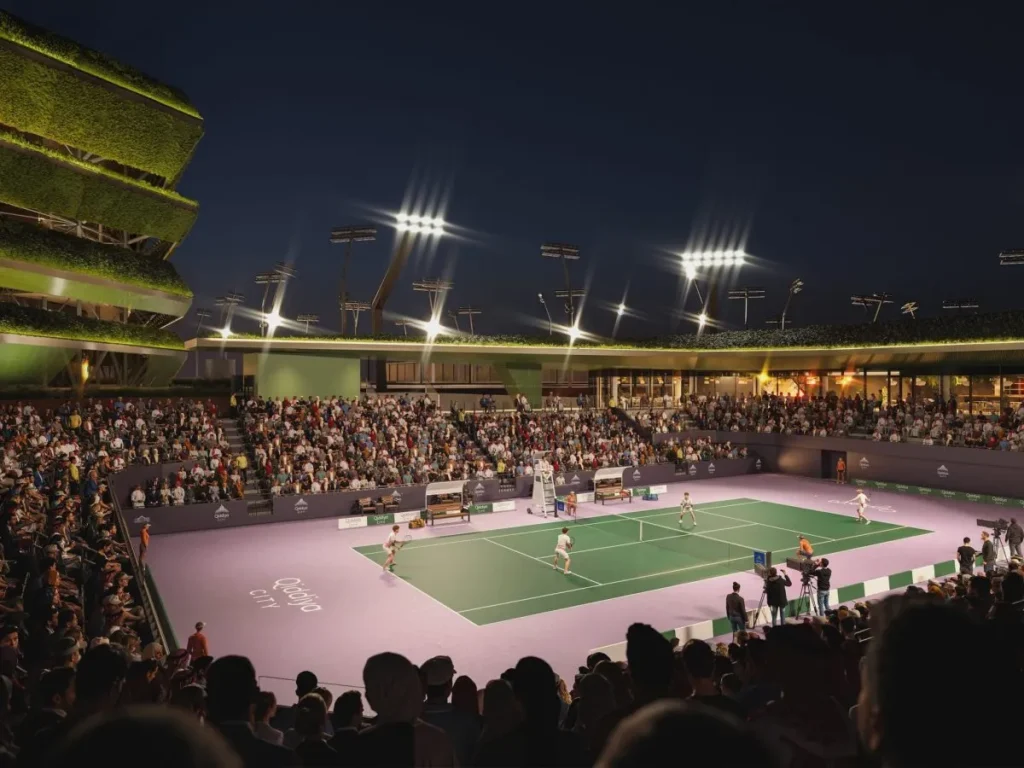
The design team prioritized operational flexibility by equipping the two largest arenas with retractable roofs. This technical choice transforms the specialized sports buildings into versatile entertainment venues capable of hosting concerts and cultural events. This strategy ensures the facility remains active outside of the professional tennis calendar, enhancing the project’s long-term economic and social utility.
Topographical Integration and Material Systems
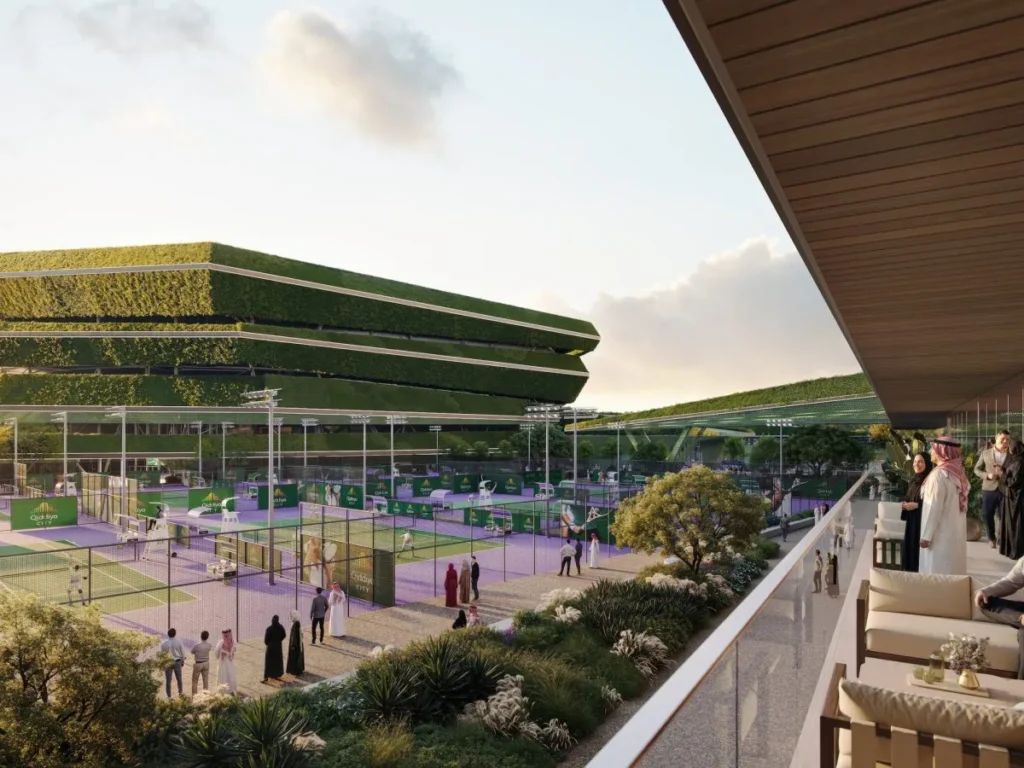
The intervention responds directly to the dramatic landscape of the Tuwaiq Mountains. The design utilizes layered green façades and landscape-driven architecture to soften the transition between the built volumes and the desert environment. This approach aligns the massive scale of the sports infrastructure with the existing geological context of Qiddiya City.
Internal circulation paths connect the spectator zones with high-performance training facilities. The scheme includes six indoor courts, 14 practice courts, and dedicated athlete recovery zones. Technical spaces such as hydrotherapy suites, physiotherapy clinics, and wellness facilities support the primary athletic program, creating an all-encompassing environment for elite training and sports science.
Circulation Hierarchy and Programmatic Intelligence
The architectural strategy organizes a complex hierarchy of movements, successfully segregating professional athlete flows from high-volume spectator traffic. By embedding the 15,000-seat center court as the primary anchor, the design establishes a clear gravitational center for the site while allowing the 28 peripheral courts to function as an accessible community campus. The use of retractable envelopes on the primary stadiums demonstrates technical rigor, solving the challenge of thermal comfort while providing the structural flexibility required for a multi-use entertainment district. This project transitions the tennis center typology from a seasonal tournament venue into a permanent piece of urban infrastructure that leverages the unique section of the Tuwaiq Mountains to create a distinct sense of place.
Project Team: Populous. Location: Qiddiya City, Saudi Arabia.
Project Notes: Qiddiya Investment Company develops the project. The scheme currently undergoes construction as part of the Qiddiya City sports and entertainment district master plan.
✦ ArchUp Editorial Insight
The National Tennis Centre in Qiddiya attempts a rare synthesis by embedding massive, high-performance athletic volumes directly into the Tuwaiq Mountains’ rugged geological section. This architecture moves beyond the static stadium model, employing retractable envelopes and tiered green façades to reconcile international tournament standards with the desert’s extreme climate, effectively recasting a specialized sporting typology as a permanent, multi-functional piece of urban infrastructure.
However, the pursuit of “landscape-driven” integration risks masking a fundamental tension between delicate topographical preservation and the invasive logistics of 33,000 spectators. While the project emphasizes flexibility, the carbon intensity of such high-spec construction in a remote mountain terrain remains a critical blind spot. True urban utility requires more than just mechanical adaptability; it demands evidence that these heavy-footprint interventions can meaningfully serve a public beyond the elite athletic circuit.