Songshan Lake Exhibition and Performance Center Opens in Dongguan

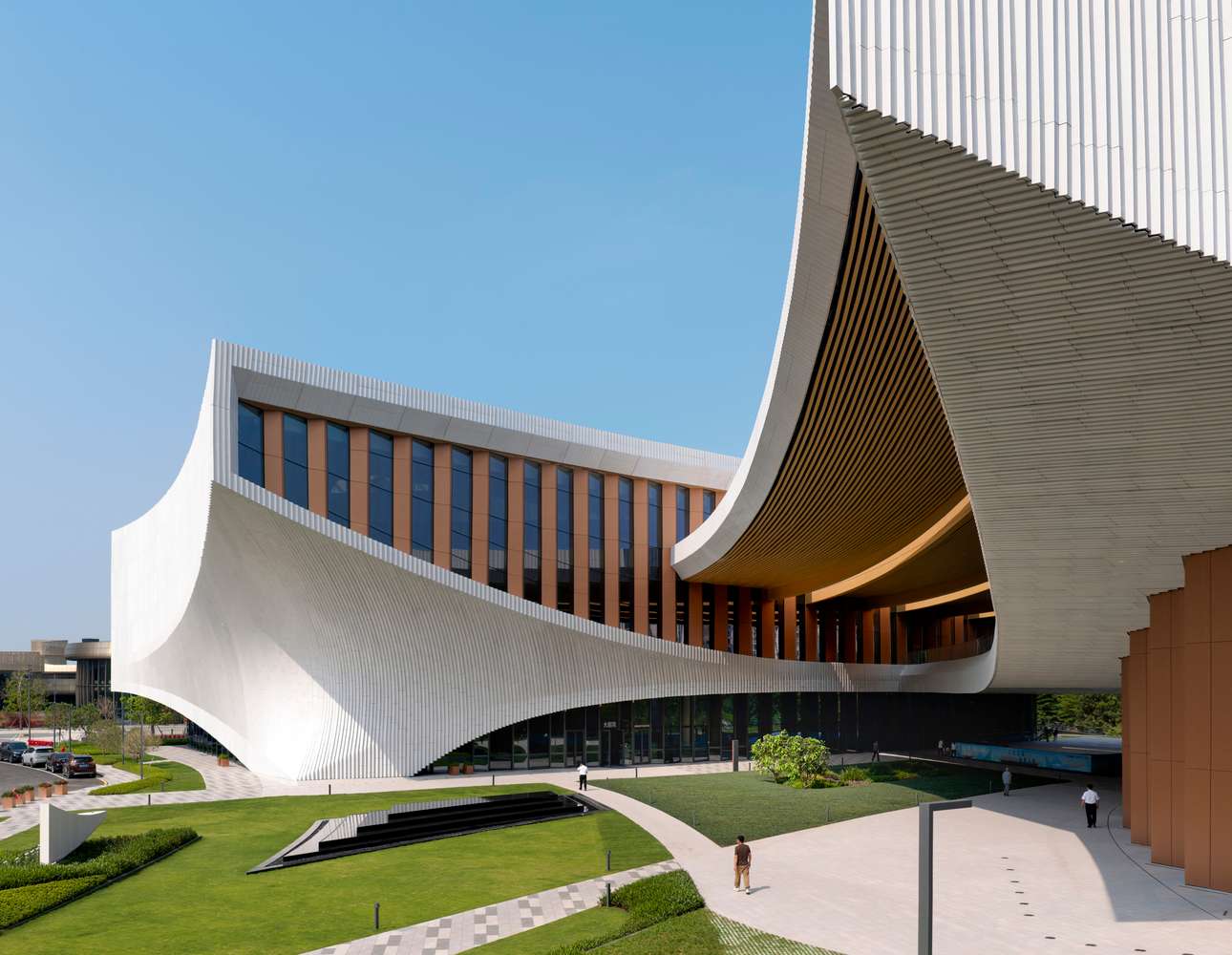
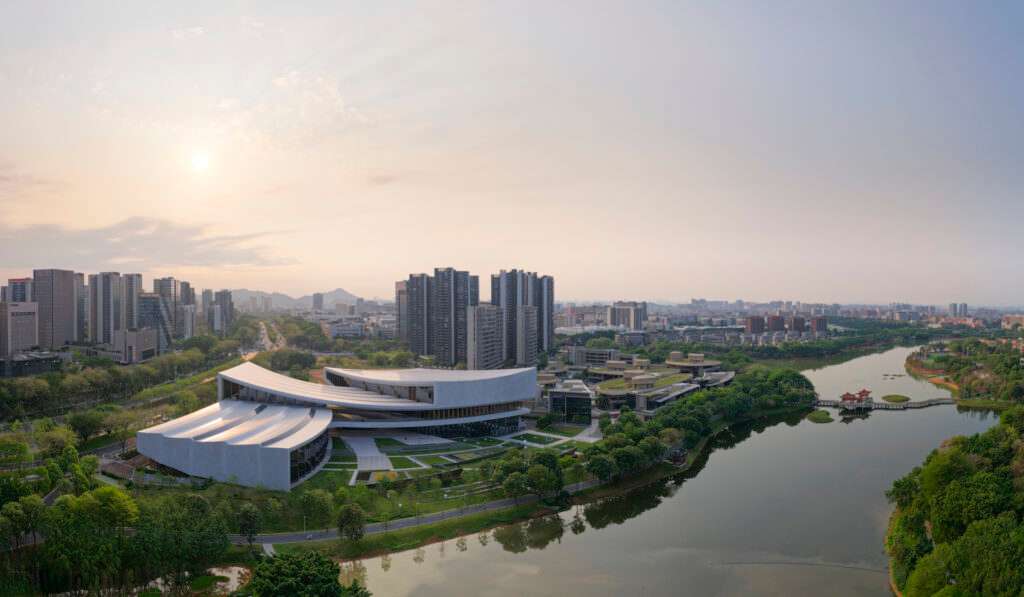
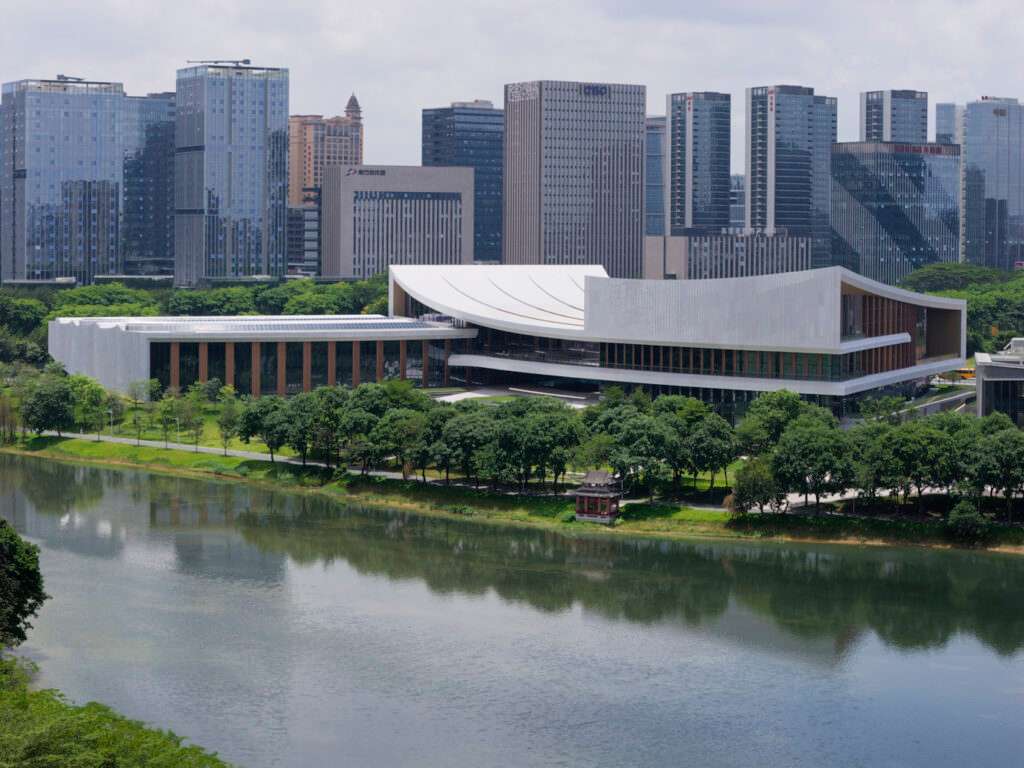
The Songshan Lake Exhibition and Performance Center recently opened in Dongguan, China, establishing a new civic anchor within the city’s High-Tech Industrial Development Zone. This 45,000-square-meter facility consolidates diverse cultural and athletic programs into a singular riverside building. The intervention redefines the waterfront through a series of sweeping geometries that reference regional performance traditions while addressing the climatic demands of the Pearl River estuary.
The design team organized the complex around a sheltered public plaza, garden terraces, and a waterfront promenade. This configuration integrates the architecture with the surrounding landscape, providing accessible public space for the growing technological district. The scheme utilizes a massive, extended roof structure to mitigate solar gain and provide protection against the region’s humid subtropical climate.
Architectural forms within the center flare and rise toward the western edge, creating a vertical crescendo that frames the primary performance and exhibition volumes. These curves draw direct inspiration from “water sleeves,” the fluid fabric extensions found in traditional Cantonese Opera costumes. By translating this movement into a structural language, the project establishes a symbolic connection to the 700-year history of the local performing arts.
Programmatic Distribution and Acoustic Engineering
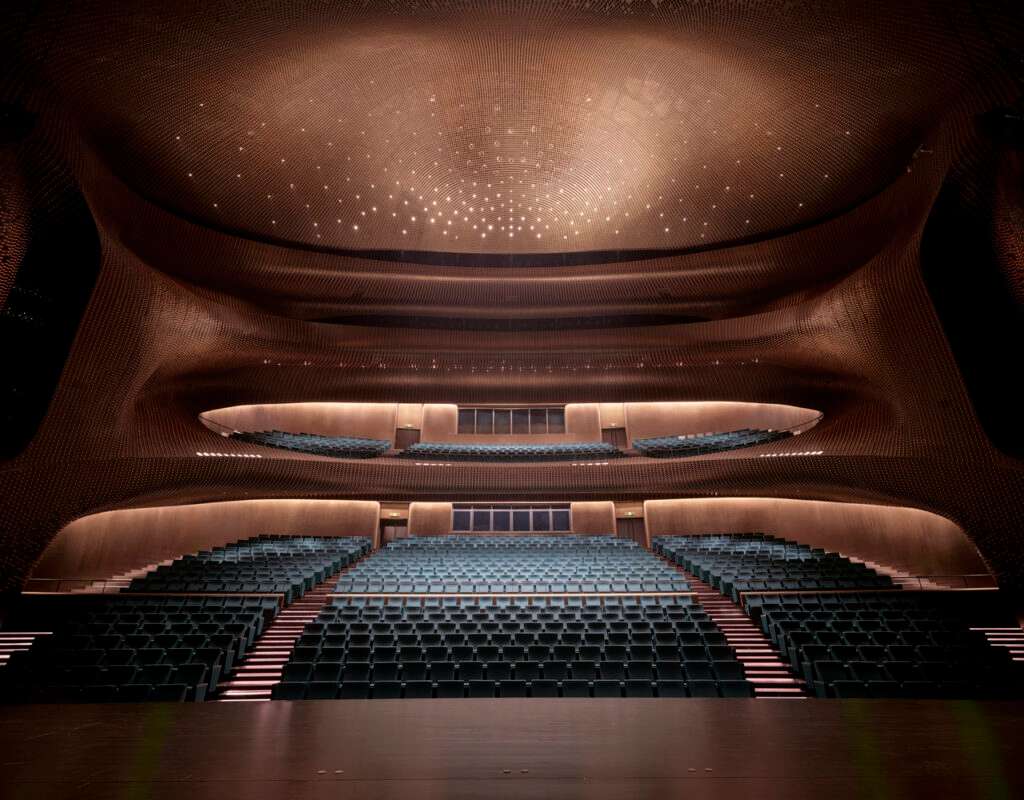
The interior program features a 1,200-seat Grand Theatre designed for international theatrical productions, alongside a 400-seat Multifunction Hall for smaller community events. An expansive exhibition hall supports conferences, industry forums, and art showcases. These spaces allow the facility to operate as a multi-functional hub for both the High-Tech Industrial Development Zone and the broader Guangdong-Hong Kong-Macao Greater Bay Area.
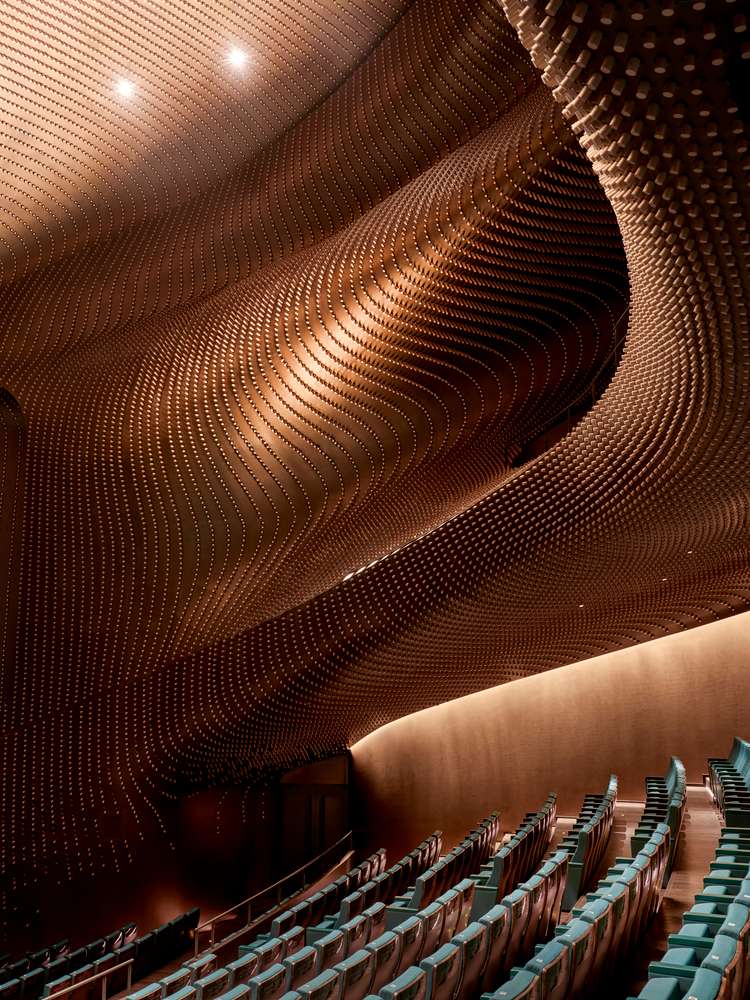
The Grand Theatre employs advanced acoustic engineering through a system of 100,000 slender spines. These elements vary in length and density across the walls and ceiling to manage sound diffusion. This strategy effectively controls reverberation and disperses standing waves, ensuring high-fidelity sound throughout the auditorium. The team selected aluminum and glass-reinforced gypsum for the interior finishes to ensure durability and low-maintenance construction.
Material Systems and Environmental Performance
The exterior envelope utilizes prefabricated ultra-high-performance concrete (UHPC) cladding. The team cast these panels from reusable molds to minimize waste and reduce carbon emissions during the fabrication process. On the upper elevations, opalescent aluminum soffits and roof panels reflect sunlight, further reducing thermal loads in the low-latitude environment.
Integrated sustainability strategies include photovoltaic arrays and rainwater harvesting systems built directly into the roof. Outside, the landscape design features permeable surfaces and replanted wetlands. These elements work together to manage stormwater runoff, mitigate local flood risks, and support biodiversity along the river’s edge.
Circulation Hierarchy and Programmatic Intelligence
The project demonstrates a sophisticated reading of public threshold and circulation. By lifting the primary massing at the western edge, the design creates a clear hierarchy that prioritizes the performance volumes while maintaining a porous ground plane. This spatial sequence guides visitors from the waterfront promenade into a sheltered transition zone before they enter the formal lobbies. The material coherence between the UHPC exterior and the technical interior surfaces provides a seamless transition between the civic exterior and the specialized performance environments. This strategy successfully balances the requirement for monumental cultural presence with the need for a permeable, accessible urban interface.
Project Team: Zaha Hadid Architects (ZHA) and Beijing Institute of Architectural Design (BIAD). Location: Dongguan City, Guangdong Province, China.
Project Notes: The facility opened on March 30, 2026, following a five-year construction period that began in 2021. The High-Tech Industrial Development Zone served as the primary client for the 45,000-square-meter project.
✦ ArchUp Editorial Insight
The project attempts a sophisticated reconciliation between high-tech programmatic requirements and regionalist memory, translating the fluidity of Cantonese opera into a rigid structural architecture. By deploying advanced acoustic spines and specialized concrete envelopes, the intervention elevates a suburban industrial zone into a legitimate civic destination. This formal crescendo successfully anchors the waterfront, utilizing the roof’s massive overhang as both a climatic shield and a public threshold for the district.
However, this reliance on symbolic “water sleeves” risks reducing deep cultural heritage to a mere parametric skin, masking the standard box-and-lobby logic typical of global cultural hubs. While the project integrates sustainability through renewable arrays, the carbon intensity of bespoke precast molds and 100,000 acoustic elements reveals a tension between environmental rhetoric and the material extravagance required for such monumental spectacle.