The Wall Dries, the Salt Remains: Rethinking Masonry Repair After Water Damage

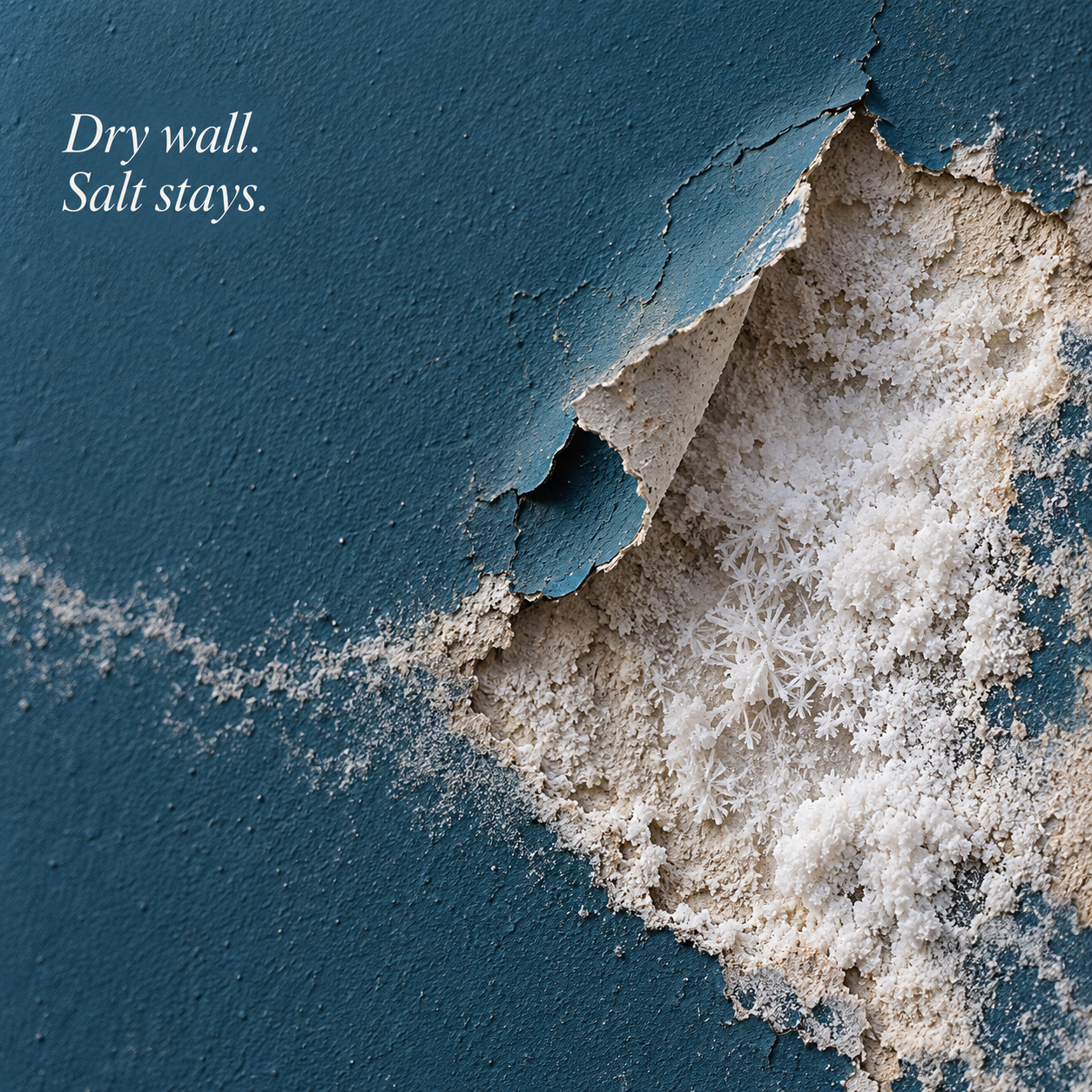
A wall can look ready for repainting while the condition of its porous material remains uncertain. For architects and contractors repairing water-damaged masonry, the question is therefore not simply when the surface becomes dry. It is what remains inside, what can happen during subsequent moisture changes, and what evidence should justify closing the repair.
This research-led analysis connects laboratory work on confined crystal growth to a specific architectural decision: accepting a masonry repair before applying its final finish. It presents no new experiment. The repair procedure proposed below is an ArchUp hypothesis for testing, not a treatment validated by the cited researchers.
What the experiment actually established
On 5 August 2016, Julie Desarnaud, Daniel Bonn and Noushine Shahidzadeh published an experiment measuring forces during salt crystallization between confining surfaces. Their findings identified the importance of a thin liquid film between crystal and wall. Hydrophobic surfaces, without the observed film, produced no detected repulsive force in that setup. The authors inferred approximately 220 ± 50 MPa for one experiment from force and estimated contact area. This is a local experimental pressure, not a design load for masonry.
Why a large microscopic pressure does not predict a failed wall
In their 2014 study, Robert J. Flatt, Francesco Caruso, Asel Maria Aguilar Sanchez and George W. Scherer varied crystallization pressure and pore saturation, showing that a strain-energy failure criterion could predict damage in their experiment. This adds an essential distinction: generating pressure and damaging an entire specimen are different questions.
ArchUp interprets that distinction as a warning against specifying repairs from a single impressive laboratory number. An engineer needs evidence about the actual substrate, the extent and distribution of contamination, and the response of the material as a whole. A microscopic mechanism can explain a route to failure without supplying the remaining inputs for a building assessment.
A later study places a limit on the analogy
Lei Li and colleagues, in Limits to Crystallization Pressure, published in Langmuir in 2022, investigated confined calcite growth with controlled pressure and imaging. Displacement stopped well below the thermodynamic limit. Their analysis addressed how interfacial conditions could shift a system from displacement toward adhesion. Because calcite and the earlier salt experiments are different systems, this is not a direct refutation of the 2016 result. It is a substantive reason to avoid treating theoretical pressure as an inevitable field outcome.
The relevant scientific qualification is therefore neither “salt always destroys stone” nor “dry stone is safe.” Behaviour depends on the material and its interfaces. These studies do not establish a universal drying period, a permissible salt concentration for every wall, or a coating that guarantees protection. Nor does the hydrophobic laboratory result validate applying a water-repellent product to an existing building.
Architectural proposition: accept a repair process, not a photograph
Consider a hypothetical ground-floor masonry wall after water ingress. Its appearance has improved, and the programme calls for finishing trades to return. ArchUp proposes separating three decisions that might otherwise be combined: whether the water source has been addressed, whether the substrate is ready for the selected repair system, and whether the completed finish has demonstrated acceptable behaviour. A dry-looking surface would answer none of those questions by itself.
The practical application is a project-specific acceptance record. A competent materials specialist would define the sampling method, identify relevant salts where investigation is warranted, and establish how moisture and material condition will be assessed. The designer and contractor would then agree on a representative trial area before extending the finish. This is a proposed way to manage uncertainty; the cited papers did not compare construction contracts or prove that this procedure reduces callbacks.
How the proposal could be tested
- Define the case. Record substrate, existing finish, water-entry history and the proposed repair. Avoid combining different stones or mortars into a single result.
- Set comparisons before treatment. Use matched samples or representative trial areas, with an untreated comparison where appropriate. Record the initial moisture condition and salt characterization using methods selected for that material.
- Test the relevant sequence. Compare the proposed preparation and finishing procedures under justified wetting and drying conditions. Establish replication and observation periods in advance; do not translate accelerated cycles directly into years of service.
- Measure material behaviour. Predefine outcomes such as material loss, crack development and finish adhesion, alongside moisture observations. Appearance remains one outcome, not the sole acceptance test.
- Make the decision reversible where possible. Agree beforehand what evidence triggers a revised treatment or further investigation before the entire wall is concealed. Do not deliberately rewet occupied or protected fabric merely to reproduce a laboratory test.
The test would support the proposition only if the chosen procedure improved the predefined material outcomes against its comparison. An attractive trial panel alone would not demonstrate durability. A negative or inconclusive result should remain visible in the repair record.
✦ ArchUp Editorial Insight
Pressure to reopen a room gives repair teams an immediate, observable target: a surface that can receive its finish. If a project releases payment at that point, the acceptance rule may reward the disappearance of visible moisture without requiring evidence about the substrate that remains. This is a hypothetical procurement mechanism, not a claim about a particular contractor. The distinction matters because confined crystallization makes the interval between apparent completion and material response a legitimate technical concern. Under an appearance-based acceptance rule, a contractor can meet the agreed milestone while the owner retains uncertainty that the milestone never measured. ArchUp proposes making a representative repair trial and a defined observation record deliverables in their own right, with responsibilities and acceptance criteria agreed before work starts. Such a provision would need project testing; the cited experiments do not establish its financial effectiveness. Its institutional purpose would be to attach payment evidence to material behaviour rather than to the speed with which deterioration becomes invisible. The architectural consequence could be a repair sequence that leaves selected areas accessible for observation before final enclosure. Whether that additional interval is justified should depend on measured risk and the value of the fabric, not on a universal waiting period.
References
- Julie Desarnaud, Daniel Bonn and Noushine Shahidzadeh. The Pressure induced by salt crystallization in confinement. Scientific Reports, 2016.
- Robert J. Flatt, Francesco Caruso, Asel Maria Aguilar Sanchez and George W. Scherer. Chemo-mechanics of salt damage in stone. Nature Communications, 2014.
- Lei Li, Felix Kohler, Joanna Dziadkowiec, Anja Røyne, Rosa M. Espinosa Marzal, Fernando Bresme, Espen Jettestuen and Dag Kristian Dysthe. Limits to Crystallization Pressure. Langmuir, 2022.