The Woodpecker Is a Hammer, Not a Helmet: Testing Impact-Resistant Facades
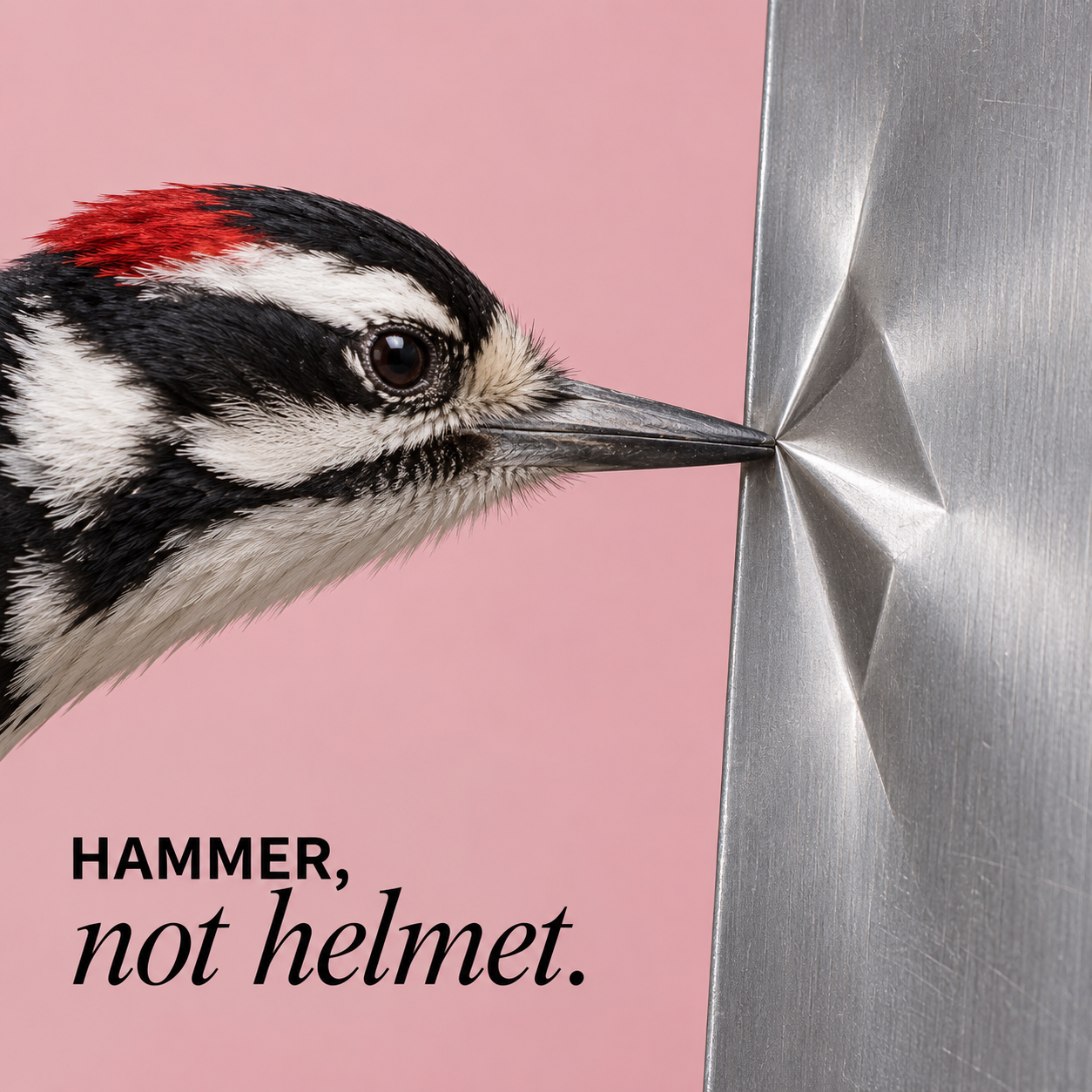
Biomimicry often begins with a memorable explanation: a woodpecker repeatedly strikes timber without obvious injury, so its head must contain an exceptional shock absorber. That account has influenced engineering concepts, yet direct measurements tell a different story. For architecture, the correction matters because an impact-resistant facade is not defined by resemblance to a biological form. It is defined by where impact energy travels, what remains serviceable and which failure the project is trying to prevent.
What the study measured
Sam Van Wassenbergh and colleagues published their study in Current Biology in 2022. They analysed 109 high-speed recordings from six captive individuals representing three woodpecker species. Landmarks on the beak, eye and, for some recordings, skin above the skull were tracked during impact. The eye was used as a proxy for the front of the braincase and was checked against a skull marker in the pileated woodpeckers.
If a compliant structure between beak and braincase absorbed substantial shock, peak deceleration at the braincase should have been lower than at the beak. The measured relationship was instead close to rigid. Across the six birds, regression slopes ranged from 0.966 to 1.308. The authors interpreted the lowest value as only a 3.3% reduction; the other individuals showed no reduction. Their biomechanical model also predicted a functional trade-off: adding compliance reduced penetration into wood at equal input, while restoring equal penetration required more energy.
The study therefore supports a narrower conclusion than popular biomimetic accounts. In the observed pecks, the cranial system behaved primarily as a stiff hammer rather than a shock absorber. Numerical models suggested that small brain size and geometry kept estimated intracranial pressure below concussion thresholds borrowed from primate data. That safety calculation is not direct evidence of an architectural material mechanism.
Limits and the later critique
The sample comprised two individuals from each of three species, all filmed in managed settings and striking selected materials. Deceleration was inferred from external landmarks, although the skull proxy was validated for one species. The head-and-neck and intracranial analyses necessarily simplified tissue behaviour, contact conditions and interspecies differences. Most importantly, comparison with primate concussion thresholds relies on assumptions about how pressure relates to injury across very different animals.
A later review by James M. Smoliga emphasized the broader translational problem: woodpeckers and humans differ in biology, scale and impact mechanics, and attractive commercial narratives can outrun evidence. Neither paper tested a building envelope. ArchUp’s architectural proposal below is therefore a testable transfer of method—not a claim that a facade should copy a skull.
The architectural question: what does “impact resistant” protect?
Consider a modular rainscreen at a loading bay or service yard where carts, maintenance equipment or handling errors can strike the lower facade. A panel may remain visually intact while transmitting a damaging impulse to rails, anchors or the substrate. A more compliant layer may lower a peak force but permit excessive movement, open a joint, rebound into circulation space or lose weather performance. These are different failure modes.
The biological study suggests a useful correction to the design question. Before selecting a “shock-absorbing” geometry, the team should identify the protected function: the visible face, the concealed attachment, the primary structure, adjacent occupants, continued weather resistance, or rapid replacement. No single response optimizes all of them. Stiffness can be valuable when the task requires transmitting force; isolation can be valuable when the task requires limiting what reaches the support. The choice cannot be resolved by a biological analogy alone.
A paired mock-up for facade impact testing
ArchUp proposes a comparative mock-up for the actual project assembly. Two specimens would use the same panel material, joints, cavity and support substrate. One would use the proposed conventional bracket arrangement; the other would incorporate the claimed isolation feature. Impact energy, striker geometry and acceptance limits should follow the applicable code, product standard and project risk assessment rather than values borrowed from the bird study.
- Measure both sides of the assembly: record impact energy, panel acceleration, force at selected anchors or rails, displacement, rebound and the duration of the response.
- Inspect hidden damage: examine fastener slip, bracket yielding, cracked coatings, delamination and substrate distress after each impact and after repeated cycles.
- Retest enclosure functions: check joint geometry and the required air- and water-control performance after impact, not only the visible dent.
- Define replaceability: document the time, access and components required to restore the affected zone. A sacrificial panel is useful only if replacement is feasible.
- Separate outcomes: report surface damage, transmitted force, residual movement and loss of enclosure performance independently. A pass in one category must not conceal failure in another.
The primary outcome should be chosen before testing. If the project’s main risk is anchor damage, transmitted load—not a visually persuasive slow-motion video—should govern the comparison. If public safety is the concern, fragments, rebound and post-impact stability may be more important. Repeated impacts are also necessary where low-energy contact is frequent, because a specimen that survives one event can accumulate hidden damage.
What would confirm or reject the application?
The proposed isolated assembly would be supported if it reduced the preregistered transmitted-load measure without creating unacceptable movement, rebound, hidden damage or enclosure leakage. It would be rejected if apparent cushioning merely shifted failure into joints, fixings or maintenance burden. Tests should include manufacturing tolerances and installation variation, because a laboratory-perfect interface may not represent site workmanship.
This procedure does not establish a universal facade detail. It converts a corrected biological finding into a more disciplined question: distinguish the function being optimized, trace the energy path and test the complete assembly. The lesson from the woodpecker is not a shape. It is that a plausible story about protection can describe the opposite mechanical function.
✦ ArchUp Editorial Insight
Biomimetic claims gain traction because procurement rewards a concise innovation story long before service evidence accumulates. A named natural model can make a proprietary layer appear self-explanatory, while the decision framework remains vague about whether the product protects the panel, the anchors or the people and spaces behind it. If approval rests on surface appearance after a single demonstration, the supplier benefits from a legible success and the design team can close the submittal; hidden movement, inspection access and repeat-impact damage pass to the facade contractor, operator and insurer. This transfer is not proof of bad faith. It follows from an acceptance criterion that measures the most visible outcome rather than the system’s risk. A performance specification should therefore assign one party to define the protected function, require comparable assembly-level evidence and state who bears replacement and verification after impact. Those decisions change material architecture: bracket spacing, cavity depth, joint tolerance, sacrificial zones and access panels become consequences of an accountable energy path. The woodpecker study matters here because it shows how easily morphology can be given the wrong function when the test is inferred from the story rather than designed around the load.
References
Sam Van Wassenbergh, Erica J. Ortlieb, Maja Mielke, Christine Böhmer, Robert E. Shadwick and Anick Abourachid. Woodpeckers minimize cranial absorption of shocks. Current Biology, 2022.
James M. Smoliga. From beaks to brains—Challenges in translating woodpecker biology into traumatic brain injury innovation. The Anatomical Record, 2026.