The City That Thinks for You

When Smart Space Becomes a Silent Adversary to the Minds That Inhabit It
There is a paradox embedded in every “smart” building designed over the past decade: the more successfully a designer eliminates friction and smooths the spatial experience, the more effectively — and entirely unintentionally — that designer trains occupants not to think. This is not a literary metaphor. It is a documented finding that emerges from a convergent body of cognitive research, all of it circling a phenomenon as deceptively simple in name as it is far-reaching in consequence: metacognitive laziness — the brain’s tendency to avoid the effort required to monitor and regulate its own thinking, and to delegate that burden to whatever external resource is nearest, including walls, screens, sensors, and algorithmically managed elevators.
The Cognitive Miser: A Brain That Resists Its Own Effort
Before arriving at architecture, the mechanism demands understanding. Decades of research in cognitive psychology have established that the human brain is not neutral toward mental effort — it is constitutionally biased against it. Researchers describe this disposition as the “cognitive miser” tendency, not a personal failing but a general evolutionary strategy: the brain evaluates the cost of any task before committing to it, and the more demanding a task appears on first appraisal, the more likely it is to be avoided or delegated outward.
The most revealing evidence for this came from experiments conducted by Tara Dunn and Evan Risko at the University of Waterloo, who constructed two reading conditions that were objectively identical in every measurable dimension — response time, error rate, and even blink frequency as a physiological indicator — but differed in how effortful participants perceived them to be. The result was unambiguous: people avoided the condition that felt more demanding, not the one that actually was. What drives behavior, in other words, is not genuine effort but the metacognitive judgment — the brain’s self-assessment — and that judgment is frequently wrong.
Cognitive Offloading: When the Wall Becomes a Backup Drive
From this foundation extends a phenomenon that redraws the relationship between human cognition and the built environment at its most fundamental level. Researchers call it cognitive offloading — the use of the body, tools, and surrounding environment to reduce internal cognitive load. In the theoretical framework Risko and Sam Gilbert published in Trends in Cognitive Sciences in 2016, the decision to offload is a strategic one, guided by the brain’s metacognitive beliefs about its own internal capacity relative to the external resource available — not by actual capacity.
The architectural translation of this principle is both direct and disquieting. When a building is designed so that its intelligent systems answer every conceivable spatial question — Where is the elevator? Which route is shorter? Is this room available? — it does not merely offer the occupant a service. It invites the brain to abandon the effort of spatial thinking entirely. The brain, operating on its characteristic economy, accepts that invitation without hesitation. The difficulty is that a cognitive faculty left unused atrophies, and what begins as daily convenience can solidify over time into chronic spatial dependency
Spatial Fluency, False Confidence: How the Brain Is Deceived by Seamlessness
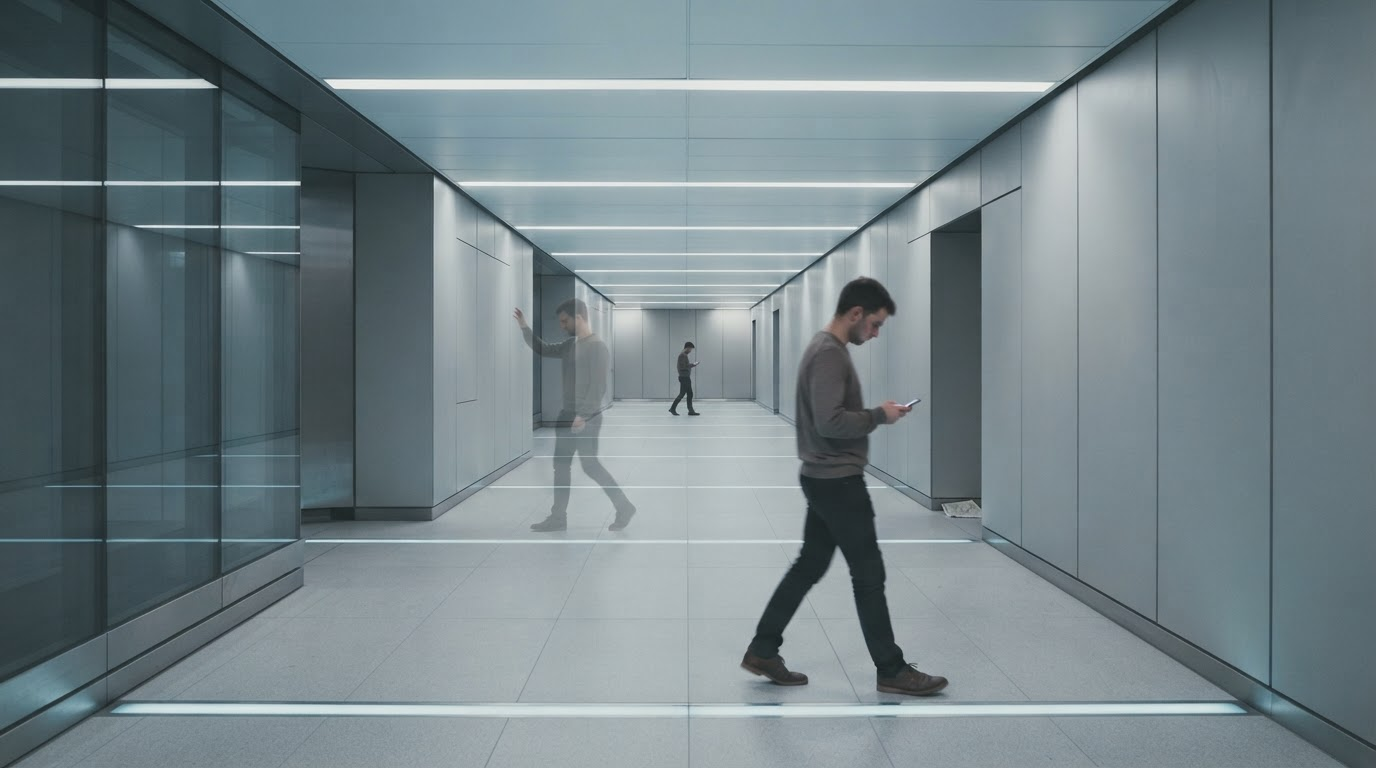
The more serious problem in this equation is not laziness itself but the illusion that accompanies it. Matthew Fisher and Daniel Oppenheimer at Princeton demonstrated across a series of experiments published in Psychological Science in 2021 that receiving external assistance — even a single modest hint — inflates a person’s estimate of their own unassisted ability in a systematically misleading way. When you move through a smart building whose corridors illuminate ahead of you and whose systems orient you at every junction, your brain registers the smooth performance as evidence of its own competence. The moment that assistance is withdrawn — in an unfamiliar building, during a power failure — the discovery arrives as a shock: you never knew the space at all. The space knew you.
Fisher and Oppenheimer also identified a reliable corrective: delaying the assistance and requiring the person to actively select it rather than receive it automatically. A moment of friction — two seconds of pause, one deliberate choice — proves sufficient to return the brain to an accurate awareness of its own limits. That moment is precisely what contemporary smart buildings are engineered to eliminate under the heading of user experience optimization.
The Elevator That Never Asks: Dissecting Offloading Inside Built Space
A more concrete example clarifies the stakes. In a conventional office building, you enter the lobby without knowing which elevator will arrive first. You read the floor indicators, calculate, anticipate, decide. The sequence appears trivial, but it constitutes daily practice in what cognitive scientists call metacognitive self-monitoring — the brain observing itself as it resolves a spatial problem. In a smart building equipped with algorithmic elevator dispatch, you are simply told: proceed to elevator three. No pause, no calculation, no decision.
Research by Kobe Desender and colleagues at the Free University of Brussels, published in the Journal of Experimental Psychology in 2017, established that avoidance of high-demand cognitive environments occurs only when a person consciously registers that an environment is demanding. Individuals who perceived no difference between two conditions of varying difficulty chose between them essentially at random and developed no preference for ease. But once the difference becomes perceptible and felt, a stable metacognitive conviction forms — that the easier environment is simply better — and that conviction hardens into persistent behavioral habit. This is precisely what smart buildings manufacture: they make the contrast legible. The digital environment reads as effortless; the conventional one reads as taxing. The brain becomes conditioned to prefer the former reflexively.
The Memory That Rents Storage in the Cloud: The Spatial Cost of Self-Doubt
The deepest dimension of this problem concerns spatial memory specifically. Xiao Hu and colleagues, in research published in Cognition in 2019, demonstrated that people offload cognitive tasks externally not when tasks are objectively difficult but when their confidence in their own ability is low — regardless of actual ability. Separately, Arran Boldt and Sam Gilbert showed in the same year that even when people are not informed that external aids are available, they generate them spontaneously, and their confidence level — not their objective performance — predicts the degree to which they rely on them.
The implication for inhabited space is direct: a smart building that presents itself as a perpetual assistant gradually persuades its occupants that their own internal navigation and spatial memory are unreliable. Once that metacognitive conviction takes hold, an unconscious arrangement forms between occupant and building — the occupant delegates, the building governs — and in that uneven relationship the brain loses something more consequential than comfort. It loses accurate knowledge of itself.
Architectural Friction: The Case for the Incomplete Design
The question that presses on every practicing designer remains: what is to be done with any of this? The answer that the research on metacognitive laziness collectively assembles is not a rejection of technology but a reconsideration of frictionlessness as an absolute design objective. The experimental evidence indicates clearly that interventions which restore accurate self-calibration are not those that train compensatory strategies, but those that make difficulty visible and felt — which is precisely what deliberate architectural friction accomplishes.
A building that uses the gradient of natural light as a wayfinding cue rather than an interactive screen requires the brain to read the environment. A corridor whose floor level or wall texture shifts announces a spatial transition without explaining it. A lobby that offers no digital map but instead a spatial sequence that implies direction invites the occupant to pause and interpret. That pause — that small friction — is what Fisher and Oppenheimer identified as the corrective delay: the moment that returns the brain to an honest reckoning with its own limits and prevents false confidence from consolidating. It is also, at its core, an architectural property rather than a technological one.
The space worth inhabiting is one that treats the brain as a faculty requiring exercise, not a device requiring a charge. It is one that preserves the right to momentary disorientation, to genuine surprise, to standing in the middle of a corridor without knowing where it leads — and being required, perhaps for the first time in months, to think.
✦ ArchUp Editorial Insight
The proliferation of sensor-saturated, algorithmically managed buildings is not the outcome of a design philosophy — it is the outcome of a procurement culture in which building performance is measured in operational efficiency metrics, energy consumption indices, and tenant retention rates, none of which capture cognitive attrition in the people who occupy the space. PropTech investment frameworks reward frictionlessness because friction is legible as a liability on a facilities management dashboard; the slow erosion of spatial self-reliance is not. When a real estate developer commissions a smart building system, the decision is governed by lease competitiveness and ESG reporting requirements — and the cognitive consequences for occupants fall entirely outside the contractual scope of any party involved. The architecture that results is not a failure of design intelligence. It is the precise and logical output of an evaluation system that was never asked to measure what a building does to the mind that inhabits it.
References
Dunn, Tara L., and Risko, Evan F. “Toward a Metacognitive Account of Cognitive Offloading.” Cognitive Science, 2015.
Risko, Evan F., and Gilbert, Sam J. “Cognitive Offloading.” Trends in Cognitive Sciences, 2016.
Dunn, Tara L., Lutes, Danah J. C., and Risko, Evan F. “Metacognitive Evaluation in the Avoidance of Demand.” Journal of Experimental Psychology: Human Perception and Performance, 2016.
Desender, Kobe, Van Opstal, Filip, and Van den Bussche, Eva. “Avoiding the Conflict: Metacognitive Awareness Drives the Selection of Low-Demand Contexts.” Journal of Experimental Psychology: Human Perception and Performance, 2017.
Hu, Xiao, Luo, Liang, and Fleming, Stephen M. “A Role for Metamemory in Cognitive Offloading.” Cognition, 2019.
Boldt, Arran, and Gilbert, Sam J. “Confidence Guides Spontaneous Cognitive Offloading.” Cognitive Research: Principles and Implications, 2019.
Baars, Martin, Wijnia, Lisette, de Bruin, Anique B. H., and Paas, Fred. “The Relation Between Students’ Effort and Monitoring Judgments During Learning: A Meta-Analysis.” Educational Psychology Review, 2020.
de Bruin, Anique B. H., Roelle, Julian, and Baars, Martin. “Looking at Mental Effort Appraisals Through a Metacognitive Lens: Are They Biased?” Educational Psychology Review, 2020.
Fisher, Matthew, and Oppenheimer, Daniel M. “Harder Than You Think: How Outside Assistance Leads to Overconfidence.” Psychological Science, 2021.
Grinschgl, Sandra, Papenmeier, Frank, and Meyerhoff, Hauke S. “From Metacognitive Beliefs to Strategy Selection: Does Fake Performance Feedback Influence Cognitive Offloading?” Psychological Research, 2020.