When the Stone Was the Payroll

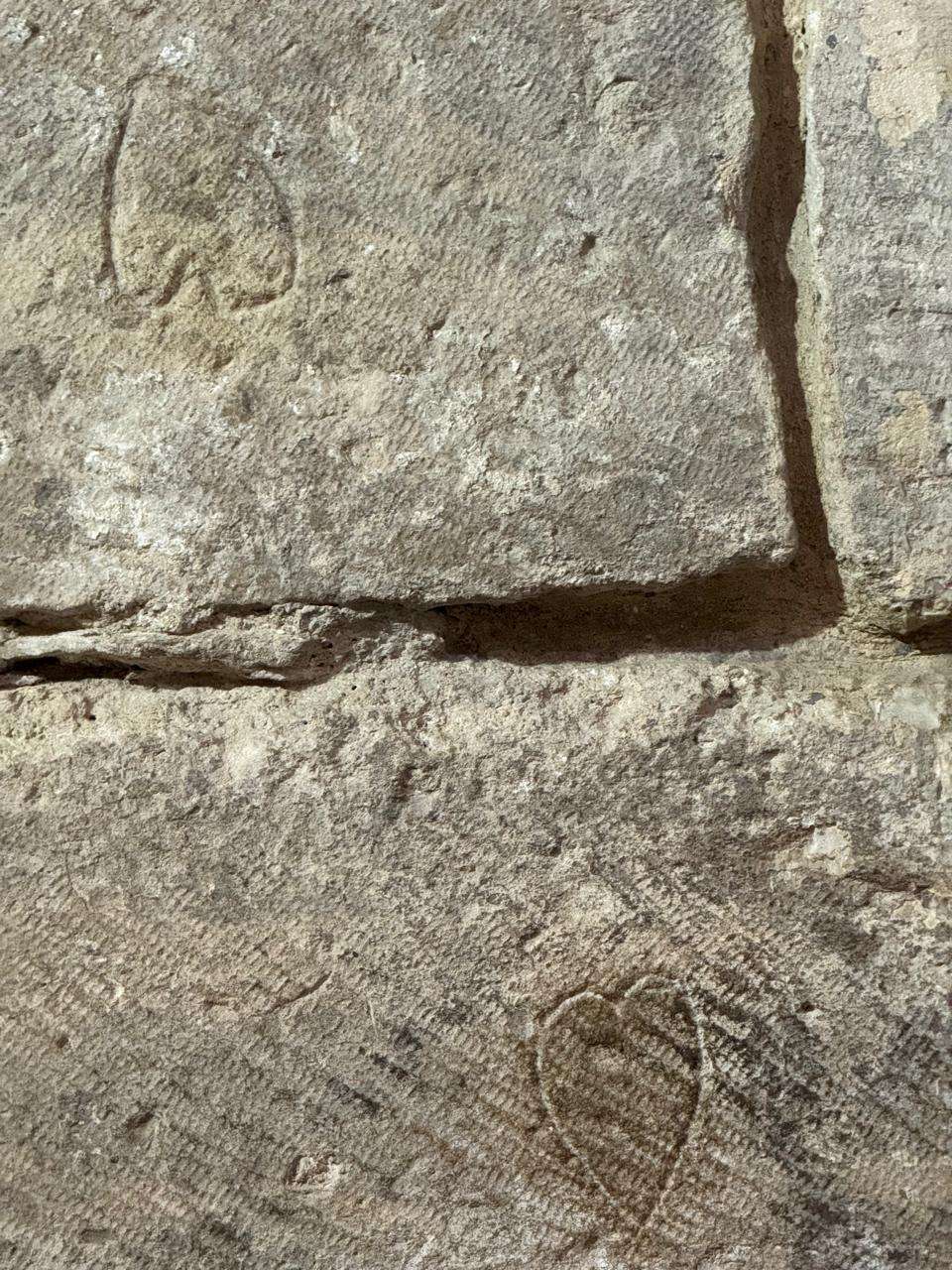
Medieval masons’ marks, found on structures like the Louvre, functioned as a sophisticated accounting system for piecework labor. These carved symbols allowed builders to record their output and secure payment without requiring literacy. The marks served as invoices, quality stamps, and assembly instructions, effectively turning the building stones into a ledger.
These ancient identifiers represent the origins of modern project management and material traceability. While these symbols historically protected workers by making their labor visible, modern construction practices sometimes lack similar transparency. The presence of these marks underscores the relationship between architectural history and the economic conditions of its makers.
In a corner of the medieval crypt beneath the Louvre, where the base of the old fortress still stands in the dark, I stopped in front of a run of ancient stones. It was not the mass of the walls that held me, nor their age reaching back through centuries. It was a set of small symbols carved into some of the blocks. A heart. A few hooks. A cross. Simple geometric shapes. My first instinct was that they were decoration, or idle marks left by bored hands, the kind of thing a visitor invents a romantic story about and moves on. Then I looked longer, and the romance dissolved into something far more interesting. Those symbols were not ornament at all. They were the surviving pages of an accounting system that predated payroll software, punch cards, and project management programs by many centuries. And in that moment I stopped seeing the stone as material. I began to see it as a document.
The marks have a name, though most people who pass them never learn it. In English they are called masons’ marks, and in French marques de tâcheron, a phrase that carries the whole economic argument inside it. Tâcheron comes from travail à la tâche, work paid by the task, what we would now call piecework. The mason did not sell his hours. He sold his finished stones, and he needed a way to prove which stones were his. So he cut a personal symbol into each block he dressed, and when the work was counted, a supervisor tallied the stones bearing each man’s mark and paid him accordingly. The wage was tied not to time but to output, and the object that recorded the output was the stone itself. Before there was a ledger, the wall was the ledger. Before there was a payslip, the stone was the payslip.
A Wall That Remembers How Its Builders Were Paid
What makes this more than a charming detail is that the marks are legible as evidence, and the evidence is unusually precise. Architectural historians who study medieval stonework have noticed a pattern that turns a wall into a fossil of its own labor contract. At Lincoln Cathedral, a contract dated to 1306 specified that the plain walling would be paid for by measure, by the quantity of stone produced, and the walls of that section are dense with banker marks, the individual signatures of the men who cut the blocks. At Exeter Cathedral, rebuilt across roughly the same decades, the masons on significant portions were paid by the week, a salary for time rather than a price for pieces, and on those parts the marks almost vanish. The architectural historian Jenny Alexander examined precisely this contrast, and the conclusion is difficult to overstate. Where men were paid by the piece, they signed every stone, because the signature was the invoice. Where men were paid by the week, they stopped signing, because there was nothing to count. The presence or absence of a small carved symbol on a medieval wall is therefore a direct readout of how that wall was financed. You can stand in front of the stone and read the wage system that raised it.
This is the intersection where a building stops being either engineering or art alone and becomes economics made visible. The construction of a great wall was not only a problem of load and joint and weathering. It was a problem of payment, of counting, of trust between a man who cut and a man who paid, and the solution to that problem was carved into the same surface that solved the structural one. The mark is where the condition of execution and the condition of survival meet on a single face of stone.
The marks were not all doing the same job, and separating their functions reveals how complete the system was. Researchers generally distinguish three families. There are banker marks, named for the banker, the bench on which the mason cut and dressed his stone, and these are the signatures tied to identity, payment, and quality, the most common of the three. There are quarry marks, added to the raw block to record where it came from, where it was bound, and sometimes its grade. And there are assembly marks, cut to instruct the setter on how a stone should be placed, its orientation, its order in a sequence, sometimes as plainly as Roman numerals running along the jambs of a window to tell the builder which block goes first and which follows. Consider what that means together. A single family of carved symbols carried the identity of the worker, the invoice for his labor, the certificate of his quality, the provenance of the material, and the instructions for its assembly. One mark did the work that today is divided among an asset tag, a timesheet, a quality stamp, and a shop drawing.
The Signature of the Unlettered
There is a quieter reason the mason cut a symbol rather than writing his name, and it matters more than it first appears. A large share of medieval building workers could not read or write, so a name was useless to them and a symbol was not. The mark was a signature that required no literacy, recognized inside the lodge the way a handwritten signature is recognized in a bank today, learned by the eye rather than the alphabet. There is something almost humbling in that. The system that paid these men did not demand that they be lettered in order to be counted. It met them where they were, and gave every worker, educated or not, a way to say this stone is mine and to be paid for saying it. A great deal of the paperwork that later replaced the mark was, by comparison, a barrier rather than a bridge.
We tend to read the history of great buildings as the history of the people who commissioned them. We stand before the Louvre, or the pyramids, or the imperial mosques, or the fortresses of Europe, and we talk about beauty, identity, power, and the names of kings. We forget a simpler question. How many hands made this place? How many workers rose with the sun, cut and carried and set the stone, and went home at the end of the day waiting to be paid? The design is remembered. The labor is anonymous. But the great architectural voids were written by workers long before they were written about by historians, and the marks are the closest thing we have to their handwriting.
There is a story often told about the Ottoman architect Sinan, that when he completed one of his imperial works he asked that a craftsman who had lost his sight during the labor be the one to open the building, in recognition of what the man had given to it. I cannot vouch for every detail of the account, and its exact truth is not the point. The idea inside it is the point. Architecture is never the signature of the architect alone. It is the accumulated signature of hundreds of people whose names never reach the facade, and a culture that remembers only the one name at the top has misread its own building. I think too of what I have read about the tombs of the workers who raised the pyramids, and how the remains suggested men who were well fed and cared for, healthier than the myth of the whip would allow. I hold that as an observation rather than a proof, because I have not verified the science myself, but the direction of it is worth sitting with. Civilizations are not built by forced labor alone. They are built by management, by organization, by the counting and the paying and the feeding of the people who do the physical work, and the quality of that management is written into what survives.
The Word That Survived on the Scaffold
In the Arab construction world there is a word still spoken every day on every site. The yawmiya, the day’s wage. I had heard it my whole life as a sum of money, a figure negotiated at dawn. When I saw the marks in the Louvre, the word changed shape for me. The yawmiya is not only an amount. It is the story of a person. Behind every dressed stone there is a back that bent, a hand that gripped a chisel, a quantity of sweat that fell to the ground before the building ever rose from it. The architectural void we enjoy today, the room, the courtyard, the nave, is in truth the sum of thousands of day wages paid to thousands of human beings across decades, and the mark is the receipt that one of them left behind.
The most striking thing about these marks is that they never actually disappeared. They only changed their medium. The heart carved into a Louvre block seven hundred years ago has direct descendants on every serious site today, and they are not sentimental. They are the serial number, the barcode, the RFID chip, the identifier inside a BIM model, the asset number stamped onto a component. The projects we manage now with entire software platforms are still trying to answer the single question the mason answered with a chisel. Who made this, and is it accounted for. The quarry mark, which recorded where a stone came from and where it was bound, is the ancestor of the material provenance tracking that sustainability certification now demands, the paper trail that proves a material’s origin and legitimacy. We did not invent traceability with the computer. We inherited it from a man who could not read, and we digitized it. Perhaps the first system of project management in history was not written on paper at all. It was carved into the material itself.
But the article would be dishonest if it stopped at admiration, because the mark has a darker mirror in the present, and any architectural research worth the name has to look at it directly. The medieval mark protected the mason. It guaranteed his count, secured his payment, and tied his reputation to his work so that good work was rewarded and poor work was traced back to its author. Turn that logic upside down and you have the condition of some construction sites today. Workers on fragile contracts, or with no papers at all, or without meaningful legal protection, paid wages that do not reflect what they give, precisely because a blurred count is cheaper than an honest one. Where the medieval stone was a technology for making the worker visible, some modern arrangements are engineered to keep him invisible. The mason cut a mark so that he could be seen and paid. The undocumented laborer is often kept unmarked so that he can be used and forgotten. The building may still succeed. It may win a competition, fill the pages of the design news, and enter the histories, while the story of the people who actually raised it remains, deliberately, without a signature.
This is the sharpest lesson I carried up out of that crypt, past the base of the old keep and back into the daylight of one of the world’s most photographed cities. The oldest tool of project management was not a schedule. It was a signature, and a signature is first of all a demand to be counted. The mason who cut a heart into a block was not decorating the Louvre. He was insisting, in the only language available to him, that his labor existed and deserved its wage. History may forget the name of the contractor, and in time even the name of the architect, but an honest stone still holds a human being inside it, one who earned his day’s wage before anyone earned any glory. So the true measure of an architecture is not only the greatness of the void it leaves for the generations that follow. It is the justice of the count it kept for the ones who cut the stone, and a civilization that has stopped marking its makers has not grown more advanced. It has only found a quieter, cleaner way to forget them.
✦ ArchUp Editorial Insight
The mason’s mark is not a historical curiosity — it is the earliest known solution to a problem that every labor economy has subsequently failed to fully resolve: how to make the individual worker’s contribution legible to the party controlling payment, in a power relationship where the worker is structurally the more vulnerable party and invisibility is always cheaper for the employer than accountability. The piecework system the mark encoded was not generous; it was precise, and precision in a labor context cuts in both directions — it protected the mason from undercounting, but it also exposed him to the full risk of his own productivity, transferring the variability of output from the employer’s ledger onto the worker’s wage in a way that the weekly salary system did not. What the article’s most structurally significant observation names — that the undocumented laborer on a contemporary site is kept deliberately unmarked so that he can be used without being counted — is not a deviation from the medieval system but its logical inversion, and the inversion is the more revealing document: where the carved symbol was a technology of worker visibility that the medieval site could not function without, the absence of any equivalent marking on informal contemporary labor is a technology of invisibility that the contemporary development model has discovered it cannot profitably function without, a condition this archive has traced from The Driver’s Room to The Taptab Illusion to Before You Enter the Office — in every case, the party whose labor is structurally indispensable to the building’s existence is the party whose contribution the procurement model is most elaborately organized to avoid counting, and the building that results is always the honest spatial record of what that arrangement was willing to acknowledge.
Ibrahim Fawakherji — ArchUp