Before Adding Another Component: What Design Reviews Overlook

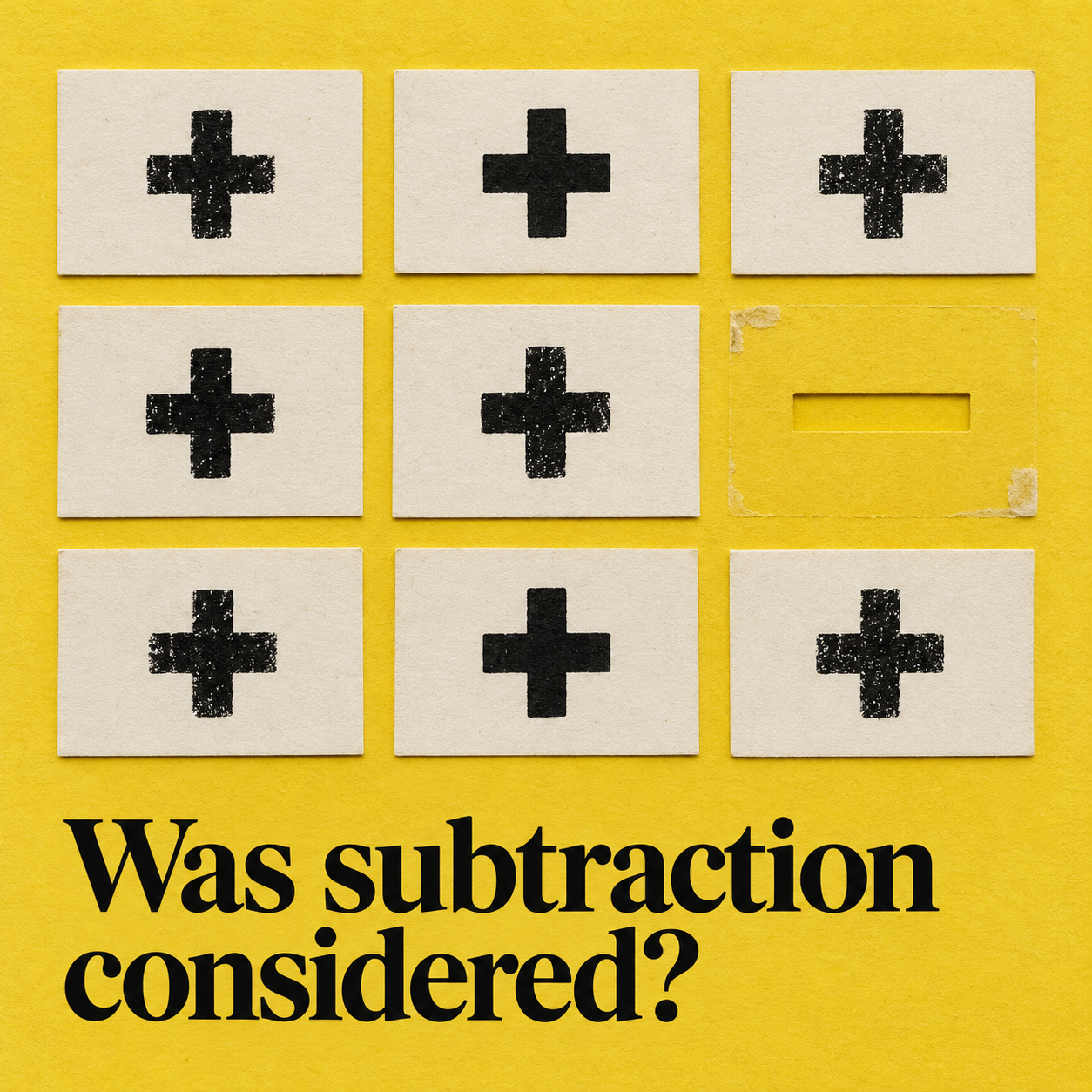
A congested entrance is often answered with another sign, a complicated detail with another component, and a confused approval process with another checklist. These responses may be necessary. But before comparing their merits, a project team must ask whether it has generated a removal option at all. Research on problem-solving offers a precise distinction: overlooking subtraction is not the same as considering it and rejecting it. For architecture, the useful question concerns the option set presented at a design review, not a preference for minimalist appearance.
What the original experiment found
Gabrielle S. Adams, Benjamin A. Converse, Andrew H. Hales and Leidy E. Klotz published People systematically overlook subtractive changes in Nature on 7 April 2021. Across eight experiments, subtraction became more likely with explicit cues, repeated search opportunities or lower cognitive load. In a Lego task with 197 participants, 40 of 98 people removed a support without a subtraction cue, compared with 60 of 99 when removal was explicitly mentioned: approximately 41% versus 61%. This demonstrates a change in responses to a bounded task, not a measured improvement in building design.
A later study complicates the explanation
Joshua Juvrud, Laurence Myers and Pär Nyström published a replication and extension in Scientific Reports on 11 January 2024. They used Lego, grid-symmetry and digital-puzzle tasks, including adults from Sweden and the United States and children aged 9–10. Results only partly supported the earlier pattern; strategies varied with task, culture and age. The implication is important: subtraction neglect should not be treated as a universal defect, and a design-review prompt cannot be assumed to work identically across teams.
Architectural application: change the review, not the aesthetic
ArchUp interpretation: a review that evaluates only additions can exclude a useful alternative before engineering or cost comparison begins. Consider a hypothetical entrance where users hesitate at a junction. Adding a sign is one option; moving a desk is another; removing a redundant visual barrier is a third. The third option is not automatically superior. It becomes eligible for comparison only when the review explicitly asks what can be removed while preserving the brief.
Apply the same reasoning to non-essential finish layers, duplicated controls or redundant administrative approvals. Distinguish deleting a function from deleting a component that duplicates that function. Removing a fire barrier, accessible facility, required structural element or necessary ventilation provision is not justified by a psychology experiment. Safety and compliance remain independent constraints.
Proposed procedure, not a proven architectural intervention: require each eligible design issue to include an addition option, a relocation or reconfiguration option, and a removal option, or a written reason why removal is inapplicable. Compare them against the same performance requirements. A justified decision to retain every component is a valid outcome.
How to test the proposal
Use a defined set of comparable, non-safety-critical coordination issues. Randomly allocate review groups, where practical, to their normal brief or a brief that explicitly requests removal alternatives. Keep review time, available information and acceptance criteria comparable. Record whether a removal option was generated before recording whether it was selected. Have assessors unaware of the review condition judge technical adequacy, clarity and maintainability.
Measure coordination time and downstream rework separately. Fewer components or a smaller initial bill do not establish lower whole-life cost. Record missing functions, maintenance access and user complaints as possible adverse outcomes. If the prompt increases removal proposals but does not improve the chosen solution, it has changed search behaviour without demonstrating a better project result.
Limits of the architectural claim
Neither cited study tested professional construction teams, contractual change procedures or occupied buildings. Real projects contain dependencies absent from puzzles: a deleted element may transfer work to another trade or make future maintenance harder. The proposed review is therefore a testable hypothesis about decision-making, not an evidence-based mandate to build less. Its value would have to survive technical assessment and follow-up after handover.
✦ ArchUp Editorial Insight
Time pressure can narrow the options a team brings to an approval meeting before anyone consciously decides that more construction is desirable. In a workflow that records proposed additions as priced variations but has no equivalent field for removing redundant work, the document itself may reinforce this narrowing. That is an institutional hypothesis suggested by the research, not a documented description of all contracts. The governance response would be to require a functional justification for both addition and retention at selected review gates, with the operator represented before the decision closes. This changes what must be explained, rather than imposing a predetermined reduction target. A contractor could then price a deletion together with its effects on adjacent trades, commissioning and warranties; the designer could demonstrate which requirement remains satisfied. Where acceptance is based only on initial completion, any resulting maintenance burden may become visible after the approval team has dispersed. Keeping the decision record linked to post-occupancy evidence would make that transfer examinable. The eventual spatial result might be a clearer entrance or a simpler service detail, but it would follow from a broader and more accountable option set, not from subtraction being intrinsically virtuous.
Prepared by ArchUp Research Lab. The editorial image is awaiting preparation by the art direction team.
References
Gabrielle S. Adams, Benjamin A. Converse, Andrew H. Hales and Leidy E. Klotz. People systematically overlook subtractive changes. Nature, 2021.
Joshua Juvrud, Laurence Myers and Pär Nyström. People overlook subtractive changes differently depending on age, culture, and task. Scientific Reports, 2024.