The Finish Looks Smooth. What Does the Hand Detect?

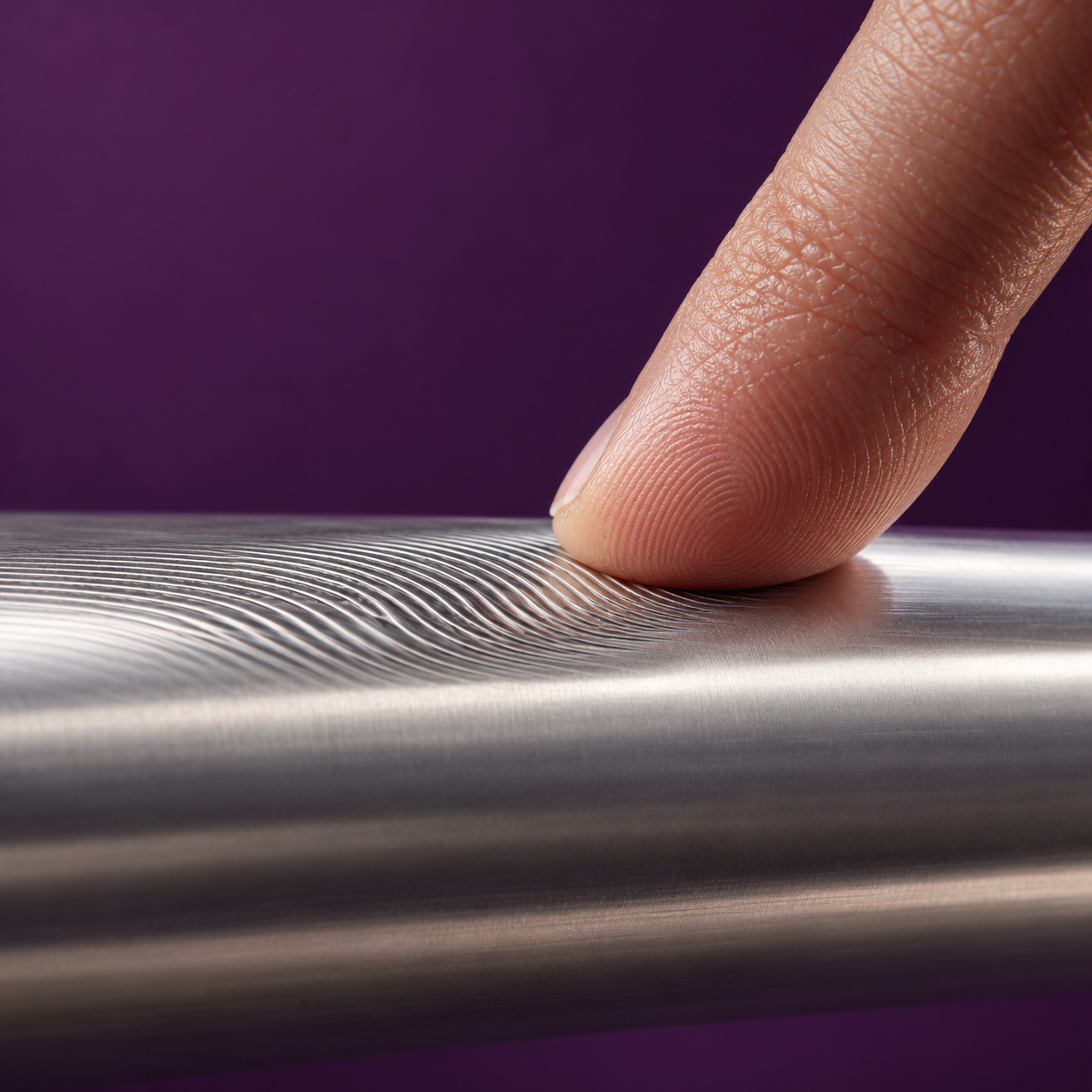
A door pull or handrail can be approved by colour, sheen and a photograph, yet encountered mainly through the hand. Its tactile surface is not simply its visible surface at a smaller scale. Materials research shows that a moving fingertip can distinguish some extremely fine patterns. The architectural question is therefore practical: what evidence should accompany approval of a finish intended for repeated contact?
The original study and its measured result
Lisa Skedung, Martin Arvidsson, Jun Young Chung, Christopher M. Stafford, Birgitta Berglund and Mark W. Rutland published Feeling Small: Exploring the Tactile Perception Limits in Scientific Reports on 12 September 2013. They compared 16 patterned surfaces and two blanks with the same surface chemistry. In active touch, a pattern with a wavelength of 760 nanometres and an amplitude of 13 nanometres was distinguishable from the blanks. A still finer tested pattern was not. Amplitude describes feature height; wavelength describes spacing. Neither number is a building-finish specification.
How the result was obtained, and why its limits matter
Twenty blindfolded participants compared pairs by sliding an index finger across the grooves. The displayed perceptual map used the first ten participants after scratching and debris affected samples; the authors reported similar, but not identical, results for the later ten. The two-dimensional model also had substantial residual mismatch. Its dimensions were associated with friction and pattern spacing. These are important qualifications: discrimination in this experiment is not a universal threshold, a preference score or proof of safe grip.
Architectural interpretation: distinguish seeing, touching and gripping
ArchUp interpretation: a visual approval alone does not establish tactile equivalence between two finishes. The study does not test architectural handles, but it gives a reason to treat actual contact as a separate acceptance question. For a hypothetical replacement handrail coating, matching the approved colour and gloss would settle only part of the specification. A physical comparison could still reveal a different sliding sensation.
Keep three questions separate. Can a user distinguish the surfaces? Does the user prefer one? Can the installed element be held and operated safely? The experiment addresses the first under controlled conditions. The other two need their own evidence. A finish that feels distinctive is not necessarily comfortable, durable or suitable for the required grip.
The proposed application is a sample-approval procedure for door pulls, handrails and other contact-intensive details, not a mandate to add nanostructures. Retain an approved physical reference and compare proposed substitutions on the same substrate, geometry and coating system where feasible. Record the exact finish process and batch identity. A description such as “satin” or “smooth” should not be treated as a complete account of how the final assembly behaves.
A project-scale verification method
Testable proposal: begin with visual and tactile assessments conducted separately. Use coded samples and randomize their order so that supplier identity does not determine the response. Ask representative users to compare similarity before asking about comfort or preference. Do not adopt a numerical pass threshold retrospectively to favour the preferred product; define the comparison and its purpose before testing.
Then test a full-size, properly installed mock-up for its actual action: grasping and pulling a handle, or supporting and sliding a hand on a rail. Assess geometry, edges and operation separately from coating feel. Any claim about grip safety must use an appropriate safety assessment rather than the psychophysical similarity test.
Include the specified cleaning procedure and a documented conditioning or wear protocol suitable for the product. Compare the conditioned mock-up with the retained reference and record any changes. This is a proposed quality-control method, not an outcome demonstrated by the 2013 study. It would be useful only if it detects consequential differences and supports consistent decisions without excluding users whose responses differ from the group average.
What cannot be inferred
The laboratory surfaces were controlled periodic patterns, not the full range of timber, metal, stone and commercial coatings. The study does not establish long-term architectural comfort, accessibility or maintenance performance. It did not directly measure the physiological pathways offered in its discussion. Its small analysed group and sample changes limit the strength of any transfer to building users. The defensible conclusion is narrower: tactile properties deserve explicit verification when contact is part of the intended function.
✦ ArchUp Editorial Insight
Remote coordination and substitution deadlines can make visual evidence the easiest evidence to circulate: a product image reaches every reviewer, while a physical sample must be delivered, stored and compared. In a procurement procedure that accepts colour and sheen as sufficient proof of equivalence, this convenience may become a decision rule. The study does not document that practice, but exposes the information it could leave untested. A contractually defined physical reference would change the burden of demonstration: the proposed substitution would need to address the contact experience, not merely resemble the approved image. Responsibility would also need to be assigned for retaining the sample and for distinguishing a manufacturing change from a change caused by cleaning after installation. Without that distinction, a later complaint could remain unresolved between supplier, contractor and operator because each is comparing a different surface state. This is a structural verification problem, not evidence of bad intent. The architectural consequence appears at the handrail or door pull, where the user meets a finish selected through an evidence chain that may never have included touch. A tactile acceptance record would make that chain inspectable without pretending that sensation alone establishes safety.
Correction, 15 October 2026: Removed the artwork-pending note after verifying the assigned featured image. ArchUp Editorial Committee.
Reference
Lisa Skedung, Martin Arvidsson, Jun Young Chung, Christopher M. Stafford, Birgitta Berglund and Mark W. Rutland. Feeling Small: Exploring the Tactile Perception Limits. Scientific Reports, 2013.