Tomorrow’s Pavements: How Material Technology Reconfigures Concrete Pavers in Urban Space

From Impermeable Surfaces to Intelligent Systems That Absorb Stormwater, Clean the Air, and Extend Municipal Infrastructure Lifespan
Pedestrian pavements in contemporary cities often appear as silent, mundane elements, designed exclusively to withstand foot traffic and vehicular wheels. Today, however, these impermeable surfaces face increasing scrutiny as primary contributors to the urban heat island effect and flash flooding. In response to these compounding environmental and economic pressures, advanced material technology is undergoing a fundamental shift. Concrete pavers are no longer mere ground covers; they have transformed into engineered systems designed to mitigate carbon footprints, manage stormwater runoff, and purify the ambient air.
The Chemistry of Density: Engineering Voids to Minimize Waste
The production of sustainable pavements begins with re-evaluating traditional concrete mixing philosophies. In this context, the packing density method emerges as an advanced engineering approach for designing concrete mixes tailored for interlocking pavers. This methodology relies on selecting optimal proportions of various aggregate sizes, ensuring that smaller particles fill the interstitial voids between larger granules with high precision.
This tight particle arrangement minimizes internal porosity, which directly reduces the demand for cement and water without compromising structural strength. Empirical tests demonstrate that high-quality pavers suitable for medium traffic can achieve an M40 concrete grade using a cement content of no more than 417 kilograms per cubic meter and a water-to-cement ratio of 0.38, balancing performance with material economy.
Compaction Technology: From Vibro-Compression to Hydraulic Force
Developments extend beyond the mix design into manufacturing engineering, where two primary techniques dominate modern production lines. The first is vibro-compacted concrete technology, which processes fresh concrete with very low water content using intense pressure and vibration. This allows the immediate removal of products from molds for rapid reuse, significantly increasing production line efficiency.
The second advancement involves wet press technology, where wet concrete is hydraulically compressed with forces reaching up to 400 tons to completely expel excess water. This immense pressure imparts immediate structural integrity, enabling the units to be handled and stacked right after pressing. Industrial research reveals that incorporating macro synthetic fibers and nanochemicals into this process increases transverse tensile strength by up to 40 percent while reducing required pressing time by approximately one-quarter compared to traditional methods.
Geopolymers: Green Pavements Eliminating Traditional Cement
In the search for sustainable alternatives, geopolymer concrete serves as a substitute for traditional Portland cement, which is otherwise responsible for significant carbon dioxide emissions. This concrete relies on activating alumina- and silica-rich materials—such as fly ash and ground granulated blast-furnace slag (GGBS)—using alkaline solutions of sodium hydroxide and sodium silicate.
Testing different configurations of this material demonstrates that increasing the GGBS content and the molar concentration of the alkaline solution elevates compressive strength to levels between 58 and 122 megapascals. Furthermore, researchers have developed geopolymer pavers that integrate recycled asphalt pavement (RAP) at replacement rates up to 80 percent. These pavements satisfy the requirements for light traffic while exhibiting a notable decrease in water absorption and reducing total production costs by nearly 24.5 percent.
Waste Recycling: Infrastructure as a Flexible Resource Reservoir
Modern pavements are translating circular economy concepts into built environment applications. Material engineers have produced eco-friendly concrete pavers using 100 percent fine recycled concrete aggregate bound with a material derived from calcium carbide residue and sugarcane bagasse ash, completely eliminating conventional cement. This configuration achieves a compressive strength of 40 megapascals within seven days, satisfying rigorous standard specifications.
Recycling efforts also extend to water resources. Scientific trials demonstrate that domestic wastewater treated via upflow anaerobic sludge blanket (UASB) and trickling filter systems can fully replace potable water in interlocking paver mixes. The results address technical concerns, as pavers manufactured with treated wastewater exhibit a compressive strength of 36.43 megapascals compared to 37.45 megapascals for conventional units—a minor variance well within acceptable international tolerances.
Sponge Pavements: Spatial Voids Modulating Climate Change
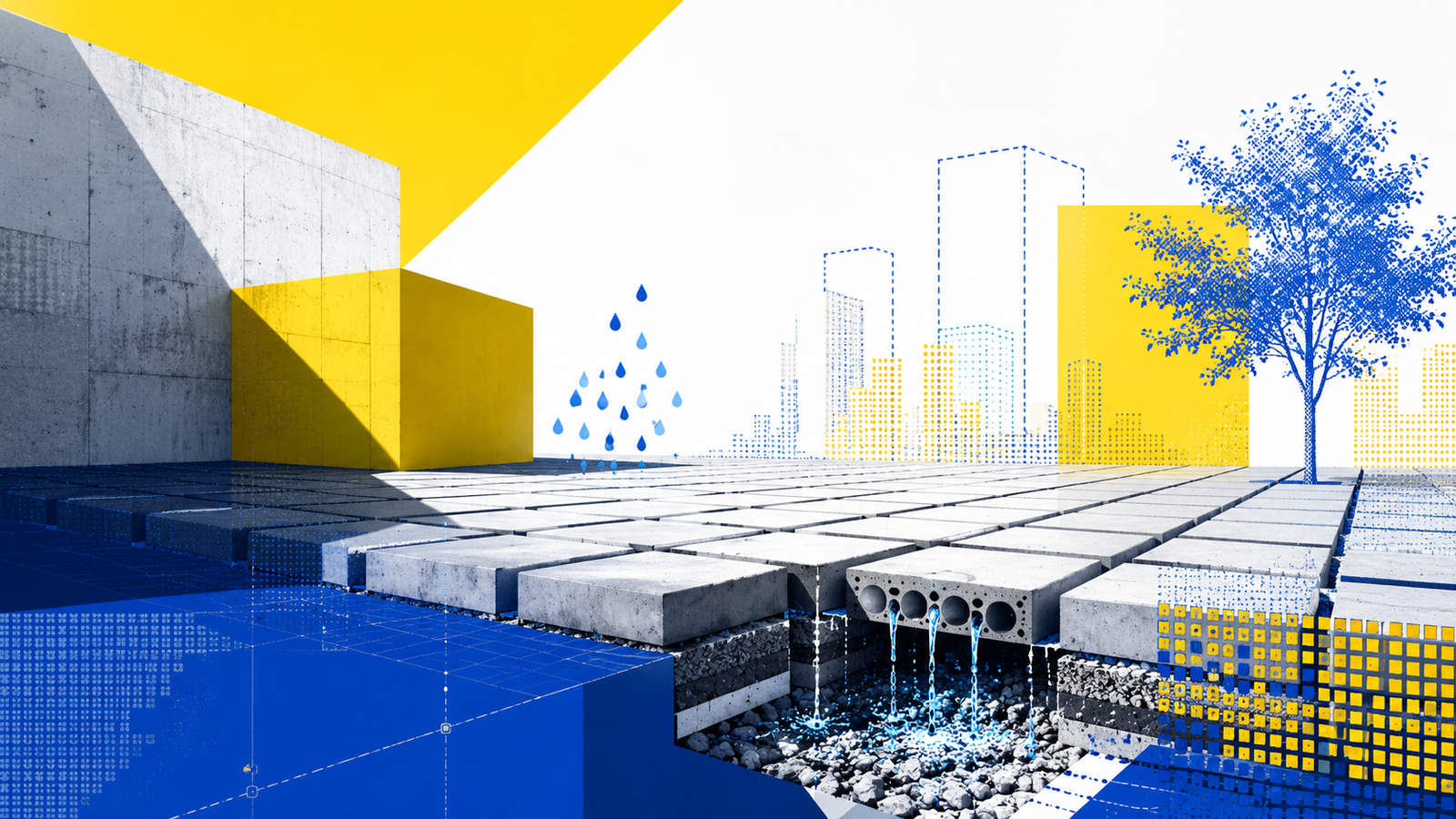
Contemporary cities can no longer rely solely on conventional subterranean networks to drain stormwater, elevating the importance of permeable pavements that function as urban sponges. Engineers have developed two types of smart pavers to manage water flows: highly pervious concrete pavers and pavers designed with internal voids. The internal void pavers (at 60 percent porosity) record the highest surface runoff reduction at 25.5 percent, while maintaining compressive strengths ranging from 40 to 108.6 megapascals.
Concurrently, comparative studies of metakaolin-based pervious concrete demonstrate excellent mechanical performance, yielding a compressive strength of approximately 22.1 megapascals. This material maintains high cohesion, preventing mass loss during repeated freeze-thaw cycles in cold climates. Environmental lifecycle analyses also reveal that greenhouse gas emissions from manufacturing these fly ash-based pervious pavements are 53 percent lower than those of conventional concrete, addressing both urban flooding and carbon management.
Breathing Pavements: Nanotechnology for Atmospheric Purification and Surface Protection
Integrating nanotechnology to give pavements active functional properties represents a key advancement in urban materials. Adding titanium dioxide nanoparticles to concrete pavers refines the microstructure, making it denser and more uniform to increase compressive strength by 17.3 percent, while introducing self-cleaning properties via photocatalysis. Upon exposure to sunlight, these surfaces decompose hazardous ambient air pollutants, such as nitrogen oxides from vehicular emissions, into harmless compounds.
To maintain these properties and protect vibro-compacted pavers from weathering, practitioners apply a liquid protective varnish to the exterior surfaces. This coating reduces capillary water absorption and increases surface hardness and crack resistance. While the varnish can reduce slip resistance, material engineers counter this effect by introducing coarse particles into the varnish formulation, ensuring a durable, clean, and safe pavement for pedestrian use.
✦ ArchUp Editorial Insight
The proliferation of advanced paver technology photocatalytic coatings, geopolymer binders, permeable void structures is not primarily a story of environmental ambition. It is the measurable consequence of municipal liability exposure, insurance recalibration following flood-event damages, and the gradual exhaustion of underground drainage infrastructure built to mid-twentieth-century hydrological assumptions. Cities are not adopting intelligent pavements because governance has become more ecologically sophisticated; they are adopting them because the actuarial cost of inaction now exceeds the procurement cost of intervention. The material innovation documented here is real, but its driver is fiscal, not ideological. What appears on the street as a permeable surface is, beneath the engineering, a renegotiation of risk distribution between municipal authorities, infrastructure insurers, and climate-exposed urban budgets.
References
- Abdulmatin, A., Tangchirapat, W., and Jaturapitakkul, C. “Environmentally friendly interlocking concrete paving block containing new cementing material and recycled concrete aggregate.” European Journal of Environmental and Civil Engineering, 2017.
- Abdullah, M. A. H., Rashid, N. A., Abdul Rani, A. L., and Omar, M. F. “New High Strength Water Retaining Interlocking Pavers Block for High Mechanical Performing Pavement and Reducing Runoff.” IOP Conference Series: Materials Science and Engineering, 2020.
- Edayadiyil, J. B., Mathew, S., and Joy, M. “A methodology for the effective use of materials in concrete paving block.” IOP Conference Series: Materials Science and Engineering, 2021.