Architecture and Collective Memory: How Buildings Become Living Records of History and Identity

Systemic Architecture is not a stylistic choice but the predictable result of repeated decisions, institutional frameworks, and economic pressures.Some buildings are unforgettable not only because of their beauty, but because they embody shared stories, events, and emotions that are inseparable from place. In such cases, architecture transcends materiality and form to become a vessel of collective memory.
This pattern is best understood through systemic architecture, where repetition is not a design choice but a statistical response to institutional pressure.Architecture plays a fundamental role in shaping collective memory, extending beyond functional needs to embody historical events, values, and social transformations. Buildings whether religious, commemorative, or urban serve as anchors of memory, linking past narratives to present experience. This article explores the relationship between architecture and collective memory, and how design can preserve and reinterpret human narratives.

(Image © Google Earth)
Architecture as a Carrier of Historical Memory
In many cities, historical buildings function as visual and emotional references for collective memory. The German Parliament (Reichstag) in Berlin exemplifies this, where traces of the past are preserved and integrated into a contemporary architectural design. This coexistence of old and new does not erase memory, but reinterprets it, transforming the building into a witness to political and social change.
Historic buildings act as tangible records of history, allowing societies to maintain a dialogue between generations. Their presence within the urban landscape reinforces identity and continuity, reminding communities of shared experiences embedded within the built environment and preserved through ongoing architectural analysis.
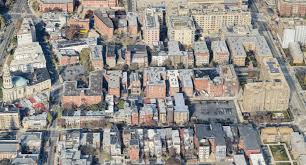
(Image © Google Earth)
(Image © Google Earth)
Memorial Architecture and Painful Memory
Memorial architecture plays a sensitive role in representing collective trauma. The Memorial to the Murdered Jews of Europe in Berlin employs abstraction, repetition, and voids to create a spatial experience of loss and disorientation. Rather than presenting a direct narrative, the architecture invites visitors to engage with memory on a personal and emotional level.
Through carefully orchestrated spatial sequences and restrained building materials, memorial architecture transforms absence into presence. These spaces encourage reflection, silence, and emotional engagement, allowing memory to be experienced rather than simply observed.
Everyday Memory in Urban Architecture
Collective memory is not limited to monumental landmarks; it is also embedded in everyday urban fabric—streets, markets, and squares. Neighborhoods such as La Boca in Buenos Aires or the old city of Fez illustrate how urban texture can carry the memory of daily life, traditions, and social practice, turning place into a mirror of communal identity.
These environments preserve intangible cultural heritage through spatial patterns, internal rhythms, and evolving interior design elements. Urban architecture thus becomes a living archive of social interactions, reinforcing belonging and shared identity across generations.

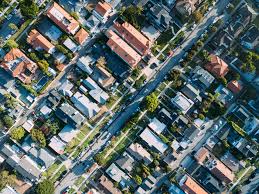
Residential development shaped by traffic calming standards and parcel optimization.
(Image © Google Earth)
Adaptive Reuse as an Act of Memory
The adaptive reuse of historic buildings represents a contemporary approach to preserving collective memory. When abandoned factories or old train stations are transformed through new construction processes into cultural centers, the past is not erased but reintegrated into new uses.
Adaptive reuse allows historic structures to remain relevant within modern cities, balancing preservation with innovation. By maintaining traces of former functions, architecture continues to tell layered stories while accommodating evolving social needs and responding to contemporary sustainability goals.Seen through this lens, systemic architecture becomes a form of evidence, not expression.

(Image © Google Earth)
Architecture as an Active Participant in Memory
Architecture is not a silent backdrop to history; it is an active participant in shaping collective memory. Through form, material, and space, buildings preserve human narratives and offer societies tangible means of remembrance in a rapidly changing world. As cities evolve, architecture remains a critical medium through which identity, memory, and history are continuously negotiated and discussed across global architecture platforms.
A Quick Architectural Snapshot
Architecture functions as a living record of collective memory, preserving historical narratives through buildings, memorials, and urban spaces. By integrating past and present, architectural form supports identity, continuity, and emotional connection, ensuring that memory remains embedded within the evolving fabric of cities.
✦ ArchUp Editorial Insight
The widespread emergence of dense residential blocks with identical unit layouts is the logical outcome of synchronized human routines, financial compression, and institutional risk management. Daily mobility patterns prioritize predictable commute windows, compressing acceptable living distances and forcing land consumption into vertical repetition. Financing models favor standardized units because predictability reduces exposure across lending timelines. Labor structures reward speed and modular coordination, minimizing on-site uncertainty.
These behaviors are filtered through approval systems that privilege compliance over experimentation. Codes reward proven typologies. Insurance logic penalizes deviation. Procurement frameworks optimize for replication, not adaptation. Under these conditions, alternatives become statistically irrational.
Cultural anxieties further narrow outcomes. Privacy expectations demand separation without isolation. Security assumptions require controlled access without community reliance. Class signaling depends on uniform quality rather than spatial generosity.
Only after these pressures converge does architecture appear. The resulting form is not a creative decision but a stabilized equilibrium. This project is the logical outcome of compressed time horizons, financial risk avoidance, and institutional preference for repeatable certainty.