Teppanyaki Restaurant: Kinetic Scenography of Mass and Space

Material Contrast and the Dialectic of the Scenographic Space
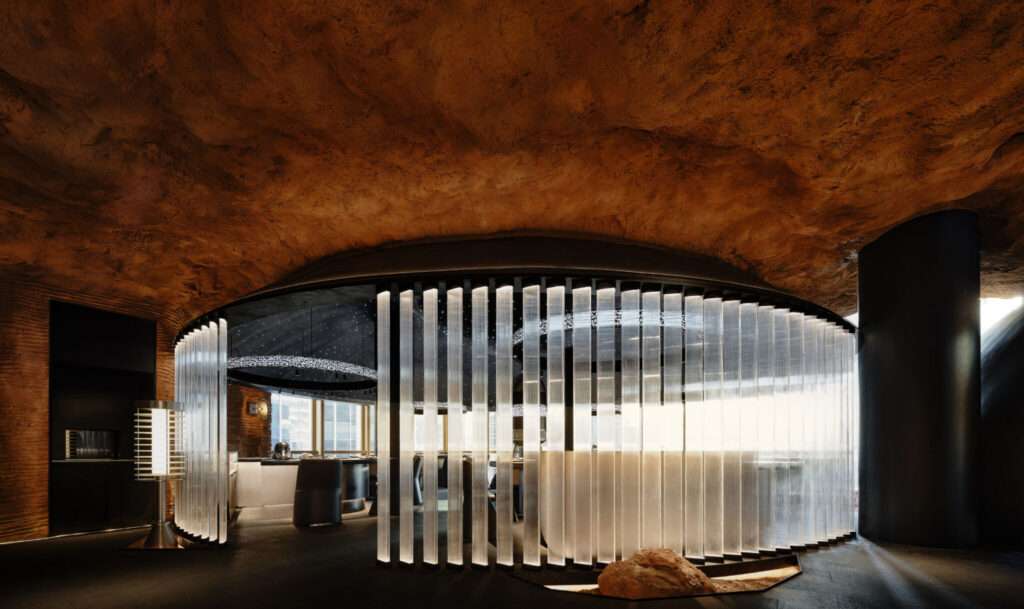
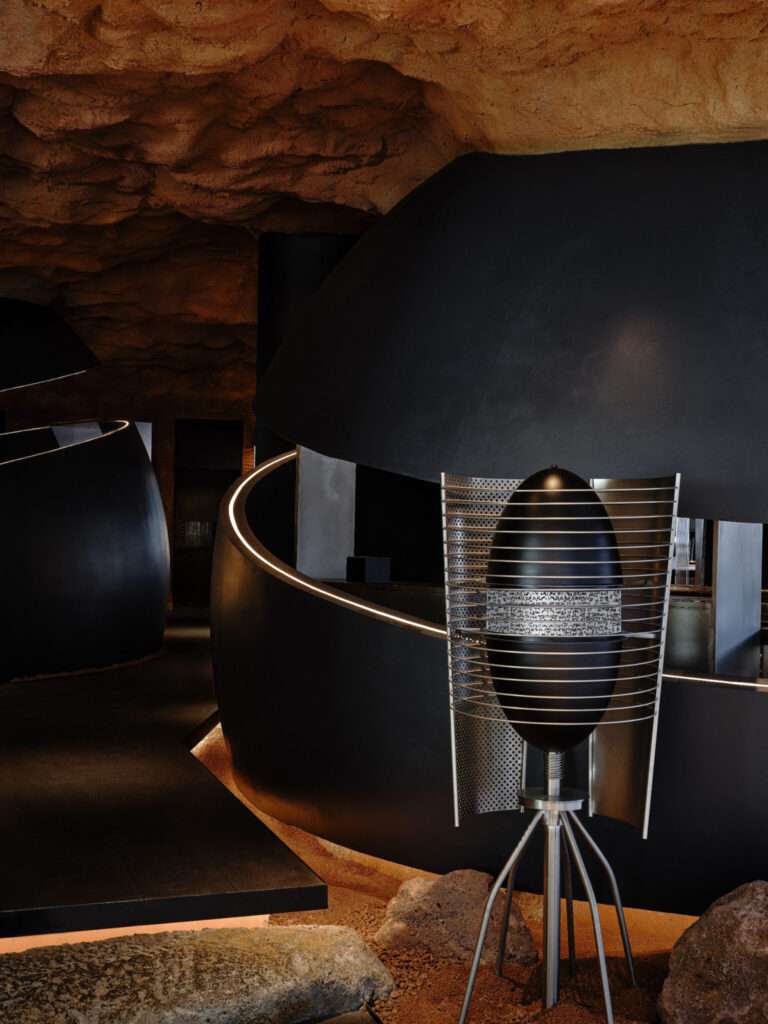
The walls of the interior void are founded on a raw material dialogue inspired by sandstone formations and the stratified layers of shale, granting the surfaces a tactile presence that evokes geological exploration rituals. This perceptual shift begins at the moment of entry, where the stainless-steel entrance gate imposes a strict character that announces the transition from the public exterior to a more controlled and dense interior.
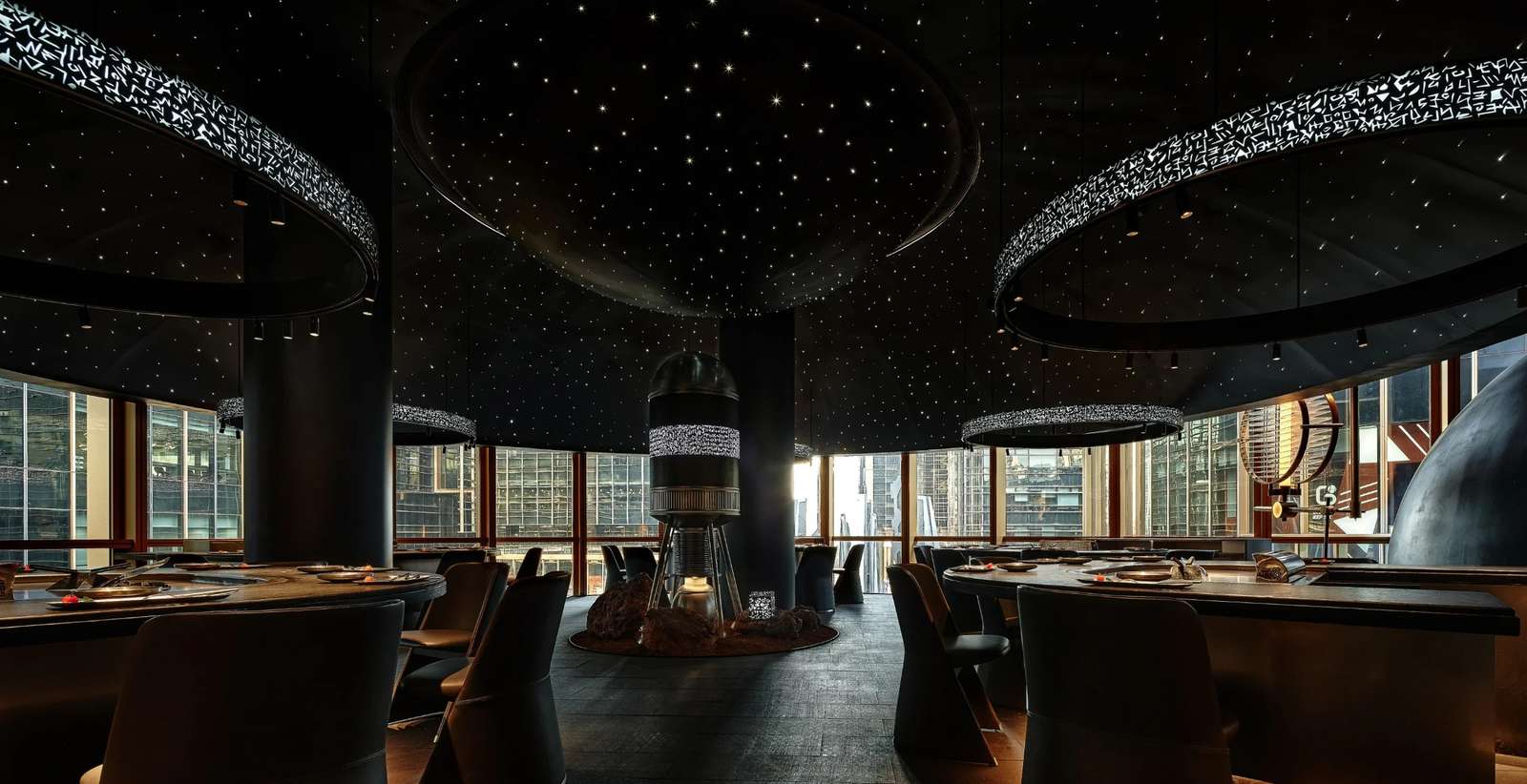
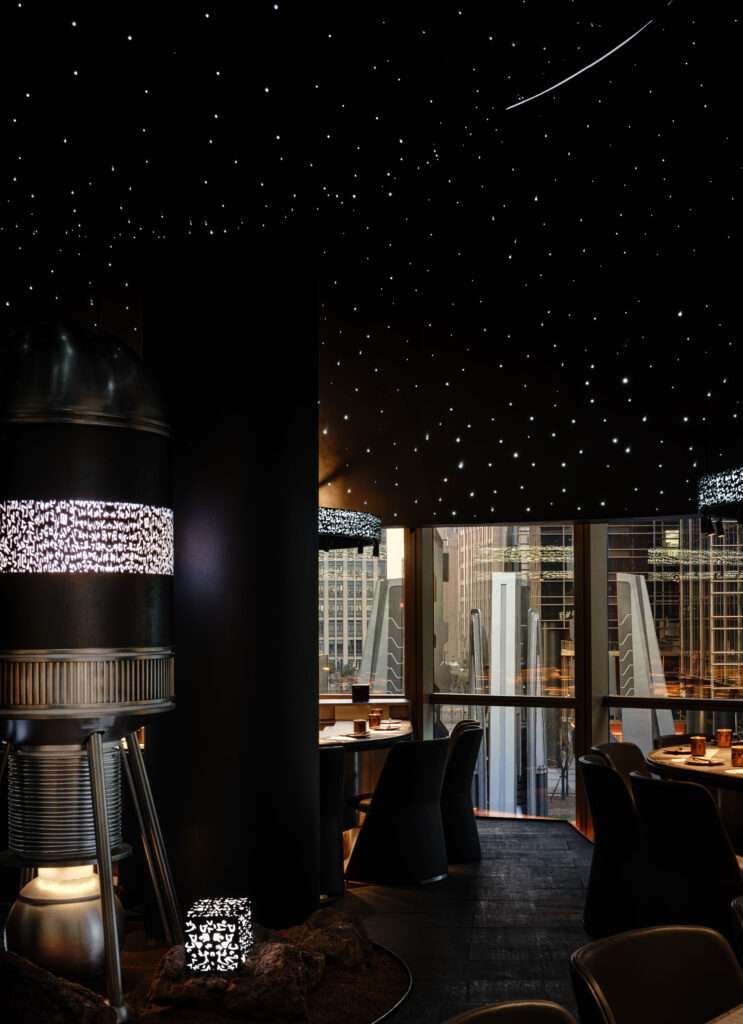
In the depth of the space, dark metallic spheres are distributed as spatial markers evoking celestial bodies, yet they functionally regulate sightlines and redistribute relationships between social openness and privacy. Above this composition, a circular lighting element evokes abstract script-like rhythms, serving as a visual guiding device that enhances the reading of design within the space, within a lighting system designed to regulate the user’s perceptual rhythm.
| Field | Value |
|---|---|
| Designer | Wuxing Youxing Space Design |
| Area | 380 m² |
| Completion Date | January 2024 |
| Photographer | Zhang Xi |
| Chief Designer | Wei Zhixue |
| Assistant Designers | Sun Zheng, Pan Ping, Xie Kaiming, Xu Peng |
| Construction Unit | Hangzhou Jutie Decoration |
| Lighting Design | Hangzhou Zhige Lighting |
| Landscape Production | Hangzhou Wolin Planting Art |
| City | Shanghai |
| Country | China |
Living Scenography and the Kinetics of Human Space
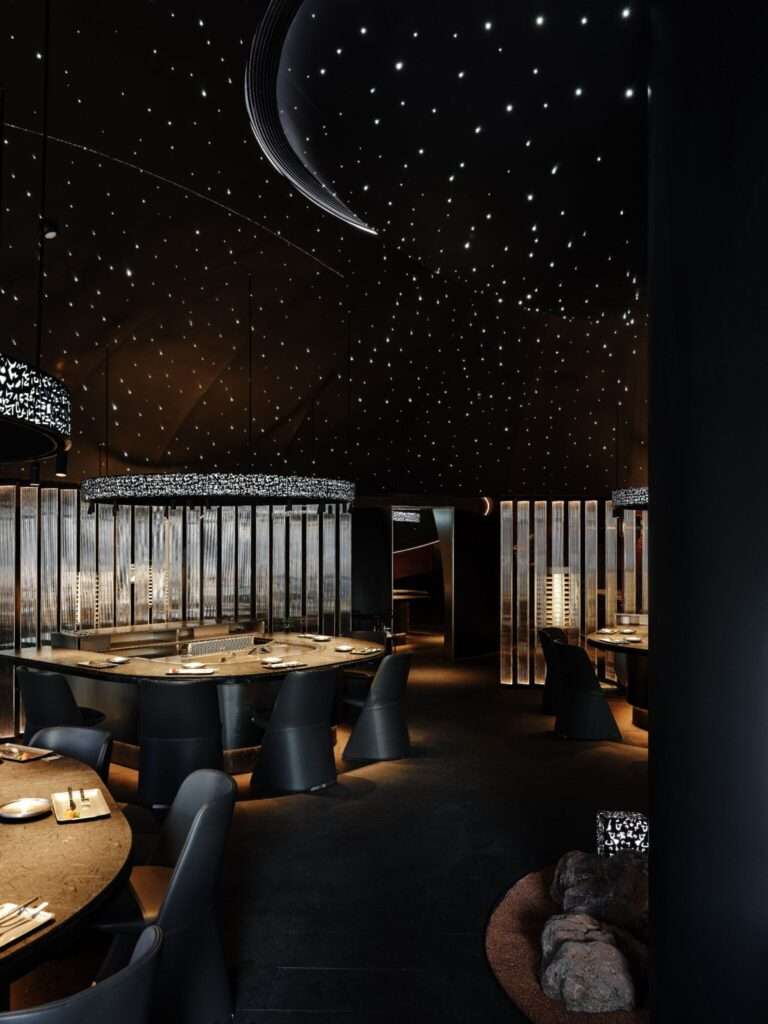
The culinary act inside the restaurant transforms into a scenographic performative structure that redefines the relationship between the user and the interior scene, countering the isolation paradigm imposed by closed kitchens in contemporary experiences. At the teppanyaki stations, the thermal act of cooking intersects with the movement of movement and shadow, producing a direct sensory moment that engages the user in the event rather than merely allowing observation.
The spatial experience varies between two private booths offering high levels of calibrated seclusion, and a main open hall that interacts with natural light through expansive glass façades, allowing the external scene and its reflections to continuously transform within the space. This gradient creates a dynamic relationship between architectural time and natural time, recalibrating the user experience within a highly visually sensitive contemporary environment.
Mass Formation and Spatial Referencing
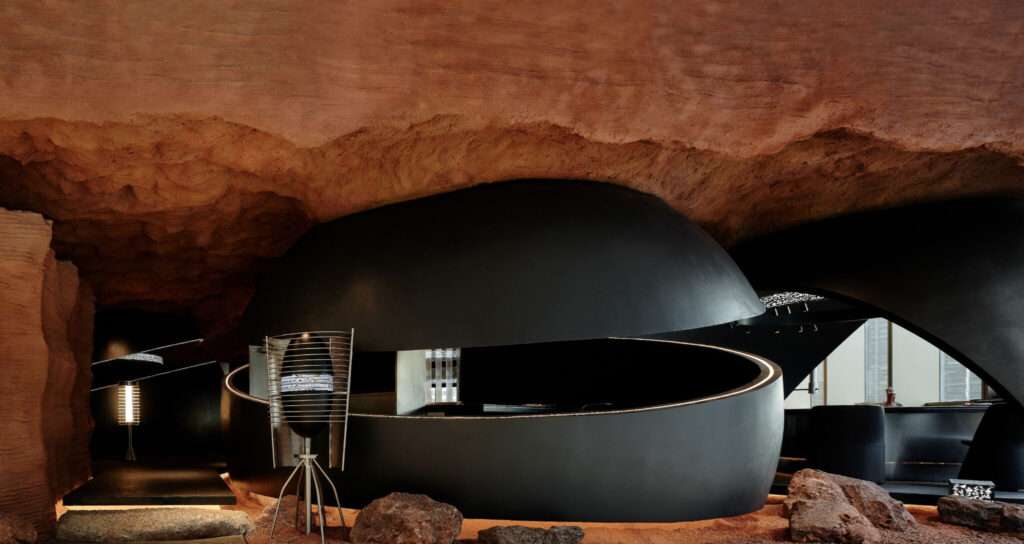
The project is based on a volumetric metaphor resembling a “mothership” concept, where sequential acrylic rings integrated with soft lighting redefine spatial boundaries both horizontally and vertically. This configuration enhances the sense of extension and transforms surfaces into perceptual layers that shift with the movement of design.
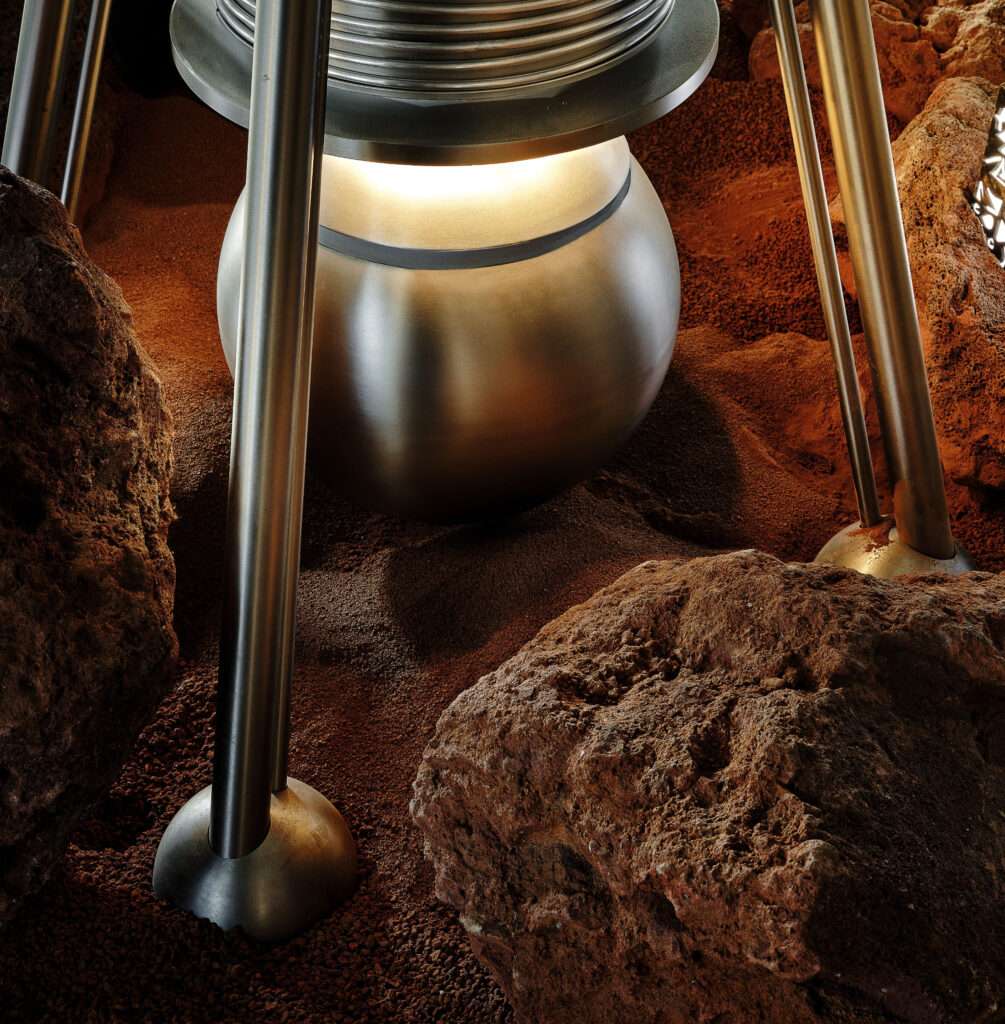
At the center, a primary spatial unit emerges, invoking natural elements such as stone and gravel to produce a sense of intentional isolation associated with exploration. Red sandstone is used as a material and chromatic contrast element that breaks away from the external commercial environment, integrating with polished steel and audiovisual systems to form a unified material language that connects visual identity with the architectural logic of the place.
Human Experience and the Kinetics of Spatial Platforms
The social function of the restaurant is distributed across five independent island dining platforms, designed to achieve a balance between visual and acoustic privacy on one hand, and spatial continuity as an interconnected whole on the other. The user transitions from being a mere diner to an active mover within a spatial structure that stimulates exploration and re-produces the notion of “path” within the experience of space.
Interactive installations at transitional points reinforce this direction, merging technology and materiality to reshape the perception of movement and deepen the psychological impact of the space, consolidating an architectural experience based on interaction rather than passive observation.
✦ ArchUp Editorial Insight
The article re-deconstructs the relationship between geological materiality and interior space through the construction of a sensory scenography that transforms the restaurant into a perceptual system governed by light and movement. Layers of sandstone and shale intersect with steel and glass to form calibrated perceptual transitions, while metallic spheres and lighting operate as organizing nodes that guide spatial behavior and integrate culinary performance within a sequential visual design logic that redefines the experience within a highly precise perceptual context of research.
However, this scenographic representation overstates the neutrality of spatial experience within a commercial hospitality environment governed by strict operational constraints. The visual intensification produced by layered lighting and acrylic rings may generate maintenance burdens and reduce the clarity of daily circulation within spaces that prioritize economic efficiency over visual narrative. Moreover, excessive reliance on spectacle may reproduce a visually striking space that remains functionally limited within architectural performance and construction logic.