The 3D-printed LUNA leg brace grows with its user

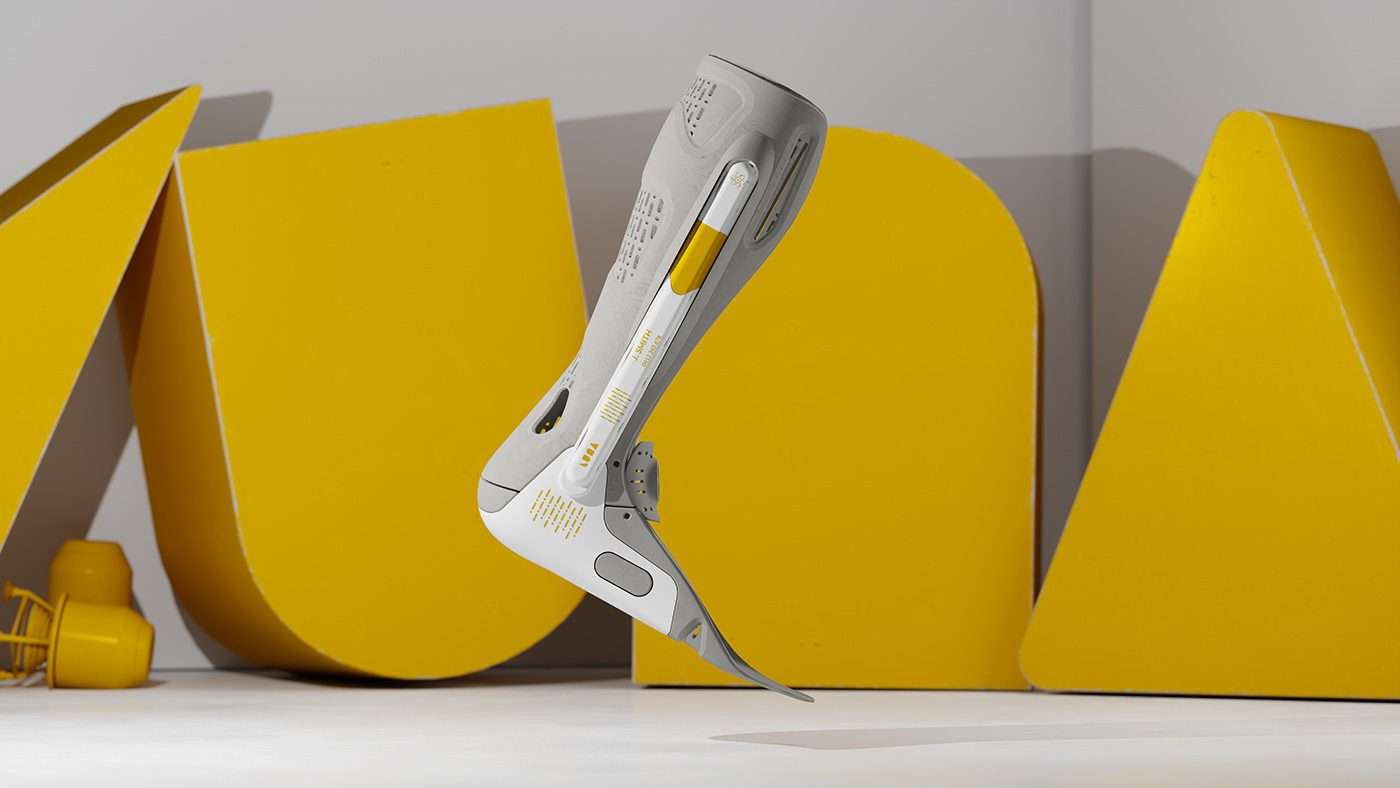
Targeted at children with Hereditary Spastic Paraplegia, the Luna Ankle Foot Orthosis uses a toolless modular system to adapt to as they grow.
Hereditary Spastic Paraplegia is a progressive disease that causes weakness and stiffness in the leg muscles. It can affect a patient’s gait and often requires assistive devices known as an ankle-foot orthosis (AFO), which fits over the lower leg and foot to support the user. However, child patients often outgrow these devices quickly, leading to cuts, bruising and blistering.
To prevent this, Australian designer Alex Nguyen has developed an Ankle Foot Orthosis with a modular component that adapts to growing users. The LUNA AFO uses a toolless system made from semi-flexible plastics that soften contact with sensitive areas like bone protrusions.
The orthosis consists of two components; a customized LUNA Surface. Which wraps around the leg and the foot according to the user. This attaches to the LUNA module, a mass-manufactured component that acts as a base for the device. When the LUNA AFO is too small, a new Surface replaces the existing one.
“The LUNA Surfaces are 3D printed parts designed to be form-fitted to each unique user,” says Nguyen. “Scanning technology digitizes the fabrication process, which currently involves complex molding and casting techniques.”
The Surfaces are in Nylon 11, a semi-flexible bioplastic, which the design process manipulates to soften in sensitive areas. The malleability of the material also offers a useful gauge for understanding when parts are too small in what Hyugen calls the Shapechange Feature.
“[It] empowers the user and their parental guardians to understand the AFO’s fitment and proactively upgrade the AFO rather than regular checks with the orthotics or when the child starts getting AFO-related injuries,” he explains.
Last month, the LUNA AFO was awarded the National Winner of the 2021 James Dyson Award because of its innovation within the design sector. It imagines an exciting alternative to common styles of AFOs for children which feature traditional vacuum-formed thermoplastics. This causes pain and user discomfort.
Separating itself from these types of devices, The LUNA AFO’s modular system not only makes for a more user-friendly experience. But it extends the life of the product from 6-8 months to several years.
And the benefits don’t just stop there. For professionals and fabricators, the system provides an open platform that utilizes a digital process to create more accessible fabrication. And more consistent orthoses for their clientele.
Finally, more on Archup:
Call for Submissions from the Istanbul Design Biennial: “Designing Resilience”
Health & Environmental Resilience and Livability in Cities (HERL) – The challenge of climate change