The Architecture of Being Unobserved

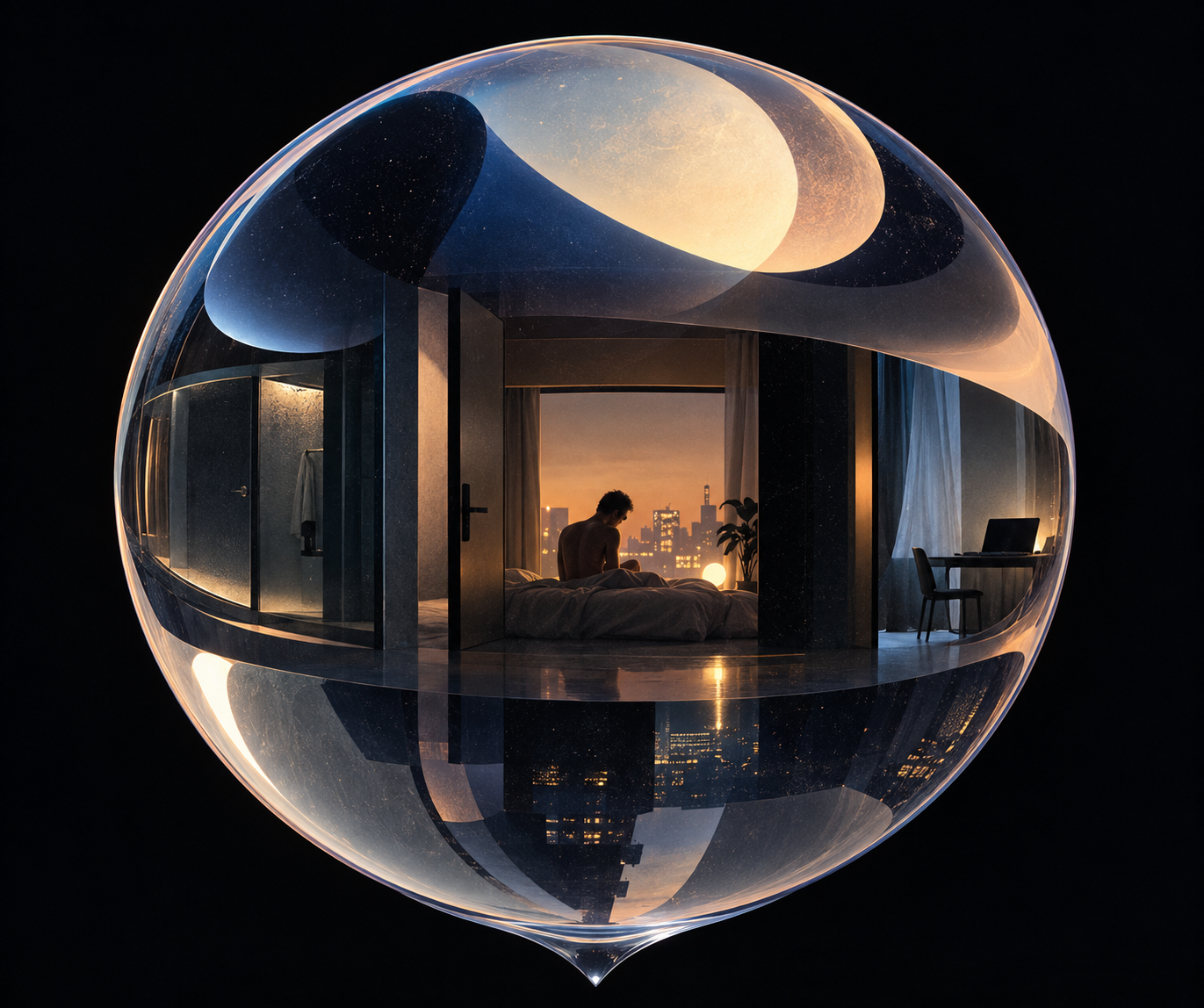
Architectural features such as wall mass, acoustic separation, and door locks establish the boundaries of private life. Dwellings directly shape unobserved human behavior by providing or withholding reliable solitude. This privacy functions as a controllable spatial resource rather than a measure of total floor size.
Factors including household composition, subjective crowding, interior disorder, and continuous occupancy from remote work affect personal well-being. As housing grows denser, intentional design choices must prioritize individual acoustic and visual privacy, ensuring occupants maintain control over their unobserved environment within shared dwellings.
There is a category of human behavior that architecture governs completely and discusses never. It is the behavior of people when they believe, correctly or not, that no one can see or hear them. Every building makes a silent promise about this. A thick wall promises one thing, a hollow partition another, a door with a lock a third, a bedroom shared with a sibling something else entirely. We design these elements as if their only job were to keep out weather and noise and intruders, and we rarely admit that their deeper job is to define the boundary of the unobserved self, the zone within which a person is finally, fully alone. Among the most private of the behaviors that unfold inside that zone is solitary sexuality, and while it is a subject the design professions have preferred to leave unspoken, a substantial body of research in sexual behavior, environmental psychology, and housing studies has quietly established that this behavior is shaped, paced, and sometimes suppressed by the physical characteristics of the interior. ArchUp treats the finding as what it is, a serious piece of evidence about how deeply the built environment reaches into private life, and examines it here as a question of architecture rather than of intimacy.
The reason the subject belongs to architecture at all is that the behavior in question is nearly universal and therefore cannot be treated as a marginal case. Representative national surveys place recent masturbation among a large majority of men and a substantial share of women, which means we are not discussing a fringe activity but an ordinary function of ordinary life that happens, overwhelmingly, indoors, in dwellings that architects and planners designed. If a common human behavior is systematically enabled or frustrated by wall assemblies, room allocations, and door hardware, then those elements are not neutral technical choices. They are instruments that regulate a dimension of wellbeing, and the profession’s silence about that fact does not make the influence any less real. The evidence simply asks to be read with the same clinical calm we bring to daylight, ventilation, or acoustics, because in the end it is a variant of the same question, what a room does to the person inside it.
Privacy as a Designed Resource
The variable that organizes all the evidence is privacy, and privacy is not a mood or a preference. It is a spatial condition that a building either supplies or withholds. The research is consistent that the absence of privacy suppresses solitary behavior primarily through a single mechanism, the anticipation of interruption or discovery, and that this anticipation operates most powerfully in shared living situations, with family, with roommates, with children in the home. What matters here for design is the precise nature of the effect. It is not that people in shared dwellings cannot find any moment alone. It is that the quality of the solitude changes. Qualitative work with young women in dense urban housing found that shared living produced a hurried, utilitarian approach to private behavior, an attending to desire quickly whenever time and space happened to allow, rather than anything unhurried or exploratory. The building did not eliminate the behavior. It degraded its conditions, compressing it into stolen intervals, and that compression is a direct architectural output, the product of a dwelling that offers no reliable interval of guaranteed privacy.
This reframes privacy as something a plan can be measured against. A dwelling in which the only private room is also a thoroughfare, or in which bedrooms are shared, or in which no interior door locks, or in which sound passes freely between rooms, is a dwelling that supplies privacy intermittently and conditionally, and its occupants adapt to that scarcity. A dwelling that provides at least one room a person can occupy with the reliable knowledge that they will not be seen or heard supplies privacy as a stable resource. The difference between these two is not a difference in floor area, and this is the point most likely to be missed. A large home with poor acoustic separation and no lockable rooms can offer less genuine privacy than a small one that is well divided and well insulated, because privacy is a function of control and boundary rather than of size. The construction details that deliver it, the mass of a party wall, the seal of a door, the presence of a lock, are humble and cheap and almost never discussed as instruments of psychological autonomy, which is exactly what the evidence shows them to be.
Living Alone, Living Together, and the Compensatory Pattern
The clearest quantitative signal in the literature concerns household composition, and it reveals a logic that every housing designer should understand. Living alone is associated with more frequent solitary behavior, and living with a partner with less, a pattern the research explains through a compensatory model in which solitary activity substitutes for partnered activity when the latter is unavailable. During the extended confinement of the pandemic, which served as an involuntary natural experiment on the relationship between dwelling and behavior, living arrangement emerged as a significant predictor of how private behavior changed. Those living with a partner were significantly less likely to report increases in solitary behavior, while those living alone, with family, or with children showed different and often compensatory patterns, including in some cases increased fantasizing when privacy for anything else was absent. The statistical relationships were strong and consistent across studies, which for our purposes matters less as sexual science than as evidence that the composition of a household, a variable partly set by how housing is sized and configured, shapes private behavior in measurable ways.
The presence of children in the home is associated, consistently and significantly, with reduced solitary behavior among adults, an effect that survives adjustment for other factors. Read architecturally, this is a statement about the failure of most family housing to provide parents with acoustic and spatial refuge from their own children. The standard dwelling is designed around supervision, around sightlines and proximity that let adults monitor the young, and it rarely provides the reverse, a space of adult retreat that is genuinely sealed. The projects that house families are optimized for one direction of privacy and neglect the other, and the behavioral data register the consequence. None of this argues for any particular design response. It simply establishes that the allocation of private space within a dwelling, who can retreat from whom and how completely, is a real determinant of adult wellbeing that current housing largely leaves to chance.
Crowding, Disorder, and the Limits of Density
Housing density and crowding have been studied in this connection since a landmark investigation of urban families decades ago, and the findings correct a common intuition. Crowding does not, in humans, produce the pathological behavioral changes that early animal studies had predicted. What it does instead is degrade perceived privacy. In that classic study, men who felt crowded were roughly twice as likely as those who did not to report that lack of privacy interfered with desired intimacy, and women showed the same pattern less sharply, yet the actual frequency of behavior barely changed. The crucial distinction the research draws is between objective density, the measurable people per room, and subjective crowding, the felt sense of having too little space, and it is the subjective measure that predicts privacy related inhibition more strongly. This is a profound finding for design, because it means the relevant variable is not simply how many people occupy a dwelling but whether its occupants feel in control of their exposure to one another, and that feeling is something spatial arrangement can shape independently of raw density. A well designed dense dwelling can feel private. A poorly designed spacious one can feel crowded.
A second and subtler environmental factor emerged from research on older couples, and it concerns not privacy but the sensory quality of the interior. Household physical disorder, the messiness, noise, poor upkeep, and general disarray of the home, was found to be significantly associated with reduced sexual interest, with one analysis showing the predicted probability of low interest among men roughly doubling between orderly and disorderly homes, an effect independent of relationship quality, health, and mood. Notably, neighborhood disorder showed no such effect. It was the proximal environment, the actual room where private life occurs, that mattered, not the broader surroundings. This points to something the cities conversation, focused as it is on the urban scale, tends to miss, that the most intimate environmental effects operate at the smallest scale, inside the room, at the level of order, cleanliness, light, and sensory calm. A home that a person experiences as chaotic or degraded suppresses the private dimensions of life in ways a masterplan will never capture, because the relevant environment is the bedroom, not the district.
Confinement, Remote Work, and the Home That Never Empties
The pandemic and the shift to remote work it accelerated form the most instructive recent evidence, because they changed, abruptly and for millions, the single most important variable in this entire subject, the amount of time the dwelling is occupied and by whom. The effects were heterogeneous in a way that is itself the lesson. For some, prolonged time at home increased privacy and opportunity. For others, the same confinement destroyed privacy, because the home that had once emptied during working hours now held partners, children, and housemates continuously, and the private intervals that the daily rhythm of departure had reliably created simply vanished. The research on remote work reveals the mechanism clearly. When a dwelling affords sufficient privacy, time, and freedom from interruption, solitary activity at home can even function as a form of recovery from occupational stress, with measurable downstream associations with wellbeing. When the same dwelling is saturated with other occupants, that function collapses. The determining factor in both directions is architectural, whether the home contains a space that one person can reliably control.
This is the finding with the most direct bearing on how we design now, because remote work has permanently altered the dwelling’s job description. The home is no longer a place occupied at the margins of the day but a place occupied continuously, by multiple people with competing needs for privacy, and most housing stock was never designed for this. It was designed on the assumption that it would empty each morning, and that assumption quietly guaranteed a daily interval of solitude that no plan had to provide deliberately. Remove the assumption, as remote work has, and the failure of dwellings to provide individually controllable private space becomes acute and permanent. The architectural research agenda that follows is clear enough, though it has barely begun, the direct study of specific environmental features, acoustic separation between rooms, the presence and reliability of door locks, the availability of at least one individually controllable room per adult, and their measurable relationship to privacy and wellbeing, replacing the current situation in which these features are left almost entirely to chance and to the accidents of the existing stock.
There is even a dimension of this that touches the sustainability conversation, because the drive toward smaller, denser, more efficient dwellings, sound in every environmental respect, collides directly with the finding that privacy depends on control and boundary. Density done carelessly, with thin walls and shared rooms and no acoustic isolation, purchases environmental efficiency at the cost of psychological privacy, and the two goals can be reconciled only through deliberate design, through the sound separation and the individually controllable space that a merely small dwelling does not automatically provide. This is a live design problem, not a rhetorical one, and it will define the humaneness of the dense housing the coming decades demand.
The news and the awards and the design competitions will continue to judge dwellings by their appearance, their efficiency, and their image, because these are the qualities a photograph can carry, and privacy, being invisible, will continue to go unjudged. Yet privacy is arguably the most fundamental service a dwelling provides, older than beauty and more essential than style, the basic offer of a space in which a person can be entirely themselves because they are entirely unobserved. The evidence reviewed here, drawn from disciplines that rarely speak to architecture, converges on a single unglamorous truth. The most private dimensions of human life are conducted inside rooms, and those rooms either grant or deny the conditions those dimensions require, silently, through the mass of a wall and the presence of a lock and the allocation of who sleeps where.
So the conclusion ArchUp draws is not about the behavior the research studied, which is the individual’s own business and no one else’s, but about the buildings that frame it. A dwelling is not merely a shelter from the elements or a machine for daily logistics. It is the boundary of the unobserved self, the physical guarantor of the human right to be, sometimes, beyond the reach of any other person’s eyes and ears, and the degree to which it honors that guarantee is a design decision made by whoever drew the wall. We have measured light and air and heat with great care because we understood them as conditions of health. The evidence now suggests that privacy, the reliable, controllable, acoustic and visual privacy of an interior, is a condition of health of the same order, and that a profession which designs the boundary of the unobserved self, and has done so for millennia without quite admitting it, owes that boundary the same seriousness it has always given to the wall’s other, more discussable jobs.
✦ ArchUp Editorial Insight
The lock on a bedroom door is not a security device — it is a constitutional instrument, the minimum physical mechanism through which a dwelling honors the most fundamental claim a body makes on its built environment: the right to be temporarily beyond the reach of other people’s perception. The article’s most structurally consequential finding is not its behavioral data, which is consistent and well-sourced, but its reframing of privacy as a spatial resource that a plan either supplies or withholds independently of floor area — because that reframing exposes the precise mechanism through which dense housing policy fails its occupants without ever appearing in the metrics that evaluate it. A dwelling can satisfy every energy performance standard, every square-meter allocation threshold, every fire separation requirement, and still systematically deny its occupants the acoustic and visual boundary that the research identifies as a determinant of psychological wellbeing of the same order as thermal comfort or daylight — and it will receive no deduction in any assessment framework currently in use, because the profession has built its entire measurement apparatus around the conditions it photographs and has never developed an instrument for the condition that only the occupant, alone inside the room, can verify. The finding that household disorder suppresses private wellbeing more powerfully than neighborhood disorder is the article’s most architecturally precise contribution, because it locates the relevant environment at the exact scale the profession most consistently surrenders to chance: not the district, not the building, but the room — the specific interior condition that the developer’s value-engineering resolves last, that the brief specifies least, and that the person who eventually locks the door behind them will spend their private life entirely within, as this archive established in The Driver’s Room and Architecture for Rent: the spatial conditions that matter most to the person who inhabits them are always the conditions that mattered least to the person who designed them.
ArchUp Editorial
Sources
- Gerressu M, Mercer CH, Graham CA, Wellings K, Johnson AM. Prevalence of masturbation and associated factors in a British national probability survey. Archives of Sexual Behavior, 2008, 37(2), 266 to 278.
- Herbenick D, Fu TC, Wasata R, Coleman E. Masturbation prevalence, frequency, reasons, and associations with partnered sex in the midst of the COVID-19 pandemic: findings from a US nationally representative survey. Archives of Sexual Behavior, 2022, 51(5), 2331 to 2350.
- Goldey KL, Shenberger-Trujillo J, Stanaland A. Sexual subjectivity in solo and partnered masturbation experiences among emerging adult women. Archives of Sexual Behavior, 2022, 51(7), 3457 to 3476.
- Wignall L, Portch E, McCormack M, Owens R, Döring N. Changes in sexual desire and behaviours among UK young adults during social lockdown due to COVID-19. The Journal of Sex Research, 2021, 58(9), 1108 to 1118.
- Döring N, Ziegelmann JP, Wignall L. Changes in sexual fantasy and solitary sexual practice during social lockdown among young adults in the UK. Sexual Medicine, 2021, 9(5), 100342.
- Fischer N, Traeen B, Stulhofer A, Hald GM. Prevalence of masturbation and associated factors among older adults in four European countries. Archives of Sexual Behavior, 2021, 50(8), 3711 to 3725.
- Booth A, Edwards JN. Crowding and human sexual behavior. Social Forces, 1977, 55(3), 791 to 808.
- Brown CC, Carroll JS, Willoughby BJ. Reasons for and for not engaging in masturbation among college students in the United States. Sexuality and Culture, 2023, 27(4), 1343 to 1364.
- Upenieks A, Schafer MH, Iveniuk J. Putting sex into context in later life: environmental disorder and sexual interest among partnered seniors. The Gerontologist, 2017, 57(6), 1080 to 1091.
- Gleason N, Grubbs JB, Kraus SW. Compulsive sexual behavior and changes in solitary sexual behaviors during the COVID-19 pandemic. Archives of Sexual Behavior, 2023, 52(4), 1541 to 1552.
- Park J, Han D, Kim T. Associations between masturbation frequency, anxiety, and sleep disturbances during the COVID-19 era. International Journal of Impotence Research, 2024, 36(4), 386 to 396.
- Leavitt K, Barnes CM, Christ MH. Conceptualizing sexual pleasure at home as a work related stress recovery activity. The Journal of Sex Research, 2022, 59(8), 1010 to 1024.
- O’Sullivan LF, Byers ES, Brotto LA, Majolo D. Actual and desired masturbation frequency, sexual distress, and their correlates. Archives of Sexual Behavior, 2023, 52(6), 2529 to 2546.
- Gana K, Trouillet R, Martin B, Toffart L. The relationship between boredom proneness and solitary sexual behaviors in adults. Social Behavior and Personality, 2001, 29(4), 385 to 390.