Space Architecture: The Discipline That Tests Every Assumption

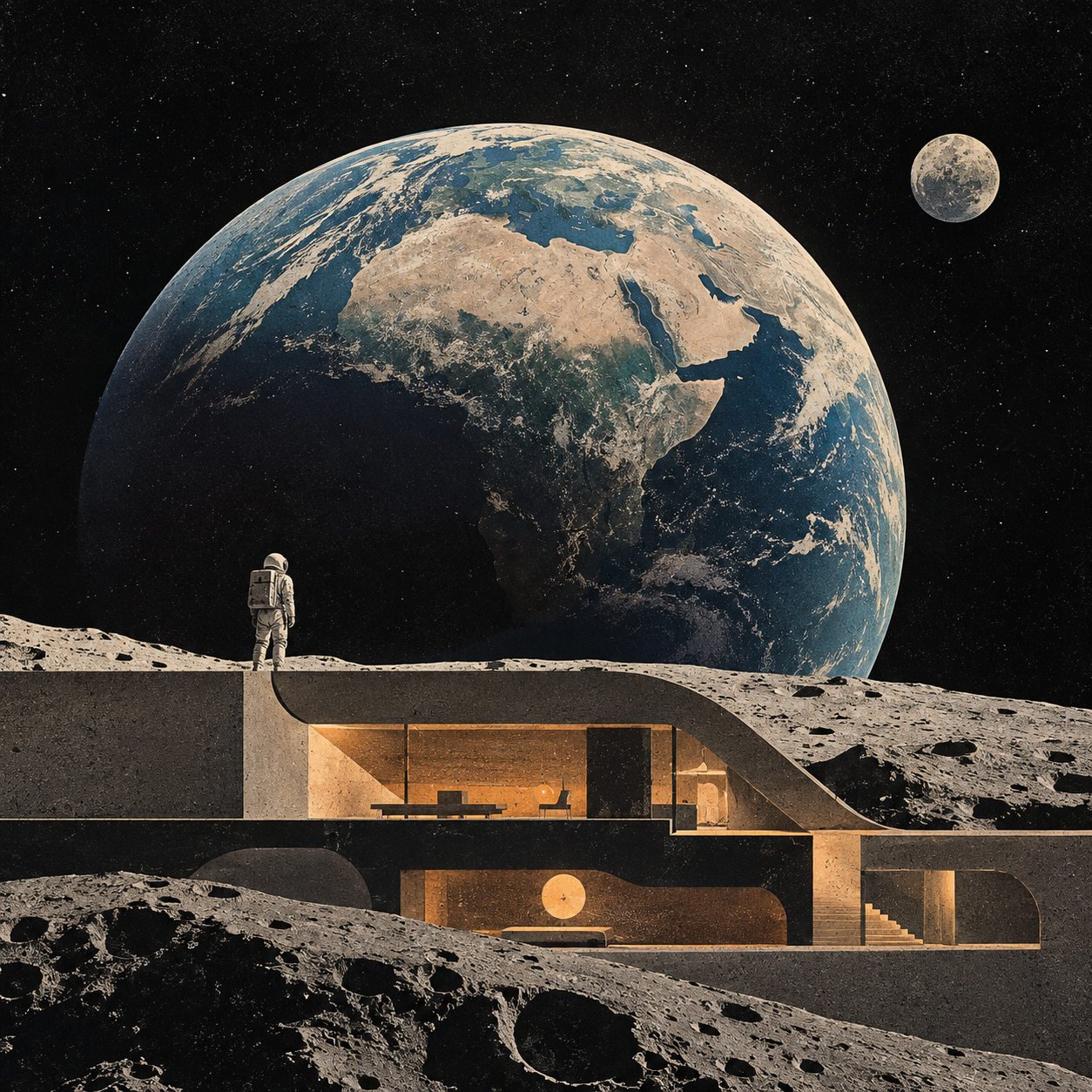
Space architecture applies architectural design to off-Earth environments, including orbital facilities and planetary surfaces on the Moon and Mars. Unlike traditional aerospace engineering, it focuses on integrating human psychological and physiological needs. Designers must overcome non-terrestrial constraints, such as altered gravity, lethal radiation, extreme temperatures, and destructive dust.
Habitat construction relies on pre-integrated modules, deployable inflatables, and in situ resource utilization like processing lunar regolith. Design solutions created for space directly inform terrestrial architecture, offering advances in closed-loop resource recycling, autonomous energy generation, and sustainable building techniques for extreme environments on Earth.
Architecture has spent its entire history solving a single problem it never had to name, because the problem was always present and never optional. That problem is gravity. From the primitive hut to the column, the wall, the arch, and the dome, every structure humanity has ever raised is a strategy for resisting the constant downward pull of the Earth, and the entire vocabulary of building, load and support, foundation and span, floor and ceiling, is the accumulated grammar of that resistance. This is why the emergence of space architecture is not a curiosity at the margin of the profession but a development that reaches into its foundations, because for the first time architecture is being asked to work in places where gravity is reduced, redirected, or absent altogether. The ArchUp team examines the field here not as science fiction made practical but as what the literature increasingly shows it to be, the most demanding test the discipline of architecture has ever faced, and a test whose results are already flowing back to change how we build on Earth.
The field now has a formal definition, established at a workshop during the 2002 World Space Congress, which describes space architecture as the theory and practice of designing and building inhabited environments in outer space. That phrasing matters, because it deliberately claims the word architecture rather than engineering. The distinction is not territorial vanity. Aerospace systems engineering, by its nature, decomposes a problem into parts in order to analyze them, while architecture works in the opposite direction, envisioning an integrated whole and then directing the supporting analyses toward that vision. Space architecture exists precisely because the engineering approach, for all its power, tends to neglect the messy, integrative questions of human psychological and social need that determine whether a habitat is survivable in the narrow sense but unlivable in the human one. The discipline spans three domains, the terrestrial facilities that support spaceflight, the orbital environments of low Earth orbit and free space, and the planetary surfaces of the Moon, Mars, and beyond, and across all three its defining contribution is to insist that a habitat is a place for a human being to live, not merely a machine that keeps a body alive.
A Continuum, Not a Rupture
The most intellectually satisfying framing in the literature treats space architecture not as a break from terrestrial tradition but as its continuation. The continuum thesis holds that the discipline is the next milestone in architecture’s millennia long negotiation with gravity, and it traces an unexpected genealogy to support the claim, running from Plato’s ordering of the five solids by their faces, which reflected a wall based way of thinking, through Leonardo da Vinci rendering those solids as edge based skeletal figures, to Buckminster Fuller reordering them by their vertices and, in doing so, liberating solid geometry from the terrestrial assumption of the wall. That liberation was not abstract. Fuller’s vertex based geometry directly enabled the triangular and tetrahedral logic that became the node and module configuration of the International Space Station, which means a philosophical shift in how humans conceived of solid form eventually became the physical structure orbiting above us. This lineage is worth dwelling on because it reframes space architecture as something the discipline has been moving toward for centuries, not a sudden departure but the arrival of a long approach.
The modern discipline has a clear birth date. It began in earnest with Skylab in 1973, the first American space station, whose interior was shaped by an architect and an industrial designer working together, establishing the founding precedent that human spaceflight required design expertise and not only engineering. What followed, through the Soviet Salyut stations and the decades of international collaboration since, was the slow construction of a body of principles specific to the field, developed through professional societies, educational programs, and hard operational lessons. And the deepest of those lessons is one the profession keeps having to relearn, that the ancient architectural traditions still apply. A recurring example in the literature is the Skylab principle that an airlock should never bisect a circulation path, a lesson so basic it sounds obvious, and yet later proposals repeatedly violated it, demonstrating that the accumulated wisdom of terrestrial design does not become irrelevant in space but becomes, if anything, more unforgiving when the cost of a bad plan is measured in survival rather than inconvenience.
The Catalogue of the Impossible
What makes space architecture the hardest test of the discipline is the environment itself, which imposes constraints that have no terrestrial precedent and that the literature catalogues with sobering precision. Consider gravity alone, which appears in four distinct regimes, the microgravity of orbit, the near absence of it on asteroids, the one sixth of Earth normal on the Moon, and the three eighths on Mars. Each rewrites the body’s relationship to space. In microgravity the human body assumes a neutral floating posture, fluids obey surface tension rather than weight, and the body deconditions over time, while lunar gravity alters human locomotion so fundamentally that it demands modified stair dimensions and generous headroom. The most humbling admission in the research is that we still do not know whether partial gravity, the Moon’s sixth or Mars’ three eighths, is enough to prevent the physiological damage of prolonged weightlessness. The discipline is designing for a human body whose response to these conditions is not yet fully understood.
The other constraints compound the difficulty. A habitat must hold Earth normal atmospheric pressure across every enclosing surface while the vacuum outside is instantly lethal, and it can shed its waste heat only by radiating it into space. Surface temperatures on the Moon swing from well above the boiling point of water in daylight to far below freezing at night across a single lunar day of nearly thirty Earth days, while Mars receives less than half of Earth’s sunlight. Radiation arrives in four forms, from galactic cosmic rays that accumulate relentlessly with time to sudden solar proton storms, and the primary defense remains crude, the burial of habitats under one to two meters of local regolith, a solution that doubles as protection against the constant bombardment of micrometeoroids traveling at velocities that make even tiny particles dangerous. And then there is dust, which the literature identifies as among the most intractable problems of all, lunar regolith being half composed of particles finer than seventy microns, abrasive, electrostatically charged, and penetrating enough to contaminate seals, degrade equipment, and threaten every mechanical system it touches. Mars adds planet spanning dust storms with winds reaching a hundred meters per second. The construction of a habitat in these conditions is a problem of an entirely different order from anything the profession has faced, because every single environmental assumption that terrestrial architecture takes for granted, breathable air, moderate temperature, a protective atmosphere, stable ground, is absent and must be manufactured.
Building With What Is Already There
The response to these constraints has produced a body of construction thinking that is genuinely novel, organized in the literature around a three part taxonomy of habitat types. The first type is pre integrated, modules built complete on Earth and launched ready to inhabit, the approach of the International Space Station, limited by what a rocket can lift. The second is deployable, the inflatables and constructible structures that pack small for launch and expand on arrival, dramatically increasing volume per unit of launch mass. The third, and the one that changes everything, is construction from in situ resources, building from the material already present at the destination, and the literature is increasingly clear that the realizable future lies in hybrids that combine all three. The hybrid logic is compelling because the tyranny of space architecture is mass, the crushing cost of lifting every kilogram out of Earth’s gravity, and any strategy that reduces what must be launched is worth enormous effort.
The in situ approach is where the field becomes most inventive, and most relevant to Earth. The research describes lunar regolith being transformed into a full palette of building materials, cast basalt and glass from molten rock, ceramics from sintered soil, metals extracted by electrolysis, and even concrete produced from lunar minerals, with the striking experimental finding that some concrete mixtures actually gain compressive strength when cured in vacuum. Detailed engineering studies have worked out the material and energy budgets for this, quantifying the hydrogen and mineral inputs and the energy required per ton of lunar concrete, while other proposals imagine large robotic systems functioning as three dimensional printers that harden powdered regolith into panels and blocks prepared in advance of human arrival. The inflatable and hybrid structures described in the literature, rigid frames supporting rigidized inflatable domes, umbrella like mechanisms that transform from compact transport configurations to deployed habitats, represent some of the most sophisticated structural thinking anywhere in contemporary architectural research, precisely because the constraints are so severe that no conventional solution survives contact with them.
The Knowledge That Comes Home
Here the ArchUp team wishes to emphasize the argument that we believe matters most, and that the interested reader should carry away above all others. The most valuable product of space architecture may not be the habitat on the Moon or Mars at all. It may be the knowledge that flows back to Earth. The literature describes this bidirectional exchange explicitly, and the return flow is arguably the richer of the two. The relationship between space architecture and extreme climate architecture on Earth runs in both directions, with terrestrial extreme environment structures supplying design concepts to space, and space derived knowledge returning to transform how we build in the harshest and, increasingly, the ordinary environments of our own planet.
The terrestrial testbeds are already teaching both fields at once. Antarctic research stations serve as Mars analogs, and their design lessons are directly transferable, the Concordia station separating quiet and noisy functions into distinct towers and providing generous habitable volume per person, the Princess Elisabeth station operating as the only zero emission base in Antarctica through solar and wind generation, a smart grid, and walls insulated beyond sixty centimeters. Underwater habitats host missions that test crew dynamics and telemedicine in cramped, high stress isolation. Arctic stations at extreme elevation and cold, in prolonged darkness and total logistical constraint, replicate conditions strikingly close to those of the Moon and Mars. And the design transfers documented in the literature run in specific, concrete channels, the convex geometry of the space station cupola derived from viewports in submarines and aircraft, regolith covered shelters mirroring the shielding of polar stations, diving suit technology adapted into spacesuits, aircraft escape systems reworked for lunar use. Every one of these is a demonstration that the design of survival in one extreme environment enriches the design of survival in all of them.
This is the point at which space architecture stops being remote and becomes urgent, because the techniques it is forced to perfect, autonomous power generation, closed loop water and air recycling, passive thermal management, radiation and dust mitigation, the humane design of small isolated volumes for psychological health, are precisely the techniques a warming and resource constrained Earth increasingly requires. The discipline’s obsession with mass efficiency and self sufficiency is, at root, an obsession with sustainability pushed to its absolute limit, a limit at which a design either sustains human life with radically minimal inputs or fails completely. Habitats designed for the Moon are, in effect, prototypes for the most sustainable buildings possible on Earth, and the lessons the analog stations offer, sound insulation as the single most common crew complaint, the need for crew control over lighting and temperature, the preference for hatches over doors, the imperative of workshops and exercise and storage and customization, are lessons about human dwelling that apply in any cities on this planet as much as any settlement beyond it.
The field’s own future is genuinely open, and the literature frames it around several possible value propositions that would each demand a different architecture, the exploration of Mars with small crews, commercial space tourism moving large transient populations, industrial infrastructure for space based solar power, and the permanent settlement of the Moon using local resources. No precedent exists for many of the problems these futures pose, for open volumes large enough to hold a town assembly in orbit, for ecological life support at the scale of a settlement, for the weekly processing of large numbers of paying passengers through an orbital facility. And the honest consensus of the research is that no existing simulation habitat on Earth would serve a real planetary mission without drastic modification, which is not a failure but a statement of how much design work remains genuinely undone, how much of this discipline is still ahead of us rather than behind.
So the conclusion the ArchUp team draws is that space architecture deserves the attention of every serious person in this field, not because most of us will ever design for the Moon, but because it is the purest available laboratory for the fundamental questions of our discipline. Strip away the atmosphere, the moderate climate, the stable ground, and the reliable gravity that terrestrial architecture has always taken for granted, and what remains is architecture in its most essential form, the deliberate creation of a humane, survivable, psychologically sustaining place for human beings in an environment that wants them dead. That is, in the end, what architecture has always been, only made visible by the extremity of the setting. The projects that will one day stand on the Moon and Mars are being designed now, and the discipline that designs them is quietly rediscovering, under the harshest possible scrutiny, the oldest truths about what it means to make a place for a person to live. The news will report the rockets and the landings, and the deeper story, the one worth the attention of the profession and the subject of the most serious competitions and research to come, is that in learning to build where building is nearly impossible, we are learning, again and more deeply, how to build at home.
✦ ArchUp Editorial Insight
The most structurally significant observation the article makes is not about gravity or radiation but about procurement: the tyranny of mass — the crushing cost of lifting every kilogram out of Earth’s gravitational well — is the financial constraint that has produced, under the pressure of absolute necessity, precisely the design intelligence that terrestrial architecture has been unable to develop under conditions of relative abundance. The closed-loop resource system, the autonomous energy generation, the radical acoustic separation that the Princess Elisabeth station discovered was the single most common crew complaint, the minimum viable volume calculated not from building codes but from psychological survival data — these are not innovations that the space program generously offers back to Earth; they are the logical outcome of a procurement model so financially punishing that it cannot externalize any cost, cannot defer any maintenance, cannot transfer any liability to a party who will inhabit the building after the developer has exited, because in a lunar habitat there is no exit and no subsequent occupant who absorbs what the brief failed to specify. This is the inversion that this archive has traced across dozens of terrestrial cases — from The Hidden Cost of Breathing to The Architecture of Not Enough to Sand Batteries — where the CAPEX-OPEX misalignment, the developer’s exit before the consequence materializes, and the externalization of environmental cost onto the least powerful occupant are all structural features of a procurement model that has never been forced to confront what space architecture confronts as its opening condition: that the person who designs the habitat and the person who must survive inside it are, ultimately, accountable to the same unforgiving environment, and that when there is no atmosphere outside the wall, the gap between specification and performance is not a maintenance issue — it is the distance between life and its absence.
Sources
- Polit Casillas R. Applied space architecture. 40th International Conference on Environmental Systems, AIAA, 2010.
- Cohen M. The continuum of space architecture: from Earth to orbit. 42nd International Conference on Environmental Systems, AIAA, 2012.
- Sherwood B. Inhabiting the solar system. Open Engineering, 2011, 1.
- Matsumoto S, Yoshida T, Kanamori H, Takagi K. Construction engineering approach for lunar base development. Journal of Aerospace Engineering, 1998, 11, 129 to 137.
- Ozdemir K. The integration of terrestrial extreme environment design concepts to lunar base designs. 3rd International Conference on Recent Advances in Space Technologies, IEEE, 2007, 678 to 683.
- Dronadula R, Benaroya H. Hybrid lunar inflatable structure. Acta Astronautica, 2021, 179, 42 to 55.
- Cohen MM. First Mars habitat architecture. AIAA SPACE 2015 Conference and Exposition, 2015.
- Howe AS, Simon M, Smitherman D, Howard R, Toups L, Hoffman SJ. Mars surface habitability options. IEEE Aerospace Conference, 2015, 1 to 9.
- Heinicke C, Arnhof M. A review of existing analog habitats and lessons for future lunar and Martian habitats. REACH, 2021, 21 to 22, 100038.
- Bannova O, Jorgensen J. Can we test design for coming interplanetary expeditions in the Arctic? Arctic research stations as test bed for simulations of future long term space environments. Space 2006, AIAA.